This Is Amiko, Do You Copy?

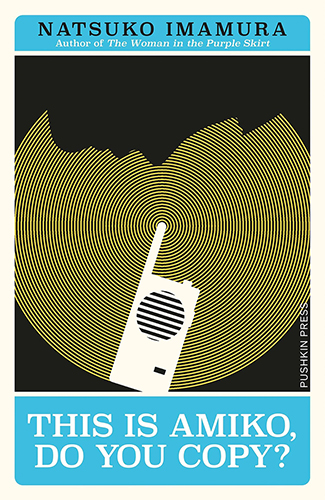
Natsuko Imamura’s novella This Is Amiko, Do You Copy? is about a neurodivergent preteen girl who’s neglected by her family and bullied at school. Though Amiko herself is quite charming, Imamura asks serious questions about the society that denies her support and understanding.

Amiko is ten years old and extremely friendly, but she has trouble fitting in. She speaks and behaves like someone much younger, and she often wanders away from class to read manga in the library. Her classmates avoid her when they can, but she’s oblivious to her alienation and remains cheerful and outgoing.

When her mother (who is actually her stepmother) has a miscarriage, Amiko does her best to comfort her, but her well-intentioned efforts are misinterpreted as malicious by both of her parents, who begin to neglect her. Without anyone to feed or bathe her, Amiko goes slightly feral, and she spends her early teenage years in almost total social isolation despite still attending school every day.

To protect Amiko from bullying, her older brother Kota toughens up, eventually joining a gang so that his reputation can shield his little sister. Kota loves Amiko and does his best to care for her, but he doesn’t have the emotional resources to deal with his clinically depressed stepmother or the lack of concern demonstrated by his workaholic father.

By the time she’s fifteen, Amiko still hasn’t matured, and she can barely read or write. She has trouble communicating and expressing herself, and she takes to singing made-up songs loudly and off-key whenever the mood strikes her. Torn between a child he can’t understand and a wife who never leaves the bed so that she’ll never have to see her stepdaughter, Amiko’s father sends her to live with her grandmother in the countryside.

The walkie talkies that Amiko’s parents give her as a gift at the beginning of the story are a chillingly direct analogy for her situation – she’s transmitting, but nobody’s responding. On a broader level, you can’t help but wonder why nobody ever reaches out to help Amiko or her parents.

This Is Amiko, Do You Copy? is narrated from a limited third-person perspective that shows the world as Amiko might see it, and Amiko is so happy and good-natured that it’s easy to skim through this short novella without really understanding the profound anger that Natsuko Imamura is expressing through the story. Amiko is a sweet and happy-go-lucky girl, but I could almost feel the author writing with clenched teeth. 

I’ve seen multiple reviews of this novella (and its 2022 cinematic adaptation Amiko) that shy away from identifying Amiko as being on the autism spectrum, maintaining instead that she transcends labels. I feel like a bit of critical thinking might be necessary here. Specifically, does not labeling Amiko as autistic help her (or her family) in any way? Because it sure seems like the lack of a formal diagnosis has resulted in nothing but neglect and abuse. On the other hand, would a greater awareness of neurodiversity, as made concrete through an imperfect but still useful label, perhaps help Amiko’s community understand and support her?

I enjoyed Imamura’s novel The Woman in the Purple Skirt, whose meaning also dwells in the seemingly empty spaces of what its alienated and unreliable narrator doesn’t say. Just as the label of “autistic” would presumably make life much easier for Amiko, I imagine that a formal diagnosis of “schizophrenia” would probably help the Purple Skirt narrator get the help she needs. Imamura’s project in these two stories is not to normalize neurodivergence, necessarily, but to demonstrate that neurodivergent people aren’t abnormal. It’s only when neurodivergent people are denied community support and resources that unfortunate things happen.

This isn’t to say that This Is Amiko is didactic or unpleasant. It’s actually quite lovely, and I hope it doesn’t make me sound like a bad person to say that I genuinely enjoyed this book. Still, Natsuko Imamura is staging a serious critique through what may initially seem like a light and breezy story, and it’s important not to ignore the subtext.   

Kudos to Hitomi Yoshio (and her seven-year-old daughter) for creating a fantastic translation of the distinctive narrative voice of this novella, and much love to Pushkin Press for bringing it to a wider audience. I’ve got my fingers crossed that Imamura’s 2017 novel Hoshi no ko (Child of the Stars), which is something of a sibling to This Is Amiko, finds a home in translation too.

Hooked

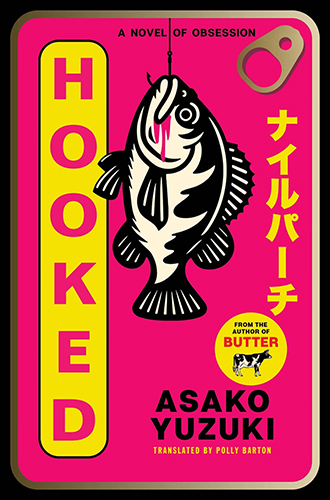
Asako Yuzuki’s novel Hooked is about an elite corporate employee who begins stalking a popular housewife blogger and then blackmails her into an artificial “friendship.” Though it occasionally feels like a suspense thriller, Hooked is primarily a dark cringe comedy about two thirty-year-old women exhibiting their absolute worst behavior.

The story opens with a morning in the life of Eriko Shimura, an employee at a product trading company that specializes in imports of foreign food. Eriko lives with her parents in central Tokyo, and she attended a top-ranked university before using her father’s connections to enter her current job immediately after graduating. She puts meticulous care into her work and appearance, and she considers herself to be well-liked by her male colleagues.

Eriko’s one regret is that, after a devastating friendship breakup in high school, she hasn’t really had any female friends. As a way to compensate for the warmth missing from her life, she becomes a fan of a lifestyle blog written by a Tokyo housewife who goes by Hallie B. Unlike Eriko, whose daily schedule is intensely regimented, Hallie takes life easy and passes her time in small cafés and chain restaurants while trying out limited-edition pastries in convenience stores. For Eriko, Hallie’s blog is an accessible fantasy of casual friendship.

The perspective then switches to Shoko, the woman behind the Hallie B. blog. Shoko moved to Tokyo from the countryside, where she grew up with a wealthy but abusive father who eventually drove her mother out of the house with his negligence and bad temper. Like Eriko, Shoko has trouble forming attachments, passing like water between friends and jobs. She gets along well with her husband, though, and she finally seems to have found her niche as a Tokyo lifestyle blogger. When Eriko suddenly shows up at a café she frequents, Shoko initially finds her to be charming, and they exchange numbers after having a lovely conversation together.

What starts as a promising friendship doesn’t last long, however. Eriko, who lives in the same neighborhood as Shoko, begins stalking her in earnest, and Shoko is understandably creeped out. As their relationship cools, Eriko responds by becoming more intense. She also starts to behave oddly at work, even going so far as to sleep with a coworker who’s engaged to one of the office admin staff. As Eriko’s behavior becomes more extreme, Hooked generates a fair bit of narrative tension by keeping the reader wondering just how far she’ll go and what horrible thing can possibly happen next.

I will admit that I had trouble getting into Hooked. I’ve met some intense and unpleasant people in my life, but the way the characters in this novel behave feels unrealistic to me. It was only when I realized that the story is a comedy that it clicked for me. I guess it’s fair to say that Hooked is like Curb Your Enthusiasm, but with two Japanese women instead of Larry David.

Once I understood that Hooked isn’t supposed to be mimetic fiction, it became much more enjoyable. Instead of feeling bad about the extreme awkwardness that Eriko and Shoko bring to their everyday interactions, I was amused to see them get worse. There’s one scene in particular where Eriko unsuccessfully attempts to seduce her supervisor at work that had me grinning and clapping like a seal. Thankfully, as a comedy (dark though it may be), Hooked allows Eriko and Shoko a measure of self-awareness and emotional resolution toward the end when both women take meaningful steps toward getting their shit together.

Still, even despite the characters’ over-the-top behavior, Asako Yuzuki makes a number of astute observations about adult loneliness. I was especially impressed by the story’s portrayal of online parasocial relationships and the ways that social media can warp the ordinary human need for connection and validation. The way that such concerns are discussed in editorial think pieces tends to be shallow and prescriptive, and I’m happy that Hooked handles these issues with sensitivity and nuance.

The casual misogyny of Eriko’s male coworkers also struck a chord with me, especially in how these men echo the cliché that female relationships are full of drama and thus destined to fail. The novel’s central metaphor of the invasive Nile Perch, a destructive fish that ruins ecosystems, implies that women like Eriko might come off as “too intense” because they’ve been forced to survive in a fiercely competitive environment engineered by men.

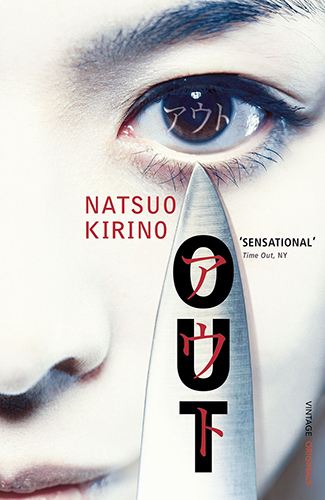
Still, I feel that Asako Yuzuki refrains from making generalizations about gender and society, preferring instead to focus on the specific relationships between characters. Hooked reminded me a great deal of Natsuo Kirino’s suspense novels Out and Grotesque, but with a stronger focus on human nature as opposed to social issues. The dark comedy of Hooked is well-observed, and I could tell that Yuzuki was having fun while writing this novel. There were a number of scenes when it was clear that the translator, Polly Barton, was having a marvelous time as well.   

Hooked succeeds because it manages to balance social commentary with a genuine empathy for its (deeply) flawed protagonists, and it’s a testament to both Yuzuki’s writing and Barton’s translation that a story about stalking and self-sabotage can leave the reader feeling strangely uplifted, and perhaps a little less alone.

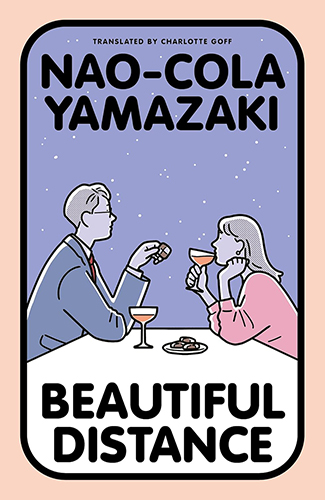
Beautiful Distance

Nao-Cola Yamazaki’s Beautiful Distance is a novel about a man watching his wife die of cancer.

The narrator, an insurance agent at a large firm, has been married to his wife for fifteen years when she’s unexpectedly diagnosed with terminal cancer. When the story opens, she’s already in hospice care and only has about a month to live.  

This isn’t a medical drama or a story about resilience; rather, it’s a gentle account of a quiet death that files away some of the harsher edges of the wife’s illness but never gives the reader a false sense of hope. 

Despite the seeming bleakness of the situation, Yamazaki’s writing is extremely gentle. It’s hard to believe that a person as sweet and kind as the narrator could exist, but he loves his wife unconditionally and is emotionally mature to an almost superhuman degree.

I’ve seen Beautiful Distance described as a love story, and it’s true that the affection between the narrator and his wife is a major element of the book and its appeal. More than anything, though, this is a story about accepting death and everything it entails, including the “beautiful distance” that will separate the narrator from his wife after she dies.

Admittedly, because the narrator is always on his best behavior, as are his wife and his mother-in-law, Beautiful Distance can sometimes feel a little shallow, especially as it shies away from more complicated emotions such as denial, anger, and the desire to find someone to blame.

Thankfully, the narrator takes on a bit of depth toward the end of the novel when he allows himself to express frustration toward the people who are unable to understand his situation. He becomes annoyed with a doctor who has trouble communicating, for instance, as well as a social worker who falls back on gendered expectations regarding caregiving instead of actually listening to what the narrator tries to tell her. These frustrations serve to make him feel more human, as well as to validate similar feelings on the part of any reader who’s had to deal with large healthcare organizations.  

Still, Beautiful Distance is a very gentle book, and it blooms and breathes in the quiet moments of the narrator caring for his wife and his wife’s friendly conversations with the people who come to visit her in the hospital. This story is about facing death with dignity, but it’s also a celebration of living well.

If you suspect that this might not be the book for you, I’d urge you to trust your gut feeling. Still, I’m glad I read Beautiful Distance, and I feel like my life is richer for it.

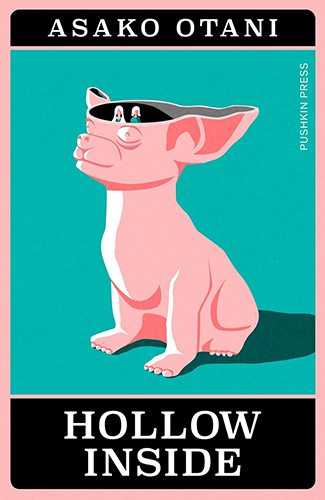
Hollow Inside

There’s an expression in Japanese that I really appreciate: shikata ga nai, which essentially means “what can you do.” Shikata ga nai is the verbal equivalent of a shrug of resignation. Sure, the situation may not be ideal, but shikata ga nai. What can you do.

Asako Otani’s 2023 novella Hollow Inside is about as close to a literary expression of shikata ga nai as you can get. Otani was born in 1990, which makes her a little younger than I am, but I feel like we’re part of the same Millennial generation that came of age right in time for the 2008 global economic recession and then got our feet kicked out from under us by the pandemic. This situation isn’t ideal, obviously. But what can you do.

Hirai, the narrator of Hollow Inside, has recently moved from a small and inconvenient flat into a nicer two-bedroom apartment. She’s able to afford a better place by splitting the rent with her friend Suganuma, who proposed the idea to Hirai because she was tired of her own tiny apartment. Both women are around 40, and neither has any real desire to get married.

Hirai works in the accounting office of a printing company, while Suganuma formerly worked for the consulting division of a company specializing in administration systems. The two women met through their jobs but became friends when they realized that they were both fans of the same idol group, KI Dash. Their social circles narrowed during the pandemic, but their friendship with each other survived.

After working more than twenty years in corporate jobs, neither has enough money to afford a decent apartment in the city. That’s not great, but what can you do. Suganuma confesses to being “desperately lonely” while working from home during the pandemic, and Hirai knows exactly what she means. The pandemic wasn’t great, but again – what can you do.

What they can do, it turns out, is to move in together. Perhaps this isn’t how either of them imagined that their lives would turn out, and perhaps this isn’t what society in general expected of them. Hirai confesses to feeling shy about explaining her situation to her colleagues at work, knowing that two women in their forties sharing a home together isn’t the usual situation. And indeed, when she gets a chance to explain her living arrangements at a work dinner with colleagues, everyone makes polite noises and before swiftly changing the topic of conversation.

Still, Hirai and Suganuma get along well together, and they support one another through the small tragedies of their lives, such the marriage of Suganuma’s favorite idol from KI Dash and Hirai’s disastrous date with a man who wants to induct her into a pyramid scheme. The two women eat out together, cook dinner for each other, take a spur-of-the-moment holiday to the beach, and fall asleep while watching DVDs of KI Dash concerts on an old PlayStation 2.

The title of Hollow Inside comes from Suganuma’s post-pandemic freelance job as a manufacturer of custom figurines memorializing the deceased pets of her clients. She’s set up a 3D printer in a corner of the living room, which also houses a wastebin of defective models. Hirai feels a kinship with these rejected memorial figurines, as she herself feels somewhat hollow during the transition between the life she assumed she’d live and the unmapped territory ahead.

This sense of hollowness isn’t necessarily a bad thing, however. As Hirai explains about a fantasy she occasionally indulges in when she’s stressed out after work… 

I let all the strength drain from my body. I gave myself over to gravity and sharpened all my awareness right up to my fingertips. I lay on the bed not moving an inch. Pretending to be dead. I sometimes did this.

I was dead. Nothing in the world had anything to do with me. I thought about the dead dogs. The dead dogs that had been doted on by their owners. They had left fake bodies in the world as figurines, and their souls were running in the other worlds wagging their tails. My soul joined them frolicking there.

…there’s a certain lightness that allows her to imagine herself as free and unburdened.

There are a range of different readings of Hollow Inside, of course. Some readers might find this novella depressing; but, to me, it’s a breath of fresh air.

In Japan and elsewhere, fewer women are getting married; and, as much as I enjoy the fantasy of romance, the reality of single life as an adult is no less interesting. Hollow Inside captures a moment in the transition of one woman’s life that happens to be representative of a major demographic shift. To me, this novella also serves as an eerily accurate reflection of the economic realities of the 21st century. We might not be able to enjoy the stability and middle-class lifestyles that our parents did, but what can you do. Shikata ga nai.

And you know what? It’s not so bad, actually.

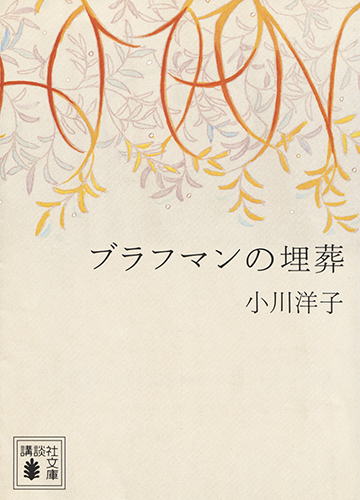
ブラフマンの埋葬

Yōko Ogawa’s 2004 novel Burafuman no maisō (Brahman’s Funeral) is a story about the lonely caretaker of an isolated artist’s retreat who adopts a forest creature of indeterminate species. Though this short novel features many of the tropes common in bestselling stories of animal companions, it was awarded the Izumi Kyōka Prize for literary fiction that explores the darker side of the human condition.

On the first day of summer, the unnamed caretaker finds a forest creature outside the back kitchen door. The creature is injured, and he doesn’t object when the caretaker picks him up and takes him inside. In fact, the creature almost seems to be asking for help, and his puppylike tameness inspires the caretaker to adopt him as an indoor pet.

The mansion where the narrator lives and works used to belong to the wealthy owner of a publishing company, but it has since been converted into an artist’s retreat. After a conversation with the stonemason who maintains a permanent studio on the grounds, the narrator decides to name the creature Brahman after the Sanskrit word the mason has carved onto a gravestone.

While Brahman recovers, the caretaker keeps the creature in his room. The caretaker’s personal space is stark and empty, but Brahman finds ways to keep himself occupied by opening drawers and gnawing on the coat hangers in the closet. At night, Brahman sleeps on the bed while curled up against the caretaker.

Once Brahman figures out how to operate the door handle, the caretaker begins taking him outside. The scenes in which he describes the meadows and forests surrounding the retreat through Brahman’s eyes are gorgeously written. Brahman delights in the sun and the wind and the grass, and he especially loves the garden pond, swimming and diving to his heart’s content as the caretaker watches.

Though the caretaker seems amiable enough, he seems to have no friends save for the stonemason. Aside from the artists visiting the retreat, the only person the caretaker speaks with is the young woman who works at the small general store outside the train station. Though the caretaker clearly has a crush on her, she’s dating an older man who lives in the city, and all she wants is to move away from the isolated village. The caretaker clearly doesn’t have a chance with her, and his yearning for connection is poignant yet gently pathetic. 

The purpose of contemporary popular pet fiction is to comfort the reader, often by anthropomorphizing the animals in service to the human protagonists. Burafuman no maisō is certainly beautiful and joyous in many places, but Ogawa has little interest in cozy vibes. To me, at least, this is an intensely gothic novel. 

Brahman dies at the end, but hints of death suffuse the entire story. Aside from the artists’ retreat managed by the caretaker, the most notable feature of the town is its sprawling cemetery, which has a strange but poetic history.

Because the mountainside town has a plentiful supply of both stone and stone carvers, people who lived upriver once commissioned its artisans to create coffins for their dead. Stone coffins were difficult to transport, however, and so the remains would be placed in wooden coffins that were sent downstream to be buried in the hillside cemetery. The isolated village thus became the final resting place for the dead who were all but abandoned by the rest of the world, a description that mirrors the position of the caretaker himself.

Ogawa has something of a fetish for sensitive but lonely men, and I have to admit that the caretaker breaks my heart a little. Along with having no name, he also seems to have no family, nor any past at all. What he has instead is an old family portrait photo that he buys from a Sunday antique market in the town square. The traveling merchant gives him an old wooden frame to go with it, so the caretaker hangs the photo in his room, where he sits on the bed and imagines the lives of the long-dead family. The only living joy in the caretaker’s life comes from his interactions with Brahman.

The genre of “cozy pet fiction” is almost always about people. As such, it often treats animals as human, even going so far as to give them human narrative voices so that the reader can better understand the human characters they observe. Burafuman no maisō does the opposite by using its nameless human narrator as a vehicle to document the short life of Brahman.

Though a human reader can never perceive the world in the way that an animal does, Ogawa asks us to sympathize with Brahman through the narrator’s documentation of his umwelt: what he sees and tastes and smells, and how he reacts to the world. To the caretaker, the behavior of other humans makes little sense, but he joyfully devotes himself to chronicling Brahman’s appearance and behavior through a series of annotated lists of observations with titles such as “Brahman’s Tail,” “Brahman’s Meals,” and “Brahman’s Footsteps.”

And finally, through no fault of his own, the caretaker is forced to close his account with a list titled “Brahman’s Funeral.” Through Brahman’s death and subsequent burial in a tiny stone coffin, Ogawa succeeds in making the reader care deeply about a semi-wild animal that was never anthropomorphized in any way. I appreciate the thematic artistry, but it’s nevertheless a difficult ending.

Hikaru Okuizumi (author of The Stones Cry Out) writes in his postscript to the Kodansha paperback edition that Ogawa more than likely started this short novel during a literary festival in the small French town of Fuveau, where she apparently bowed out on a large group dinner to stay alone in her room and write. This makes perfect sense to me, as Okuizumi’s anecdote accurately reflects the tone of the story. Despite Brahman’s death and the caretaker’s loneliness, Burafuman no maisō dwells in the quiet and contemplative corners of the gothic genre, and this short novel feels like a small but meditative retreat.

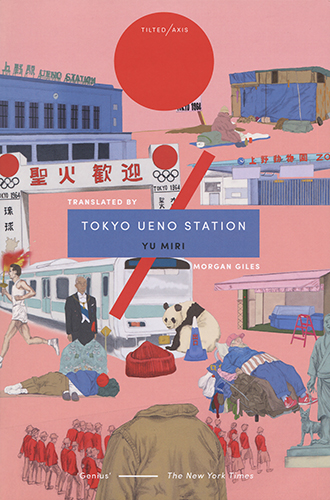
Tokyo Ueno Station

Yū Miri’s 2014 novel Tokyo Ueno Station is a compelling portrait of one man’s life and a pointed critique of the inequalities that support the supposed national prosperity championed by the Tokyo Olympics. 

Kazu, an unhoused man living in Ueno Park, was born in the town of Sōma in Fukushima in 1933. In order to support his family, Kazu moved to Tokyo in 1963 as a laborer engaged in the construction of athletic facilities for the 1964 Tokyo Olympics.

Kazu has lived in Tokyo since then, only visiting his family occasionally. When he finally retires and returns to Fukushima, his wife dies seven years later. Not wanting to become a burden to his daughter and granddaughter, Kazu takes the train back to Tokyo. He’s so exhausted when he disembarks at Ueno Station that he simply lies down in the large public park outside the station and goes to sleep. In this way, almost by accident, he becomes homeless. As Kazu reflects:

If you fall into a pit you can climb out, but once you slip from a sheer cliff, you cannot step firmly into a new life again. The only thing that can stop you is the moment of your death. But nonetheless, one has to keep living until they die.

Though Kazu’s story is easy enough to follow, it’s narrated in fragments broken by the conversations of people walking through the park, which juxtapose the comforts of middle-class leisure against the day-by-day existence of unhoused people. The men and women living rough in Ueno Park aren’t abject by any means, as they’re cared for by each other and a network of local communities. Still, their lives are precarious, and they can be ordered to leave at any time.

Tokyo Ueno Station isn’t misery porn. Rather, it’s about helping the reader notice what was always visible. In a rare aphorism toward the end of the novel, Kazu remarks, “To be homeless is to be ignored when people walk past, while still being in full view of everyone.”

In another sense, however, the conversations Kazu overhears in Ueno Park are indicative of how most people living in Tokyo don’t view the unhoused as dangerous. If two middle-aged housewives chatting about their pets don’t care about whether an unhoused person is chilling out on the next bench over, are homeless people really so much of an eyesore? They’re not criminals, so why shouldn’t they have the same right to occupy public space as everyone else?

And why should the police have the right to force the unhoused away from their belongings and their communities every time a member of the imperial family visits the area?

The novel closes with Kazu being kicked out of Ueno Park and forced to seek shelter elsewhere until an imperial visit is concluded. During this intensely uncomfortable period, he suffers a minor stroke and decides to throw himself on the train tracks at Ueno Station, a decision that happens to coincide with the 2011 Tōhoku earthquake and tsunami. In his last moments, Kazu’s spirit returns to the Fukushima town of Sōma, which was directly impacted by the tsunami and resulting nuclear crisis (as documented brilliantly in Ryo Morimoto’s monograph Nuclear Ghost).

Yū’s irony isn’t subtle: the fantasy of “Japan” can only be celebrated if the people who literally build its monuments and provide its energy are hidden away. Tokyo Ueno Station asks the reader to consider the symbol of the Japanese Emperor, as well as the persistence of the ideologies that once supported Japanese military imperialism and continue to marginalize Japan’s own people.

As an American, I will readily admit that this is not my circus, but I can’t deny that Yū’s writing has given me some strong feelings about clowns. To me, it makes perfect sense that Tokyo Ueno Station was awarded the National Book Award for Translated Literature in 2020, right in the middle of the first Trump presidency.

Still, despite the strength of its argument and the sharpness of its critique, I don’t think that shaping political opinion is the point of this novel. Rather, the beauty of Tokyo Ueno Station lies in Kazu’s individual story, as well the fascinating collage of impressions he creates through his observations of the city, which are linked to his experiences growing up in the regional culture of coastal Fukushima. There is value in seeing what is often ignored, and value in documenting quiet voices that are often unheard.

What Yū demonstrates is the value and dignity of small and personal stories, especially in the face of large national narratives that crush the marginalized in the name of progress. Tokyo Ueno Station doesn’t make any sweeping political arguments or engage in polemics, but rather allows the remarkable individuality of Kazu’s story to shine. The brilliance of Yū’s critique is that, while Kazu’s story is his own, his unfortunate fate feels inevitable in the current of larger forces. Despite its literary style and gut-punch ending, Tokyo Ueno Station isn’t a difficult novel to read, but it’s a difficult story to sit with.

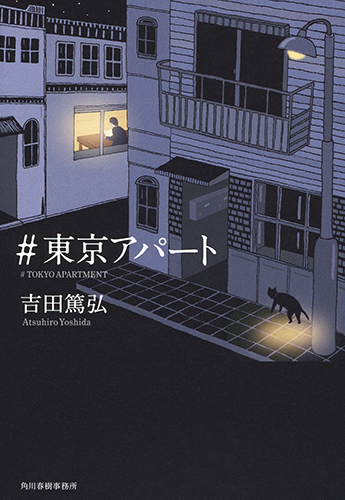
Tokyo Apartment

Atsuhiro Yoshida’s 2025 short fiction collection #Tokyo Apartment brings together 21 stand-alone stories about people living in and around Tokyo. The characters are usually living on their own, almost always in retro buildings removed from the city center. There’s very little wealth or glamor in these stories, but their protagonists nevertheless manage to become swept up in the magic of a densely populated megacity.  

A representative story is Tokage-shiki gomuin kaisha (“Lizard-style rubber stamp company”), whose narrator recalls a time when he lived in a building that was once famous for being the largest apartment complex in Japan. The building had multiple floors of businesses, and the narrator worked at one of them as an apprentice to an artisan who took commissions for document signature seals. While dining at his favorite pubs in the same building, the narrator grew friendly with a woman who also worked there. He courted her by sending letters to her apartment – which was naturally in the same building. This story perfectly captures the flavor of the comfortably chaotic retro spaces of the old business/residential complexes of West Tokyo.

Not all of the stories are so cozy, however. Sutorei kuriketto (“Stray cricket”) is about a young man with no money, no friends, and no real prospects for finding a decent job. For the time being, he washes dishes in a small diner. He doesn’t have much room in his life for hobbies, but every night he brings back scrabs of cabbage to feed to a cricket that has entered his tiny apartment through a ventilation shaft. While listening to the cricket chirp in the darkness, the narrator is inspired to help the tiny creature find its way back outside. He might have nowhere to go in his own life, but at least the cricket can be happy and free.

Many of the stories end on a more ambiguous note. In Heya o kimeta hi (“The day we decided on an apartment”), two single fathers become online friends as they swap stories and advice with one another. In time, they become real-life friends and begin sharing childcare responsibilities. They mutually arrive at the conclusion that their lives would be easier if they lived in the same apartment building, so they hire a realtor to find a suitable property. There’s something about this sort of housing decision that feels final, however, and this causes the two dads to wonder if they’re really ready to take such a momentous step into the beginning of middle age.

For the most part, the stories in #Tokyo Apartment are fairly mundane, but there are occasional touches of magical realism. In Yūrei no denwa (“Ghost telephone”), the character Moriizumi returns from Yoshida’s novel Goodnight, Tokyo. Moriizumi manages a service that helps people dispose of their old telephones, which often have too much sentimental value to throw away. In a conversation with a crow who makes nightly visits to her balcony, Moriizumi reflects on how analog technology can feel haunted by the ghosts of people with whom our connections have faded. The crow, who is a connoisseur of the unused objects people dispose of on their balconies, agrees with Moriizumi but prefers to focus on making new connections.

A word I often see in reviews of Atsuhiro Yoshida’s writing is yomi-yasui, or “easy to read.” Yoshida has spent more than a decade carefully cultivating a light and precise writing style, and #Tokyo Apartment is indeed a relaxed and chill reading experience. It’s entertaining to encounter such a wide range of variations on the theme of “apartments in Tokyo,” especially since the narrative voices of these stories are so distinct – which is no mean feat when accomplished within the simplicity of the author’s characteristic style.

As an aside, I might recommend the stories of #Tokyo Apartment to people studying Japanese language. Any one of them might be good for inclusion on the syllabus of an upper-level Japanese language class. In particular, the first and final stories of the collection are short, amusing, and easy to understand from context clues, and I imagine that either of them would be a nice treat for anyone just starting to read Japanese fiction.

At the Edge of the Woods

In the woods, there is a castle. The castle was once the residence of the landowning family that ruled the area. During the war, it was the headquarters of a resistance movement. Now it sits empty and abandoned. The castle is so deep in the woods that most people couldn’t find it if they tried. No one tries, however, as the woods are filled with child-snatching imps. Strange noises come from the woods, and occasionally strange people as well.

Masatsugu Ono’s At the Edge of the Woods is a novel about dread and anxiety. There’s no plot, nor is there any sort of story. Instead, Ono presents four episodes in the life of a father left alone with his young son while his wife is away. There’s no chronological order to the four chapters, which all occur at roughly the same time, and there’s no meaningful change in the personalities of the characters. Rather, the story development involves the slow intensification of an atmosphere of foreboding.

The nameless father who serves as the narrator is Japanese, as is his wife, who is pregnant with their second child. The wife has flown back to Japan to visit her parents, leaving her husband and son in an unspecified European country that reads as Germany-coded. The family has taken up residence at the eponymous edge of a vast forest in a rural area dotted with small towns.

The country is now at peace, but its neighbors are not so lucky. Long lines of refugees stream across the borders, seemingly unhindered by local authorities. It’s entirely possible that some of these refugees have camped out in the woods next to the narrator’s house, but it’s difficult to say for sure. It’s equally difficult to specify the origin of the odd sounds constantly emerging in the forest.

Characters drift in and out of the narrative, leaving behind very little of themselves save for strong emotional impressions. The disabled daughter of a bakery owner has good intentions but struggles to make herself understood. The postal worker who delivers the mail relates grotesque stories to the father, who suspects the man might be reading and discarding his wife’s letters. A neighboring farmer has always been kind to the narrator’s family, but his son reports that he once saw the man tie a dog in a burlap sack and beat the poor creature to death.

Perhaps the most striking of these characters is an elderly woman that the narrator’s son invites into the house. She appears seemingly from nowhere, and she vanishes just as mysteriously. While she’s in the house, though, she becomes a living symbol of the narrator’s anxieties regarding his ill-fitting role as the solitary caretaker of a young child in a foreign land:

Overcome, the old woman buried her face in her hands. She trembled violently, and a sob escaped her. I looked up. The kitchen windows were all closed. And yet in the air there hovered the sour smell of decayed leaves from deep in the woods, leaves that would never dry out. Steam rose from the old woman. The steam was not from her tea. A puddle spread at her feet. (20)

In his “Introduction” to The Oxford Book of Gothic Tales, Chris Baldick neatly summarizes the genre as an expression of the fear that the horrors of prior eras will not remain comfortably in the past. At the Edge of the Woods presents the readers with a range of Gothic tropes to heighten the sense of uneasy suspicion that, even in the most progressive of European countries, there is no escape from misery and cruelty. While the back-cover copy of At the Edge of the Woods calls the novel “an allegory for climate catastrophe,” this feels like a bit of an interpretive reach. Instead, Ono seems to be suggesting more broadly that, even in our bright society sustained by futuristic technologies, we’re never that far away from the edge of a large and unknowable forest.

At the Edge of the Woods can be difficult to read, and it’s probably not for everyone. Speaking personally, though, I love this book, and I’ve read it on the winter solstice every year since it was published in 2022. Ono’s writing is gorgeously atmospheric, and the legendary Juliet Winters Carpenter has done a dazzling job with the translation. If you appreciate the sort of quiet, eerie, and darkly suggestive Japanese Gothic writing typified by Yoko Ogawa’s short story collections Revenge and The Diving Pool, I’d recommend At the Edge of the Woods as the next step on a shadowed path into the liminal spaces in the penumbra of modern civilization.

Silent Singer

Yōko Ogawa’s 2025 novel Silent Singer (Sairento Shingā) is a bittersweet story about a woman named Ririka who lives alone in a mountain forest near a community of people devoted to silence. Ririka is a professional singer, but she never makes a name for herself, only taking freelance jobs that require a performer with an anonymous voice. Though the singer and the silent community eventually fade into obscurity, Ogawa celebrates the beauty and dignity of their lives, as well as the significance of creativity that never finds an audience.

On an isolated mountain in the countryside, a group of people calling themselves “The Introverts’ Club” have bought a parcel of land and formed a community named Acacia Fields, which is devoted to quiet and simple living. The Acacia Fields community isn’t a religious organization; rather, they’re normal people committed to the philosophy that “silence soothes the soul.” Anyone can join as long as they’re content never to speak in the presence of others.

Ririka lives in an old house next to a forest adjoining Acacia Fields, where her grandmother is employed as the gatekeeper. The gatekeeper’s job is to communicate with people from the outside world while also managing a small store that sells produce, pastries, and other items produced by the community, which raises livestock and maintains extensive gardens.

While her grandmother manages in the gatehouse, Ririka has the run of Acacia Fields. She spends hours with the aging doctor of the community’s small clinic, who isn’t bound by a vow of silence and reads to her while teaching her “finger language,” a simple form of sign language used by the community. Though her mother committed suicide after being abandoned by her father, Ririka enjoys a happy childhood divided between the public school in the town below the mountain, the doting care of her loving grandmother, and the quiet but genuine affection of the people living at Acacia Fields.

Ririka discovers her path in life during a sheep shearing session at Acacia Fields, when she’s asked to sing a simple lullaby to help keep the animals calm. She performs beautifully and enjoys herself immensely. A town official who attended the event is impressed by Ririka’s singing, and he asks her to record a similar song to be played over the municipal loudspeakers every evening at 5pm. Though no one knows the singer is Ririka, the song is so well-received that the tradition continues indefinitely.

Shortly after she graduates from high school, Ririka’s grandmother passes away. Ririka remembers her grandmother by visiting her Puppet Garden, which the old woman created after a child went missing in the mountain forest one summer. To soothe the boy’s spirit, Ririka’s grandmother fashioned five dolls from discarded household objects and placed them at the center of a small grove. For Ririka, the Puppet Garden serves as a place of quiet meditation. 

Ririka takes over her grandmother’s position as the Acacia Fields gatekeeper while supplementing her income through various freelance jobs passed along by her voice instructor. In each case, Ririka is recommended because of her relative anonymity. Ririka sings jingles for television commercials, performs anime theme songs, records vocal tracks for idol groups, and even provides the voice of a talking children’s toy. Though she doesn’t seem to realize it, Ririka is quite successful as a professional singer, but she never leaves her home on the mountain.

As an adult, Ririka strikes up a romance with the security guard at the parking lot where she keeps her car. On their first date, Ririka takes him to the Puppet Garden, whose dolls are in a severe state of decay. Instead of being creeped out, the security guard is charmed. He’s a good match for Ririka, as he has an odd hobby of his own – piecing together carefully curated scrapbooks devoted to the lost works of famous authors.

The only shadow over the relationship is that Ririka finds herself unable to sing for her boyfriend. She can only sing, she explains, if her audience isn’t a living human. Meanwhile, with few young people moving to the mountain, the Acacia Fields community is in danger of being claimed by entropy and senescence.

Silent Singer resonates with echoes of the Studio Ghibli charm of Mina’s Matchbox; but, as is often the case with Yoko Ogawa’s work, a major theme of the novel is the gentle beauty of decay. Ririka’s house is slowly falling apart, as are the dolls in her grandmother’s Puppet Garden. The agricultural holdings of Acacia Fields are gradually diminishing, and the members of the community are growing old. Regardless, the village remains peaceful, as does the surrounding forest, especially in contrast to the absurdities of the freelance work Ririka takes as a singer. 

In many ways, Silent Singer reminds me of Haruki Murakami’s 2023 novel The City and Its Uncertain Walls, especially in its aggressive refusal to engage with contemporary technology. It could be the case that the nostalgic settings of the two novels are simply a product of the preoccupations of two aging writers, but that’s not how these stories feel to me.

At this point in the death spiral of our capitalist hellworld, I’m bone-tired of “progress” that dehumanizes everything it touches. Meanwhile, Murakami’s narrator leaves his corporate job to work in a small-town library in Fukushima prefecture, while Ririka remains loyal to her home in a quiet mountain forest, which provides a refuge from the profit-driven demands of the entertainment industry. And good for them! I am here for characters who do not give a single fuck about social media or self-branding.

While it might be a stretch to call Silent Singer “anticapitalist,” this is a story about the value of creativity at the margins, as well as the beauty of art without an audience. Ogawa’s obsession with the decay that creeps in at the edges of isolated communities and individual lives can sometimes feel uncomfortable, but let it be uncomfortable! There’s nothing cozy about the richness of human experience, and the care and attention Ogawa devotes to the slow endings of her stories is one of the great pleasures of her work. The work of Ogawa’s “silent” creatives may be unremarked, but it’s far from unremarkable.

Sympathy Tower Tokyo

Rie Qudan’s short novel Sympathy Tower Tokyo, which was awarded an Akutagawa Prize in 2023, is a story about language, generative AI, and the culture war discourse surrounding the construction of a fictional prison facility in a high-rent area of Tokyo’s Shinjuku district. 

Sara Machina is an artist and architect who wants to win the bid to design and build the eponymous “Sympathy Tower Tokyo,” a prison right in the middle of metropolitan Tokyo that will operate according to a utopian vision of providing state-mandated shelter to “homo miserabilis,” or people driven by economic precarity to commit crimes because they had no other options, Les Misérables style.

The main problem, in Sara’s eyes, is the name of the building, which is written in English and a mouthful to pronounce: Shinpashii Tawaa Toukyou. It’s also somewhat meaningless, Sara reflects, as are a number of other politically correct English terms that have replaced native Japanese expressions. Amusingly, she provides a list that includes examples such as negurekuto (neglect), which has replaced the formal term ikuji hōki (child abandonment) in public discourse.

Most of these loanword expressions don’t really change the meaning or public perception of the concept itself, but some do. “Homo miserabilis” is one such (fictional) example, having replaced the word hanzaisha, meaning “criminal.” Which is all well and good, Sara admits, but she still can’t envision a structure called “Sympathy Tower Tokyo.” If the building were to have a name that was more euphonic in Japanese, that would be a different story.

An appropriate name is provided by a beautiful young man who goes by “Takt,” a loanword from German used for an orchestra conductor’s baton. Takt became Sara’s casual boyfriend after she saw him through the display window of a luxury fashion store in Aoyama and point-blank asked him out; and, despite the difference in their ages, he does genuinely care for her.

While Sara frets over the intricacies of language, Takt has no qualms about using AI-built, the novel’s version of ChatGPT, to address any questions he might have. Despite his casual use of AI to understand the world and communicate with other people, Takt naturally and organically comes up with the expression Tōkyō-to Dōjō-tō (Tokyo City Sympathy Tower), which rolls off the tongue “like a spell from Harry Potter” and turns out to be exactly the inspiration Sara needs. 

Sara’s design wins, and the tower is built on prime real estate for everyone to see. It is, she says, “the answer to the question posed by Zaha Hadid’s Olympic Stadium.” 

Sara narrates the first and fifth chapters of the novel, while Takt narrates the second and fourth. The third chapter belongs to Max Klein, an American journalist covering Japan who’s gone freelance after being accused of making racist cultural generalizations. Takt is charmed by Max and begins adopting his speech patterns, while Sara (bless her heart) is mainly concerned about Max being fat and stinky and sweaty.

Max himself is a budget version of Hunter S. Thompson who seems to want to “tell it like it is” but unfortunately doesn’t possess the political acumen to make it as a mainstream reporter. In particular, Max is frustrated by what he sees as the tendency of Japanese officials (and Japanese people in general) to use smooth and politically correct language to mask their actual views and agenda.

While Max’s tirade is admittedly gauche, it seems to partially echo the author’s own views regarding excessive linguistic masking, which she expressed succinctly in an interview with The Guardian (here):  

“There are people all around you who you would never think hold discriminatory views but actually do hold those views. A lot of Japanese people, on the surface, they know how to act in a way that makes them seem welcoming of diversity. And this discrepancy between what people think on the inside and what they say is a very distinctive feature.”

In other words, language is political, but the degree to which “correct” language can shape or reshape society is debatable. This question calls to mind the online conversations in 2022 surrounding Tetsuya Yamagami, the man who assassinated Shinzō Abe and attracted immediate widespread sympathy. While the murder itself was shocking, Yamagami’s motives were faultless. How, then, would it be appropriate to talk about him? Is someone like Yamagami truly a “criminal,” or rather a “homo miserabilis”? Regardless, the language we use to refer to people who commit crimes doesn’t change the fact that we feel compelled to incarcerate them, “Sympathy Tower Tokyo” though their prison may be. 

Sara Machina was the victim of an assault that was never punished or even acknowledged, and she can’t quite reconcile herself to rhetorical towers built with politically correct language. Max goes five steps farther and expresses open disdain for the sort of wokeness that dictates that people who caused so much suffering to others aren’t properly treated like criminals but are instead allowed to live rent-free in a gorgeous luxury tower.

In the middle is Takt, the son of a high-profile “homo miserabilis” who ultimately decides to become a PR representative for the tower. Perhaps because he’s so used to consulting AI-built, his speech soon becomes just as smooth and beautiful as his face. When he begins to write about Sara Machina’s architectural genius, however, he finds that AI is insufficient, yet he can find no words in himself. This is fine with Sara, who (relatably) doesn’t wish to be perceived after becoming the target of sustained abuse on social media. 

The plot summary I’ve given here doesn’t begin to do justice to the actual conflict of Sympathy Tower Tokyo, which revolves almost entirely around language. Both English-language and Japanese-language journalists have made a big deal about how “a portion of this award-winning novel was written by ChatGPT,” but this description is painfully misleading. When characters in the novel engage with AI-built, the program’s text was in fact generated by AI, as is appropriate. Although Qudan never has her viewpoint characters make a definitive statement about LLMs, the “smoothness” of machine-generated text is positioned as a mirror to the sort of “politically correct” language used by public officials to disguise and downplay critical issues in contemporary Japanese society.  

In any case, Jesse Kirkwood’s translation is brilliant, and I very much appreciate the brief and informative “Translator’s Note” at the beginning of the book. Also, for what it’s worth, though the diegetic AI-built text may have been generated by an LLM, I didn’t get the sense that it was translated by one. If there’s any criticism to be directed at Sympathy Tower Tokyo, it’s that its emotional core is ephemeral and difficult to pin down. Perhaps ironically, the characters aren’t sympathetic; rather, their role is to serve as viewpoints along a spectrum of opinion. Still, Sympathy Tower Tokyo is a remarkably playful and intellectually stimulating book, and you can’t help but admire Qudan’s boldness in standing up and speaking to the current moment of culture war discourse.