Horses, Horses, in the End the Light Remains Pure

Horses Horses

Title: Horses, Horses, in the End the Light Remains Pure
Japanese Title: 馬たちよ、それでも光は無垢で
(Umatachi yo, sore demo hikari wa muku de)
Author: Furukawa Hideo (古川 日出男)
Translators: Doug Slaymaker and Akiko Takenaka
Publication Year: 2016 (America); 2011 (Japan)
Publisher: Columbia University Press
Pages: 147

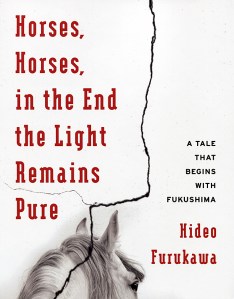
Furukawa Hideo, born in 1966 in Fukushima prefecture, is a prolific author who has won numerous awards for his work, which ranges from mystery to sci-fi to literary fiction. Horses, Horses, in the End the Light Remains Pure is a memoir that defies genre as it responds to the March 2011 triple disaster of earthquake, tsunami, and nuclear meltdown.

Horses is the story of a road trip that the author makes to Fukushima almost immediately after the disasters. Furukawa lives in Tokyo, and he was in Kyoto when the earthquake hit. He describes himself watching the news on the television in his hotel room, unable to process what he was seeing but unable to look away. “That’s when that period of steady gazing began,” he admits (19). Furukawa describes his continuing shock as living in “spirited-away time,” as if “the dates of the calendar disappeared” (6).

He is shaken from his torpor by the voice of a character from a novel he has recently published, The Holy Family (Seikazoku). This character, who is from the Tōhoku region, tells the author to go there and see it for himself. Furukawa therefore gets in a car with three other people who are identified only by letters (as in, “Young S was driving”) and heads north from Tokyo, all the while commenting on the seemingly normal state of traffic, gas stations, and convenience stores. When he arrives at the affected area, however, nothing is normal. As Furukawa explains it…

We were overwhelmed by the sense of how powerful it was. The scene spread out before us, everything wiped clean away. There are no words for it. We didn’t just feel it, we were pummeled by it. I am ashamed to admit it – I want to spit at myself in disgust – but I was looking at the scene as if it were a great spectacle. I thought of air raids. And atomic-bomb sites. It hit me like a smack to the side of the head: it’s just like a city in wartime. I couldn’t help it. I exploded: “This scale, it spreads too far.” (41-42)

Although the disasters are never far from Furukawa’s mind, descriptions of its aftermath don’t form a particularly large portion of his narrative. Instead, he is concerned with his identity as a writer and his responsibility in chronicling what has happened. Throughout the book, Furukawa seems almost narcissistic in the way he dwells on the process of writing, as well as the invitations he receives to discuss it. This is not unique to Furukawa, of course; very rarely is an artist’s statement anything other than a validation of the artist’s ego. It’s what these meditations evolve into halfway through Horses that makes the book so interesting. Specifically, Furukawa tries to pick apart the various strands of meaning tangled up in the knot of Japanese identity, repeatedly returning to the question of how to approach Japanese history and myth. For example, he ponders…

How does one sing praises to this national land? Especially now, given that there is a second sun in the nuclear core? A meltdown that has taken its name from Fukushima. Can a name be given to this particular sun deity? (65)

Furukawa goes on to discuss how the vaunted warrior class and the great military leaders of the sixteenth century were brutal and pitiless murderers. “Our history is nothing more than a history of killing people,” he concludes (78). When he reflects on how he wrote about Japanese history in The Holy Family, Furukawa claims that he was therefore writing “for the horses.” If the history of humans is a history of killing people, then the history of horses is a history of being killed in human wars. Just like the animals around the Fukushima reactor, the lives of horses are affected by events that are only tangentially related to them. Although the author never makes this parallel clear, he suggests that there isn’t a great deal of difference between the “otherness” of domestic animals and the “otherness” of the people who fall outside the political center of Japan.

Furukawa’s memoir is not challenging in the traditional sense of being difficult to understand, but reading it can be challenging at times, as the author follows his train of thought without stopping for a full 140 pages. His style is not quite stream-of-consciousness, but he makes no attempt to order his thoughts or to impose structure to any sort of argument he might be making. As a response to the disasters, then, Horses feels less like a polemic and more organic and sincere. Furukawa ends his narrative on a somewhat surreal note, but Doug Slaymaker’s concise “Translator’s Afterword” neatly ties together the disconnected themes of the work, and I would recommend that the reader glance over it before embarking on the main text.

Horses, Horses, in the End the Light Remains Pure is a trenchant and often surprising work of literary ecocriticism. Furukawa transforms both the immediate disasters in Fukushima and the broader historical currents that flow around them into deeply personal experiences, resisting large narratives as he argues for the validity of individual stories, especially those that rarely make it into official histories. The smooth and well-considered translation gives the text, in all its complexity, a compelling sense of forward momentum. Furukawa’s memoir is just as engaging as it is important, and it will be of immense interest to anyone concerned with how views regarding the relationship between human beings and the natural environment have shifted during the twenty-first century.

Manabeshima: Island Japan

Manabeshima

Title: Manabeshima: Island Japan
Artist: Florent Chavouet
Translator: Periplus Editions
Publication Year: 2015 (America); 2010 (France)
Publisher: Tuttle
Pages: 142 (plus one amazing map)

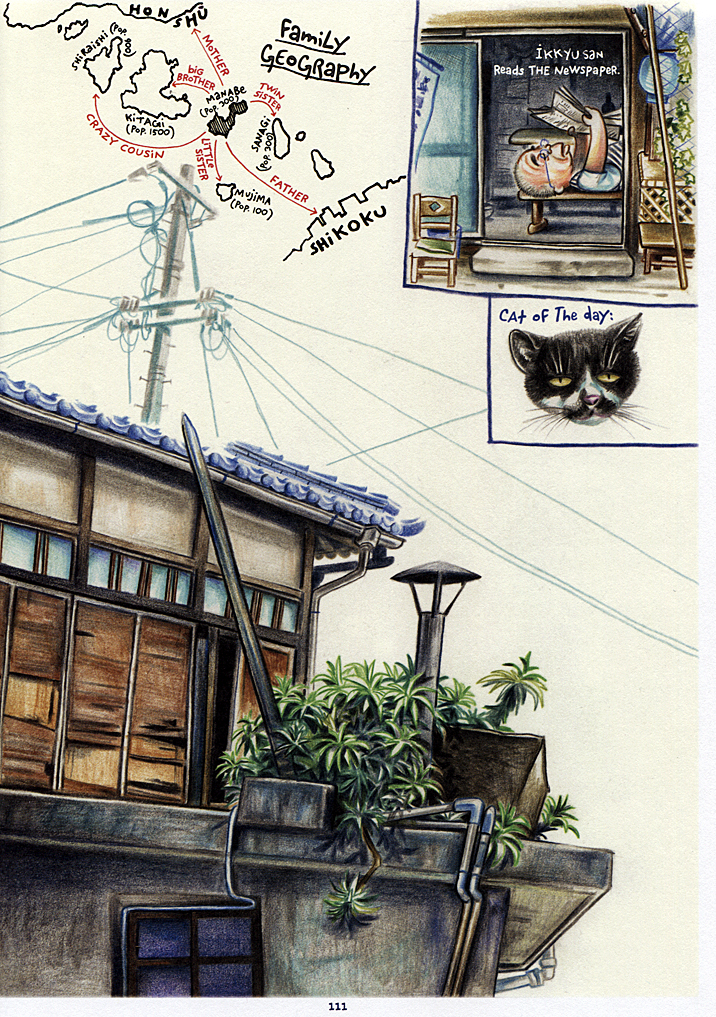
I love French artist Florent Chavouet‘s 2009 book Tokyo on Foot, which captures the charm and vibrancy of my favorite city. Manabeshima: Island Japan was a tougher sell for me, as I’m not particularly interested in nature or rural communities. I was therefore pleasantly surprised to find that the careful attention Chavouet brings to human habitats – garbage and vending machines and rusting powerlines and all – has carried over from Tokyo to Manabeshima. Regardless of whether he’s drawing the town or the ocean and forests that surround it, Chavouet transforms the mundane into the extraordinary with his gorgeous colored pencil illustrations.

Because he felt that he had only been exposed to a tiny fraction of the Japanese archipelago, Chavouet decided to spend a summer on an island he hadn’t yet seen, and he ended up in Manabeshima, Okayama Prefecture, population 326. According to the artist, the average age of the people living on the island is around 50 years old, and many of them are already well set in their daily routines. Chavouet observes them on their daily progress, taking careful note of their mannerisms and idiosyncrasies, as well as the props they use on the stage of their daily lives. His artistic interest is drawn not only to humans, but also to the island’s abundant wildlife, including cicadas, fish, and cats. These cats gradually become characters in their own right as Chavouet documents their small dramas and battles over contested territory.

My favorite part of Manabeshima is how the artist portrays architecture as a living part of the environment and the island society, with each room and table and upended bucket telling its own story. Cars and boats become palimpsests of personal history, and each garden and untended backyard is portrayed its own tiny ecosystem. Chavouet also pays particular obeisance to food, placing each meal in context, whether it’s a community barbeque or freshly prepared sashimi.

I must admit that a certain amount of anxiety underlay my reading of Manabeshima. As with any travel account, part of the pleasure of the experience involves imagining yourself following in the footsteps of the writer. Even if it’s something you have no intention of ever doing, like the hiking the Shikoku pilgrimage route, it’s still fun to pretend that you’re there along with the author, sharing her triumphs and sympathizing with her tribulations. In the case of Chavouet’s account of Manabeshima, this sort of identification was very difficult for me.

Although nothing in the book makes this explicit, Chavouet’s experiences are gendered. Within the first twenty pages, he makes it clear to the reader that he has been, after a fashion, accepted into the community. He is taken in by Ikkyu-san, the owner of a small bar and restaurant who plies him with food and alcohol, asking only that he sit and eat and drink with the regulars. He is invited to two religious ceremonies (a Buddhist ritual presided over by Ikkyu-san and an evening of Shinto kagura dances), where he is expected only to sit and eat and drink. He goes to the neighborhood association meetings, he gets invited to go out crab fishing, and he participates in the island summer festival. He seems like an extremely friendly person, and he mentions exchanging drawings for food and goodwill; but, if anyone ever requests that he do anything except enjoy himself, the reader never hears anything about it.

My own experience with small communities both inside and outside of Japan is that, in order to be included, I am expected to perform labor, such as cooking or laundry or childcare. Since I am an undomesticated animal who is not good at any of this, things always get awkward. If you asked me if I, as a woman, would want to spend two months in a tiny village on a small island, my response would be something along the lines of AW HELL NO. While Chavouet would be eating and drinking, I would more than likely be summoned to the kitchen to help do the dishes. I use the hypothetical example of being asked to help clean up because it’s actually happened to me enough times (especially in Japan) that I would almost be taken aback if it didn’t. In other words, the price of admission is gendered and – let’s be honest – unfairly so.

Again, there’s nothing in the book that suggests that the people on Manabeshima are old-fashioned sexist pigs, but Chavouet is definitely writing from a privileged position, and your ability to identify with this position will more than likely affect your relationship to the world Chavouet creates for you with his words and illustrations. Personally, I found reading Manabeshima to be a bit stressful because I couldn’t help waiting for the other shoe to drop, like, so when are they going to ask him to serve tea? (Spoiler: No one ever does.)

Don’t get me wrong – I am enamored of Chavouet as a kind and compassionate observer who can communicate the wonder and beauty of even the most commonplace objects and settings, and his already enviable skill in drawing and annotating his environment has tangibly improved since Tokyo on Foot. Still, I can’t help but prefer Tokyo on Foot, which pieces together a physical, social, and cultural landscape that even the most casual of readers can easily enter. While Tokyo on Foot collects a multitude of fragments and progressively demonstrates how they are all connected, everything is already a cohesive whole in Manabeshima, which, unlike Tokyo on Foot, has a cast of recurring characters and something resembling a narrative. On the other hand, although it’s harder for a reader to imagine entering this narrative herself, the easy flow of the story renders Manabeshima a more satisfying extended reading experience.

The best part of Tuttle’s lovely softcover edition of Manabeshima is that it comes with a huge map folded into a pocket on the back cover. This map is intensely detailed, showing every house and garden and boat on the island and labeled with references to people, landmarks, and events from the main text. I spent at least an hour with the map alone, catching new details each time I opened it and spread it out over my kitchen table.

If you have kids in your life, and if you’d like to get one of those kids (or their parents) a really cool present, consider handing them a copy of Manabeshima, whose every page celebrates the thrill of exploration and discovery.

A review copy was provided by the good people at Tuttle Publishing.

Manabeshima Page 111

Yūrei: The Japanese Ghost

Yūrei The Japanese Ghost

Title: Yūrei: The Japanese Ghost
Author: Zack Davisson
Publication Year: 2015
Publisher: Chin Music Press
Pages: 206

Zack Davisson is a major rising star in the world of manga translation, having worked on high-profile and award-winning titles such as Mizuki Shigeru’s Showa: A History of Japan and Oishii Mamoru and Kon Satoshi’s Seraphim: 266613336 Wings. He is also a consultant for the ongoing comic series Wayward, for which he writes the closing essays. Fans of yōkai and other Japanese cryptids will know him from his blog, Hyakumonogatari Kaidankai, and he also maintains an active Twitter account, which is a great source of news on the American comics scene. Yūrei: The Japanese Ghost is Davisson’s first book, and it’s published by no less than Chin Music Press, which regularly releases Japan-related literary objets d’art such as Kūhaku & Other Accounts from Japan and Otaku Spaces. There’s obviously been a great deal of talent invested in this book, and it shows.

Yūrei are the ghostly cousins of yōkai, and their spectral tendrils stretch deep into Japanese history. Although he occasionally touches on contemporary popular culture, Davisson is mainly concerned with the society and print media of premodern and early modern Japan. Each of the twelve chapters in Yūrei covers one in-depth topic, the discussion of which is usually centered around a specific artistic work.

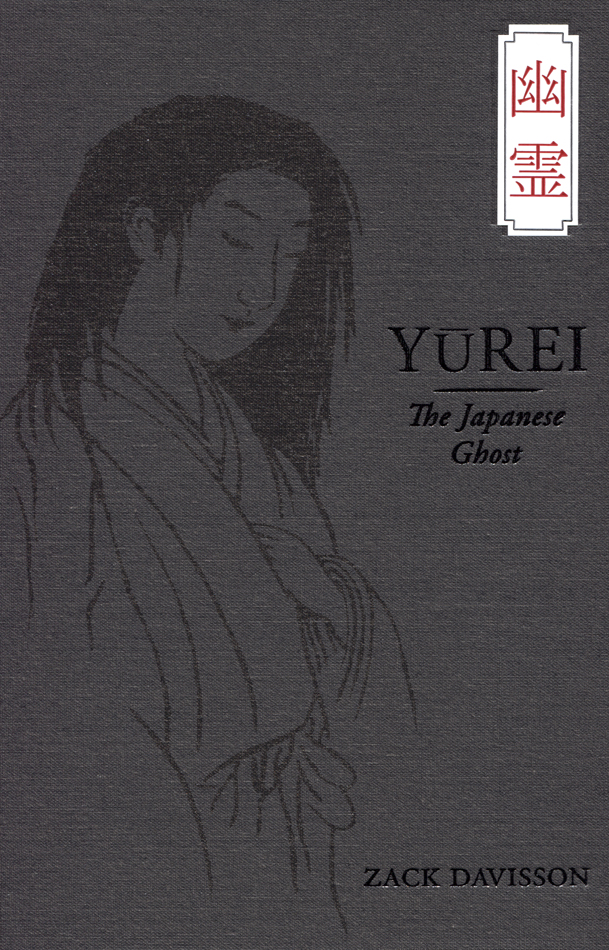
The first chapter takes as its subject “The Ghost of Oyuki,” the Edo-period painting by Maruyama Ōkyo that appears on Yūrei‘s cover. Davisson investigates the origin of this iconic image, melding history with legend. The second chapter covers kaidanshū, or “collections of weird tales,” while the third delves into the world of kabuki. The fourth and fifth chapters offer maps of the geography of the land of the dead, both imagined and, in the case of certain sacred mountains, real. Chapter 6 conveniently details how not to end up as a ghost, and Chapters 7 and 8 recount the lives and afterlives of people who really could have used this advice. Chapter 9, “The Ghost of Okiku,” is an Edo-period case study in how hauntings occur, and Chapter 10 brings the concept of haunting, or tatari, into the present by way of horror movies and urban legends. The eleventh chapter provides an explanation of the traditions surrounding Obon, the festival of the dead. Finally, the twelfth chapter is an informative analysis of Ueda Akinari’s Tales of Moonlight and Rain, which was published in 1776 but still stands (or hovers creepily) as one of the finest works of dark fantasy in any language.

Although every chapter is a lot of fun, my favorite section of the book is its Introduction, in which Davisson relates a personal anecdote about how he and his wife lived in a haunted apartment in Osaka for seven months. Part of the appeal of reading ghost stories is imagining that you yourself might one day come into contact with the supernatural, so I can’t imagine a better way to begin a book like this. Davisson transitions into a brief overview of what the term “yūrei” signifies, how it differs from the Western concept of “ghost,” and its pervasiveness in contemporary film and literature. If I were a curious horror fan, or perhaps a teacher looking for a concise and engaging essay to assign as reading for a class on Japanese folklore, Yūrei‘s Introduction would suit my needs perfectly.

Unfortunately, the writing in Yūrei is not always uniformly smooth. In certain sections of the book, there are brief moments of jarring dissonance, as when one paragraph states that the constant warfare of the Sengoku period (1467-1603) generated countless ghost stories because of people needed a way to process their fear, while the next paragraph argues that ghost stories proliferated in the Edo period (1603-1868) in a way that they couldn’t before because people were finally free from fear. These paradoxes are relatively minor; and, in Davisson’s defense, such seeming contradictions need not be regarded as such, as multiple interpretations are equally valid. This is a book about ghosts, after all.

Yūrei is an extremely handsome publication. It opens with eight full-color images depicting yūrei as imagined by artists in the Edo period. There are fifteen additional images interspersed throughout the book, each of which is accompanied by a short explanation. There is also a glossary at the end, which helpfully provides the kanji for each term, as well as a useful five-page list of English-language works referenced.

The book’s most interesting index is its collection of 33 yūrei kaidan (“strange tales”), which are organized by theme, such as “Tales of Ghostly Vengeance” and “Tales of Ghostly Love.” As it’s difficult to find stories from medieval and Edo-period kaidan compilations outside of out-of-print academic publications, these translations are an extremely welcome addition to the project.

Review copy provided by Chin Music Press. (Full disclosure: I was so excited about this release that I begged for a review copy, and they sent me one just to get me to go away. It was totally worth it.) You can preview the book on Davisson’s blog.

The Art Lover’s Guide to Japanese Museums

The Art Lover's Guide to Japanese Museums

Title: The Art Lover’s Guide to Japanese Museums
Author: Sophie Richard
Publication Year: 2014
Publisher: The Japan Society
Pages: 176

According to the good people at The Japan Society, art historian Sophie Richard’s The Art Lover’s Guide to Japanese Museums has been very popular, quickly selling out of its first print run. Between its convenience as a guide and its beauty as a physical object, it’s easy to understand why.

The Art Lover’s Guide to Japanese Museums is so titled because it’s aimed at serious art appreciators who are willing to go off the beaten path in order to visit smaller museums that offer a more personalized and intimate experience. Richard skips the large national institutions and instead highlights private or regional galleries that would be worthy of a day trip or that necessitate a willingness to venture off the beaten path in urban and suburban areas. Based on my personal experience with several of these museums, the trip will definitely be worth it.

The main body of the guide is divided into five sections: Tokyo, Around Tokyo, Kyoto Area, West, and East (with “West” designating the area from Osaka to Hiroshima and “East” designating the area from Nagoya to Aomori). 29 of the 52 museums profiled are in or around Tokyo. In some cases, a location “around Tokyo” might require a long train ride and an overnight stay, but most are well within the city limits or accessible by commuter rail.

Most of the entries are two pages long. Each opens with the museum’s address in English and Japanese and general information (hours, holidays, access, website). This is followed with three paragraphs of description. The content of varies but can include information about the museum’s history, the highlights of its collection, and the availability of English text or audio guides. The short “In the neighborhood” section at the end of every entry tempts the reader out into the open to take in the layout of the town, the local cuisine, nearby temples, and even other museums. Each entry also includes two or three full-color photographs of the museum space and representative works from its holdings. The occasional four-page entries are usually longer because of their inclusion of more pictures, all of which are gorgeous.

Even if you’re not planning on visiting Japan, browsing through The Art Lover’s Guide to Japanese Museums is still enjoyable, as Richard’s articulate prose guides the reader through the experience of visiting the galleries. For example, writing on the Chichu Art Museum designed by Andō Tadao, Richard offers this intriguing description:

The museum’s complex space includes passageways and stairs set at sharp angles and a courtyard with evergreen plants that contrast starkly with the grey concrete. The interior of the building is lit with natural light alone. At the heart of the museum, five monumental paintings by Claude Monet from the late Waterlilies series appear to float mysteriously in a serene space gently illuminated by the sun’s rays, which are diffused through channels in the ceiling. Security guards wearing futuristic white uniforms ask visitors to remove their shoes before entering the room, which adds to the compelling atmosphere.

As in the excerpt above, Richard does walkthroughs like Sherlock Holmes, albeit with less of an emphasis on dry facts and with more of an emphasis on atmosphere. If you’d prefer to travel from the comfort of your own sofa, Guide to Japanese Museums is a perfect companion.

Also included in the guide are a short “Introduction” in which the author explains her motivations for embarking on this project, an overview of “Museums in Japan,” a six-page essay on “Looking at Japanese art,” and a brief list of “Tips and advice.” These sections are useful regardless of whether you’re making plans to visit Japan or whether you’re already there. For instance, this is the first time I’ve heard of the Grutt Pass, a ¥2,000 booklet that provides one-time admission to several of the museums profiled in this guide.

I should add that Guide to Japanese Museums came with me across the North American continent twice during the past two months, and it’s still in pristine condition. The book is lightweight and flexible, and it can easily be slipped inside a backpack or a suitcase. If I couldn’t destroy it, it’s more than likely safe with you as well, so don’t feel as if you need to leave it on a shelf while you go and have adventures, whether those adventures are in Japan or at your local café.

Review copy provided by The Japan Society of the UK.

Cool Japan Guide

Cool Japan Guide

Title: Cool Japan Guide: Fun in the Land of Manga, Lucky Cats and Ramen
Artist: Abby Denson
Publication Year: 2015
Publisher: Tuttle
Pages: 127

Abby Denson is a comics writer who has worked on a number of high-profile and kid-friendly titles, such as the comic adaptations of Powerpuff Girls and Sabrina the Teenage Witch. She’s also drawn two graphic novels of her own, Dolltopia and Tough Love: High School Confidential, both of which I love beyond all reason. She has a quirky style all her own, and her charm shines from everything she creates.

I should probably get this out of the way first – Denson is a wonderful writer, but her art can sometimes be a little uneven. In Cool Japan Guide, the continuity between panels is inconsistent, and her characters all tend to have the same の∇の facial expression. The coloring is absolutely flat, and the bright primary colors can occasionally clash against each other violently.

Even if Denson’s art style isn’t to your taste, is Cool Japan Guide still worth reading?

It definitely is!

As you progress through the book, the art will grow on you, I promise. Denson has a special talent for depicting places and objects, and the details of each panel are fun and creatively stylized.

All of Denson’s travel advice is spot-on. Seriously, this woman has excellent taste – if she recommends something, then it’s definitely worth doing. By all means, check out the train-themed socks for sale at Tokyo Station! Try the sweet potato soft serve ice cream in Kamakura! Enjoy a cocktail at the 8bit Café in Shinjuku! Make plans to attend the Kaigai Manga Festa! Soak in the warm water and kitschy atmosphere of Oedo Onsen Monogatari!

Cool Japan Guide also offers a fair bit of reference material, such as websites with travel resources and smartphone apps convenient for tasks like train scheduling and quickly finding phrases in Japanese. Each chapter is preceded by eight or nine useful words or expressions, and the hand-drawn map of Japan at the end of the book is a treasure, especially for people planning longer journeys.

Cool Japan Guide is definitely not for the type of thirty-something hipsters who are into the Wallpaper* city guides or the type of forty-something yuppies who are into Fodor’s, but I can imagine a younger person smiling with joy while reading through the book. Since Denson takes care to ensure that the content is family-friendly, the book would make a great gift for a child or teenager. The gentle silliness and positivity of the guide succeed in making it enjoyable for older readers as well.

For more pictures, stories, and news, Abby Denson has her own website, and Cool Japan Guide has its own Tumblr.

Review copy provided by Tuttle.

Cool Japan Guide Page 37

The Princess of Tennis

The Princess of Tennis

Title: The Princess of Tennis
Author: Jamie Lynn Lano
Publication Year: 2014
Publisher: Amazon CreateSpace
Pages: 203

The Princess of Tennis the Jamie Lynn Lano’s non-fiction memoir of the year she spent working as an art assistant for Konomi Takeshi’s mega-popular manga Prince of Tennis, which has been serialized in one form or another since 1999. If you’ve ever wondered about the gritty details of the manga industry in Japan, then this the book for you, as the author’s account of her apprenticeship to a successful manga artist is rich with colorful descriptions enhanced by numerous photographs and illustrations.

The book jumps right into Lano’s position as an art assistant without much preamble: she applies for the position on page 3, gets a callback on page 6, and is being driven to Konomi’s studio on page 9. The reader is able to piece together details about her life outside The Princess of Tennis over the course of the following pages as she plunges headlong into her new job. She has graduated from art school, she has never drawn manga-style illustrations using professional tools (such as screentone and a maru-pen), she teaches English in Japan, and she doesn’t speak much Japanese. She’s also more of a fan of the Prince of Tennis anime than she is of the manga, thus rendering her qualifications as an art assistant for Konomi somewhat dubious. Still, she takes the opportunity when it is offered to her, and she ends up having an amazing experience. As she writes in her prologue, “This book is for anyone who has ever wondered if they should make a choice to take the scary but tempting new opportunity in front of them.”

Lano promptly quits her job teaching English, and from that point forward she gets paid to draw, to play golf with Konomi and the other assistants, to draw, to watch a live performance of the Prince of Tennis musical with Konomi and the other assistants, to draw, to drive around Chiba prefecture with Konomi and the other assistants, to draw, to go out to eat with with Konomi and the other assistants, to draw, to attend the JUMP Festa industry-sponsored fan event with Konomi and the other assistants, to draw, and so on. Along the way, Lano learns professional manga illustration techniques such as how to trace backgrounds and how to draw speed lines. She also enjoys several chances to express her talent and creativity, especially concerning character design, and she ends up influencing critical visual aspects of the manga, such as the logo and patterns that adorn the jerseys worn by the main characters. Along the way, she becomes friends with her fellow assistants, her fellow fans, and even one of the actors starring in the Prince of Tennis musical.

The main tension of Lano’s narrative comes in around halfway through the book, when the sparkles have faded from her vision of Konomi Takeshi and the star-studded universe that revolves around him. Although many of the miscommunications in the first half of the book are related to Lano’s self-proclaimed lack of proficiency with the Japanese language, the miscommunication in the latter half of the story stems mainly from industry-standard assumptions regarding the role of manga art assistants, who are apparently allowed very little freedom and personal space while they’re on the job. Assistants eat, sleep, and bathe in the studio, and they aren’t really allowed to leave the building, even when they have no work to do. This is especially hard on Lano as she struggles with relationship and visa issues. After the initial heady rush of drawing marathons and group outings, the frustration arising from the paradoxical combination of impossible work deadlines and being expected to kill time in the studio despite pressing personal concerns forces Lano to question whether she wants to continue her job as an art assistant to Konomi. Her doubts are complicated by similar disappointments on the part of her coworkers, not to mention Konomi’s own admission that he himself hated being an art assistant. Although the reader knows from the beginning that Lano will resign, I still found the details surrounding the ending of this particular chapter in her life to be unexpected and dramatic.

As someone who reads self-published Kindle singles the way that some people eat potato chips, I have encountered my fair share of author-edited writing so awful that it would make any respectable connoisseur of fan fiction cringe with shame and embarrassment. Despite being self-published through Amazon’s CreateSpace independent publishing platform, The Princess of Tennis is beautifully edited and perfectly formatted, with no typos or grammatical errors to be seen. If you’re intrigued by Lano’s story but worried about the presentation of a self-published memoir, fear not; everything about The Princess of Tennis is polished and professional.

Lano’s style is colloquial without being breezy, and her mixture of exposition, explanation, dialog, and interior monolog is fast paced and reader friendly. It’s true that certain aspects of the text, such as emotional reactions rendered in caps lock sentence fragments, are reminiscent of the style of blogging common to fannish social networking hubs like Livejournal and Dreamwidth, but I found such instances of internet language humorous and charming. If you feel that occasional asides such as OMG HOW EMBARRASSING!! inserted into otherwise cleanly structured prose are a deal breaker, then you’re probably not the target demographic for this book anyway.

For the rest of us, The Princess of Tennis is an entertaining glimpse into the lives of the creators working at the top of the manga industry in Japan, not to mention an artfully presented memoir tackling the theme of dealing with intense emotional conflict while following a long-cherished dream. Even if you don’t know anything about the Prince of Tennis manga, it’s still worth checking out Jamie Lano’s lovingly crafted book.

The Princess of Tennis can be purchased as a print or a digital edition on the American and UK Amazon websites, as well as in a digital edition on the Australian Amazon website. Lano frequently updates her blog Living Tall in Japan with illustrated essays on manga and the manga industry, so check her out there too if you’re interested!

Neon Pilgrim

Neon Pilgrim

Title: Neon Pilgrim
Author: Lisa Dempster
Publication Year: 2009
Publisher: Aduki Independent Press
Pages: 237

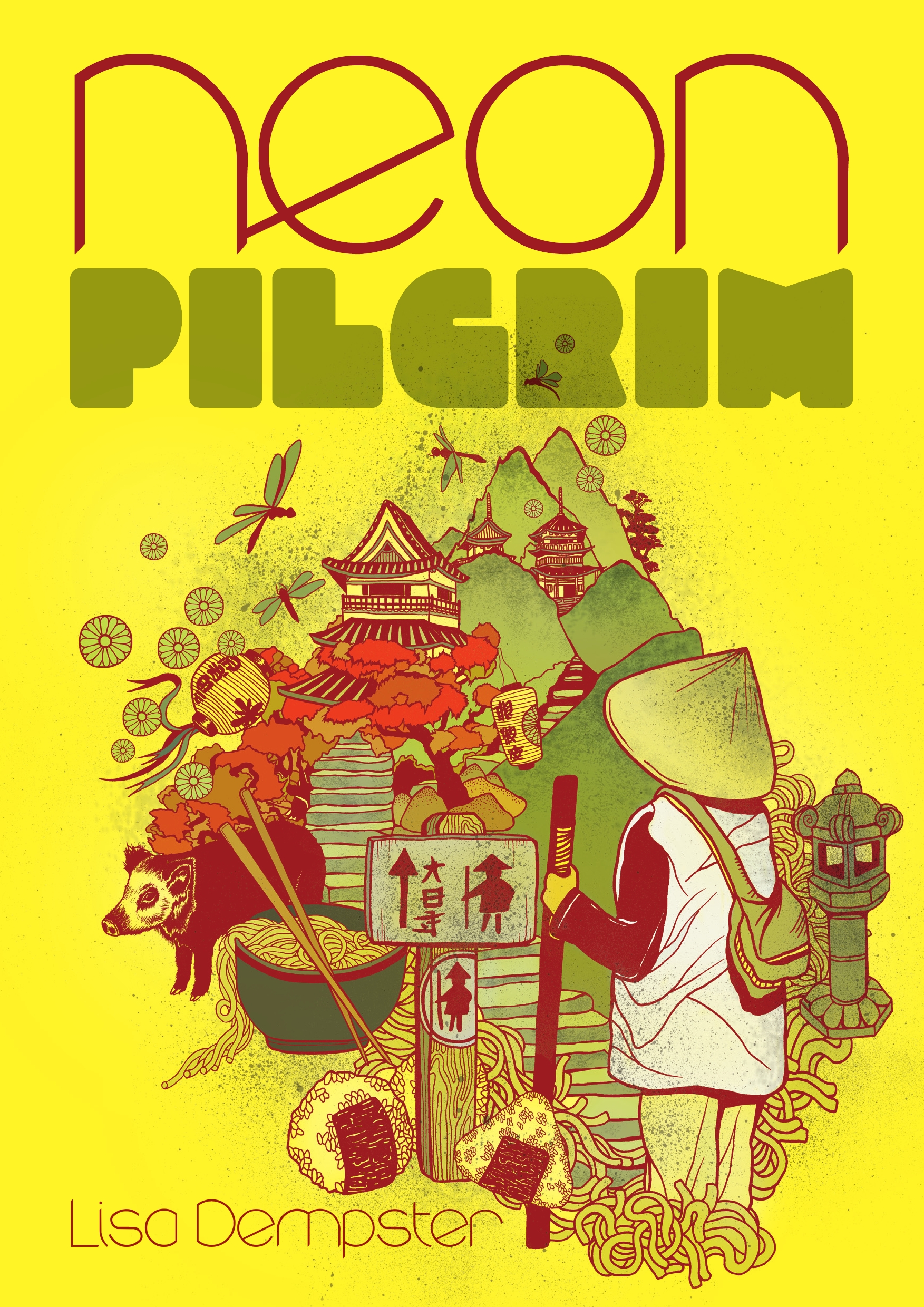
According to her own description of herself, Lisa Dempster was an overweight and depressed woman approaching thirty when she decided to walk the Shikoku pilgrimage route between eighty-eighty temples. I am currently an overweight and depressed woman who just turned thirty, and I have dreamed of visiting Shikoku ever since I read Kafka on the Shore as a college senior. Since I moved to the Midwest this past fall, I’ve been mostly confined to my car as the snow piles grow ever higher in the frigid air outside my windows. How lovely it would be, I keep thinking, to be able to walk the Shikoku pilgrimage. Failing that, how lovely it would be to read someone else’s account of traveling, exploring, and walking across a region known for its beautiful mountains and lush tropical beaches.

Neon Pilgrim is just such an account, but what I love about Dempster’s narration of her pilgrimage is that she is completely upfront about how difficult it is to complete the pilgrimage on foot, especially while doing nojuku, or sleeping out in the open. At the beginning of her journey, she is in almost constant pain. It’s summer, and it’s unbearably hot and humid. Her thighs are chafing, there are blisters on her feet, and her skin is breaking out in all sorts of embarrassing places. During the first two weeks of the pilgrimage, the physical strain causes her to throw up at least once a day. People that she meets along the road jovially tease her about how slow she is, and she does indeed move too slowly to have regular walking companions. When all she wants is to sit down in the air conditioning and have something to eat, she has trouble explaining what she means by “vegetarian.”

As Dempster passes through the mountains, she worries about snakes and inoshishi. As she walks along the side of roads and highways, she worries about the lack of shade and places to stop and rest. At one point, she has to deal with a (possibly good intentioned?) stalker who doesn’t understand that she doesn’t want to get in his car or go out to dinner with him. Temple offices keep strict hours, and the rudimentary lodgings they sometimes provide for pilgrims can fill up, so she worries about making good time and not getting lost as well. Although nothing truly frightening or terrible happens to her, Dempster makes it clear that walking all day every day without a guidebook, a smartphone, or any clearly defined itinerary is not as fun and spiritually liberating as one might imagine it to be. After all, sleeping under the stars isn’t as romantic as it’s cracked up to be, as illustrated by Dempster’s attempt to spend the night in a building housing a public restroom:

I turned my attention to the toilet. As promised, it was clean and new, and with lovely stones and polished wood. Two wings of toilets led off from a small undercover vestibule – ladies to the right, men to the left. The vestibule would be the best place to sleep; at least I wouldn’t actually be in the toilet. It was weird but ok. I already felt more secure here than I had back at the road station.

Putting my bag down, I went to use the facilities. Pushing the door to the cubicle open, I screamed. There was an enormous black spider on the wall! If there’s one thing I’m scared of, more than bears and snakes, even more than inoshishi, it’s spiders. Even thinking about them makes me shake. I know it’s wussy but fear is irrational like that.

The door slammed as I jumped back in fright, and the bang of the door sent the spider scurrying over it. I backed up some more. Hang on, that wasn’t the same spider. It was big and black, sure, but it was a decidedly different size. Everything suddenly came into sharp focus – like those stupid Magic Eye pictures – and I realized that the place was riddled with spiders. I counted seven of them. All big. All black. All waiting to suck my brains out of my nose while I slept.

Although Dempster doesn’t marginalize the difficulties of the pilgrimage, she doesn’t whine about them either. For the most part, Neon Pilgrim is an account of interesting experiences and unique interactions with cool people met along the way. When these experiences, interactions, and people are painful, ridiculous, or creepy, Dempster handles them with a light touch so that they become amusing to the reader. What her narration of her difficulties does is to move the story forward and make it compelling to the reader. Will she make it through the whole pilgrimage? Will she give up and go home? Is she going to be okay? How is she going to get out of whatever bizarre situation she’s currently found herself in?

Despite the author’s concerns over her state of mind and the physical hardships she experiences, her account of the Shikoku pilgrimage glitters with tiny gems of natural splendor, as in this description of her ascent to the sixtieth temple in the pilgrimage, Yokomineji:

Everything was green and mossy, glistening with moisture. It was very calm and the dark, cloudy atmosphere made me think again of the pilgrims who had gone before. It had an amazing kind of energy. There were many sets of steps, hewn into the mountain, or constructed from stone now smooth from millions of feet. The path was slippery and precarious and I picked my way up slowly and gingerly, stopping to catch my breath and gaze with amazement at the view around me.

Every now and then a little wooden bridge, strung together with rope, would cross over a mountain stream. They were the slipperiest bits of all, and yet I didn’t care that the weather was bad or the climb was an arduous three kilometers. I had fallen under the spell of the ancient mountain.

Another thing I appreciate about Neon Pilgrim is that it contains a minimum of editorializing about Japanese society. Sometimes tourists from other parts of Japan gawk and make strange comments about the gaijin, but the people who actually live along the pilgrimage route are mostly friendly and treat the author like a normal human being. The students partying on the beach and other pilgrims also treat her normally and offer her whatever food and alcohol they have at their disposal. Since Dempster can speak Japanese, the interactions she describes have nothing to do with “the Japanese character,” or any sort of related silliness, but are instead exchanges between individuals, some of whom are quite eccentric (one of my favorites is the charmingly filthy and half-blind old man who drives the author to the foot of the mountain path described in the previously quoted passage). Occasionally, however, Dempster will wander into an interesting cultural experience, such as when she arrives in Kochi right in the middle of the city’s famous Yosakoi festival:

I had, completely unwittingly, wandered into the Yosakoi matsuri, an annual dance festival that takes place during the height of summer, and a crazy one at that.

Dancers in the festival use a traditional Japanese instrument, the naruko. Known as ‘clackers’ to the rest of the world, the one function of the instrument is to make noise. Wood slaps noisily on wood, and with several thousand dancers clutching a naruko in each hand, the noise is deafening.

The teams, which can be as big as several hundred people, each have their own costumes and moves. Some teams go for traditional kimono and hairdos, others modern and funky. The dance teams weave through the long streets and shopping malls in town, dancing the whole way, each booming their own music, each clacking their naruko. It’s a riot of noise and color.

Like most Japanese festivals, for spectators the usual schedule is about six minutes of watching dancers followed by six hours of drinking. Kochi is known for its love of alcohol, and at festival time it’s fairly safe to say the whole city gets incredibly drunk.

Even if you can’t visit Shikoku in person, it’s an incredible experience to follow Dempster on her pilgrimage while sharing her defeats and triumphs. The chapters of Neon Pilgrim are short, generally around ten pages or so, which makes it easy to put down the book and pick it back up again whenever the spirit moves you. Because there’s no sort of introduction or afterword that provides a broader perspective on the author’s pilgrimage, I have no idea how she took down or edited her notes, but her narrative flows smoothly without any backtracking or inconsistencies. Although the reader can turn the process of reading Neon Pilgrim into a sort of daily practice, I personally found it difficult to stop reading the book – I always wanted to find out what lay around the next corner on the path to the next temple. The author’s good humor is infectious, and she’s a perfect companion for the journey.

Neon Pilgrim is published by Aduki Independent Press in Australia, and it’s almost impossible to get a physical copy of the book (trust me, I tried). A digital copy can be had for five USD from Smashwords, however, so it’s worth checking out. I read the mobi version of the book on my Kindle app, and it was beautifully formatted and functioned flawlessly.

The Night Parade of One Hundred Demons

The Night Parade

Title: The Night Parade of One Hundred Demons
Author: Matthew Meyer
Publication Year: 2012
Publisher: Amazon CreateSpace
Pages: 224

The Night Parade of One Hundred Demons, which began its life as a Kickstarter project, collects roughly four dozen entries on various yōkai, which are accompanied by lavish full-color illustrations. Both the pictures and the text are by Matthew Meyer, an artist heavily influenced by Japanese prints. Meyer has lived in a rural town in Fukui prefecture since 2007, and, as he explains on his Kickstarter page, he has been collecting and translating local folklore for years. There are a number of other books on yōkai available for digital download (such as Matt Alt and Hiroko Yoda’s fantastic Yokai Attack!), but what The Night Parade does especially well is to add regional color and variety to Japanese legends of supernatural creatures that may already be familiar to many Japanophiles.

Compiled in such a way as to resemble an illustrated bestiary, The Night Parade is divided into several sections, which include “In the Wilds,” “Out on the Town,” and “In the House.” The book includes entries on yōkai that appear frequently in popular media, such as the kappa, the kirin, the kitsune, the tanuki, and the yuki onna, as well as many lesser-known creatures, such as the bake kujira (an enormous ghostly whale), the jorōgumo (a man-eating spider), and the nuppepō (a flabby, stinky lump of flesh that lives in temple graveyards), and the nopperabō (who looks and acts like an ordinary person but has no face). Each entry contains information on the diet and appearance of these yōkai, their behavior, their interactions with human beings, and the various forms they may take, as well variations on and translations of their names.

Many of the entries are also peppered with interesting information about the historical and cultural contexts of these creatures. For example, the entry on the takanyūnō, or “tall priest,” contains a special section on why suffixes relating to Buddhism and Buddhist priests are so common in the names of yōkai. (Apparently, it’s not so much a connection to religion as it is a certain wariness regarding traveling priests, or at least strangers dressed as traveling priests.) The entry on the kerakera onna, a gigantic “cackling woman” who haunts the alleyways of red light districts and hounds men into their graves with her incessant laughter, alludes to the tendency in Japanese folklore to grant great power to long-lived things, whether they be cats (which become neko mata) or eating utensils (which become tsukumogami), and surmises that prostitutes who managed to live into middle age may well have become yōkai, an interesting conjecture that leaves the mind to wonder about what such a bit of folklore might correspond to in a less numinous context.

Meyer has published his work through Amazon’s CreateSpace program, which offers both print and digital versions of the collection. I can’t offer an opinion of the physical copy of The Night Parade, but the digital edition is beautifully formatted, and its images are of extremely high quality. Although the book is relatively kid-friendly, it includes frank (although far from explicit) references to prostitution and human sexuality. Most of the images are stylized as colorful and cute or understated and eerie, but a few (such as the illustration of the ubume, a spirit of a woman who has died during childbirth) may be too intense for younger readers. My honorary nieces and nephews have been delighted by pictures like the illustration of the onryō, a vengeful ghost who is depicted as a pale shrieking woman bleeding from her eyes, but discretion might be advised for more sensitive children.

Meyer has recently launched a successful Kickstarter project for a second collection, titled The Hour of Meeting Evil Spirits, so expect another excellent illustrated bestiary from him soon!

Matthew Meyer - Tanuki

Yurei Attack!

Yurei Attack!

Title: Yurei Attack! The Japanese Ghost Survival Guide
Authors: Hiroko Yoda and Matt Alt
Illustrations: Shinkichi (Satoko Tanaka)
Page Design: Andrew Lee
Year Published: 2012
Publisher: Tuttle

This is the best book ever, and I love it.

Hiroko Yoda and Matt Alt, the authors of Yokai Attack!, have come out with another fantastic field guide to the supernatural phenomena of Japan. Everything about this book, from the selection of topics to the authors’ sense of humor to the colorful and creepy style of the illustrations, is wonderful, and the physical book itself is a work of art.

Like Yokai Attack!, Yurei Attack! is divided into four-page entries on famous ghosts, ghost stories, and haunted places. Each of these entries contains not just the legends associated with the ghost in question but also its real-world historical background, its method of attack, and a short section on “how to survive” (which is always appreciated). The second page of each entry is a full-page illustration, and photographs and woodblock prints are scattered across the rest of the pages. The entire book is printed in high-contrast full color, so the images and page layout are just as entertaining as the text.

The ghosts indexed include fictional characters from literature and kabuki plays, real historical figures, and legends that have arisen from historical events. Lady Rokujō from The Tale of Genji is catalogued (that’s her on the cover), as is Oiwa from the Yotsuya Kaidan. The outcast Heian noble Sugawara no Michizane, the crucified peasant Sakura Sōgorō, and the fallen soldiers of Saigō Takamori’s counter-revolutionary group make an appearance. You’ll visit haunted hotel rooms, weeping rocks, castle ruins, tunnels and waterfalls with terrible histories, and the “suicide forest” of Aokigahara. The range of material on offer in Yurei Attack!, which includes famous ghosts and hauntings as well as lesser known spirits and folklore, is incredible, and the authors treat all of their subjects with equal thoroughness and attention. It was immensely gratifying to me personally to learn the full stories behind the vague urban legends I had heard regarding places such as the Sunshine 60 building in Ikebukuro and the tiny shrine dedicated to Taira no Masakado in Tokyo’s Chiyoda ward.

I especially enjoyed “Chapter Five: Dangerous Games,” which deals with matters such as how to curse someone and how to summon ghosts. In this chapter, the reader can learn about Kokkuri-san (which sort of like an Ouija board), all the ways in which ghosts can manifest themselves in photographs, and how real estate agents deal with “houses with histories” (wake ari bukken or jiko bukken). Speaking of haunted houses, apparently agents are legally required to inform prospective buyers if something terrible has happened on the property. If, however, the house has been occupied – for however short a time – since the incident, they don’t have to say anything. Luckily there’s a website that can be consulted to make sure that the reduced price you’re being quoted for a property isn’t due to a ghost: Oshimaland. Good to know!

The opening of the book is really cool, as is its back matter. The five-page introduction is a well-organized discussion on yūrei that highlights trends without forcing any interpretation on the reader, and it’s followed by a seven-step guide to ascertaining if the strange ghostly presence in your life is indeed a yūrei. In the back of the book is a glossary of Japanese terms, a cool (and I mean really cool) photo collage of Japanese toys based on yūrei, a short section on the ofuda charms believed to be able to drive ghosts away, and a bibliography that is actually worth reading in its entirety. There’s also a short guide to the Japanese Buddhist hells, which are all lovingly illustrated.

I can’t exaggerate the awesomeness of the illustrations in Yurei Attack!. According to her short profile, the illustrator is an “active creator” of dōjinshi, or self-published comics. Shinkichi’s pictures do indeed have a sketchy, digitally colored feel, but this is not a bad thing by any means, and her slender-framed, angular chinned human (and not so human) figures are wonderfully expressive. What Shinkichi especially excels at is portraying all of the myriad calamities that can befall the human body. Blood, rotting flesh, missing teeth, emaciation, severed limbs, bloated skin, burn wounds, disfigurations, dangling umbilical cords, scalping, biting, rage, and extreme fear – Shinkichi does it all. The illustrations are generally more fun and dynamic than they are Stephen Gammell-style nightmare fuel, but they can occasionally be genuinely creepy. Shinkichi’s depiction of the frostbitten soldiers who died in a training exercise on Mount Hakkoda in Aomori prefecture in 1902 is particularly disturbing.

I can imagine small children being really upset by Shinkichi’s illustrations, but older children (such as myself) should find them morbidly delightful. I think kids would probably go nuts this book in general. The combination of colorful and imaginative imagery is perfect for a young reader, and the book eschews any serious discussion of adult topics such as sexuality and religion. The bound volume is fairly sturdy and can withstand hard usage (it is a field guide after all), so no worries on that end.

What I especially appreciated about Yurei Attack! is that asinine overgeneralizations about Japan and Japanese people are completely absent. Nowhere in the book will the reader have to suffer through idiotic statements about how “the Japanese have always revered nature” or how “funeral practices are very important in Japan” or how “there is no differentiation between good and evil in Japan.” It’s kind of nice. If nothing else, Yurei Attack! proves that it is entirely possible to write a fun cultural study of Japan for a broad audience without relying on meaningless stereotypes.

Isora from Ugetsu Monogatari

Isora from Tales of Moonlight and Rain

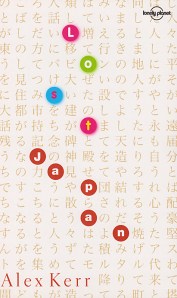
Lost Japan

Title: Lost Japan
Japanese Title: 美しき日本の残像 (Utsukushiki Nippon no zanzō)
Author: Alex Kerr
Translator: Bodhi Fishman
Publication Year: 1996 (America); 1993 (Japan)
Publisher: Lonely Planet
Pages: 269

If you’re thinking about reading this book because you’re interested in Japan, I am sorry to inform you that Alex Kerr doesn’t like you. He just doesn’t think you’re very smart:

I will surely be criticized for making broad generalizations about the nature of Japanologists and Sinologists – but I can’t resist. Lovers of China are thinkers; lovers of Japan, sensuous. People drawn to China are restless, adventurous types, with critical minds. They have to be, because Chinese society is capricious, changing from one instant to the next, and Chinese conversation is fast moving and pointed. You can hardly relax for an instant: no matter how fascinating it is, China will never allow you to sit back and think, “All is perfect.” Japan, on the other hand, with its social patterns designed to cocoon everyone and everything from harsh reality, is a much more comfortable country to live in. Well-established rhythms and politeness shield you from most unpleasantness. Japan can be a kind of ‘lotus land,’ where one floats blissfully away on the placid surface of things. […] Since World War II, Japan has had fifty years of uninterrupted peace, during which time the concrete of its social systems has set hard and fast. It has become a land of social stasis, and the foreigners drawn to Japan tend to be those who find comfort in this. (106, 107)

A Rhodes scholar friend of Kerr’s from Australia studying China, for instance, had the opportunity to become involved in the 1989 Tienanmen [sic] Square incident. What a hero! There is nothing more exciting than politically motivated massacres. If only they had more of those in Japan, amirite? Japan is such a boring place. All they have there are earthquakes, terrorist attacks, and nonviolent political upheaval, not to mention a dynamic feminist movement that really began to gather momentum in the years following an unprecedented economic downturn. Japan is home to a conformist society, where everyone is unbearably polite, and there aren’t any youth movements to capture to attention of intellectuals who have picked on the connections between Japanese society and their own.

Perhaps I’m being too critical. Lost Japan doesn’t have end notes or a bibliography, and the book works much better as a travelogue than as a serious study of Japan. Unlike many other “foreigner in Japan” books that came out of the nineties, however, Lost Japan is still in print and still referenced and recommended within communities of English-speaking people visiting and living in Japan.

As should be apparent from the passage I quoted above, Kerr is a person with strong opinions. As Kerr himself readily admits, his opinions tend to be polarizing, but it is their controversial nature that make them so interesting and compelling. Unfortunately, these opinions also tend toward sensationalism. Kerr seems to firmly believe that Japan is hurdling along a downslope slope towards cultural disaster. In order to demonstrate what Japan is losing, Kerr offers examples of the beauty he himself has experienced. These descriptions are vivid and immersive. Kerr details natural beauty…

As anyone who has hiked through the mountain ranges of Shikoku and Kyushu will know, Japan’s mountains are a jungle of sorts. Wherever one looks, the humid, dense slopes are covered with ferns, moss and fallen leaves. Coming along the bend of an unpaved mountain road, I would suddenly have the illusion that I had traveled back hundreds of millions of years. It felt as though at any moment a pterodactyl might come flying out of the mist. (17-18)

…architectural and artistic beauty…

Even within tourist-clogged Nara Park there are places which possess […] religious appeal. Entering the Sangatsu-do Hall, next door to the Hall of the Great Buddha, you find a quiet room far removed from the flurry of people in the park. In this dim space, there towers a magnificent gilt statue of the Fukukensaku Kannon Buddha, surrounded by a mandala arrangement of statues of guardians, the Sun and the Moon, and other bodhisattvas. From the halo behind the Buddha’s head project gilded rays, gleaming in the darkness. Tourists come to Sangatsu-do talking and laughing, but they soon fall silent in the presence of Fukukensaku Kannon’s fearsome light. None of them, including myself, has the slightest idea what the significance of Fukukensaku Kannon is. It doesn’t matter – those beams of light are enough. (207)

…and more intangible types of cultural heritage:

Other villagers from Tsurui came one by one to look at the foreigner, and then pitched in to help with the renovation. A foreigner was rare enough, but a foreigner who was trying to repair an old thatch-roofed house was doubly bizarre. Old folk took an interest, and would come over with straw to teach me how to weave straw sandals. […] At night, Shokichu and his friends told ghost stories in the spooky light of the floor hearth. (35)

What Kerr seems to love more than describing beauty, however, is describing ugliness. There is the ugliness of Japanese cities in general…

There are innumerable detailed building codes, but the overall design of a building and its aesthetic relation to street and skyline are ignored; the result is careless, disjointed, ugly. (66)

…the ugliness of Japanese cities in particular…

I was once taken to see the new Yokohama residential district Kohoku New Town, and was amazed at the multitudes of enormous steel pylons and smaller utility poles clustered everywhere – a hellish web of power lines darkening the sky above one’s head. This is a site which is considered a model of urban development. (50)

…the ugliness of the Japanese countryside…

There is hardly a single object on the Kabuki stage recognizable to young people today. When stage chanters sing of fireflies or autumn maples, such things are now almost mythical objects in this land of vast cedar plantations. (67)

…and the ugliness of the Japanese people themselves…

Japan’s national problem is homogeneity. The school system teaches everyone to say and think the same thing, and the bureaucracies restrict the development of new media, such as cable TV, the information highway and even movie theaters. As a result, no matter where you go, from Hokkaido to Kyushu, all the houses look the same, the clothes look the same and people’s loves center around the same humdrum activities […] The passivity, the way in which [a department store counter saleswoman]’s shut out the outside world – it was a distinctive posture which I have seen in Japan so many times. Sensory deprivation? Passive silence? Fear of the world? I wish I could find the right words for it, but Japan is becoming a nation of people like this. (223)

…even though they know better:

I do not believe that the Japanese have completely lost the delicate sensibility of the Heian era. Somewhere, deep in their hearts, they know that Japan is becoming an ugly country. (51)

Sometimes I wondered whether Kerr really believed what he was saying, which seemed to be that Japan is an ugly country full of people who are either stupid or lazy. I wondered if it was really okay to say make generalizations like that about a country with a land area of more than 350,000 square kilometers and a population of more than 127,000,000 people. I also couldn’t help wondering what sort of person sees beauty only in very a small number of specific instances while seeing ugliness everywhere else.

It wasn’t just Kerr’s diatribes against ugliness that made me raise an eyebrow. For example:

Today, many Japanese would hardly know what the word yobai means, and it was a little short of miraculous that the custom still existed when I arrived in Iya. It was the subject of many a laughing conversation, and villagers slyly asked me now and then when I was going to start on my nocturnal adventures. At the time, yobai seemed to me just another local oddity, but later I discovered that there was more to it than I had thought. In the Heian period, the loves of the aristocrats immortalized in novels such as the Tale of Genji were modeled on the yobai pattern. (37)

Yobai, or “night crawling,” is when a young man breaks into a young woman’s bedroom late at night, often after a village festival (which usually involves alcohol), and ostensibly with the consent of the young woman’s parents. What an elegant, noble custom! It’s a shame that people don’t do this anymore. Let’s laugh about it, because there is nothing funnier than surprise sex! (Also, I think Kerr might be suggesting that marriage practices among the elite in an earlier historical period were modeled on a subset of rural customs from later historical periods, but this is excusable as everyone knows that history is like a big ball of wibbly-wobbly… timey-wimey… stuff.)

Also, sometimes Kerr says things that made me wonder if the Japan he’s talking about is some kind of bizarro-Japan from an alternate dimension. For example:

Standard Japanese, to the sorrow of [my younger cousins], has an almost complete lack of dirty words. (224)

The Japanese language has an almost complete lack of dirty words only if the words used to describe feces, effluvia, human genitalia, sexual acts, gay men, gay women, women in general, and displeasure at the behavior of others aren’t considered “dirty.” Seriously, there’s a whole book about this, and this book was written before cell phones and the internet became mainstream.

The finished pearl is a thing of great beauty – often, as in the case of the tea ceremony, more refined than the original – but the essential nature of the original is lost. This is why Japan, which has hundreds of thousands of Italian and Chinese restaurants, has almost no genuine Italian or Chinese food. (231)

I guess the huge historic Chinatowns in cities like Yokohama and Kobe don’t exist?

One can scour the history of Japan, however, without finding much in the way of articulated philosophy; to put it strongly, Japan is not a country of thinkers. (113)

Not only is this not true, it’s also not a very nice thing to say.

If nothing else, Alex Kerr is an extraordinarily entertaining writer, and his strong opinions certainly contribute to the entertainment value of his writing. If one can simply take what he says with a grain of salt and understand Lost Japan as a story the author is telling about Japan, then it’s easy to enjoy being swept up in his tales of adventure. Kerr has had no small number of unique experiences, and he can take his readers into worlds that they would not be able to enter without him. Bodhi Fishman’s translation is both eloquent and frank, and each of Kerr’s chapters is written so that disappointment with one aspect of Japan will be balanced out by wonder and amazement at another.

Kerr’s follow-up book to Lost Japan, Dogs and Demons, reprises many of the same themes but contains a great deal more factual information. The author’s bitter and rancorous tone is somewhat gentler in Lost Japan than it is in of Dogs and Demons, however, and the earlier book contains much less ranting on the topic of how all popular culture is worthless and offensive. In comparison, Lost Japan has aged much better than Dogs and Demons, and its balance of adulation, criticism, colorful descriptions, and strong opinions make it an enjoyable light read more than ten years after its first publication in English.

Still, the book is far from unproblematic, and the reader is encouraged to maintain an attitude as critical of Kerr as Kerr’s own attitude is critical of Japan.

I’d like to end this review with a picture that I took while waiting for the bus one morning this past April just outside of the center of town in Kyoto, which Kerr describes as one of the ugliest cities in Japan. Is it really ugly? It’s a truism that beauty is in the eye of the beholder, so it’s ultimately up the reader to decide for him or herself.