From Impressionism to Anime

From Impressionism to Anime

Title: From Impressionism to Anime: Japan as Fantasy and Fan Cult in the Mind of the West
Author: Susan Napier
Publication Year: 2007
Publisher: Palgrave
Pages: 243

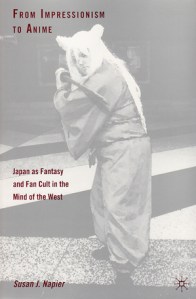
Let me start off by listing the obvious flaws of this book. First of all, the cover. It’s terrible. Whose idiot idea was it to take a crappy photo of crappy cosplay, run it through the “Impressionism” filter in Photoshop, and then put it on the cover of a book? According to the back cover, this monstrosity is the work of “Scribe Inc.” Shame on you, Scribe Inc., and shame on you, Palgrave, for letting them get away with it! Second of all, in a book primarily concerned with visual culture, there are surprisingly few illustrations. To be precise, there are ten, and only four of them are in color. This I am going to blame on the author, whose 2005 work Anime from Akira to Howl’s Moving Castle is also surprisingly under-illustrated (while other Palgrave scholarly publications have no shortage of well placed, high-quality greyscale images). Napier has no excuse for this, especially since the cosplay culture she details so lovingly is all about getting pictures of itself published. Third, Napier’s scope is very broad, but her treatment of her many topics is, perhaps unsurprisingly, shallow. I did not find this to be the case with Anime (despite many critical accusations to the contrary), but I’m disappointed with what I found to be the lack of sustained intellectual rigor in Impressionism.

Now that that’s out of the way, let me be something of a fangirl for a second and say that I love all of Napier’s work, Impressionism included. Napier always manages to choose the most fascinating things to write about, and she always does an excellent job of explaining why her chosen subject matter is interesting and important. Her analysis is apt, penetrating, and lucid, and her work does not suffer from any of the structural weakness found in a great deal of recent academic work – you always know what she’s trying to say, and her way of saying it is both logical and artistic. Although her theoretical background is rock solid (her bibliographies are a bit intimidating), she doesn’t blithely toss around big names and critical jargon. Also, you can tell that, even though she occasionally betrays a bit of light-hearted sarcasm, she has nothing but respect for the topics of her studies.

This attitude of respect is very important for a work like Impressionism, which deals with some strange and, depending on one’s perspective, almost contemptible subject matter. The book is divided into eight chapters (not including the Introduction and Conclusion). The first four chapters each take up a different aspect of the West’s fascination with Japan during the last two centuries. The first chapter covers turn-of-the-century Impressionists like Claude Monet and Vincent Van Gogh, who revolutionized the fine arts with a little inspiration from Japan, or at least the “Japan” of their imaginations. The second chapter goes into famous inter-war Japan enthusiasts such as Lafcadio Hearn, Arthur Waley, and Frank Lloyd Wright. The third chapter follows the antics of post-war American writers like Jack Kerouac, Gary Snyder, Michel Crichton, and William Gibson, and the fourth chapter is all about how Western men perceive and interact with Japanese women in works like Madame Butterfly and Memoirs of a Geisha. The last four chapters, which I consider to be the true raison d’être of this book, deal with American anime fandom and all its various manifestations, from anime conventions to cosplay to slash fan fiction. Through all of this, Napier attempts to uncover the source of the West’s long fascination with Japan, all the while making astute references to the global political and economic climates during which this fascination has become manifest.

The first four chapters, while interesting, are, as I said earlier, somewhat shallow. Each topic that Napier covers in these chapters has been written about extensively by other scholars, a fact which she openly acknowledges. Her originality here lies in the fact that she documents what she sees as a trend, although she is cautious about saying that the various moments in the history of what I am going to call “Japan fandom” are directly related. The main point of interest for readers is the work that Napier has done on post-1980 American anime fandom, which is the culmination of many years of interviews and surveys. Mainly speaking through the voices of the fans she has contacted, Napier attempts to explain the appeal of contemporary Japanese popular culture to Americans, often in contrast to American popular culture. Although she offers no strong conclusion, the variety of insights Napier offers are invaluable.

My one real criticism of this study is that, although Napier hints at exposing the power relations underlying fan culture, she never really follows through. In other words, she is mainly concerned with the relation of fans to the world outside fandom (what she calls “the Muggle world”) and doesn’t delve into the hierarchies of power within the in-group of fandom itself. For example, I would have found an analysis of the term “weeaboo” (an American who loves anime so much that he or she wants to become Japanese) to be a pertinent addition to her discussion. Instead, Napier makes American anime fandom seem like something of a utopia; although she mentions the darker side of fandom by quoting scholars who bring up the concept of “fan pathology,” she never directly acknowledges that such a thing might actually exist in her own object of study.

Otherwise, I found From Impressionism to Anime to be a very satisfying read. It’s an excellent cultural study and could double as a perfect introduction to modern and contemporary Japanese history for someone considering pursuing the subject as an undergraduate – or simply as an intelligent, interested individual. Don’t let the cover fool you. This is actually a book you want to read!

The Flash of Capital

The Flash of Capital

Title: The Flash of Capital: Film and Geopolitics in Japan
Author: Eric Cazdyn
Publication Year: 2002
Publisher: Duke University Press
Pages: 316

For all of the back-breaking piles of academic books I read, I sure don’t get around to reviewing many. I suppose this is because I spend so much of what passes for my real life writing about them that I don’t have many nice things to say at the end of the day. The Flash of Capital is an exception. Perhaps I feel this way because I was inspired to read every word of the book – and Cazdyn’s book is not easy to read. Interesting and thought-provoking, yes, original, yes, lots of fun, yes, but not easy to read. If you are at all interested in Japan, film, or even Japanese film, though, it’s worth the trouble.

Cazdyn’s basic thesis is that the major trends of Japanese film correspond with the major developments of capitalism in Japan, which is only natural, considering that both movies and modern capitalism came to Japan at roughly the same time. The first five of the six chapters explore these intersections by examining certain key questions of film studies. For example, the second chapter is concerned with film historiography and how the discourses surrounding the Japanese state have shaped the way that critics and scholars have talked and written about film. The fourth chapter discusses how economic development, especially as it has engendered interest in socialism, has affected the agency of the actor. It also touches on the politically utopian and dystopian implications of the professionalism or amateur status of the actor. And the fifth chapter, which focuses on pornography, completely changed the way I think about the meaning of visual representation in film. The sixth chapter takes the various concepts presented in these five chapters and uses them to give new, interesting, and politically significant readings to the canonical films of canonical directors, like Kurosawa Akira’s Rashōmon, Ozu Yasujirō’s Late Spring, and Oshii Mamoru’s Ghost in the Shell.

My favorite part of the book, however, was not the theoretical acrobatics or the micro-analysis of non-mainstream films and directors, but rather the information regarding the cultural context surrounding each topic. For example, the first chapter, which concerns the relationship between actors, spectators, and the medium of film, begins with a discussion of kabuki, which is linked to a discussion of the wanted posters for the members of the Aum Shinri-kyō cult (responsible for the 1995 Tokyo subway sarin gas attacks). And the discussion of the pornography industry in Japan in the fifth chapter is beyond fascinating.

Unfortunately, the valuable ideas and information presented by Cazdyn occasionally become mired in the language of post-structuralist theory. Some of his sentences derailed me for days at a time. I will give an example:

The problem, instead, lies in the way Iwasaki works through the problematics, which ultimately betrays (the dialectical implications of) his work’s title and resembles a teleological history more than a relational one, with the telos being the birth of the proletarian film or even a later moment of actually existing socialism.

Excuse me, what? I’m feeling a little stupid and uneducated here. Also, as you might be able to tell from the above passage, Cazdyn is a bit of a Marxist. Although he vehemently denies such an affiliation, his ideology comes on fairly strong at points, such as at the close of the fourth chapter:

What Ogawa’s Sundial Carved by a Thousand Years of Notches (and the Yamagata Documentary Film Festival that it inspired) suggests is that new transnational networks must be built, no matter how unprofessional and utopian, in order to wrest at least some of the power away from the core of brokers whose monopoly on world power grows increasingly consolidated by the day.

To be honest, though, I find Cazdyn’s occasional ideological outbreaks inspiring. Even if they are sometimes uncomfortably Marxist, they make me think that Cazdyn is one of the good guys, and that simply by watching movies and thinking and writing we can make a difference and triumph over the evils of the world. Even if you’re not entirely convinced that this is true, it’s still fun to read The Flash of Capital solely for the thrill of encountering new ideas and tackling big intellectual concepts. And did I mention the awesome chapter on porn? In any case, this book isn’t for the casual reader, but if you think you’re interested, you definitely want to read this book. Go for it.

The Housekeeper and the Professor

The Housekeeper and the Professor

Title: The Housekeeper and the Professor
Japanese Title: 博士の愛した数式
Author: Ogawa Yōko (小川洋子)
Translator: Stephen Snyder
Publication Year: 2009 (America); 2003 (Japan)
Publisher: Picador
Pages: 180

Yay! I’m so happy! Finally, another Ogawa Yōko translation! Ogawa Yōko is one of the most interesting writers working in Japan right now, and her popularity only increases with each passing year. A recent search on Amazon.fr yielded more than a dozen translations of Ogawa’s work into French, and I understand that there are just as many translations of her books into German. I feel a little jealous, but, in any case, it’s better to have two books in English than none at all. Ogawa’s prose is hyper-intelligent yet subtle, and her narratives are very Raymond Carver: very simple at first glance, but oh what wonders lurk under the surface. As he did in The Diving Pool, veteran translator Stephen Snyder renders Ogawa’s Japanese into lucid yet multilayered English.

I consider The Housekeeper and the Professor to be close to the perfect “Japanese” novel. There is a bit of drama, but it is notable only for its understatement, and there is almost no plot to speak of; the novel simply ends when one of the main characters dies. The character development is what keeps the narrative going; and, in fact, it’s actually hard to put down. Quite simply, a single mother, who works as a housekeeper to make ends meet, is given an assignment by her agency to take care of a retired math professor, who lives in a small house by himself at the edge of his family’s property. The catch is that the professor’s short-term memory only lasts for eighty minutes. Despite this, the housekeeper manages to establish a good relationship with the professor, whose abbreviated life is enriched by his two great passions, math and baseball. When the professor learns that his housekeeper has a son who must wait for her return from work alone at home, he insists that she brings the boy with her to his house. The professor bonds with the housekeeper’s son over their mutual interest in baseball, and both the boy and his mother come to share an appreciation for numbers and equations with the professor. And that’s it, at least on the surface.

Under the surface, there are a significant number of interesting yet unstated relationships that will intrigue the reader, as well as an implicit question concerning the constantly developing meaning of family in postmodern society. The professor’s mini-lectures on prime numbers, amicable numbers, perfect numbers, and so on are actually quite interesting, as is the way that the old man uses number games to deal with the stress and awkwardness caused by his memory disorder. Just as the housekeeper and her son come to place a great value on these numbers and number games, the reader cannot help but start to see numbers as protagonists of sorts, or at least as oblique symbols concerning the relationship of human beings to one another. Really, like The Diving Pool before it, The Housekeeper and the Professor is good literature and a good read, and Picador has ensured that the paperback as a physical object is quite beautiful as well. I can’t recommend this book enough. Go get it! And, if you haven’t read The Diving Pool yet, go get that one, too!

Kamikaze Girls

kamikaze-girls

Title: Kamikaze Girls
Japanese Title: 下妻物語
Author: Takemoto Novala (嶽本野ばら)
Translator: Akemi Wegmüller
Publication Year: 2008 (America); 2002 (Japan)
Publisher: Viz Media
Pages: 219

In his afterward to Kamikaze Girls, Takemoto Novala writes that “Lolita is a fusion of the spirit of punk rock with formal beauty that honors tradition. Lolitas value independence and beauty above all else. In Kamikaze Girls, the two girls are drawn to each other’s independent natures and eventually come to respect one another.” Such a lofty statement is belied by the colorful and overwhelmingly pink cover of the novel, as well as the fact that the “two girls” in question (the protagonists of the novel) are a stereotypically representative Sweet Lolita and a stereotypically representative Yanki, or juvenile motorcycle (or, as the case may be, scooter) gang member.

The novel is narrated by Momoko, who describes herself in this way: “A red felt mini-hat accented with rose-shaped burnout lace is perched on my hair, which is styled in a princess cut with long ringlets, and I have on frilly white over-the-knee socks. So aside from my shoes, which are Vivienne Westwood’s Rocking Horse Ballerinas and Lolita must-haves (they go with any Lolita outfit), I am clad head-to-toe in my darling Baby, the Stars Shine Bright.”

In other words, Momoko is a Lolita among Lolitas, and she peppers her story with all sorts of references to and explanations of Lolita culture. In fact, Momoko begins her engagingly chatty narrative with a pseudo-historical lecture on the Rococo era in France, which supposedly inspired Lolita fashion and its ideals. Despite the silliness of the premise, Momoko’s narrative style is one of the major attractions of the novel. An unreliable narrator par excellence, Momoko relates the often sordid and depressing details of her personal and family history in witty, toungue-in-cheek monologues that reflect teenage power fantasies (at least as I remember my own) to an amazing degree.

In any case, the aggressively anti-social Momoko manages to attract the attention of Ichigo, a similarly dysfunctional seventeen year old. Unlike Momoko, Ichigo was born to a fairly bourgeois family; but, upon encountering ijime (group bullying) in middle school, she fell into despair and was rescued by a female Yanki gang. Although Ichigo respects and admires the leader of this gang for both her toughness and her nurturing personality, she is drawn to Momoko despite the Lolita’s almost constant derision. When the Yanki leader announces her intention to “graduate” from the gang (she intends to get married), Ichigo wants to present her with a kamikaze coat embroidered by the legendary Yanki figure Emma, who can supposedly be found in the fashionable Daikanyama district of Tokyo. Emma doesn’t exist, unfortunately, but Momoko is quite skilled at embroidery herself, and the pair’s adventures in Tokyo have some unexpected outcomes for both of them.

Even though Nakashima Tetsuya’s 2004 film version of Kamikaze Girls was so ridiculous and oversaturated that it made my eyes bleed a little, I found that I honestly enjoyed Takemoto’s original novel. As I mentioned earlier, the informal, chatty, and at times almost essay-like narrative style is quite enjoyable, the dialog is quick and jazzy and well-translated, and the characterization is surprisingly deep and complex for a book with such a pink cover. I’m not quite sure what Takemoto’s novel says about gender performity, post-modern identity construction, or the historical moment in which it was written, but hey, it’s a really fun book with two awesome protagonists.

Gothic & Lolita Bible

gothic-lolita-bible

Title: Gothic & Lolita Bible
Editors: Jenna Winterburg and Michelle Nguyen
Publisher: Tokyopop
Publication Schedule: Quarterly
Pages: 128

This month has seen the publication of the fifth issue of the English edition of the famed Japanese “mook” (magazine-book) Gothic & Lolita Bible (ゴシック&ロリータバイブル). Since the theme of the Spring 2009 issue is “A Dreamy Gothic & Lolita Wedding,” and since I find the obsession with weddings somewhat troubling (blame my inner feminist), I will base this review on the Winter 2009 (fourth) issue of the Bible. The focus of this issue seems to be “badassery and cupcakes,” which provides more comfortable thematic material for me to work with.

So, what is the Gothic & Lolita Bible all about, anyway? Well, obviously, it’s about Gothic and Lolita fashion, but there is also information about visual kei singers and bands, as well as copious amounts of information concerning the Gothic Lolita lifestyle so vividly portrayed in contemporary Japanese fiction like Novala Takemoto’s novel Kamikaze Girls (下妻物語, published in translation by Viz Media). The English version of the Bible provided both translated material from the original Japanese mooks and incorporates new material of interest to Western (especially American) readers.

Because the English edition of the Bible just came into existence (the first issue was released in early 2008), the content tends to change from issue to issue, as features and formats still seem to be in a developmental stage. Each issue, however, will contain numerous fantasy-inspired photo shoots of both Japanese models and Western readers, a Fruits magazine-esque montage of Harajuku street fashion photos, and, of course, a detailed section featuring the season’s offerings from major Japanese Gothic Lolita fashion brands like Baby, the Stars Shine Bright, Angelic Pretty, Innocent World, h.NAOTO, Black Peace Now, and Atelier Boz. Also, like the Japanese version, each issue contains patterns and instructions for do-it-yourself pieces (mainly accessories). Other articles may feature interviews with American Gothic Lolita designers, information on American and Japanese artists specializing in Gothic Lolita art, and reviews of fancy cupcakes that would presumably complement a Gothic Lolita tea party.

Personally, my favorite features are the “Letters from Our Readers” section, which includes, for example, poetry and reader-submitted art of surprisingly high quality, and the occasional fiction and essays that make it into the magazine, such as Arika Takarano’s manifesto titled “Oh Maiden, Advance with a Sword and a Rose,” which encourages young ladies to follow their hearts and their dreams regardless of the social pressures they might face. Along these lines, the reader letters published by the mook tend to deal with issues of participating in the Gothic Lolita culture even though you’re too old, too fat (by Japanese sizing standards), or live in the middle of nowhere. If nothing else, the Gothic & Lolita Bible gives its readers a sense of community, regardless of whether they own a stitch of the clothing or not.

Does this sound corny? You bet it’s corny. The whole mook is corny, actually. If you’ve already made up your mind that Gothic and Lolita culture is the most silly, superficial thing you’ve ever had the misfortune to encounter, the Gothic & Lolita Bible will not convince you otherwise. If you’re even the slightest bit curious about Gothic Lolita, however, I would recommend picking up a copy of this mook. It’s a gorgeous publication and well worth the $20 price tag.

Anime Explosion!

anime-explosion

Title: Anime Explosion! The What? Why? & Wow! of Japanese Animation
Author: Patrick Drazen
Publication Year: 2003
Publisher: Stone Bridge Press
Pages: 369

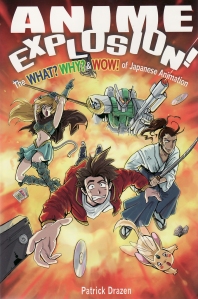
When I got Anime Explosion! in the mail from Amazon, I was so excited. I had seen it on a friend’s bookshelf, and, silly cover illustration aside, it seemed like a fairly serious reference source on anime. Instead of merely listing one anime series after another, its chapters are structured around broad themes (portrayals of nature, anti-war messages, etc.), with chapters devoted to single works or directors at the end of the book. The chapters are filled with well-selected and well-formatted illustrations accompanied by captions that do not merely repeat what is in the text, and there are numerous footnotes, which are also well-formatted and easy to read. The bibliography at the end of the book references such serious scholarly works as Professor William LaFleur’s Liquid Life: Abortion and Buddhism in Japan as well as numerous creator interviews from the pages of the long defunct but still fondly remembered anime magazine Animerica. The book hits all the big bases, like Japanese folklore in anime, nudity in anime, the Pokémon phenomenon, Studio Ghibli, and even one of my personal favorite series, Revolutionary Girl Utena. What’s not to like?

The fact that Anime Explosion! is one of the more boring books I’ve ever read is not to like, actually. And you’ll have to believe me when I say that, during my six years in higher education, I have read some pretty boring books. During my two years in higher higher education, I have also read some pretty terrible student papers, and so I think I can put my finger on what I dislike about Anime Explosion! – it’s the plot summary. Pages and pages of it. All written in singularly uncreative and unevocative prose. Judging from the level of the language, I would say that, despite the occasional frank discussions of sex and sexuality, the target audience for this book is currently enrolled in middle school. The book also assumes that the reader knows nothing about Japan, which I suppose is fair; but, to those of us who have studied the country, the cultural clichés referenced over and over again come off as a little stale. There also isn’t much interpretation involved, and the little that does exist is tepid and sophomoric.

I hesitate to say this, as Drazen acknowledges this problem in both his introduction and his conclusion, but Anime Explosion! is also a bit dated. The individual works covered in the book are, for the most part, classics, and no amount of time is going to change that. In that sense, Drazen has done an excellent job of creating a reference work that will transcend the whims of an extremely capricious field. On the other hand, for having been published in 2003, this book feels like a relic from the mid-nineties. The internet? What is this strange thing? The Japanese bubble economy collapsed? Oh my god! Also, to me, a presumably serious scholar, many of the seventies and eighties era texts Drazen references (like Kitteridge Cherry’s Womansword: What Japanese Words Say About Women) can no longer be taken seriously. Also, for those fans curious about such recent phenomena as moe and hikikomori, there is nothing to be found.

All that being said, this is a solid book and may prove interesting to younger or more hard-core anime fans. And, to be fair, Drazen’s chapter on “Gay and Pseudo-Gay Themes in Anime” (which Drazen aptly titles “A Very Pure Thing”) is bold, insightful, and well ahead of its time. For those of us interested in how anime stereotypes came to be, chapters like “Shojodo: The Way of the Teenage Girl” are also useful. For older readers looking for thrills and entertainment, however, I would recommend an anime magazine like Otaku USA, which tends to function at a much higher level than Drazen’s well-meaning but regrettably prosaic reference work.

Moribito: Guardian of the Spirit

moribito

Title: Moribito: Guardian of the Spirit
Japanese Title: 精霊の守り人
Author: Uehashi Nahoko (上橋菜穂子)
Illustrations: Yuko Shimizu
Translator: Cathy Hirano
Publication Year: 2008 (America); 1996 (Japan)
Publisher: Arthur A. Levine
Pages: 260

To hold the book Moribito: Guardian of the Spirit in my hands is something of a nostalgic experience. This may be because the book is published by the Arthur A. Levine imprint of Scholastic, which is also responsible for the beautiful hardcover editions of the Harry Potter books. Like its famous cousins, Moribito features beautiful binding and page design, as well as detailed and dynamic illustrations provided by the chic young illustrator Yuko Shimizu. At the end of the book is a list of characters, a list of places and terms, and a short yet intriguing note from the author. In other words, in terms of sheer physical beauty and craftsmanship, Moribito is a pleasure to read.

Thankfully, the actual content of the book is just as appealing, both to younger and to more mature readers. There is action, adventure, magic, intrigue, and a touch of romance with none of the pandering to adult sensibilities of what children should and shouldn’t read that generally clouds the narratives of Western children’s literature. Equally refreshing is the change of scenery from a whimsical fantasyland inspired by Western folklore to a fictional yet strangely believable setting drawn from East Asian (especially Japanese) geography, history, and mythology. Gone are the kings and knights of Western fantasy; in their place are the emperors and scholars of Chinese, Korean, and Japanese tradition.

One of the reasons why I personally like this book, however, is its strong female characters. The plot revolves around a young prince, Chagum, who is being hunted by his father, the Emperor of New Yogo, because he carries the seed of the land’s destruction within him in the form of a magical egg from Nayugu, a realm of spirits that overlaps the physical realm of humans. In order to save her son, Chagum’s mother enlists the services of Balsa, a spear-wielding bodyguard with three decades of fighting and hardship behind her. Aiding Balsa in her mission to protect the prince and discover the secret of the egg are Torogai, an old woman well-versed in lore and shamanistic magic, and Tanda, an herbalist and childhood friend of Balsa who heals her when she is injured in battle. Both Torogai and Balsa are extraordinary characters who have lived extraordinary lives, and they easily qualify as two of the most realistic yet appealing female characters I have encountered in literature. They are nothing if not the equals of the men they encounter, and it is their actions that drive the majority of the plot. This is not to say that the male characters are downplayed in any way; rather, the female characters are not driven into any stereotypically “female” behavior vis-à-vis their male counterparts.

Uehashi’s Moribito is courageous not just in its portrayal of female characters but also in its questioning of the Japanese myths of national founding and the imperial system. Even more than fifty years after Hirohito proclaimed that the Japanese emperor is not a god but rather the symbol of a nation, a great deal of controversy still surrounds the imperial institution in Japan. By uncovering the surprising reality behind the myths surrounding the creation of New Yogo, Uehashi indirectly encourages a more critical attitude towards Japan’s own national mythology.

Both children looking for entertainment and adults looking for something more will heartily enjoy every page of this book. And, should the reader decide that he or she wants more, there is a 26 episode, beautiful anime series (released in America by Media Blasters) that follows the events of the novel, as well as several other volumes in the series, the second of which is slated to be released in an English translation on May 1, 2009.

Yokai Attack!

yokai-attack

Title: Yokai Attack! The Japanese Monster Survival Guide
Authors: Hiroko Yoda and Matt Alt
Illustrations: Morino Tatsuya (森野達弥) 
Publication Year: 2008 (America)
Publisher: Kodansha International
Pages: 191

I was absolutely certain that I was not going to like Yokai Attack. I had fully expected it to be a boring and poorly organized mishmash of folklore, citations, and half-baked interpretation along the lines of Borges’s The Book of Imaginary Beings. But the illustrations for this book were commissioned from Morino Tatsuya, a famous apprentice of Mizuki Shigeru (a manga-ka known especially for his manga Hakaba no Kitarō, which was adapted into multiple versions of the anime franchise Ge Ge Ge no Kitarō), so I decided to give it a shot, despite the silly cover.

To my immense surprise, I fell in love with Yokai Attack right from the book’s dedication to Lafcadio Hearn and his wife, which I found apt and also quite touching. It is clear from the first few paragraphs of the preface that the authors have done their research and are extremely knowledgeable on the subject matter. In fact, the “Yokai Resources” section at the end of the book, with its extensive bibliography, is almost worth the price of the entire book itself for people interested in yōkai. Alt and Yoda draw on wide range of materials, from Nō plays to Edo-period collections of woodblock prints to Yoda’s memories of the ghost stories she heard as a child, to bring together about thirty-five detailed, four-page profiles of Japanese ghosts and goblins.

The joy of this book is not its wealth of information, however, but rather the lucid and witty style in which the information is presented. Alt and Toda obviously enjoy what they do, and they make sure their readers are just as amused as they are. I don’t mean to say that Yokai Attack is condescending or facetious; rather, the writing is exuberant and filled with small, good-natured jokes that make it a pleasure to read. The format and organization of the book are reader-friendly as well, and the captions, panels, and side notes are enjoyable and not distracting.

Yokai Attack seems to be targeted towards an audience of all ages, with perhaps a movie rating of “PG.” Although instances of people (or other strange and inappropriate things) getting eaten are directly referenced with much glee, all mention of grotesque violence and sexual activity has been struck from the text. This is something of a shame, as I’m sure the writers ran across enough upsetting and salacious material to fill another couple of books, but I suppose it’s for the best, as it will allow this gem of a book to reach a wider audience.

The one qualm I have with Yokai has nothing to do with the authors but rather with the publisher. Kodansha International, true to its Japanese origins, is known for going out of its way to publish beautiful books. It seems that it has shortchanged Alt, Yoda, and especially Morino by being only half full-color. Although the first two pages of each yōkai entry are full-color, the second two are not, and the publisher seemed to give up around page 145, when the full-color pages end. Since this book is beautifully formatted and filled with interesting images, I can’t even begin to imagine why Kodansha would cut corners like this. I am so disappointed in them! Such a fine book deserves better.

Another thing that bothers me is that I have not seen this book in bookstores anywhere – not even Kinokuniya in New York. Kodansha should get on the PR train and market Yokai Attack as a manga, so that it will be shelved with manga and reach its target audience. I kind of want to go to Kodansha and throw something at them for being so willfully ignorant.

But three cheers for Hiroko Yoda and Matt Alt! Yokai Attack is a wonderful book, and I highly recommend it to anyone interested in Japan in any capacity whatsoever.

Chain Mail: Addicted to You

chain-mail

Title: Chain Mail: Addicted to You
Japanese Title: チェーン・メール―ずっとあなたとつながっていたい
Author: Ishizaki Hiroshi (石崎洋司)
Translator: Richard Kim
Publication Year: 2007 (America); 2003 (Japan)
Publisher: Tokyopop
Pages:209

Okay, I’ll admit it: when I came back home from Japan this past summer, I got really into Stephenie Meyer’s Twilight series. I know that many people like to complain about how the books are poorly written, misogynistic, heterocentric, painfully conservative, blah, blah, blah (I’m surprised no one has ever called them “phallogocentric” – that’s my personal favorite). First of all, the Twilight books are not poorly written; anyone who’s actually seen “poorly written” can attest to that fact. Second, I like to turn my feminist switch off when I read sparkly teenage vampire romance novels.

In any case, the Twilight series alerted me to the existence of the American genre of young adult fiction in a way that Harry Potter never did. (I think this is partially because I wouldn’t be caught dead reading “young adult fiction” when I was actually a “young adult,” but kids were a lot cooler seven or eight years ago.) I went to my local Borders and started doing market research, finding that, indeed, young adult fiction is a thriving genre, even though the vast majority of it is absolute crap. Perhaps the only good thing about the sudden popularity of the genre is that manga publishers like Tokyopop have started translating and publishing Japanese light novels.

A light novel is the Japanese equivalent of young adult fiction. These short, middle-school reading level books read like the plot of a manga, are often illustrated by noted manga artists, and are generally serialized like manga. Many popular anime, such as Slayers (スレイヤーズ) and The Melancholy of Haruhi Suzumiya (涼宮ハルヒの憂鬱) are adaptations of even more popular light novel series. Just as is the case with America, most light novels are absolute crap, and you will find a good selection of these less-than-stellar light novel series in Tokyopop’s catalog. Thankfully, the company has chosen to publish a few good light novels, even if they don’t have brand-name recognition.

One of my favorite offerings from Tokyopop is Ishizaki Hiroshi’s Chain Mail. Ishizaki has penned the text of several manga, most notably Miss Black Witch’s Halloween (黒魔女さんのハロウィーン), but he is also quite famous in Japan as an author of realistic fiction for young women. Although the plot of Chain Mail is somewhat far-fetched, this novel focuses on the development of its characters and their daily life as high school students in Tokyo.

What attracted me to this novel was its narrative structure. The narrative is divided between three narrators: Mai, Sawako, and Mayumi. These three girls, who may or may not know each other in real life, play a game in which they collaborate on a murder-mystery novel via posts made to an online message board on their cell phones (the internet is widely available on Japanese cell phones and has been for years). Thus, the narrative switches between the main story and the story that the girls are writing. Each girl is in charge of a certain character in the online story, and things get interesting when the events that happen to the characters in real life start to mirror the events they write into the story. There is never a hint of anything supernatural, but the blurred identities and real-life mysteries are quite uncanny.

Although only one of the three characters can be called sympathetic, I did feel a great deal of sympathy for each of them. Ishizaki doesn’t pull punches in his characterization and shows each of the three girls at her weakest moments. These three girls, who have been damaged by their families and the pressures forced on them at school, seek real friendship and connection through a cell phone game that had initially been created as a joke. Is the story pathetic? You bet. But it’s also touching and exciting, with lots of Nietzsche and Shibuya thrown in for good measure.

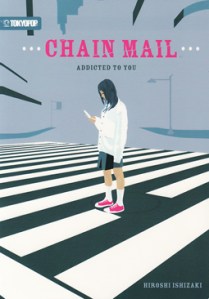
I would highly recommend Chain Mail to anyone interested in young adult literature, contemporary Japanese popular culture, or even Japanese literature in general. It’s a fascinating book, even if it doesn’t have pictures. Other fiction I would recommend from Tokyopop includes the Twelve Kingdoms series (by Ono Fuyumi), Kino’s Journey (by Sigsawa Keiichi) and anything written by Otsuichi, like Calling You or Goth. Tokyopop has recently taken down the “novels” section of its website, which makes me worry that the company doesn’t see a future for them, but I will go ahead and provide a link to their light novel catalog:

Tokyopop Catalog

Kafka on the Shore

kafka-on-the-shore

Title: Kafka on the Shore
Japanese Title: 海辺のカフカ
Author: Murakami Haruki (村上春樹)
Translator: Philip Gabriel
Publication Year: 2005 (America); 2002 (Japan)
Publisher: Vintage International
Pages: 467

Kafka on the Shore is another Murakami novel about disappearing women. That, and penises – or, to be faithful to Gabriel’s translation, cocks. The “Kafka” of the title, “the world’s toughest fifteen year old,” gets a handjob from his (maybe) sister, has sex with his (maybe) mother, and fondles himself (maybe) half a dozen times in between. There are a lot of pages in this book, but there are a lot of cocks, too. Be forewarned.

If you can get past all that, Kafka on the Shore is an utterly charming book. In 2005, when Gabriel’s bestselling translation of the book was released in America, Kafka on the Shore was given a place on the New York Times’s “Ten Best Books of the Year” list and received the World Fantasy Award. I can’t help but wonder how much of this attention was simply a manifestation of the guilt and embarrassment of the American publishing industry, which failed to recognize Murakami’s genius as displayed in such monumental novels as The Wind-Up Bird Chronicle (ねじまき鳥クロニクル, 1995); but, in any case, a lot of people found this book to be utterly charming.

The plot of the novel is long and convoluted, and I see no need to go into it. I would much rather talk about what exactly I found charming about the novel. What I enjoyed the most were the parallel plot lines. Every odd-numbered chapter focuses on the fifteen-year-old runaway Kafka, and every even-number chapter focuses on the sexagenarian Nakata, a likable man who has been rendered mentally deficient by a strange incident in his childhood. Although the two plot lines never meet in anything but the most indirect and metaphysical way, Murakami handles the structure just as skillfully as he did in his earlier novel Hard-Boiled Wonderland and the End of the World (世界の終りとハードボイルド・ワンダーランド, 1985), and I found the experience of following the two stories to be very enjoyable.

The overall atmosphere of the novel was also quite enjoyable. Over the course of his career, Murakami has become more skillful at depicting the small details of everyday life in contemporary Japan, and the attention to setting in Kafka on the Shore should dispel any lingering doubts as to Murakami’s status as a “literary” writer. Particularly enjoyable were the early Nakata chapters, in which the fuzzy-headed old man wanders around Tokyo’s Nakano Ward looking for a lost cat. Nakata apparently has the ability to talk to cats, so he is employed in his neighborhood as a finder of missing pets. Following the details of his life through his muddled but quaint way of looking at the world is, as I have said before, utterly charming. Kafka’s experiences at a small, private library in Takamatsu are rendered in loving detail and will probably send bibliophiles directly to the internet, where they will compare prices on plane tickets to Shikoku. As a side note, the Komura Library described in the novel actually exists and is apparently every bit as pleasant and charming as Murakami makes it out to be.

I hope that I have been able to convince you that this novel is “utterly charming.” Indeed, despite some bizarre cameo appearances by Colonel Sanders and Johnnie Walker, Kafka on the Shore is not as dark as many of Murakami’s other novels and actually manages to break out of the Murakami cycle of privileging the world inside one’s own head above living in the real world. Miss Saeki, the disappearing woman of Kafka on the Shore, is elegantly mysterious and achingly eloquent concerning love, life, childhood, and memory. Her final fate is one of the many mysteries the reader must solve on his or her own, as, like the other supernatural elements in the novel, Murakami never quite satisfactorily explains it. Thankfully, this is another one of the charming points of Kafka on the Shore.