Yurei Attack!

Yurei Attack!

Title: Yurei Attack! The Japanese Ghost Survival Guide
Authors: Hiroko Yoda and Matt Alt
Illustrations: Shinkichi (Satoko Tanaka)
Page Design: Andrew Lee
Year Published: 2012
Publisher: Tuttle

This is the best book ever, and I love it.

Hiroko Yoda and Matt Alt, the authors of Yokai Attack!, have come out with another fantastic field guide to the supernatural phenomena of Japan. Everything about this book, from the selection of topics to the authors’ sense of humor to the colorful and creepy style of the illustrations, is wonderful, and the physical book itself is a work of art.

Like Yokai Attack!, Yurei Attack! is divided into four-page entries on famous ghosts, ghost stories, and haunted places. Each of these entries contains not just the legends associated with the ghost in question but also its real-world historical background, its method of attack, and a short section on “how to survive” (which is always appreciated). The second page of each entry is a full-page illustration, and photographs and woodblock prints are scattered across the rest of the pages. The entire book is printed in high-contrast full color, so the images and page layout are just as entertaining as the text.

The ghosts indexed include fictional characters from literature and kabuki plays, real historical figures, and legends that have arisen from historical events. Lady Rokujō from The Tale of Genji is catalogued (that’s her on the cover), as is Oiwa from the Yotsuya Kaidan. The outcast Heian noble Sugawara no Michizane, the crucified peasant Sakura Sōgorō, and the fallen soldiers of Saigō Takamori’s counter-revolutionary group make an appearance. You’ll visit haunted hotel rooms, weeping rocks, castle ruins, tunnels and waterfalls with terrible histories, and the “suicide forest” of Aokigahara. The range of material on offer in Yurei Attack!, which includes famous ghosts and hauntings as well as lesser known spirits and folklore, is incredible, and the authors treat all of their subjects with equal thoroughness and attention. It was immensely gratifying to me personally to learn the full stories behind the vague urban legends I had heard regarding places such as the Sunshine 60 building in Ikebukuro and the tiny shrine dedicated to Taira no Masakado in Tokyo’s Chiyoda ward.

I especially enjoyed “Chapter Five: Dangerous Games,” which deals with matters such as how to curse someone and how to summon ghosts. In this chapter, the reader can learn about Kokkuri-san (which sort of like an Ouija board), all the ways in which ghosts can manifest themselves in photographs, and how real estate agents deal with “houses with histories” (wake ari bukken or jiko bukken). Speaking of haunted houses, apparently agents are legally required to inform prospective buyers if something terrible has happened on the property. If, however, the house has been occupied – for however short a time – since the incident, they don’t have to say anything. Luckily there’s a website that can be consulted to make sure that the reduced price you’re being quoted for a property isn’t due to a ghost: Oshimaland. Good to know!

The opening of the book is really cool, as is its back matter. The five-page introduction is a well-organized discussion on yūrei that highlights trends without forcing any interpretation on the reader, and it’s followed by a seven-step guide to ascertaining if the strange ghostly presence in your life is indeed a yūrei. In the back of the book is a glossary of Japanese terms, a cool (and I mean really cool) photo collage of Japanese toys based on yūrei, a short section on the ofuda charms believed to be able to drive ghosts away, and a bibliography that is actually worth reading in its entirety. There’s also a short guide to the Japanese Buddhist hells, which are all lovingly illustrated.

I can’t exaggerate the awesomeness of the illustrations in Yurei Attack!. According to her short profile, the illustrator is an “active creator” of dōjinshi, or self-published comics. Shinkichi’s pictures do indeed have a sketchy, digitally colored feel, but this is not a bad thing by any means, and her slender-framed, angular chinned human (and not so human) figures are wonderfully expressive. What Shinkichi especially excels at is portraying all of the myriad calamities that can befall the human body. Blood, rotting flesh, missing teeth, emaciation, severed limbs, bloated skin, burn wounds, disfigurations, dangling umbilical cords, scalping, biting, rage, and extreme fear – Shinkichi does it all. The illustrations are generally more fun and dynamic than they are Stephen Gammell-style nightmare fuel, but they can occasionally be genuinely creepy. Shinkichi’s depiction of the frostbitten soldiers who died in a training exercise on Mount Hakkoda in Aomori prefecture in 1902 is particularly disturbing.

I can imagine small children being really upset by Shinkichi’s illustrations, but older children (such as myself) should find them morbidly delightful. I think kids would probably go nuts this book in general. The combination of colorful and imaginative imagery is perfect for a young reader, and the book eschews any serious discussion of adult topics such as sexuality and religion. The bound volume is fairly sturdy and can withstand hard usage (it is a field guide after all), so no worries on that end.

What I especially appreciated about Yurei Attack! is that asinine overgeneralizations about Japan and Japanese people are completely absent. Nowhere in the book will the reader have to suffer through idiotic statements about how “the Japanese have always revered nature” or how “funeral practices are very important in Japan” or how “there is no differentiation between good and evil in Japan.” It’s kind of nice. If nothing else, Yurei Attack! proves that it is entirely possible to write a fun cultural study of Japan for a broad audience without relying on meaningless stereotypes.

Isora from Ugetsu Monogatari

Isora from Tales of Moonlight and Rain

Thermae Romae

Thermae Romae

Title: Thermae Romae
Japanese Title: テルマエ・ロマエ(Terumae Romae)
Artist: Yamazaki Mari (ヤマザキ マリ)
Translation: Stephen Paul
Publication Year: 2012 (America); 2009-2010 (Japan)
Publisher: Yen Press
Pages: 372

This manga is fantastic.

There’s a drawing of a naked man on the cover (you can see his penis under the removable acetate), and there’s a chapter about Roman and Japanese phallus worship. There’s also a chapter about the Bar Kokhba revolt that’s sympathetic to the Romans. The manga tacitly acknowledges Roman homosexuality (Emperor Hadrian is an important character) and Roman slavery (Emperor Hadrian thinks it’s funny that his pet crocodiles have bitten his slaves). All of this is in the background, however; and, if you can get around it, you will love this manga. It’s like reading a super-awesome issue of National Geographic, except with time travel.

Thermae Romae is about Lucius Modestus, a Roman architect living in the first half of the second century who specializes in designing baths and balnea, or bath houses. At the beginning of the story, he sees his own time as possessing an inferior bathing culture and wants to return Rome to the glory days of bathing, but his designs are considered old-fashioned and unmarketable. While taking a breather in a public bath house after being fired from his job at an architectural firm, Lucius slips and is sucked through a water vent into a sentō, or public bath, in twenty-first century Japan. Lucius thinks the Japanese are just slaves from one of the lands that Rome has conquered (he calls them “flat-faces”), and the Japanese think Lucius is just another clueless foreigner (they call him “gaijin-san”), and thankfully no gaping time-travel-related holes open in time and space. Lucius is taught the joys of contemporary Japanese baths; and, after being sucked through another hot water vent, he returns to Rome to share his own adaptations of certain aspects of this culture, which prove popular with his fellow romans.

Although the story gradually develops over the course of the manga, it remains largely episodic. In each chapter, Lucius encounters a problem, is transported to contemporary Japan, learns about Japanese bathing culture, returns to Rome, and implements his own versions of what he saw in Japan to the amazement and delight of everyone involved.

Through these episodes, the reader gets to visit various parts of the city of Rome, as well as locations such as Emperor Hadrian’s mansion in Tibur, Trastevere (a small city on the banks of the Tiber River), and the Roman province of Judea. Also on offer are the hot springs of the Tōhoku region, including monkey hot springs and therapeutic hot springs for convalescents. In his accidental journeys to Japan, Lucius also finds himself in the bathroom of a private residence, a corporate showroom for bathtubs, and even an aquarium that uses the water from a natural hot spring to create a habitat for crocodiles and banana trees.

If exploring contemporary Japan and ancient Rome is half the fun of this manga, the other half is watching Lucius in action. Lucius, earnest to a fault, is a classic straight man who is very serious about everything and responds to every situation he finds himself in with utmost sincerity. Although his upright personality isn’t directly exploited for laughs, it occasionally leads to humorous situations, such as when Lucius takes off his clothes in inappropriate places (for science!) in modern Japan. Mostly, however, Lucius’s personality allows him to act naturally in situations that would otherwise be extremely awkward or uncomfortable. He’s a sympathetic character, and his intelligence and curiosity allow the reader to see and experience more than would be possible if Lucius were a more cynical or self-conscious person.

At first glance there seems to be an undercurrent of “everything in Japan is the best thing ever” running throughout the manga, but I don’t think the artist ever takes the story seriously enough for her celebration of Japanese bath culture to come off as jingoistic. Through Lucius, who is by turns clueless and comically sincere, Yamazaki pokes fun at both ancient Rome and contemporary Japan. The Romans thought they were the most civilized people in the world, but their culture is capable of improvement through outside influences; and, while Japan has a fantastic bathing culture, it’s not flawless either. If Emperor Hadrian trying to recreate the scenery of the Egypt in his private estate is a bit silly, so too is a Japanese zoo that grows bananas. Whether it’s foreign live-in caregivers for elderly people in Japan or Lucius’s frustrated wife leaving him for another man after he runs off to spend three years in Judea, the manga always treats its subject with gentle good humor.

Yamazaki’s art isn’t hyper-detailed, but it is pleasantly realistic. Although she uses screen tone, most of the texture in her drawing, such as the roughness of cloth or the movement of water or the blush on freshly bathed skin, is conveyed by pen strokes. She slightly abbreviates both line and texture in about half of her panels to give the page a clean and open feel and to draw attention to the more visually dense panels. There are always several pages in each chapter that display nothing more than talking heads, but Yamazaki is capable of conveying such a wide and deep range of emotion with facial expressions and body language that these pages never become oppressive or boring.

Perhaps the most pleasant surprise for me in Thermae Romae were the two-page essays at the end of each chapter. These essays, which are always accompanied by a handful of captioned images, offer the reader a few more details about the cultural and historical elements of the preceding chapter. Yamazaki supplements factual information with her experiences travelling through Europe and Japan and anecdotes about famous figures of the ancient world, and her essays are entertaining without ever becoming too personal or pedantic.

Yen Press has done a beautiful job with Thermae Romae. Although the book is a bit too large to comfortably read in the bath, the extra size is worth the better print quality. It’s also worth mentioning that Stephen Paul’s translation is superb. When I read the manga in Japanese earlier this year, I wondered how certain aspects of the text (such as the Tōhoku dialect spoken by a handful of secondary characters) could be handled in translation, and I think the translator and editorial staff did a wonderful job; the language in Thermae Romae is beautifully smooth with no awkward translatorese or corny attempts to reproduce dialect.

Thermae Romae is fantastic. I’m so happy this manga finally made it to America.

The Lord of the Sands of Time

Title: The Lord of the Sands of Time
Japanese Title: 時砂の王 (Tokisuna no Ō)
Author: Ogawa Issui (小川一水)
Translator: Jim Hubbert
Publication Year: 2009 (United States); 2007 (Japan)
Publisher: Haikasoru
Pages: 196

Sometimes you get to the end of a book and wonder what just happened.

The Lord of the Sands of Time was like that for me.

Allow me to spoil the ending:

The weakness of the aliens attacking the earth is salt water.

There is also time travel involved. Androids with highly advanced artificial intelligence are sent back in time to fight seemingly mindless mechanical extraterrestrials who for some reason are bent on wiping out the human race, and it takes the best among the androids several sweeps of human history to figure out that sea water kills the aliens.

I’ll be the first to admit that premise of the novel is kind of silly, but it’s still an engrossing tale of adventure across alternate histories.

The Lord of the Sands of Time is about Orville, an android who was created on Triton, one of the last outposts of human civilization in the year 2598. Orville is one of many Messengers, who were engineered with the purpose of going back in time and saving the humanity from destruction at the metallic tentacles of an alien force from beyond the solar system, which is collectively referred to as ET.

The novel begins in Japan in the year 248, a destination at which Orville has arrived after many timestreams of trial and error. With the cooperation of Himiko, the ruler of the Kingdom of Wa, Orville tries once again to rally the human race against the ET, but the situation is dire. The ET have already overwhelmed the Asian mainland, and many of Orville’s Messenger comrades have fallen over the course of their long journey. Even worse, the ET are also capable of time travel; and, unlike the Messengers, they have the capacity to attack from space.

Every alternate chapter tells a segment of Orville’s backstory. The Messengers first came to Earth in the twenty-second century, but humanity was too busy bickering with itself to launch an effective resistance against the ET. After failing to rescue humanity in that timestream, the Messengers try again, transporting themselves to the eve of the second World War. Once again, however, humanity is too busy bickering with itself to fight the ET. The Messengers thus try again, and again, and again, their numbers decreasing as the ET use their own version of time travel to thwart them.

Although it first appears that the humans of Himiko’s timestream will also fall victim to internecine warfare and thus prove incapable of marshaling a united front against the ET, Himiko is strong willed and politically savvy enough to keep the peoples of the Japanese archipelago from killing themselves long enough to realize the full extent of the threat the ET pose. Even though Orville lends Himiko his superhuman strength and knowledge of technological advances, the outcome of this timestream seems bleak as well, and the fight will be a close one.

For the first half of the novel, tension builds steadily as Himiko deals with political machinations and Orville comes into his own as a character. The descriptions of Japan in the late Yayoi period are just as fascinating as the descriptions of the doomed yet utopian society on Triton, and Himiko’s growth as a ruler is just as compelling as Orville’s blooming love affair with Sayaka, a human woman in the Triton Defense Force, as he learns about what he is trying to protect.

Unfortunately, things begin to fall apart in the last quarter of the novel. As the narrative rushes toward its conclusion, world building and character development are neglected in favor of battle scenes. In the midst of this fighting, Orville trips and falls into bed with Himiko. This is not quite as epic as it could be. In two short paragraphs, Orville tells Himiko about Sayaka, Himiko calls Orville by his first name, Orville cries, and Himiko hugs him. There’s a page break, and then the narrative is back to talk of fighting and armies.

“From that night on, Miyo [Himiko’s personal name] and Orville shared the same bed” is about the extent of the romance between them, but Himiko undergoes a startling personality shift after she begins sleeping with Orville. She becomes a background character in her own story and spends most of her time panicked and helpless. The following “newsflash,” which has been making the rounds on Tumblr recently, states:

If a strong, independent female character falls in love, it does not automatically mean that she has lost her values or that she’s become less strong and independent, and does not necessarily change her story into an anti-feminist one. The idea that all women should fall in love and get married IS sexist, but a woman actually falling in love and getting married of her own free will is NOT sexist. Thank you and good day.

Sometimes, however, a female protagonist will fall love with a male protagonist and suddenly cease to be a protagonist at all, and that’s what happens in The Lord of the Sands of Time. Himiko is barely even fully conscious throughout the final quarter of the novel, and Orville is too busy kicking ass and taking names off camera to have any real input in the story. With the two main characters out of the picture, the novel gears up for its big reveals – what the motive of the ET is, how time travel works and doesn’t work, how the ET will be defeated – but these big reveals are rushed don’t really make any sense. The weakness of the aliens is water, the power of love plays a role in this discovery, and the aliens don’t have any real motive for attacking the earth. The time travel mechanics are especially disappointing. To be fair, time travel never makes sense, but it’s as if the author got around all the problems implicit in time travel by simply pretending that they don’t exist.

The last sixty pages of The Lord of the Sands of Time thus pass by in a flurry of tropes and battle scenes that might have worked better if they were filmed instead of written. In the novel’s defense, though, the buildup to these last sixty pages is strong enough to carry the reader all the way to the end. Sure, the love story between Orville and Himiko/Miyo never goes anywhere, and sure, this flaccid non-relationship diverts the narrative focus away from the relationships between Orville and the other Messengers (which are infinitely more interesting), but the reader is still curious to see how it all ends (and don’t worry, I didn’t spoil everything).

The Lord of the Sands of Time is not high art or epic romance, but it’s a fun novel, especially if you have a soft spot for science fiction. Jim Hubbert’s translation doesn’t call attention to itself and allows Ogawa’s prose to flow quickly and seamlessly. (In fact, I’m so impressed by the eighties American sci-fi feel of Hubbert’s translation that I’ve already ordered a copy of his other translation for Haikasoru, Hayashi Jyōji’s The Ouroboros Wave.) As much as I make fun of science fiction tropes, I can’t get enough of them, and The Lord of the Sands of Time fully satisfied my holiday craving for a sci-fi novel of manageable length to chill out with over a relaxed weekend.

Danchi junrei

Title: Danchi junrei (団地巡礼)
Author and Photographer: Ishimoto Kaoru (石本 馨)
Publication Year: 2008
Publisher: Futami Shobō
Pages: 176

I learned about this book while doing research on the manga Hot Gimmick, which is about teenage romance and social hierarchies in company-owned danchi housing. If a certain living arrangement exerts such a strong influence on people’s lives that it can determine patterns of everyday interaction, I wanted to know more about what these danchi actually look like.

Danchi are apartment complexes. Unlike the stand-alone manshion apartment buildings found everywhere in the urban centers of Japan, danchi are sprawling arrangements of buildings situated in more peripheral locations such as suburbs and commuter towns. As seen from the windows of passing trains, danchi are almost monstrous, and I’ve always counted myself lucky to not have to live in one. After reading Danchi junrei, though, I’m now jealous of the people who have had the experience of living in a danchi.

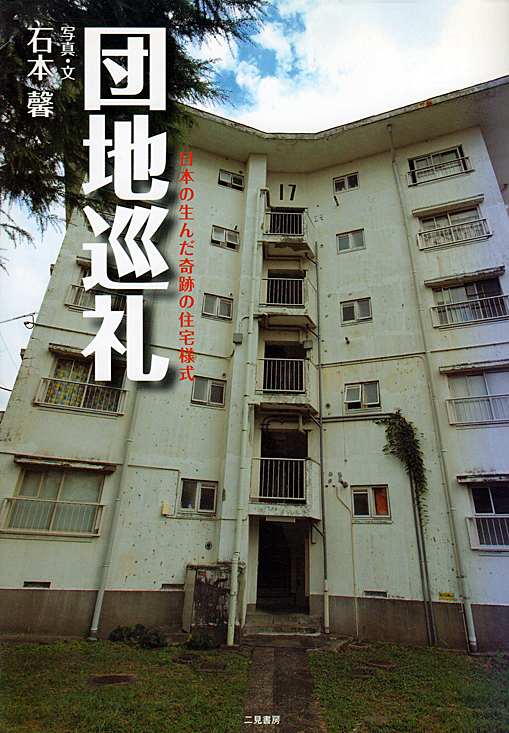
In Danchi junrei, or “danchi pilgrimage,” professional photographer Ishimoto Kaoru takes the reader along on his journeys into danchi complexes of various sizes and layouts. His pictures don’t beautify the buildings, but he does give the reader a sense of the charm and livability of the danchi he visits. Although the buildings themselves, which were constructed in the housing boom of another era (usually the late fifties), are often dilapidated, the backyards and balconies and inner courtyards and playgrounds of these danchi are filled with children, pets, greenery, and the evidence of the daily lives of the people who live in the complex, from hanging laundry to bicycles to discarded toys to graffiti.

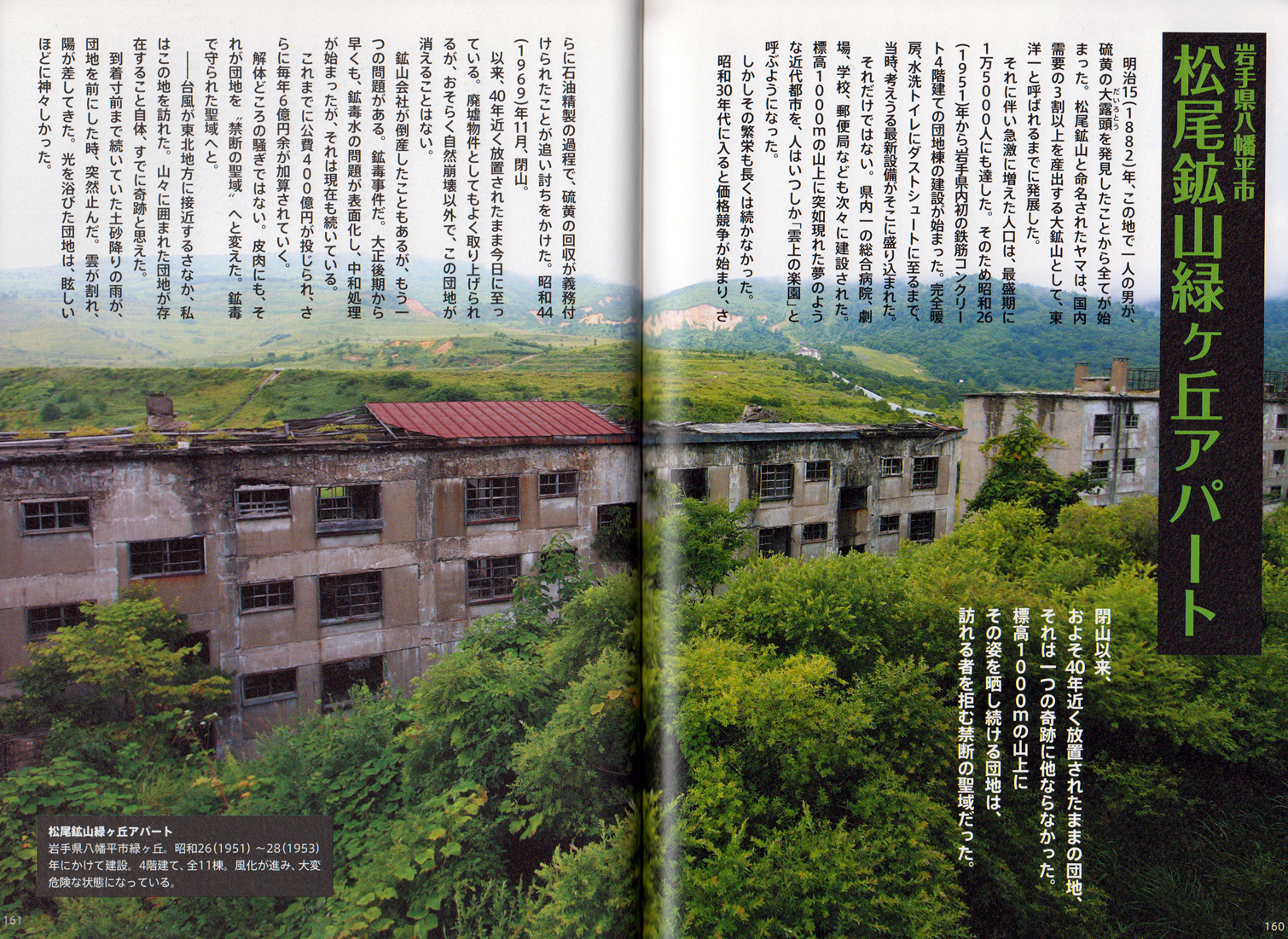
Of course, this is when there are people living in the danchi at all. Over the course of his pilgrimage, Ishimoto also visits complexes that are nearly abandoned, fully abandoned, or already demolished at the time of printing. Some of these danchi have historical significance, such as a structure in Daikanyama built in 1927 that was one of the first modern apartment complexes in Japan. Some of them, such as the “ghost danchi” in Meguro, are associated with urban legends and famous among people into haikyo, or the exploration of abandoned buildings. Although these derelict danchi are covered with rust and mold, they’re surprisingly well preserved, and one might think that people could still be living there were it not for the rampant, jungle-like plant growth that has filled the open spaces and started to encroach into the buildings themselves.

Ishimoto’s photographs are enhanced by his text. Each photograph is accompanied by an unobtrusive one-line description, and each set of photographs is introduced by a short paragraph of flavor text. What I really enjoyed reading, however, were the one-page descriptions of each danchi, which would usually include the history and occupancy status of the complex as well as any rumors that Ishimoto had picked up from fellow danchi enthusiasts or just people living in the neighborhood of the danchi in question. Ishimoto also describes his own experiences of walking around each danchi, which tend to be particularly interesting when the complex has been abandoned.

Ishimoto is an engaging writer, and the undoctored feel of his photography gives the reader a sense of proximity that wouldn’t be possible with more polished-looking set pieces. Danchi junrei is urban exploration at its finest, and I surprised myself by enjoying the book so much. I highly recommend it to people interested in Japanese cities and architecture. I might also recommend it to people interested in Japanese aesthetics, because you can’t get any more wabi-sabi than a deserted apartment complex slowly going to seed on the borders of Tokyo.

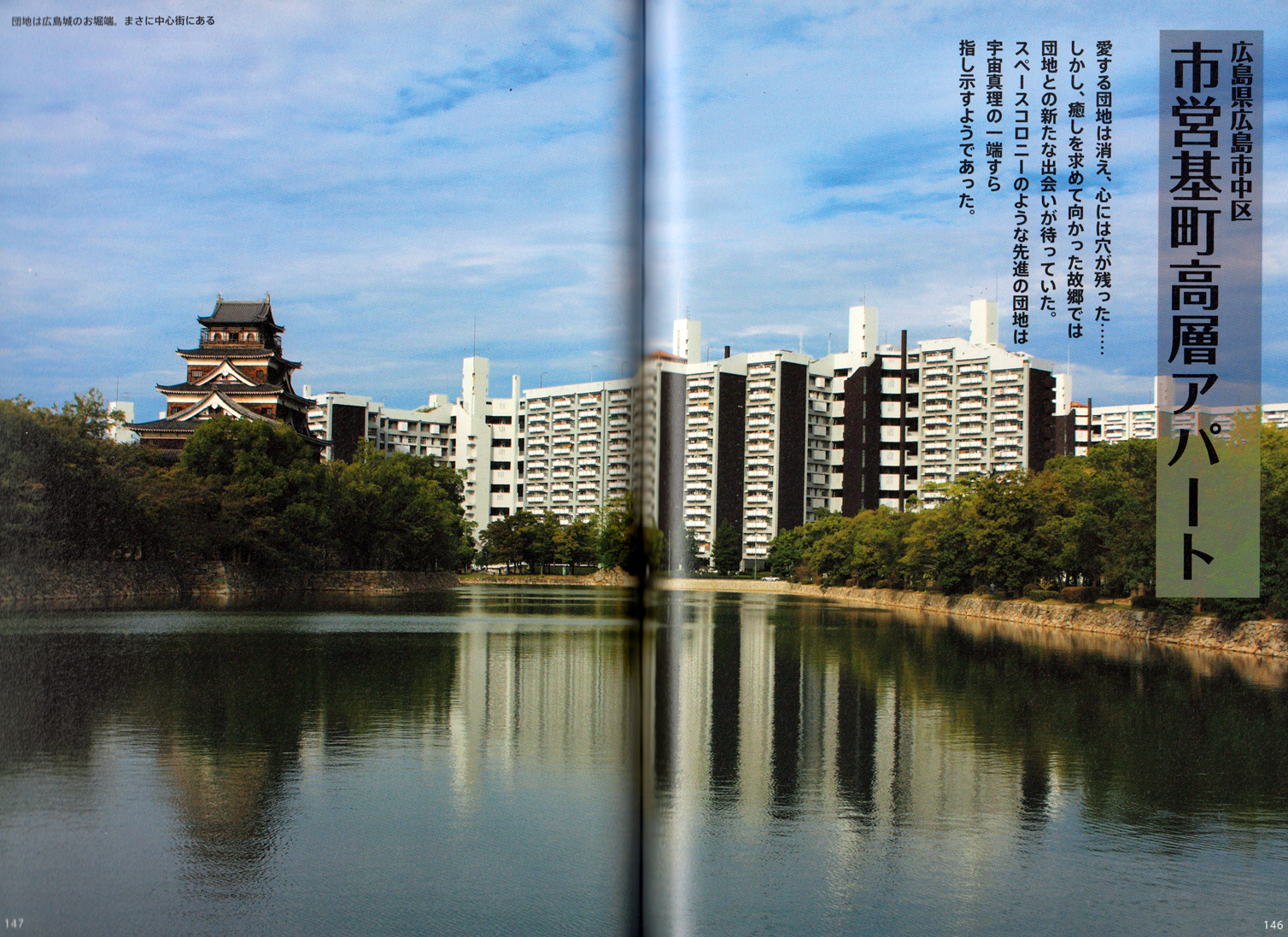
I should mention that Ishimoto ventures out of the greater Tokyo metropolitan area as well. Here are two examples from the end of the book…

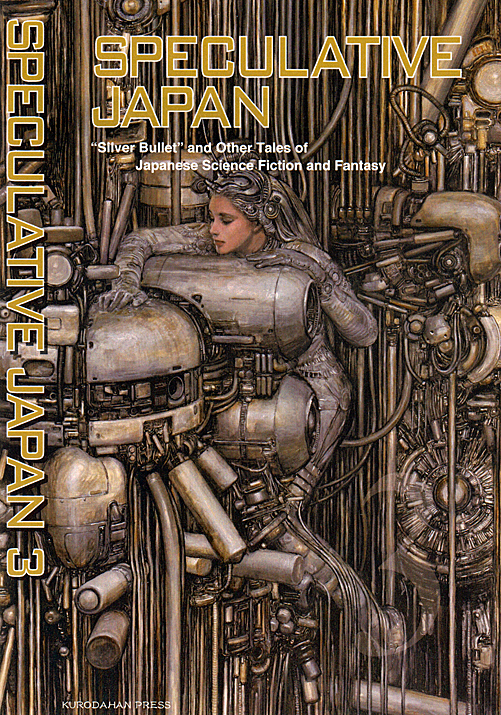
Speculative Japan 3

Title: Speculative Japan 3: “Silver Bullet” and Other Tales of Japanese Science Fiction and Fantasy
Editor: Edward Lipsett
Publication Year: 2012
Publisher: Kurodahan Press
Pages: 270

In my review of Speculative Japan 2, I said that I loved the anthology and couldn’t wait until the next installment was released. Speculative Japan 3 is finally here, and it’s everything I hoped it would be: a diverse collection of intelligent and beautifully translated short stories.

Speculative Japan 3 opens with several shorter pieces. These shorter pieces, which range in length from five to twenty pages, run the gamut from hard science fiction to magical realism to fantasy with a sci-fi twist to elegiac horror. Fujita Masaji’s “Angel French” is about the romance between two deep space robotic probes who began life as two college students hanging out in Mister Donut. “To the Blue Star,” written by Ogawa Issui (whose novels The Lord of the Sands of Time and The Next Continent are published in translation by Haikasoru), is another story about a self-aware technological entity. This entity, whose name is X, is a collective intelligence made up of a fleet of robotic star cruisers that represent the last remnants of human civilization. X tells its own story as it travels through the universe, watches civilizations rise and fall, fuses with other advanced life forms, and finally meets God. Matsuzaki Yuri’s “The Finish Line” is a thought experiment in the form of a short story and features a quiet but chilling scenario of the end of all life on earth. Kamon Nanami’s “A Piece of Butterfly’s Wing,” which is probably my favorite story in the collection, is a beautifully creepy ghost story in the literary tradition of writers like Kurahashi Yumiko and Kanai Mieko. Like the work of these masters of the poetics of horror, Kamon’s story is filled with beautiful, atmospheric imagery and resonant symbolism. It also features a delightfully disturbing twist at the end.

The longer stories of Speculative Japan 3 shine just as brightly as the shorter pieces. Even though none of these stories are more than thirty-five pages in length, they’re long enough to allow nuanced character development as they explore their premises in greater depth. Suga Hiroe’s “Five Sisters” is about a woman named Sonogawa Hanako who meets four clones of herself that have all been raised in different households. Each of these women has a different personality, and it’s fascinating to see how each has lived her life with the knowledge that she is a clone created to be harvested for organs. Ueda Sayuki’s “Fin and Claw” is a window into a future where humans have been genetically modified to be more adaptable to an environment covered in seawater. “Fin and Claw” is sort of like Jurassic Park with enormous sea creatures, and the moral of the story is the same. The last three pages of Ueda’s nightmarish vision are particularly terrifying in their visual imagery.

The title story, Yamada Masaki’s “Silver Bullet,” is a Japanese Cthulhu mythos story (more of which are collected in Kurodahan’s Night Voices, Night Journeys). In my experience, there are two main types of Cthulhu mythos stories: pseudo-Victorian and classy, and unabashedly pulpy. “Silver Bullet” belongs to the latter category. Its protagonist is sufficiently hard boiled, and the story contains more cheap sexuality than you can shake a flagella at. Still, all of the story’s thematic elements mesh together nicely, the ending is well earned, and the method used to summon Cthulhu is awesome (as is the instrument used to stop the summoner).

If there’s one story in the collection that feels out of place, it’s “Green Tea Ice Cream,” which is written by Mark Schultz. Perhaps it feels out of place because it’s merely good instead of excellent, but perhaps this is also because it bears the traces of awkwardness that often afflict stories written about Japan in English (a few of which have been recently collected in The Future Is Japanese). It’s difficult to pinpoint what the exact causes or sources of this awkwardness are, but it probably has to do with the writer feeling the need to explain certain “Japanese” things to the reader, as well as with the unstable balance between Japan as a real place and Japan as a fictional creation in these stories. “Green Tea Ice Cream” also revolves around a science fiction trope that I personally find silly and boring, namely, the unnecessary sexualization of a young woman who embodies fears concerning the changing relationship between human beings and technology. If the non-consensual impregnation and subsequent abduction of mindless machine girls is your cup of tea, though, knock yourself out. There are also some uncomfortably sexual father-daughter issues on display, if you’re into that sort of thing. That being said, the unsavory nature of the scenario and the characters of this story gives it greater depth and impact as a speculative commentary on contemporary bioethics.

To counter the sour taste of “Green Tea Ice Cream,” Mori Natsuko’s “It’s All Thanks to Saijō Hideaki” is made of pure sugar. To give a summary would be spoiling the fun, so let it suffice to say that this is one of those stories that you can’t believe you’re reading while you’re reading it and then can’t believe you’ve read once you’re finished. The experience of reading this story filled me with joy. If you’re a fan of yuri or bara stories (or brilliant parodies of such stories), then this is the story of the elegant, fabulous apocalypse you’ve been waiting for.

As in Speculative Japan 2, the translation is smooth and even throughout, with each story retaining the individual characteristics and quirks of its author. It’s a pleasure to read the stories in this anthology not just for the freshness and wonder of their ideas but also for the high quality of their writing and translation. As both an anthology of contemporary science fiction and an anthology of contemporary Japanese literature, Speculative Japan 3 succeeds brilliantly in collecting not the newest or the most popular, but rather the most interesting and the best written. Speculative Japan 3 is an excellent collection of short stories, and I highly recommend it to anyone looking for intelligent and exciting new fiction, speculative or otherwise.

Review copy provided by Kurodahan Press

Rivalry

Title: Rivalry: A Geisha’s Tale
Japanese: 腕くらべ (Ude kurabe)
Author: Nagai Kafū (永井 荷風)
Translator: Stephen Snyder
Publication Year: 2007 (America); 1917 (Japan)
Publisher: Columbia University Press
Pages: 165

Nagai Kafū is a fascinating person and an incredible writer, but, without access to the resources of a university library, it’s almost impossible to find his work in translation. Thankfully, Columbia University Press has recently released a paperback edition of Stephen Synder’s excellent translation of one of the writer’s most popular novels. Rivalry is full of rich detail and beautifully drawn characters, as well as compelling melodrama that draws the characters and setting together into a highly entertaining story.

The narrative perspective of Rivalry is split between multiple characters, but the protagonist of the story is Komayo, an aging geisha (she’s 25 years old) who married and left Tokyo to live with her husband’s family in the country. When her husband dies three years into the marriage, Komayo finds herself increasingly alienated by his family and thus returns to Tokyo, where she resumes her life as a geisha. Komayo is beautiful and highly talented in a number of traditional arts, and her goal is to secure a patron, or danna, who will buy out her contract with the house that currently employs her and help support her as she begins a career as an artist and proprietor of her own establishment in the “flower and willow world” of professional entertainers.

At the beginning of the novel, the top candidate for Komayo’s danna is a wealthy “man of affairs” named Yoshioka, who had known Komayo in his student days. Yoshioka wants to rise in the world, and he sees his patronage of the highly desirable Komayo as a means to do so. Komayo enters into a financial and sexual relationship with Yoshioka but also falls in love with Segawa, a Kabuki actor specializing in female roles. When Yoshioka learns of this relationship, his pride is so affronted that he begins to scheme at how to get back at Komayo. Meanwhile, how long can Komayo’s relationship with a fellow performer actually last?

Oh, the drama!

Rivalry is like Gossip Girl with geisha, and it is immensely entertaining to watch these beautiful people fall in and out of love and squabble with each other. The trappings of the world they occupy are just as glamorous as they are, and the reader is often given the opportunity to pass judgment on characters based on their outfits. For example, this is Komayo at the beginning of the novel:

Her hair was done in a low shimada style with an openwork, silver-covered comb and a jade hairpin. She had changed into a kimono of light crepe with a fine stripe. The effect was quite refined, but perhaps fearing that it would seem too old for her, she had added a half collar with elaborate embroidery. Her obi was made of crepe in the old-fashioned Kaga style, lined with black satin, and it was held together with a sash of light blue crepe dyed in a bold pattern. The cord word over the obi was a deep celadon green decorated in front with a large pearl. (10-11)

Obviously, such an elegant and tasteful woman should hold our sympathies. Here is Segawa at the end of the novel:

He sat casually with his legs folded to one side, as a woman would, showing a bit of the material of his underkimono, a yellow brown fabric dyed with a pattern of wheels rolling through waves that could only be a specific order from the Erien. His obi, narrow in the old style and tightly bound, was made of satin decorated with a single stripe and marked at one end with the name of the maker embroidered in red. It was most likely the work of the Hiranoya in Hama-chō. On most men, this costume would have been terribly gaudy, but for an onnagata it seemed positively inspired. (136)

What a rake! But what woman wouldn’t fall for such a handsome devil?

Komayo and her relationship with Segawa take center stage, but other characters flit in and out of the story. One of my favorite of these characters is Kikuchiyo, a geisha who is more Western than Japanese. Her sensuality isn’t expressed by her art but directly connected to her concupiscent physicality. Interestingly enough, Kikuchiyo’s ambition is to become a stage actress in the new Western-style theater productions. Also amusing are Kurayama Nansō and Yamai Kaname. Both are writers; but, while Nansō writes Edo-style novels and lives in a beautiful old Japanese house with a traditional garden, Yamai writes modern confessional novels and lives like a vagrant. The two men are friends, and their commentary and ramblings through the glitzy Asakusa neighborhood help to create critical distance from the main story while establishing the world of professional entertainers in a wider context.

It’s difficult to separate any story of geisha from discussions of sexual slavery and sexual politics. I won’t give my own opinions here, but Rivalry itself has more than enough to say concerning the paid relations between women and men, which it views from both a male and a female perspective.

For a man, the patronage of a geisha is apparently about ownership and practicality. This is how Yoshioka sees Komayo in a particularly intimate moment:

He wanted to see every detail of her expression, every inch of her body as she writhed with pleasure. He wanted to see her beg him to stop. Among all his experiences, this was the richest; among all the postures and poses he had seen in erotic prints, these were the most exotic – and he wanted to study them with his eyes wide open. (22)

This is how Yoshioka justifies his dalliance with geisha in his student days:

Rather than suppress his sexual desire only to risk shaming himself by falling under the spell of a maid or some other amateur, it was far safer to spend the money to buy a woman properly when needed. To pay for a woman and have her without undue worry to relieve his sexual tension and then pass his examinations with high marks – this was combing duty with pleasure and, he though, killing two birds with one stone. For a young man of the modern age, in whom there was no trace of the Confucian values that had shaped earlier generations, the only thing that mattered was success, reaching his goal, and he’d had neither the inclination nor the leisure to question the means that got him there. (36)

For the geisha herself, relationships with men are mostly based on practicality and careful planning, and geisha understand what they must tolerate in order to become financially self-sufficient. Here, Komayo and Hanasuke (another geisha in Komayo’s house) discuss whether Komayo should take on another steady client:

Hanasuke’s attitude was that men were fine when things were going well, but once they had a change of heart, they could be terribly cruel. This sentiment fitted nicely with Komayo’s long-standing theory that men were fickle by nature, and from that time the two women began to compare notes more frequently. Ultimately, they decided that the best plan was to put away as much as they possibly could while they still had earning power and thereby accumulate the resources that would allow them to live comfortably, perhaps running a small business of some sort, and have nothing further to do with men. (52)

Having taken on this client, a physically imposing man from Yokohama who made his fortune in the import business, Komayo must then deal with him:

The sea monster was silent, his eyes, dim with saké, passing back and forth between the enticing scene of the bed and the melancholy figure of the woman seated with her back to the lamp. Like a gourmet before an array of delicacies, he seemed unsure where to begin; but he was in no hurry, choosing instead to study the prospects carefully, determined, when the time came, to lick the carcass down to the marrow, according to some private design of his own. For her part, Komayo recoiled from those piercing eyes, and yet she knew there was no use objecting at this point. As long as she was in no real danger, no matter what happened she would quickly close her eyes and try to bring things to a conclusion as quickly as possible. (60)

Although the novel gradually shifts to the perspective of its male characters as its female characters become more embittered against each other, the author never lets his readers forget that the women who operate within the confines of the glamorous world of geisha are real human beings who are just as rational and aware of their social and economic circumstances as the men who enter into relationships with them. There is also much more variety in the female characters of Rivalry than in the novel’s male characters, and Kafū uses the attitudes and behavior of these women to subtly illustrate generation gaps and shifts cultural ideology between various understandings of “traditional” and “modern.”

Rivalry is an accessible novel that rewards multiple readings. It’s exciting and scandalous and sexy enough to read for pleasure, but it’s also intricate and detailed enough to be used in a classroom. The themes of the novel are timeless and universal, but Kafū is also able to open a window onto a different time and place with his incredible prose.

Stephen Synder’s translation of Kafū’s novel is excellent. As the above passages detailing the clothing of Komayo and Segawa demonstrate, Synder is superbly skilled at rendering even the most Japanese of descriptions and settings into natural and readable English. The one word left in italics is danna, but the translator’s six-page introduction at the beginning of the novel explains the meaning and context of this term as it relates to the pleasure districts of Tokyo during the Taishō era. Synder’s translation is an enormous improvement over the translation by Kurt Meissner and Ralph Friedrich published by Tuttle, which is currently available on the Kindle store. Even though Columbia University Press’s physical publication of Snyder’s translation is gorgeous, I wish they would release a digital edition as well.

Review copy provided by Columbia University Press

Lost Japan

Title: Lost Japan
Japanese Title: 美しき日本の残像 (Utsukushiki Nippon no zanzō)
Author: Alex Kerr
Translator: Bodhi Fishman
Publication Year: 1996 (America); 1993 (Japan)
Publisher: Lonely Planet
Pages: 269

If you’re thinking about reading this book because you’re interested in Japan, I am sorry to inform you that Alex Kerr doesn’t like you. He just doesn’t think you’re very smart:

I will surely be criticized for making broad generalizations about the nature of Japanologists and Sinologists – but I can’t resist. Lovers of China are thinkers; lovers of Japan, sensuous. People drawn to China are restless, adventurous types, with critical minds. They have to be, because Chinese society is capricious, changing from one instant to the next, and Chinese conversation is fast moving and pointed. You can hardly relax for an instant: no matter how fascinating it is, China will never allow you to sit back and think, “All is perfect.” Japan, on the other hand, with its social patterns designed to cocoon everyone and everything from harsh reality, is a much more comfortable country to live in. Well-established rhythms and politeness shield you from most unpleasantness. Japan can be a kind of ‘lotus land,’ where one floats blissfully away on the placid surface of things. […] Since World War II, Japan has had fifty years of uninterrupted peace, during which time the concrete of its social systems has set hard and fast. It has become a land of social stasis, and the foreigners drawn to Japan tend to be those who find comfort in this. (106, 107)

A Rhodes scholar friend of Kerr’s from Australia studying China, for instance, had the opportunity to become involved in the 1989 Tienanmen [sic] Square incident. What a hero! There is nothing more exciting than politically motivated massacres. If only they had more of those in Japan, amirite? Japan is such a boring place. All they have there are earthquakes, terrorist attacks, and nonviolent political upheaval, not to mention a dynamic feminist movement that really began to gather momentum in the years following an unprecedented economic downturn. Japan is home to a conformist society, where everyone is unbearably polite, and there aren’t any youth movements to capture to attention of intellectuals who have picked on the connections between Japanese society and their own.

Perhaps I’m being too critical. Lost Japan doesn’t have end notes or a bibliography, and the book works much better as a travelogue than as a serious study of Japan. Unlike many other “foreigner in Japan” books that came out of the nineties, however, Lost Japan is still in print and still referenced and recommended within communities of English-speaking people visiting and living in Japan.

As should be apparent from the passage I quoted above, Kerr is a person with strong opinions. As Kerr himself readily admits, his opinions tend to be polarizing, but it is their controversial nature that make them so interesting and compelling. Unfortunately, these opinions also tend toward sensationalism. Kerr seems to firmly believe that Japan is hurdling along a downslope slope towards cultural disaster. In order to demonstrate what Japan is losing, Kerr offers examples of the beauty he himself has experienced. These descriptions are vivid and immersive. Kerr details natural beauty…

As anyone who has hiked through the mountain ranges of Shikoku and Kyushu will know, Japan’s mountains are a jungle of sorts. Wherever one looks, the humid, dense slopes are covered with ferns, moss and fallen leaves. Coming along the bend of an unpaved mountain road, I would suddenly have the illusion that I had traveled back hundreds of millions of years. It felt as though at any moment a pterodactyl might come flying out of the mist. (17-18)

…architectural and artistic beauty…

Even within tourist-clogged Nara Park there are places which possess […] religious appeal. Entering the Sangatsu-do Hall, next door to the Hall of the Great Buddha, you find a quiet room far removed from the flurry of people in the park. In this dim space, there towers a magnificent gilt statue of the Fukukensaku Kannon Buddha, surrounded by a mandala arrangement of statues of guardians, the Sun and the Moon, and other bodhisattvas. From the halo behind the Buddha’s head project gilded rays, gleaming in the darkness. Tourists come to Sangatsu-do talking and laughing, but they soon fall silent in the presence of Fukukensaku Kannon’s fearsome light. None of them, including myself, has the slightest idea what the significance of Fukukensaku Kannon is. It doesn’t matter – those beams of light are enough. (207)

…and more intangible types of cultural heritage:

Other villagers from Tsurui came one by one to look at the foreigner, and then pitched in to help with the renovation. A foreigner was rare enough, but a foreigner who was trying to repair an old thatch-roofed house was doubly bizarre. Old folk took an interest, and would come over with straw to teach me how to weave straw sandals. […] At night, Shokichu and his friends told ghost stories in the spooky light of the floor hearth. (35)

What Kerr seems to love more than describing beauty, however, is describing ugliness. There is the ugliness of Japanese cities in general…

There are innumerable detailed building codes, but the overall design of a building and its aesthetic relation to street and skyline are ignored; the result is careless, disjointed, ugly. (66)

…the ugliness of Japanese cities in particular…

I was once taken to see the new Yokohama residential district Kohoku New Town, and was amazed at the multitudes of enormous steel pylons and smaller utility poles clustered everywhere – a hellish web of power lines darkening the sky above one’s head. This is a site which is considered a model of urban development. (50)

…the ugliness of the Japanese countryside…

There is hardly a single object on the Kabuki stage recognizable to young people today. When stage chanters sing of fireflies or autumn maples, such things are now almost mythical objects in this land of vast cedar plantations. (67)

…and the ugliness of the Japanese people themselves…

Japan’s national problem is homogeneity. The school system teaches everyone to say and think the same thing, and the bureaucracies restrict the development of new media, such as cable TV, the information highway and even movie theaters. As a result, no matter where you go, from Hokkaido to Kyushu, all the houses look the same, the clothes look the same and people’s loves center around the same humdrum activities […] The passivity, the way in which [a department store counter saleswoman]’s shut out the outside world – it was a distinctive posture which I have seen in Japan so many times. Sensory deprivation? Passive silence? Fear of the world? I wish I could find the right words for it, but Japan is becoming a nation of people like this. (223)

…even though they know better:

I do not believe that the Japanese have completely lost the delicate sensibility of the Heian era. Somewhere, deep in their hearts, they know that Japan is becoming an ugly country. (51)

Sometimes I wondered whether Kerr really believed what he was saying, which seemed to be that Japan is an ugly country full of people who are either stupid or lazy. I wondered if it was really okay to say make generalizations like that about a country with a land area of more than 350,000 square kilometers and a population of more than 127,000,000 people. I also couldn’t help wondering what sort of person sees beauty only in very a small number of specific instances while seeing ugliness everywhere else.

It wasn’t just Kerr’s diatribes against ugliness that made me raise an eyebrow. For example:

Today, many Japanese would hardly know what the word yobai means, and it was a little short of miraculous that the custom still existed when I arrived in Iya. It was the subject of many a laughing conversation, and villagers slyly asked me now and then when I was going to start on my nocturnal adventures. At the time, yobai seemed to me just another local oddity, but later I discovered that there was more to it than I had thought. In the Heian period, the loves of the aristocrats immortalized in novels such as the Tale of Genji were modeled on the yobai pattern. (37)

Yobai, or “night crawling,” is when a young man breaks into a young woman’s bedroom late at night, often after a village festival (which usually involves alcohol), and ostensibly with the consent of the young woman’s parents. What an elegant, noble custom! It’s a shame that people don’t do this anymore. Let’s laugh about it, because there is nothing funnier than surprise sex! (Also, I think Kerr might be suggesting that marriage practices among the elite in an earlier historical period were modeled on a subset of rural customs from later historical periods, but this is excusable as everyone knows that history is like a big ball of wibbly-wobbly… timey-wimey… stuff.)

Also, sometimes Kerr says things that made me wonder if the Japan he’s talking about is some kind of bizarro-Japan from an alternate dimension. For example:

Standard Japanese, to the sorrow of [my younger cousins], has an almost complete lack of dirty words. (224)

The Japanese language has an almost complete lack of dirty words only if the words used to describe feces, effluvia, human genitalia, sexual acts, gay men, gay women, women in general, and displeasure at the behavior of others aren’t considered “dirty.” Seriously, there’s a whole book about this, and this book was written before cell phones and the internet became mainstream.

The finished pearl is a thing of great beauty – often, as in the case of the tea ceremony, more refined than the original – but the essential nature of the original is lost. This is why Japan, which has hundreds of thousands of Italian and Chinese restaurants, has almost no genuine Italian or Chinese food. (231)

I guess the huge historic Chinatowns in cities like Yokohama and Kobe don’t exist?

One can scour the history of Japan, however, without finding much in the way of articulated philosophy; to put it strongly, Japan is not a country of thinkers. (113)

Not only is this not true, it’s also not a very nice thing to say.

If nothing else, Alex Kerr is an extraordinarily entertaining writer, and his strong opinions certainly contribute to the entertainment value of his writing. If one can simply take what he says with a grain of salt and understand Lost Japan as a story the author is telling about Japan, then it’s easy to enjoy being swept up in his tales of adventure. Kerr has had no small number of unique experiences, and he can take his readers into worlds that they would not be able to enter without him. Bodhi Fishman’s translation is both eloquent and frank, and each of Kerr’s chapters is written so that disappointment with one aspect of Japan will be balanced out by wonder and amazement at another.

Kerr’s follow-up book to Lost Japan, Dogs and Demons, reprises many of the same themes but contains a great deal more factual information. The author’s bitter and rancorous tone is somewhat gentler in Lost Japan than it is in of Dogs and Demons, however, and the earlier book contains much less ranting on the topic of how all popular culture is worthless and offensive. In comparison, Lost Japan has aged much better than Dogs and Demons, and its balance of adulation, criticism, colorful descriptions, and strong opinions make it an enjoyable light read more than ten years after its first publication in English.

Still, the book is far from unproblematic, and the reader is encouraged to maintain an attitude as critical of Kerr as Kerr’s own attitude is critical of Japan.

I’d like to end this review with a picture that I took while waiting for the bus one morning this past April just outside of the center of town in Kyoto, which Kerr describes as one of the ugliest cities in Japan. Is it really ugly? It’s a truism that beauty is in the eye of the beholder, so it’s ultimately up the reader to decide for him or herself.

Dreamland Japan

Title: Dreamland Japan: Writings on Modern Manga
Author: Frederik L. Schodt
Publication Year: 1996
Publisher: Stone Bridge Press
Pages: 360

In his write-up of this summer’s Otakon convention, Ed Sizemore briefly mentions a panel held by the Anime and Manga Research Circle, in which Frederik L. Schodt’s classic work on manga was discussed. “I was glad to see Fred Schodt’s Manga, Manga! The World of Japanese Comics mentioned,” Sizemore says. “For a while, it seemed like there was a concerted effort in academia to pretend Schodt’s book didn’t exist even though it’s foundational to the study of manga in America.”

I’ve never been able to get my hands on Manga! Manga!, but I love its updated successor, Dreamland Japan. In fact, I love it so much that I read it for the third time earlier this summer. I think Sizemore’s statement about the “concerted effort in academia to pretend Schodt’s book didn’t exist” perhaps betrays a difference in understanding concerning the academic value of Schodt’s work, and so I would like to offer my own assessment of Dreamland Japan.

Even though Dreamland Japan is full of interesting and useful information, it’s not an academic study. The book reads like journalism; and in fact, as Schodt explains in his introduction, he has drawn much of the material published in this volume from material published earlier in newspapers and magazines. As journalism, the writing in Dreamland Japan is marked by certain features that do not often appear in academic writing, such as personal anecdotes. For example, information about how Schodt once witnessed a certain manga artist enter a porn shop in San Francisco may add color to his description of the artist, but it doesn’t really serve as evidence to support Schodt’s argument that the work of the often overlooked artist contains substantial artistic merit. Some of Schodt’s statements also come off as contradictory over the course of the book, such as when he mentions towards the beginning of the book that most manga artists employ a studio system, yet argues later that a certain artist is unique because she employs a studio system.

Dreamland Japan is written in a very personal style, and the reader ends up learning all sorts of information about the author over the course of the book. Some of this information is completely random. For example, in his blurb about Okano Reiko’s manga Fancy Dance, Schodt reveals that one of his friends from high school has lived in a Zen monastery for almost twenty years. Um, okay. Some of this information is unintentionally hilarious. For example, in his chapter on Osamu Tezuka, Schodt brags that he is one of the only people to have seen Tezuka without his trademark beret – before mentioning a page or two later that Tezuka only takes off his beret in bed. Wow, okay. Some of this information is perhaps a little too much information, such as Schodt’s description of his physical reaction to all of the pretty ladies surrounding him at a major dōjinshi convention at the beginning of his second chapter, or how he feels like he knows the manga artist Uchida Shungicu intimately even though he has never met her. Uhh… okay.

To return to the point, Schodt’s writing is not academic. He’ll describe a certain artist as incredibly influential without giving any examples of who or what the artist influenced, he’ll refer to a certain art style as uniquely Japanese without explaining what such a thing might mean, and he takes the things people say in interviews as absolute fact without any further corroboration. He engages in hero worship. He does not consider alternate arguments or non-obvious interpretations of certain works. He’ll summarize complicated issues or topics in one sentence. There aren’t footnotes or references explaining where he got his data. None of this makes Schodt’s work any less interesting or informative, but it’s not “academic.”

This is not a bad thing, and it doesn’t mean that Schodt’s work isn’t worthwhile reading both for manga fans and for people with a more than casual interest in Japanese popular culture. Not only is Dreamland Japan an invaluable resource, but it’s also an absolute pleasure to read.

The book has an interesting layout. Five short chapters sandwich the bulk of the volume’s two longest chapters, a 54-page catalog of manga periodicals and a 96-page catalog manga artists.

The shorter chapters, which gather together bite-size essays on subjects such as “Modern Manga at the End of the Millennium” and “Manga in the English-Speaking World,” serve as informative editorials and snapshots of manga fandom as it existed in the early nineties. In his opening and closing chapters, Schodt covers topics such as censorship and self-regulation in the manga industry, the amateur comics scene in Japan, how manga can be used as propaganda, the panel layout and cinematism of manga, and the first generation of anime and manga fan conventions in the United States. Reading these shorter chapters is like listening to someone who is deeply knowledgeable give an informal lecture on a topic very near to his heart. Not only is Schodt remarkably well read and well informed about the manga industry and fandom on both sides of the Pacific at the time he was writing, but his opinions have also aged well. Schodt’s tone is urbane and polished; and, as I mentioned earlier, his essays are given flavor and texture by his personal anecdotes, many of which are quite fascinating. You have to respect a man who sought out the official store of Aum Shinrikyō after the Sarin gas attack on the Tokyo subway in order to investigate the manga the organization was creating to educate potential members, after all.

The essays contained in Schodt’s shorter chapters are fun and informative, and they don’t feel dated in the slightest. What about the two longer chapters, then?

As Schodt states in his introduction, “fans of manga should not expect to see many of their favorite works here. There are no extended commentaries on Ranma 1/2, Akira, or Pretty Soldier Sailor Moon.” Indeed, most of the manga creators Schodt profiles in his “Artists and Their Work” chapter would probably be unknown to Japanese manga fans. These artists create what might be called “independent comics” or “small press comics” in the West, and they are just as fascinating as they are obscure. There is at least one high definition example of each artist’s work accompanying his or her profile, with translations provided by Schodt. Even if it’s nigh impossible to get one’s hands on the work of these specific artists outside of Japan, Schodt’s discussions of them deal with broader topics, such as the more specialized genres of manga in Japan (like manga about Japanese law and business strategy).

The “Manga Magazine Scene” chapter, which provides information about ten specific manga periodicals and two subgenres of manga periodicals, was probably the most interesting to me, as Schodt’s treatment of each topic functions as a small case study of how the manga industry finds and grooms talent, targets a specific demographic, and then sends its content out into the world in the form of different types of media. Many of the manga magazines Schodt covers, such as Weekly Shōnen Jump, Nakayoshi, and Morning, are still industry leaders; so, even if the circulation data given for each publication is no longer current, the demographic and historical information is still pertinent to someone interested in contemporary manga.

In conclusion, while Dreamland Japan feels a bit dated and obscure at times, and while it’s not exactly a scholarly study, it’s a useful resource to anyone interested in manga in any capacity, and it doubles as entertaining reading material for anyone interested in popular culture in general.

The Briefcase

Title: The Briefcase
Japanese Title: センセイの鞄 (Sensei no kaban)
Author: Kawami Hiromi (川上 弘美)
Translator: Allison Markin Powell
Year Published: 2012 (America); 2001 (Japan)
Publisher: Counterpoint
Pages: 176

Kawakami Hiromi’s novel Manazuru, translated by Michael Emmerich and published in 2010 by Counterpoint, is a strange, dreamlike story told from the perspective of an otherworldly and unreliable narrator. Manazuru is about pain and bitterness, and broken hearts and broken families.

Kawakami’s newest novel in translation, The Briefcase, is a far cry from the atmospheric surrealism of Manazuru. Its narrator, Ōmachi Tsukiko, is a single woman in her late thirties who is firmly grounded in reality. The Briefcase is about her daily life and centers around her encounters with her former Classics teacher, Matsumoto Harutsuna, whom she still refers to as “Sensei.” Two decades after graduating from high school, Tsukiko meets Sensei by chance at a neighborhood bar, and the two strike up an easy friendship. Each of the ten-page chapters in The Briefcase details an episode in this friendship, such as a trip to an outdoor market or a mushroom hunting excursion with the owner of the bar Tsukiko and Sensei frequent. Seasons change, but not much else does. Nothing particularly dramatic or unexpected happens throughout the large majority of The Briefcase, and the novel’s close attention to detail provides much of its charm.

Although it doesn’t become apparent until a little more than halfway through the novel, Tsukiko gradually develops romantic feelings for Sensei. I would love to say something along the lines of “despite the significant age difference, the relationship between Tsukiko and Sensei blossoms beautifully;” but, in reality, it’s quite awkward. Not only is the situation itself awkward, but both Tsukiko and Sensei are awkward people. They’re not charmingly awkward, or amusingly awkward, or so awkward that want to hug them – they’re just awkward. Still, the gentle progression of their relationship is entertaining in its earnestness, and Kawakami describes it from Tsukiko’s perspective with commensurate delicacy:

At some point, sitting beside Sensei, I began to notice the heat that radiated from his body. Through his starched shirt, there came a sense of Sensei. A feeling of nostalgia. This sense of Sensei retained the shape of him. It was dignified, yet tender, like Sensei. Even now, I could never quite get a holf on this sense – I would try to capture it, but the sense escaped me. Just when I thought it was gone, though, it would cozy back up to me.

The quiet normalcy of The Briefcase is satisfying in and of itself, yet there are some disturbing undercurrents running through the novel. Why is Tsukiko alone? Why is Sensei alone? What happened to him? Why does he always carry around his briefcase? These uncertainties serve to make the story more intriguing, however, and don’t escalate into a full-blown crisis until the very end of the novel, when Tsukiko undergoes a startlingly surreal experience. During two of the final chapters of the novel, Tsukiko’s feelings for Sensei, as well as her fear of his rejection, are explored in a strange sequence titled “The Tidal Flat – Dream,” which may or may not have actually happen. This chapter is a unexpected break from the regular mundane atmosphere of The Briefcase, but it pulls the novel together thematically in a creative and unexpected way.

Allison Markin Powell, who also translated Dazai Osamu’s Schoolgirl, deftly conveys the lightness and humor occasional strangeness of Kawakami’s prose. Although Powell’s English is flawless (with the possible exception of a few out-of-place Britishisms), her style of translation leaves the reader with no doubt as to the Japanese setting of the novel. Passages like…

“Yes, today is a tomobiki day. But tomorrow is a red-letter day, a konoe-tora!”

…and…

Daikon, tsumire, and beef tendons, please, Sensei ordered. Not to be outdone, I followed with Chikuwabu, konnyaku noodles, and I’ll also have some daikon. The young man next to us asked for kombu and hanpen.

…are not uncommon. It’s an interesting style of translation that emphasizes the novel’s focus on peaceful daily life in a richly detailed environment, and it’s fun to read. The culturally specific words scattered throughout the text can be largely ignored if you’re not feeling up for a hyperlinked adventure on Google, though, so they shouldn’t be distracting for the reader.

The Briefcase is a gentle and quiet novel that’s enjoyable both for its story and for its atmosphere, and it’s much more accessible than Manazuru (which is not to say that Manazuru is bad, just very weird). It’s literature that doesn’t take itself too seriously, and I very much enjoyed reading it.

Kieli: The Dead Sleep in the Wilderness

Title: Kieli: The Dead Sleep in the Wilderness
Japanese Title: キーリ ― 死者たちは荒野に眠る
(Kiiri: Shishatachi wa kōya ni nemuru)
Author: Kabei Yukako (壁井 ゆかこ)
Illustrator: Taue Shunsuke (田上 俊介)
Translator: Alethea Nibley and Athena Nibley
Publication Year: 2009 (America); 2003 (Japan)
Publisher: Yen Press
Pages: 228

Kieli is one of those hauntingly pretty girls whose special blood and pure heart allow her to see things unnoticed by others. Harvey is one of those chiseled copper-haired boys who is seventeen and has been seventeen for a long time. When their paths cross seemingly at random, Harvey finds himself charmed by Kieli, and Kieli finds herself dazzled by Harvey… Stop me if you’ve heard this story before.

What’s special about this novel isn’t its love story, however, but rather its setting. In her “Afterword,” the author says, “Wasted planets, steampunk, old-fashioned radios, rusty machines, old oil. It would make me as happy as I could be if all of you who like dilapidated things and react to that kind of vocabulary like this book.” I hope the author is indeed as happy as she can be, since her book is perfect for anyone who enjoys the atmosphere conjured by such words. Kieli is set on a dying planet where society still functions to a certain degree as life crumbles to dust in stages. This decay pervades every corner of the novel:

The next morning, when Kieli opened her eyes she was lying on a sofa with broken springs in the waiting room, wrapped in her coat and a dusty old blanket.

The clinic had completely fallen to ruin. Yellow sand and dust had settled below the crisp, clear, cold morning air, and the once clean, white paint on the walls had faded to yellow and peeled off in places, showing the concrete wall underneath.

Kieli spent a while walking through the deserted house, looking for Harvey, the floor creaking with every step she made. When she went up to the second floor, the plants that decorated the balcony had withered to nothing, and only the cracked pots remained under the nebulous morning light.

Everything in Kieli’s world is slowly falling apart. Isolated cities are separated by vast stretches of desert, small villages that serve as way stations along the side of railway lines are slowly shrinking in population, and the wasteland outside habited areas is still littered with the detritus for a war over natural resources that petered out a hundred years ago. Kieli is strangely suited to life in this world, as she possess the unusual ability to see and interact with the ghosts of the dead, who are seemingly more numerous than actual living people. Through the mischief of her dead roommate, Kieli encounters Harvey, who used to be a soldier in the war. Harvey is a creation known an as Undying, a class of artificial beings powered by mechanical cores of pure energy. Aside from his bad attitude, Harvey seems mostly harmless until he unwittingly drags Kieli into a conspiracy concerning the Church that governs Kieli’s world. The two are accompanied by the ghost of an older man known as the Corporal, who resides in the shell of an old radio and provides both insight and comic relief. In an environment where everything is dead or dying, Kieli and Harvey shine brightly as they find adventure and new life in each other’s company.

Since Kieli is a light novel, it receives the full graphic treatment, with eight full-color anime-style illustrations at the front of the book and a number of black-and-white illustrations scattered throughout the book’s chapters. The tropes of the novel are not specific to Japanese popular media, and they should appeal to a wider audience for young adult fiction. Kieli is an orphan who lives in a boarding school, where she is misunderstood and unappreciated by her peers. Harvey is an angsty, brooding badass who has a soft side that he keeps hidden in order to survive in a harsh world. The spirit of the Corporal residing in Harvey’s radio is a grumpy old man who cheerfully dispenses humorous complaints. The Church is mysterious and sinister, and its agents are genuinely frightening.

A shortcoming of many light novels published in translation is that their language is more manga-like than literature-like, by which I mean that its primary purpose is to shoot the reader forward as quickly as possible through a series of increasingly improbable events. Kieli occasionally suffers from this style of narration, but it usually allows the reader time to linger over events and absorb the story’s atmosphere. The translation of Kabei’s prose is lucid and engaging, inviting the reader to enter Kieli’s world without fussing over translation notes and awkwardly translated dialog. Occasionally a character will bow to another character, but the novel otherwise has very little “cultural odor.” Because of the quality of the translation, I found myself reading not just for the story but also for the pleasure of reading such straightforward and well edited language. I also feel the same way about the translation of the Spice and Wolf light novels, and I can’t help but offer my most profound thanks to the editorial staff at Yen Press for doing such an excellent job with their releases.

Kieli ends with a bit of a cliffhanger, but its sequels have already been published by Yen Press, which seems to be keeping up a steady release schedule. I don’t know why I waited so long to start reading this series, because it’s really quite good. I can’t wait to read the next volume!