Under the Midnight Sun

under-the-midnight-sun

Title: Under the Midnight Sun
Japanese Title: 白夜行 (Byakuyakō)
Author: Higashino Keigo (東野 圭吾)
Translators: Alexander O. Smith and Joseph Reeder
Publisher: Minotaur Books (a division of St. Martin’s Press)
Publication Year: 2016 (America); 1999 (Japan)
Pages: 560

This guest review is written by Tyran Grillo (@TyranGrillo on Twitter).

Although Naoko was the first novel by Keigo Higashino to appear in English, it wasn’t until The Devotion of Suspect X that an energetic following of the author grew among Anglophone readers. Subsequent novels by Japan’s salaryman-turned-mystery writer, however, left fans hungry for something different, as the clothes of his popular Detective Galileo were beginning to wear thin. Enter the gruffer Sasagaki, whose investigation of a 1973 murder in Osaka starts him on a 20-year chase after the truth. The circumstances surrounding said murder play on the classic locked room scenario, as the body of a man is discovered by children playing in an abandoned building.

Our body of interest was once the property of Yosuke Kirihara. The owner of a pawn shop, the unfortunate Yosuke has left behind a son, Ryo, and a wife, Yaeko. Sasagaki immediately suspects the latter, due to a seeming lack of emotion toward her spouse’s death. Ryo, for his part, is broken by the loss, and offers little in the way of helpful information. Even as Sasagaki fears for the boy’s future, he cannot help but marvel at Yaeko’s performance. As he watches her late husband’s funeral procession from a respectable distance, he thinks to himself, “The strange attraction of a woman in mourning…. If she’s trying to play the part of the beautiful young widow, she’s doing a knockout job.” Such statements may be common hardboiled fare but here set the tone for an unnecessarily chauvinistic slog of a novel. Sasagaki’s suspicions turn to Fumiyo Nishimoto, the last person to have seen Yosuke alive, and her daughter Yukiho is described in such perverse terms that it’s all this reader could do not to gag on their persistence.

Yukiho and Ryo, in the wake of a tragedy that has affected them both, become our main protagonists. We follow their diverging paths out of the nostalgic ignorance of the 1970s into adulthood. Along the way, Higashino introduces us to a chain of new characters, some of whom feel unnecessary as false witnesses. Each subsequent chapter throws new names into the mix to throw us off the scent. Ryo goes on to become a bootleg video game manufacturer, while Yukiho goes on to become a male fantasy of femininity.

Therein lies a fundamental problem of the narrative. Like all of the women in Higashino’s testosterone zone, she is little more than the sum of her apparently siren-esque charms, which Yukiho hones in service of being what she is called from the start: a “perfect lady.” On the surface, one might read this as a noble critique of the ways in which women are expected to live up to idealized images of beauty, but assertions of this point reach a level of absurdity that make the story nearly impossible to finish. For while Yukiho’s beauty is doubtless the very epitome of feminine perfection, she is also described as having “thorns in her eyes,” and, as our omniscient narrator so dutifully explains, a “true lady would never have eyes like that.” In other words, a “true lady” cannot be prone to dark thoughts or ever have an off day; she must maintain a perfect and consistent exterior, if only to please the men around her.

Higashino’s descriptions of the mature Yukiho are striking in their blatant vacillation between praise and condemnation, not to mention their occasional slip into racial stereotypes. To give an example: “Yukiho looked down at the table. She had long eyelashes. Some of the people in the club said she looked like one of those French porcelain dolls. The comparison was admittedly apt, with the exception of her Asian eyes.” When a younger detective by the name of Imaeda picks up where Sasagaki left off years ago, his first look at Yukiho reminds him of the “women he’d seen in old foreign films” and makes him wonder “where she got her seemingly natural elegance and grace. What had polished her to gleam so brightly?” More than overstating Yukiho’s beauty, such language elevates it to farce, so that the woman herself no longer functions as a human character.

When Yukiho finally marries, her husband Makoto cheats on her by falling for a temp who works at his company. Not only does this downplay Yukiho’s tireless attempts to live up to perfection, it undermines her intelligence in choosing a suitable life partner, a point further stressed when we learn that Makoto, who admits to having an inferiority complex around his savvy wife, has beaten her in a drunken rage that he conveniently forgets. In addition to being entirely out of her husband’s character, this disclosure comes across as a desperate attempt to elicit pity for a woman of whom by this point we have no idea what to think.

Anytime a female character is described, the reader can be sure to learn a lot about her body, and Yukiho is no exception. Rather than add to knowledge of her character, as his visualizations of men do, Higashino indulges in details that have no bearing on her psychological profile. In an awkward scene of lovemaking between Yukiho and her husband, for instance, we get this: “Her breasts were soft and bigger than you might think to look at them.” Does this detail matter? Only to a voyeuristic narrator who takes pleasure in it.

Yukiho is animalized, as when she is compared to a cat for her “feline eyes.” When she later becomes a suspect, she is variously likened to a “black rose,” an “evil flower,” and ultimately an “artificial flower,” as if the combination of intelligence and femininity were a surefire recipe for malice. Although one might argue that Higashino is simply playing with the femme fatale trope like so many before him, it is far too convenient that Yukiho’s beauty, which for most of the novel has been seen as a divine gift inherent to her every fiber, suddenly ceases to be real once it’s revealed as a mask hiding an actual human being. Such classical sexism precludes any progressive tendencies that might be attributed to Under the Midnight Sun.

The issue of its depictions of female characters aside, problems abound in the novel’s structure and pacing. Aside from being too long for its own good – there is, for example, a full page of unnecessary dialogue between Yukiho’s college classmate and a future boyfriend about how wet one gets by either walking or running in the rain – it pads out a foreseeable conclusion with unrealistic conceits. The result is a novel whose flaws are, like Yukiho’s much-discussed features, bigger than you might think to look at them.

In addition, Detective Sasagaki is a rather uninteresting lighthouse decorating a coastline of possible perpetrators. We understand that he is skillful at his job, but his obsessive interest in this case feels somewhat out of place, given what we know about him. Then again, mistakes have been made on both sides of the equals sign that would have brought his suspicions to a verdict much sooner, and perhaps subconscious awareness of this drives him to overcompensate for the embarrassment of what ends up being a simple explanation. As in any mystery of this length, it’s the actions of investigators who unwittingly build a complex wall around the truth that allow murderers to get away with what they do for so long. As the story progresses, the plot becomes so unbelievable that it feels like a letdown when one reaches the tail end of its denouement.

Ironically, the novel’s meandering tendency is also its greatest strength, and the clearest justification of its author’s fame. Higashino makes it easy to keep track of an ever-growing cast of characters – almost to a fault, because many revelations, at least to this reader, were clear from many pages away. Above all, the book provides a fascinating cross-section of late twentieth-century Japan, tracing trends in manga, television shows, video games, and other popular arenas of technological production through a key transitional period in the nation’s history. Higashino juggles multiple arcs and implications with ease, and the reverse engineering required to put them all together will satisfy even some avid mystery fans, to be sure.

As a published translator of Japanese fiction myself, I feel compelled to note that none of my criticisms are the fault of Alexander O. Smith and Joseph Reeder, who have done an admirable job rendering Higashino’s often-terse and idiomatic prose into fluent English. The novel reads smoothly, handles cultural differences with tact, and evokes the original’s grittiness with clarity. If anything, it was the quality of their work that kept me engaged.

In the end, Under the Midnight Sun is a lackluster story with little payoff. As for the back cover copy’s comparisons of this book to Les Misérables and Crime and Punishment, I can only say these constitute a deception as criminal as the novel they are describing.

Under the Midnight Sun will be released on November 8, 2016. Review copy provided by St. Martin’s Press.

* * * * *

Tyran Grillo is a Ph.D. candidate at Cornell University, where his research focuses on the (mis)representation of animals in contemporary Japanese literature. He has translated nine books from Japanese into English, five of which have been published. The most recent of these is the science fiction masterpiece Mr. Turtle by Kitano Yūsaku. Tyran is also an avid blogger, having to date written over one million words of criticism on music, books, and film at ecmreviews.com.
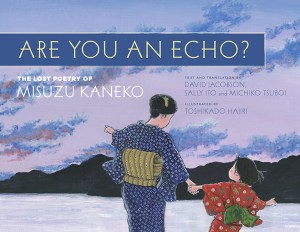
Are You An Echo? The Lost Poetry of Misuzu Kaneko

are-you-an-echo-book-cover

Title: Are You An Echo? The Lost Poetry of Misuzu Kaneko
Poems: Kaneko Misuzu (金子 みすゞ)
Illustrations: Hajiri Toshikado (羽尻 利門)
Text and Translation: David Jacobson, Sally Ito, and Michiko Tsuboi
Publication Year: 2016
Publisher: Chin Music Press
Pages: 64

This guest review is written by Holly Thompson (@hatbooks on Twitter).

Are You An Echo? The Lost Poetry of Misuzu Kaneko, published by Seattle-based Chin Music Press, is an unusual picture book — bold and broad in concept and scope. This is a multifaceted book, containing a history of the rediscovery of the writings of Japanese poet Misuzu Kaneko (1903-1930), a biography of Kaneko’s short life, current context for her work, and a selection of 25 of her poems.

With a foreword by Setsuo Yazaki, the Japanese children’s author and poet whose curiosity led to the rediscovery of her writings in 1982 and subsequent publication of all 512 of her poems in six volumes plus his own complete biography of Misuzu Kaneko, the reader is offered context: “Misuzu Kaneko’s poems are part of every child’s curriculum at Japanese elementary schools.” Of the intense fondness readers feel for Kaneko’s poems, Yazaki points out that her words “possess a deep kindness toward all things whether they are alive or inanimate.”

The story opens with a question — “Who was Misuzu Kaneko?” — then chronicles Yazaki’s quest to learn more about this insightful poet. From Yazaki’s encounter of Kaneko’s poem “Big Catch” about a huge sardine catch, which led to his desire to learn more about the poet and his ultimate discovery of her pocket diaries full of her poems, the narrative shifts to Kaneko’s life story and her childhood in the town of Senzaki (now part of Nagato City) in Yamaguchi Prefecture near the western tip of Honshu where her family ran a bookstore. Raised among books, Kaneko began writing poems, and at the age of twenty, after several of her poems were published in Japanese magazines, she became a well-known children’s poet. Kaneko’s poems appear interspersed with the book’s narrative — poems that focus on ordinary local topics, imbued with a sense of awe and curiosity. The poems “Benten Island,” “Wonder,” “Beautiful Town,” “Fish,” “Snow Pile,” and “Flower Shop Man” provide a solid introduction to the deceptively simple poetics of Misuzu Kaneko.

Kaneko’s life unfortunately took a tragically dark turn after her marriage to a man who was, as explained in the story, “a bad, unfaithful husband.” She gave birth to their child who she adored, but she “caught a disease from her husband that caused her great pain.” What’s more, he forbade her to write. Kaneko divorced him, but he demanded custody of their daughter. The book does not shy away from the truth that Kaneko, in her illness and despair, made the decision to end her life after writing a letter to her husband imploring that he leave their child in the care of her mother.

This is admittedly dark material, but picture books are not only intended for the youngest readers. Are You An Echo? is a picture book for all ages and is especially well suited to the middle grades. Kaneko’s poems resonate in part because she wrote while suffering and longing. Her poems, so simple at first glance, reach straight to the heart, lift the spirit and stay with you. To write a story about Misuzu Kaneko without broaching her death by suicide would have constituted a huge omission.

Thus, after a spread illustrated in gray tones that includes Kaneko’s poem “Cocoon and Grave” containing a metaphor of a butterfly as an angel, a subsequent warm double-page spread offers hope, depicting Kaneko’s mother and her daughter by the sea remembering Kaneko’s “kind and gentle soul.” The narrative then shifts once again, this time to more recent history — the devastating earthquake and tsunami of March 11, 2011, in northern Japan. Kaneko’s poem “Are You An Echo?” was featured in a public service announcement televised after the disaster, and survivors in Tohoku, and people all around Japan struggling to cope after such profound and enormous loss, found comfort and hope in her words.

Following the story is “A Selection of Misuzu’s Poems,” with fifteen illustrated double-spread pages of Kaneko’s poems, impressively presented side by side in both the original Japanese and in English translation. Counting the poems that appear in English within the narrative, as well as the fifteen selected poems presented bilingually, Are You An Echo? offers 25 of Kaneko’s tender poems that reveal her extraordinary heart and boundless empathy. The titles of poems like “Stars and Dandilions,” “Telephone Pole,” “White Hat,” “Waves,” and “Dirt” reveal Kaneko’s unique ability to imbue ordinary items with sensibility and love.

What a feat to contain all of this material — history, biography, poetry collection — in a single picture book, including an informative author’s note by David Jacobson and a Translators’ Note by co-translators Sally Ito and Michiko Tsuboi. Expansive watercolor illustrations by Tokushima-based Toshikado Hajiri capture early 1900s provincial Japan and provide sweetly detailed and poignant accompaniment to the story and various poems.

Are You An Echo? The Lost Poetry of Misuzu Kaneko is a beautifully packaged, substantial picture book to treasure — a book to give poetry lovers of all ages, in all corners of the world.

Visit the Chin Music Press website for the book, Misuzu Kaneko, for information, backstory and further resources.

Review copy provided by Chin Music Press.

* * * * *

Holly Thompson (www.hatbooks.com) is a longtime resident of Japan and author of the novel Ash and three verse novels for young people: Falling into the Dragon’s Mouth, The Language Inside, and Orchards, winner of the Asian/Pacific American Award for Literature. She compiled and edited Tomo: Friendship Through Fiction — An Anthology of Japan Teen Stories, and she teaches writing in Japan, the U.S. and places in between.

are-you-an-echo-page-14

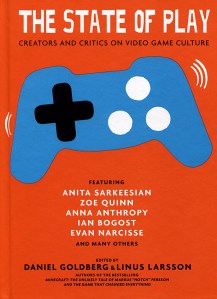
The State of Play

The State of Play

Title: The State of Play
Editors: Daniel Goldberg and Linus Larsson
Publication Year: 2015
Publisher: Seven Stories Press
Pages: 256

This guest review is written by John D. Moore (@johndmoore5 on Twitter).

The State of Play is a collection of sixteen diverse essays on a variety of topics related to contemporary video game culture written by game creators, journalists, and academics. The collection comes from Seven Stories Press, a company that has demonstrated a dedication to publishing interesting and new kinds of books about video games in the last few years, including anna anthropy’s Rise of the Videogame Zinesters and The State of Play editors Daniel Goldberg and Linus Larsson’s own Minecraft. The essays consist of some previously published material as well as pieces original to or adapted for this volume. This is not a video game culture primer; while each essay does an adequate to great job of describing the particular corner of video game culture it explores, a basic familiarity with games and the popular discourse surrounding them is necessary to keep the reader from feeling disoriented.

The book is prefaced by a short introduction written by the editors that argues for its own necessity in the current climate of video game culture. The editors propose the term “post-escapism” for our present moment, pointing to a paradigm shift for independent game production and video game criticism symbolized by – if not initiated by – the miserable advent of Gamergate. As such, it explicitly announces its progressive stance against an oppositional conservative “side.” The majority of the essays have a definite progressive political slant, dealing primarily with race, gender, and sex. Not every piece is so politically conscious, such as level designer David Johnston’s rich account of his approach to designing CounterStrike maps and the tensions between level design and real-world architecture. Curiously, the introduction does not make reference to this or other pieces that fit this loose classification, and that lack of framing is disappointing. It does provide for their place obliquely by linking progressive politics to a progressive approach in writing about games as cultural objects that matter and are subject to the same scrutiny as other media.

There are as many approaches to writing as there are contributors in this volume. anna anthropy’s essay “Love, Twine, and the End of the World” is characteristically playful and borrows the format of a choose-your-own-adventure book, sometimes even inviting the reader-player to exit the book and take action elsewhere, advancing her cause for games as a powerful medium of self-expression. In “A Game I Had to Make,” Zoe Quinn writes of her experiences surrounding the development, release, and reception of her Depression Quest in an intimate and challenging second-person perspective, stylistically reminiscent of the text of her game. Cara Ellison and Brendon Keogh share a meandering correspondence about the meaning of violence and its dominance in contemporary video games, trying on frames like colonialism. History professor William Knoblauch offers a wide-reaching analysis of apocalyptic scenarios in games from the late Cold War to the present.

In one of the book’s finest pieces, Anita Sarkeesian and Katherine Cross describe their separate and varied stories of online harassment, putting them together to expose their common threads of misogyny that are, in turn, pervasive in mainstream video games and video game culture, dehumanizing and objectifying real women as non-player characters. Sarkeesian includes a harrowing sample of the threats she received. It is a vivid and accessible chapter that succeeds in succinctly delivering many of the main points of Sarkeesian’s Feminist Frequency project and I’d nominate it as required reading for anyone involved in video games.

With no thematic divisions, there is no clear structural logic to the book’s presentation, though some of the juxtapositions provide provocative or synergistic effects when read together. Evan Narcisse’s “The Natural: The Parameters of the Afro,” an exploration of black representation in games, pairs very neatly with Hussein Ibrahim’s “What It Feels Like to Play the Bad Guy,” about playing first-person shooters where the only in-game people who look like the author are presented as enemies and the representations of his culture are often ludicrously inaccurate. Together, these issues connect to the next essay by Quinn in a way that opens up broader questions about embodied experiences. Other essays, especially toward the end of the collection, seem arranged at random.

In these pages, it is unfortunately rare to see an acknowledgement of the specific regional discourse the writers are talking about, even as Japanese companies (which are admittedly multinational, with major global presences) are routinely referenced. An exception is in one of the standout pieces of the collection, in which merritt kopas examines the intersection of sex, games, consumerism, and culture, arguing that the intertwining of these themes in mainstream game productions is a reflection of our society’s misogynistic and problematic relationship to sex. While she acknowledges that her discussion might be applicable in some areas to other cultures, she emphasizes that her focus is on her own American context. This statement stands in contrast to the introduction, which identifies the mainstream game industry as historically preoccupied with the “young, white, Western male” from its genesis. That of course applies to what would generally be termed the Western video game market since the late 1980s, but it seems to dodge the problem of other major markets, or at the very least the Japanese market. Oli Wikander, a professor of Religious Studies, offers a strong exception, examining Western theology and Gnosticism in 1990s Japanese role-playing games. It’s an excellent piece, but its position at the back of the volume seems to speak to its outsider status.

The book would have benefited from more careful editing on both macro and micro scales. There are a few more instances of awkward grammar and spelling mistakes than I’m accustomed to seeing. In addition, only a handful of the pieces cite their sources, which is disappointing. Predictably, those who cite are among the small handful of academics in the collection.

On a related note, my biggest complaint about the book is its lack of contextualization. At least three essays were originally written for their authors’ blogs, and I think it would strengthen the book to contextualize these articles as such. Short introductions preface each piece, but they mainly serve to specify the topic of the essay. This book was published in 2015, so it is mildly confusing when Ian Bogost’s piece on the fantastic stupidity of Flappy Bird and video games at large, originally posted at The Atlantic, refers to “last summer” but means the summer of 2013. The nature of blogging tends to produce writing that is very reactive to its moment and the broader online ecosystem of blogging. These repurposed bog posts are all fine pieces by themselves, but their transition between media calls for some more compensation than the book provides. Another example would be Dan Golding’s fine specimen of rhetoric “The End of Gamers,” originally a 2014 Tumblr post, in which Golding opts to not delve into the events commonly credited for spearheading Gamergate, deeming it not worthy of consideration. Given the priorities of his post, this makes sense on Tumblr. The nature of a print anthology, however, would almost certainly benefits from a stronger historicization either in the text or in footnotes, especially if it aspires to continued relevance.

While the collection’s lack of an absolute unifying coherence is arguably a weakness, it is simultaneously a strength. The diversity of content allows for a wide range of examples of different ways people are approaching video games. The collection and availability of the pieces that were originally published online in a physical book has great value, preserving them from the vicissitudes of ephemeral news cycles. To give an example, in researching this review I discovered that Shanahan’s essay has disappeared from its original home on the Internet. While it remains available elsewhere online for the time being, it would be a shame if it were ever lost to the Internet’s ever-growing cemetery of failed servers and expired domains.

The book’s inclusion of essays on so many varied subjects from so many different angles inspires an excitement concerning the existence of new possibilities and fresh approaches that even this wide-reaching collection cannot accommodate. The collection’s title, The State of Play, suggests a sort of crystallization of all the current discourse surrounding games. I would love to see something like this turn into a series, chronicling these conversations as they continue to evolve in coming years.

The State of Play is strongly recommended for any reader with an interest in the current culture of video games and how we talk about them. Each individual essay could provide, at minimum, a jumping-off point for a spirited discussion on a major topic in contemporary video game culture. Indeed, I can imagine this volume providing the backbone for a unit in a college course. To that end, it’s worth noting that Seven Stories Press offers (free examination copies of its titles to professors.

* * * * *

John D. Moore is an M.A. student in the Department of East Asian Languages & Literatures at the University of Oregon researching Japanese anime in general and Mobile Suit Gundam in particular. He is also a filmmaker and hobbyist developer of several dozen freeware video games, including Caverns of Khron and ExpandoScape.

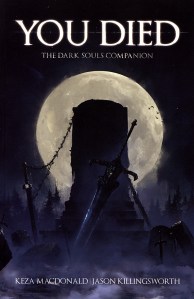
You Died: The Dark Souls Companion

You Died

Title: You Died: The Dark Souls Companion
Authors: Keza MacDonald and Jason Killingsworth
Illustrators: Paul Canavan and Angus Dick
Publication Year: 2016
Publisher: BackPage
Pages: 333

This guest review is written by Ryan Nock.

I came to You Died: The Dark Souls Companion as a casual fan of the Japanese video game series Dark Souls (and its sister Bloodborne), and I was expecting the text to explore the craft, the development, and the secrets of the games. It’s not quite that book, though, and devotes its attention to the game’s fandom rather than its creation.

The Souls series is infamous for its difficulty, and you’ll see the words “YOU DIED” flash on the screen dozens of times as you learn how to play. The most casual encounters with enemies can kill your character repeatedly until you get into the groove and learn the dangers of the world and the attack patterns of the undead and other monsters that roam it. While you’re connected online, other players can scrawl notes from a limited set of available words to offer hints, and you can call on help from other players, but they cannot speak to you. Moreover, those same players can “invade” your game and try to kill you.

While yes, this is challenging, it has created an interesting sense of community, as players all struggling at the same time to survive the game and solve its mysteries. That community, which expanded from the video game to the internet and even into the real world, is the focus of You Died.

The authors, Keza MacDonald and Jason Killingsworth, are both game journalists who had early access to games in the Souls series and were early popularizers of them in the West. Through this book (which doesn’t have a table of contents), they recount the history of how the precursor game Demon’s Souls came to the West through imports and fan translations, how its popularity led to the enthusiastic reception of the eventual release of Dark Souls, and how the fanbase proselytized the game firmly into the sphere of gaming pop culture icons.

Today, myriad YouTube channels highlight hidden bits of lore and showcase the skills of expert players, and the authors document some of the most famous examples of each. They seem to be trying to craft a sort of historical record of the game community, with whole chapters devoted to the time a Twitch stream crowd-sourced playing Dark Souls, or how one YouTube celeb got in hot water for collating insights into the gameworld’s mysteries without providing proper attribution to the messageboard community where that information was first posted.

Unfortunately, You Died is not adequately comprehensive as a reference, and as a documentary piece it doesn’t remain engaging all the way through. The presentation is a tad dry and perhaps a bit overlong; and, for a book about a video game, it’s a shame the only art is a series of black-and-white line drawings. I wonder if I, as a casual fan, am not the target audience. The authors assume the reader has beaten Dark Souls, and every once in a while I found passages of the book rather self-congratulatory, like the twelve pages detailing how one author got a 100% completion achievement. Rather than a unified book with a coherent through-line that builds to a satisfying conclusion, You Died is better read as a series of articles, which makes sense considering the pedigrees of the authors.

Still, there’s plenty to like. Entertaining vignettes recall how a couple bonded through co-op play, and how trickster players subvert the “invasion” mechanic to goof around and give rewards to would-be enemies who play along with their shenanigans. The chapters I found most interesting were the ones about the actual craft of the games – a biography of and excerpted interview with the series creator Hidetaka Miyazaki, recollections of the translators who localized the games and the British voice actors who gave gravitas to a mournful story about a world where nothing can truly die, and musings of other game designers on what lessons they’ve learned from the Souls series.

One early and appealing chapter quotes from a long email chain that bounced back and forth among game reviewers who got advance copies of Dark Souls before it was released in the West. The reader is invited to witness their shared amusement and frustration as they work through the game, share tips with each other, and brag about their successes.

For my taste, there’s a bit too much on the community around the game – a still-active community one can easily learn about with some web searches – and not enough behind-the-scenes information. Dark Souls has a setting you have to dig your teeth into in order to really appreciate the game’s plot. Today, it’s easy for someone new to the franchise to hit up a wiki and have all the secrets revealed, and I wish this book had cared more about the unrolling of revelations in the games – the lovely “aha!” moments that cause pieces of the puzzle to fit together.

Also, the focus is almost wholly on Westerners, with scant attention paid to the fans in Japan or the other designers – artists, programmers, composers – who are all Japanese. What inspired these developers to create a setting so firmly rooted in a medieval and Renaissance European aesthetic? All the authors offer the reader is a few paragraphs on Miyazaki’s interest in Western fantasy, and I lament that the topic was not explored in more detail.

By chance, shortly before reading You Died, I finished another book about a pop culture phenomenon with a large community centered on unraveling mysteries. In 1979, the British artist Kit Williams buried a bejeweled golden rabbit and published Masquerade, an illustrated, riddle-filled book that served as a treasure map. In 1982 the rabbit was found, and in 1983 Bamber Gascoigne (a name which will be familiar to players of Bloodborne) released Quest for the Golden Hare. The book served as both a thriller, deftly portraying a cast of characters trying to locate the rabbit, and as an oral history of William’s creation of the puzzle and of the phenomenon of Masqueraders around the world trying to crack the code he’d crafted. Perhaps unfairly, I ended up comparing the two books, and I found Quest for the Golden Hare more compellingly written, though this could be a result of different journalistic styles separated by thirty years – or because I’m not exceptionally engrossed in the Souls franchise.

You Died certainly has its moments, and as a celebration of a fandom it has the potential to inspire appreciation within the community of people who love the game. Its content could have been tightened and condensed, however, and I think it would have been improved by a stronger focus on its Japanese origins rather than just its reception in the West.

You Died: The Dark Souls Companion is available on Kindle and in print.

. . .

Ryan Nock is a writer and tabletop game designer at EN Publishing and product line director of ZEITGEIST: The Gears of Revolution and War of the Burning Sky, two adventure series for Dungeons & Dragons and the Pathfinder Roleplaying Game.

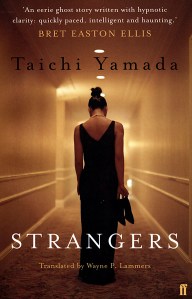
Strangers

Strangers

Title: Strangers
Japanese Title: 偉人たちとの夏 (Ijintachi to no natsu)
Author: Yamada Taichi (山田 太一)
Translator: Wayne P. Lammers
Publication Year: 2003 (America); 1987 (Japan)
Publisher: Vertical
Pages: 203

A 48-year-old television script writer named Harada is having a tough time of it. Having divorced his wife, he now lives by himself in a small apartment in a mostly empty building. A drama series he was supposed to work on has been canceled, and a friend and colleague has announced his intentions to pursue Harada’s ex-wife. After Harada’s friend informs him that they can no longer work together, he wanders in a haze until one day he decides to return to the Asakusa neighborhood of Tokyo where he grew up. On a whim he enters a rakugo performance, where he catches sight of a man who looks just like his late father. When the man goes out for a cigarette, Harada follows him and ends up being invited to the man’s home, where a woman who looks exactly like his late mother is waiting for them.

Around the same time, Harada has a strange encounter with a woman in her thirties whom he has nodded to a few times in the lobby of his building. Late one evening she shows up at his apartment with a bottle of champagne, remarking on how it’s eerie that the two of them are the only humans in the building. Because he’s still reeling from the emotional impact of his friend’s pronouncement regarding his wife, Harada tells her that he’s busy. When he calls her a week later, however, she gladly comes over. She makes romantic overtures and says she’ll sleep with him on the condition that he promises not to look at a mysterious wound on her chest. Is she just shy, or is something more sinister going on?

Harada’s ghost parents are charming and hospitable, so he continues visiting them. Harada’s father, a sushi chef, exhibits the charming gruffness and bluster of a stereotypical tradesman from the Shitamachi “old Tokyo” area in east Tokyo, and his mother is a sweet and gentle woman who loves her husband and son despite their flaws and amuses herself by playing old-fashioned games with hanafuda cards. Unlike Harada’s barren neighborhood in Shinjuku, Asakusa is full of warmth, and returning to his parents feels like stepping back into an idealized past in the postwar era.

Harada feels more alive than he has in years, but the people around him keep remarking on how terrible he looks. His new girlfriend seems especially concerned, and the intensity of her emotions is almost frightening. What does she want from him? What do his deceased parents want from him? Will he live long enough to find out?

Although Strangers plays with an interesting set of themes, the novel feels somewhat shallow. Harada is introspective but never arrives at any striking realizations about himself, and he’s too self-absorbed to make any serious attempts to understand the behavior of the people around him. Unfortunately, this Harada’s position as the point-of-view character renders the other characters as nothing more than stereotypes. Why do Harada’s parents return to the world of the living to see him? Because all parents love their children, of course. Why does Harada’s ex-wife pick fights with him? Because all women are crazy, of course. Why doesn’t Harada’s college-age son want to talk to him? Because all young people are ungrateful and temperamental, of course.

To me, Harada came off as an embodiment of male entitlement, and the books ends with his preconceptions justified and his place in the world reaffirmed. His seeming inability to change himself as the world changes around him is presented in a romantic light, as are the noble struggles of middle aged dudes everywhere. I didn’t find this story particularly engaging, but perhaps I’m simply not the intended audience.

Strangers is neither grisly nor subversive enough to inspire chills, but as a ghost story it offers an interesting theory on how different parts of Tokyo are haunted.

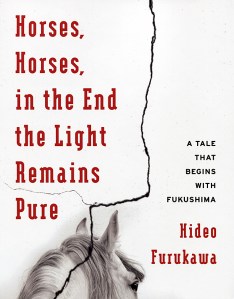
Horses, Horses, in the End the Light Remains Pure

Horses Horses

Title: Horses, Horses, in the End the Light Remains Pure
Japanese Title: 馬たちよ、それでも光は無垢で
(Umatachi yo, sore demo hikari wa muku de)
Author: Furukawa Hideo (古川 日出男)
Translators: Doug Slaymaker and Akiko Takenaka
Publication Year: 2016 (America); 2011 (Japan)
Publisher: Columbia University Press
Pages: 147

Furukawa Hideo, born in 1966 in Fukushima prefecture, is a prolific author who has won numerous awards for his work, which ranges from mystery to sci-fi to literary fiction. Horses, Horses, in the End the Light Remains Pure is a memoir that defies genre as it responds to the March 2011 triple disaster of earthquake, tsunami, and nuclear meltdown.

Horses is the story of a road trip that the author makes to Fukushima almost immediately after the disasters. Furukawa lives in Tokyo, and he was in Kyoto when the earthquake hit. He describes himself watching the news on the television in his hotel room, unable to process what he was seeing but unable to look away. “That’s when that period of steady gazing began,” he admits (19). Furukawa describes his continuing shock as living in “spirited-away time,” as if “the dates of the calendar disappeared” (6).

He is shaken from his torpor by the voice of a character from a novel he has recently published, The Holy Family (Seikazoku). This character, who is from the Tōhoku region, tells the author to go there and see it for himself. Furukawa therefore gets in a car with three other people who are identified only by letters (as in, “Young S was driving”) and heads north from Tokyo, all the while commenting on the seemingly normal state of traffic, gas stations, and convenience stores. When he arrives at the affected area, however, nothing is normal. As Furukawa explains it…

We were overwhelmed by the sense of how powerful it was. The scene spread out before us, everything wiped clean away. There are no words for it. We didn’t just feel it, we were pummeled by it. I am ashamed to admit it – I want to spit at myself in disgust – but I was looking at the scene as if it were a great spectacle. I thought of air raids. And atomic-bomb sites. It hit me like a smack to the side of the head: it’s just like a city in wartime. I couldn’t help it. I exploded: “This scale, it spreads too far.” (41-42)

Although the disasters are never far from Furukawa’s mind, descriptions of its aftermath don’t form a particularly large portion of his narrative. Instead, he is concerned with his identity as a writer and his responsibility in chronicling what has happened. Throughout the book, Furukawa seems almost narcissistic in the way he dwells on the process of writing, as well as the invitations he receives to discuss it. This is not unique to Furukawa, of course; very rarely is an artist’s statement anything other than a validation of the artist’s ego. It’s what these meditations evolve into halfway through Horses that makes the book so interesting. Specifically, Furukawa tries to pick apart the various strands of meaning tangled up in the knot of Japanese identity, repeatedly returning to the question of how to approach Japanese history and myth. For example, he ponders…

How does one sing praises to this national land? Especially now, given that there is a second sun in the nuclear core? A meltdown that has taken its name from Fukushima. Can a name be given to this particular sun deity? (65)

Furukawa goes on to discuss how the vaunted warrior class and the great military leaders of the sixteenth century were brutal and pitiless murderers. “Our history is nothing more than a history of killing people,” he concludes (78). When he reflects on how he wrote about Japanese history in The Holy Family, Furukawa claims that he was therefore writing “for the horses.” If the history of humans is a history of killing people, then the history of horses is a history of being killed in human wars. Just like the animals around the Fukushima reactor, the lives of horses are affected by events that are only tangentially related to them. Although the author never makes this parallel clear, he suggests that there isn’t a great deal of difference between the “otherness” of domestic animals and the “otherness” of the people who fall outside the political center of Japan.

Furukawa’s memoir is not challenging in the traditional sense of being difficult to understand, but reading it can be challenging at times, as the author follows his train of thought without stopping for a full 140 pages. His style is not quite stream-of-consciousness, but he makes no attempt to order his thoughts or to impose structure to any sort of argument he might be making. As a response to the disasters, then, Horses feels less like a polemic and more organic and sincere. Furukawa ends his narrative on a somewhat surreal note, but Doug Slaymaker’s concise “Translator’s Afterword” neatly ties together the disconnected themes of the work, and I would recommend that the reader glance over it before embarking on the main text.

Horses, Horses, in the End the Light Remains Pure is a trenchant and often surprising work of literary ecocriticism. Furukawa transforms both the immediate disasters in Fukushima and the broader historical currents that flow around them into deeply personal experiences, resisting large narratives as he argues for the validity of individual stories, especially those that rarely make it into official histories. The smooth and well-considered translation gives the text, in all its complexity, a compelling sense of forward momentum. Furukawa’s memoir is just as engaging as it is important, and it will be of immense interest to anyone concerned with how views regarding the relationship between human beings and the natural environment have shifted during the twenty-first century.

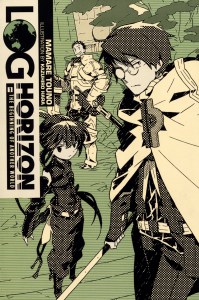
Log Horizon: The Beginning of Another World

Log Horizon Volume 1 Cover

Title: Log Horizon: The Beginning of Another World
Japanese Title: ログ・ホライズン: 異世界のはじまり (Rogu Horaizun: Isekai no hajimari)
Author: Tōno Mamare (橙乃 ままれ)
Illustrator: Hara Kazuhiro (ハラ カズヒロ)
Translator: Taylor Engel
Publication Year: 2015 (America); 2011 (Japan)
Publisher: Yen On
Pages: 215

This guest review is written by Jeremy Anderson (@GameNightJeremy on Twitter).

Log Horizon: The Beginning of Another World is a light novel about people who become trapped in a fantasy video game world and must figure out what to make of themselves in this new environment as they navigate its dangers.

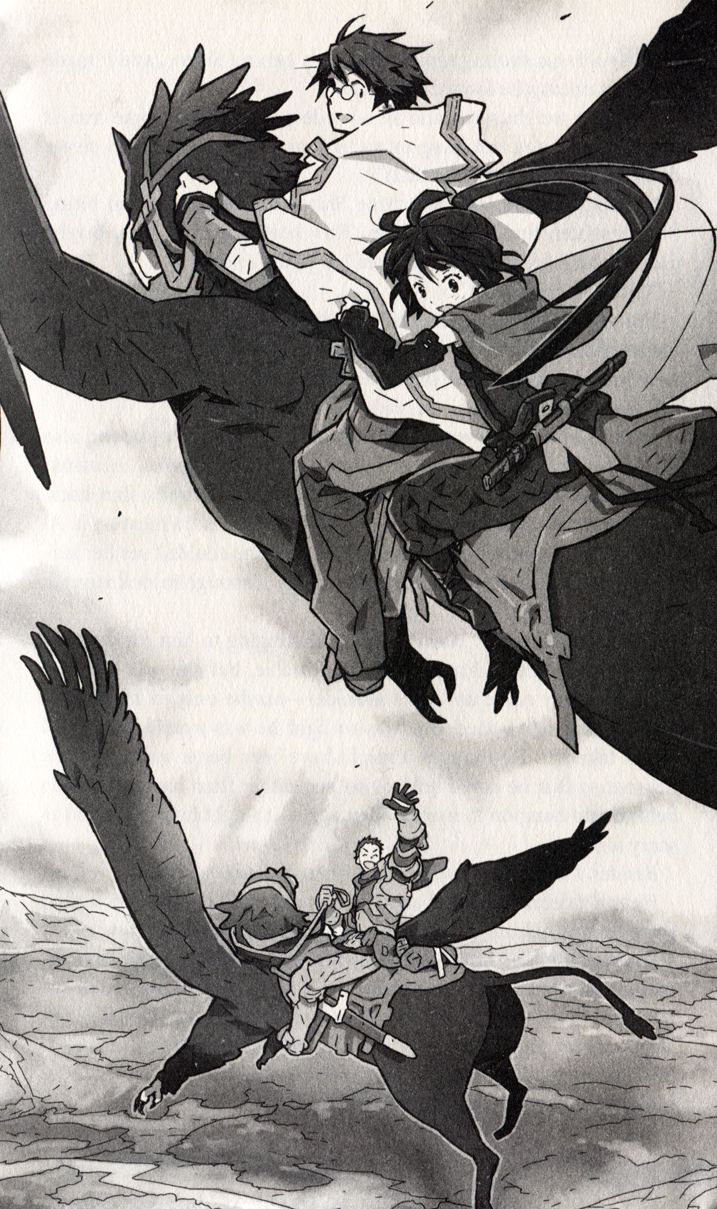
The plot is as follows: A young, intelligent, and socially awkward man named Shiroe finds himself physically inside a world roughly identical in form to the world of an online game he’s been playing for years, and he doesn’t know how to escape. He locates his friends, rambunctious but solid Naotsugu and quiet but reliable Akatsuki, and together they begin to explore the reality in which they’ve become trapped.

Log Horizon distinguishes itself from other entries in the “video game world” trope by changing the stakes. Other such stories, such as the light novel series Sword Art Online, tend to include comatose people who need to be woken up, a situation often nested with some hidden or overt moral about the importance of rejoining the real world. While Log Horizon‘s protagonist Shiroe ponders the possibility that everyone is comatose, he dismisses it as unlikely and doesn’t consider actively seeking an exit to be a productive use of time. Instead, the story is about taking life on its own terms and living life right now, where you are.

Log Horizon starts a little slow but builds on what it’s laid down early on to do more interesting things as it rolls along. I can tell you why I found it to start a little slow: I’m a gamer, and I’m already familiar with gaming terminology. Log Horizon devotes its first chapter to bringing readers up to date on this terminology. If you know what a guild is, how chat and friending functions work, what XP and HP mean, what a level cap is, what an MMORPG is, and so on and so forth, you may find yourself rolling your eyes and saying, “Yeah I get it.”

To me, this slow start is forgivable for two reasons. First, because I understand that not everyone is a gamer, and it’s better that I spend two seconds rolling my eyes than that another reader give up on the story because the writer never explained important terms. Second, because even within the first chapter the revelations about the way this MMO reality and the human-world reality interact are fascinating. That clash of worlds – the logical-but-unintuitive way new rules form from the known systems – is one of the main attractions of setting the story in a video game world. Log Horizon provides a number of clever details regarding world-building, and the protagonist spends a lot of time thinking about those details and responding to them.

In essence, the “video game world” trope provides an excuse to follow a set of strictures that will be easy for some to understand intuitively, and that will be easy to explain to the rest. The other value of setting the story in a video game world (instead of, say, Narnia) is that it allows our hero Shiroe to start off as intimately familiar with how the new world works. After all, he’s been playing the game for years, and he can approach the situation of becoming trapped within it with the calm and rational mind that distinguishes him as a player.

Whereas Sword Art Online explains the mystery behind how its characters have entered the game world almost immediately, Log Horizon doesn’t explain how this happened, might never explain how this happened, and tells the story in a way that makes this lack of information surprisingly acceptable. The story is about what the characters make of their situation, not how they got there.

The conflict in Log Horizon is a struggle for the soul – both the individual souls of the adventurers (Shiroe in particular), and the soul of the community. One of the most illuminating moments in the story is when Shiroe notes that the true threat to players in the game world is social. Thirty thousand people have been uprooted from their lives and transplanted into a new world, which does not have any government or laws. By the end of the novel, the reader sees how ugly this scenario becomes, with a major in-game city resembling a town run by a villain in a spaghetti western. In addition, Shiroe expresses concerns about sexism, such as the legitimate worry that female players, who form a distinct minority, will be harassed more than male players.

As fun as the fight scenes can be in Log Horizon, the novel’s most impressive moments aren’t when a dude is being cut in half or a building explodes; they’re when a man decides to stand up for someone he’s never met, because he knows he and his friends are best suited to get the job done. When his friends, new and old, push him to live more fully. When three people realize they’re the first ever to see the sunrise from a certain previously-unexplored hill. The fundamental question in Log Horizon is not, “How do we escape this false reality so we can get back to living our lives?” It’s a much simpler, broader, and deeper, “How do we live well?”

Log Horizon‘s story isn’t revolutionary in its interpretations of the “video game world” trope or the broader “team fantasy adventure” genre, but it does tell a story that is unique enough to keep the reader interested from cover to cover as it continues to chip away at the limitless edge of narrative possibility.

The story is also available in manga and anime formats.

. . .

Jeremy Anderson is a writer and game designer best known for the Shadowrift card game, and a consumer of far more comics and anime than anyone should have access to. He is currently on the design staff of Rise of the Eagle Princess, a JRPG set in a fantasy world based on the Mongolian empire.

Log Horizon Volume 1 Page 153

Legends of Localization

Legends of Localization

Title: Legends of Localization, Book 1: The Legend of Zelda
Author: Clyde Mandelin
Publication Year: 2015
Publisher: Fangamer
Pages: 198

Clyde “Mato” Mandelin is a professional translator who is famous on the internet for two things: first, leading the team of fan translators who put together an English patch for Mother 3 (which was never given a commercial release outside of Japan), and second, his website Legends of Localization, on which he posts detailed essays about the changes made to video games as they are prepared for the North American market.

Legends of Localization, Book 1: The Legend of Zelda is an offshoot of this website and the first book in what seems slated to become an ongoing series. As its title suggests, it focuses on the original The Legend of Zelda game from 1986.

The book is divided into six main sections.

The first section, which lists the differences in the game music and sound effects between the Japanese and American versions of the game, is an odd place to start (seeing as how books don’t produce audio – yet!), but the descriptive comparisons are a good introduction to just how far (and deep into the game code) the process of localization can go.

The second chapter, which analyzes the text spoken by the old men and women (and lone Moblin) in the game, explains the linguistic justifications for the bad grammar of the English text. It also bravely attempts to puzzle out what the hints these characters offer the player are actually supposed to indicate.

The third section, which covers the game’s items, explores some interesting cultural differences, including why the “Bible” was called such and why it was changed to the “Book of Magic.”

The fourth section explains the origins of the names of common Zelda enemies, such as Moblins and Like Likes, which are based on Japanese wordplay.

The fifth section, which examines the game manual, is a blast of nostalgia for those of us who treasured the little booklets that came included with game cartridges. This section includes an amazing line-by-line comparison of the introductory story text in Japanese and the English translation (which was surprisingly well executed), as well as several cogent explanations for the mistranslations that litter the remainder of the text.

The final section, “Beyond the Game,” collects information on hardware, promotional materials, television commercials, strategy guides, and spin-off games, including the vastly different Japanese and American board games.

What I especially appreciate about Legends of Localization are its illustrations. In addition to a wealth of screenshots, the book contains high quality scans of various print media, as well as photographs of game consoles, cartridges, and other paraphernalia. All of the images are informatively and appropriately labeled, and many are accompanied by humorous captions. My favorite of these captions are the ones that propose outlandish theories, such as “Link is dead and everyone is directing him to the light.” Because of the book’s uncluttered layout, it’s fun to flip through the pages while letting the pictures and cute captions catch your attention.

Legends of Localization is brilliant, witty, and thoroughly entertaining. Mandelin is a hero of the international gaming community, and this paper-and-ink publication of his work is a treasure. Even if you couldn’t care less about the Zelda games, or video games in general, I still recommend Legends of Localization for its clever insights into both Japanese and American popular culture.

As the cave-dwelling shield merchant should have said (if his dialog had been translated properly), “This is a good value and definitely worth buying.” Don’t keep it a secret to everybody!

The publisher, Fangamer, has put out a number of other gaming books, including the Zelda-themed graphic novel Second Quest and a small guide to navigating The Legend of Zelda in Japanese. They’re good people, and everything they release is golden as the Triforce.

Tokyo Decadence

Tokyo Decadence

Title: Tokyo Decadence: 15 Stories by Ryu Murakami
Author: Murakami Ryū (村上 龍)
Translator: Ralph McCarthy
Publisher: Kurodahan Press
Publication Year: 2016
Pages: 280

Tokyo Decadence contains fifteen stories drawn from five of Murakami Ryū’s collections published between 1986 and 2003. As translator Ralph McCarthy explains in his acknowledgments, he has been translating his favorite Murakami stories since the late 1980s, and now he’s finally able to publish them thanks to the blessing of the author and the encouragement of Edward Lipsett of Kurodahan Press.

The first story in Tokyo Decadence, “Whenever I Sit at a Bar Drinking Like This,” has a passage at the beginning that reads as follows:

It’s probably safe to say that everyone sitting here is looking for some sort of sin tonight. The circumstances are different for each, of course, but everyone has the same general destination in mind. No one gets drunk in order to raise their moral standards.

It’s probably safe to say that no one opens a collection of Murakami Ryū’s short fiction in order to raise their moral standards. If you’re looking for some sort of sin, you’ve found yourself the right book. All of the stories in Tokyo Decadence are surprising and unique, but they all move toward the same general destination – sex and drugs and blood and tears.

This first story takes the form of an elaborate fetch quest across the seedy underbelly of Shinjuku in which the protagonist must exchange promises for favors. His goal is to get one of his former lovers to testify in court that they were sleeping together so that another of his former lovers doesn’t claim common law marriage and sue him for divorce. The point seems to be that people are terrible and selfish creatures, but it’s a lot more fun arriving at this conclusion than you’d expect.

The second story, “I Am a Novelist,” involves another strange situation in which a man posing as a bestselling writer gets a girl at a hostess club pregnant. When her manager insists that he meet the young woman, she quickly admits he’s not the person she slept with, but the writer still takes her out to dinner. She tells the writer that she’s a fan of his work, so he tries to get her to fall in love with him instead of his impersonator. It doesn’t work (obviously), and the novelist ends up finding out that he was just a minor character in someone else’s story.

In other stories, a trucker loses his wife and his job and becomes a host at a gay club, a guy with no self-esteem invades a woman’s home and smashes her television, and a young prostitute buys herself a topaz ring to remind herself of a musician whose world she can never enter. In “Penlight,” a call girl with serious issues talks about her imaginary friend to a guy she meets at a bar, who is interested in her body, but in the way you think (unless you happen to be thinking of horrific murder and cannibalism). A few of these stories are drawn from Murakami’s 1988 collection Topaz, which became the basis for the 1992 film Tokyo Decadence, which was directed by the author and banned in a handful of countries precisely because it’s the sort of movie you’d expect to have been directed by the author.

If you’ve read Murakami’s work before, you know what to expect. Since all of these stories are twenty pages or less, however, there’s no slow buildup to the carnage. That being said, the violence is tempered with irony, black humor, and intriguing characterizations that elevate the stories above simple splatterfests.

In contrast, the three stories drawn from the 1995 collection Ryu’s Cinematheque are vaguely autobiographical.

In “The Last Picture Show,” the 18-year-old narrator is living in Kichijōji and trying to make it big with his blues band. His upstairs neighbor, who is obviously a yakuza, wants to pay him to pick hydrangea leaves in Inokashira Park to dry and then sell as marijuana to American soldiers. In “The Wild Angels,” the 18-year-old narrator has started a relationship with a woman who works as a hostess, which makes him feel like less of a man, so he starts shooting heroin. In “La Dolce Vita,” the college student narrator hooks up with an older woman who lives in Yokosuka and gets her drugs from the American army base, which doesn’t end well.

To me, these coming-of-age stories were nowhere near as interesting or amusing as the murder stories, but they provide an interesting picture of the 1970s that serves as a counterpoint to the stories of the other Murakami; these stories forgo nostalgia in favor of an emphasis on the grittiness and despair and self-indulgent navel gazing of fringe counterculture.

The last third of Tokyo Decadence eases up on the drug use but maintains its focus on sex and emotional violence. Some of the stories reference each, and I got the sense that I was only being glimpses into a larger narrative. I dearly wish we lived in a world in which Ralph McCarthy was able to publish his translations of entire Murakami collections instead of selected stories, but each piece included in Tokyo Decadence shines brightly enough on its own merits that the reader is not disappointed by the relative lack of context.

I thoroughly enjoyed Tokyo Decadence. The collection portrays the Japan of the bubble and postbubble decades as a place where anything in your wildest dreams and darkest nightmares could happen. Murakami’s fiction is a love letter to the infinite possibilities of urban life delivered with style and panache. Just be warned – Tokyo Decadence is not for the faint of heart.

Tokyo Decadence will be released on March 15, 2016. A complete table of contents can be found on its page on the Kurodahan Press website.

Review copy provided by the noble and selfless people at Kurodahan Press.

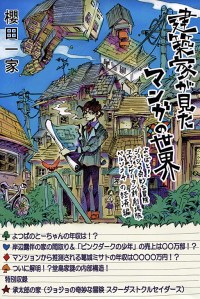
Manga through the Eyes of an Architect

Manga through the Eyes of an Architect

Title: Manga through the Eyes of an Architect: The Economics of Yotsuba&!, Jojo’s Bizarre Adventure, Evangelion, and Persona 4
Japanese Title: 建築家が見たマンガの世界:よつばと!、ジョジョの奇妙な冒険、ヱヴァンゲリヲン新劇場版、ペルソナ4の経済編 (Kenchikuka ga mita manga no sekai: Yotsubato, Jojo no kimyō na bōken, Evangerion shingekijōban, Perusona 4 no keizaihen)
Author: Sakurada Ikka (櫻田 一家)
Publisher: Gloria Earth Technology
Publication Year: 2015
Pages: 199

In his preface, architect Sakurada Ikka explains that the idea for this book came about through a conversation with a group of friends at a bar. A young editor, referring to the adage that “a good novel will make its protagonist’s economic circumstances clear,” wondered if the same could be said for manga. Sakurada, knowing full well that someone’s home reflects their socioeconomic status, posited that any story with solid worldbuilding would give the reader a clear picture of the living space of its characters. Once he set about investigating this issue, however, he realized that there were a great many gaps lurking in the shadows of even the most solidly constructed manga (and anime, and video games). Manga through the Eyes of an Architect thus functions as a set of close readings that attempt to fill in these gaps.

Sakurada opens his book with a precise examination of Yotsuba&! in an attempt to hammer out the details of its setting. For instance, when does it begin? (Probably July 18.) Where in Japan is Ajisai City, the fictional town where Yotsuba and her adoptive father Koiwai Yōsuke live? (Probably in Chiba Prefecture in the general vicinity of Narita airport.) What direction does Yotsuba’s house face? (Probably south.)

Sakurada uses evidence not only from passages in the manga but also from his own real-world research and observation. For example, in trying to figure out where Koiwai’s parents live, Sakurada argues that, since Koiwai borrowed a light cargo truck (a 2001 Mazda 660KU series, to be exact) from his friend Jumbo to move from his parents’ house to Ajisai City at the beginning of the first volume of the manga, he probably wasn’t traveling for more than a few hours. The “New Pione” label on a package Koiwai’s mom sends him (in Chapter 27 of Volume 5) would seem to indicate Okayama Prefecture, but that’s too far away, so it’s probably coming from nearby Yamanashi Prefecture, a somewhat lesser-known source of the brand’s grapes.

When I wrote “a precise examination” earlier, that’s the level of precision I mean. Sakurada does walkthroughs of his reasoning like Sherlock Holmes, and it’s fascinating to read through his evidence and conjectures.

The next section of the book investigates the floorplan of Kishibe Rohan’s house from Part 4 (the “Diamond Is Unbreakable” arc) of Jojo’s Bizarre Adventure. Despite Araki Hirohiko’s comment that his manga isn’t popular in America because Americans have no sense of style, all of the homes of the major characters exhibit classically American architecture. Sakurada teases out the layout of Rohan’s house room by room while discussing the history of the architecture and the furniture. As an American, I enjoyed seeing things I take for granted, such as Queen Anne houses and Mansard roofs, being treated as fascinating – and expensive! – foreign oddities. Sakurada tries to puzzle out how successful Rohan is as a manga artist by referring to the information presented in the manga Bakuman (about two manga industry hopefuls). For example, how many manga would Rohan need to sell in order to afford his Porsche 928 GTS? How do Rohan’s sales compare to the sales of Jojo’s Bizarre Adventure? Was this sort of wealth achievable for a manga artist in the late 1990s?

Sakurada continues with an analysis of the Rebuild of Evangelion movies (released in 2007, 2009, and 2012). In order to figure out how much Ikari Shinji’s guardian Katsuragi Misato is paying for her apartment, he argues that we must first understand how the catastrophic “Second Impact” event affected the earth. Since the viewer is told this disaster melted the polar ice caps, Sakurada employs math and maps to demonstrate what parts of Japan would have been submerged. He also speculates on how various Japanese industries would suffer from the resulting climate change, as well as how this would affect local economies and regional infrastructures within Japan.

Sakurada’s main concern in this section, however, is Misato’s annual salary. Her apartment accommodates herself, her pet penguin, two teenagers who get their own bedrooms (Shinji and Asuka), plus tons of extra space for her garbage, including a nice kitchen and living room. Given the state of Japan’s postapocalyptic economy, Misato must be doing well for herself in order to afford such a large place. (I guess NERV has to pay people the big bucks to put up with Shinji’s asshole father.) In addition, Sakurada gives a detailed analysis of each character’s room, providing an interesting set of insights. For instance, Shinji’s haplessness is emphasized by the fact that the room he’s given in Misato’s huge apartment is tiny and has no windows. Sakurada concludes with an estimate of Shinji’s dad’s salary, arguing that the women in Shinji’s life should really consider being nicer to him.

The final section of the book, which is by far its shortest, is about “The Mysteries of the Dōjima House.” The Dōjima house is the residence of the protagonist of the 2008 PlayStation 2 game Persona 4. Although a wealth of material related to the game and its 2011-2012 animated adaptation (not to mention several spin-off titles) has been released, Sakurada has been able to find numerous inconsistencies in the official floorplans of the quaint Shōwa-era structure that serves as the player’s (or viewer’s) home base. Where is the staircase, exactly? What’s filling all the space that’s unaccounted for on the second floor? Where’s the bathroom?

Although it helps to be familiar with the source texts under discussion, this is not necessary in order for the reader to enjoy his speculation and analysis. No prior knowledge of architecture is required, and Sakurada’s clear explanations and frequent illustrations render his arguments accessible to even a casual reader.

Granted, both the information presented and Sakurada’s readings are highly specific. In fandom terms, what Sakurada is performing would be referred to as “textual meta,” meaning that his analysis is so minute and self-referential that it might not make sense to people outside the fandom. As I wrote above, I don’t think this is true – I know very little about Jojo’s Bizarre Adventure but still enjoyed reading Sakurada’s essays on its architecture and economics.

Still, it brings up an interesting point concerning how manga and other pop culture texts should be discussed in an academic context. Is it absolutely necessary to reference larger social, historical, and intellectual currents, or are we allowed to dig our heels into the text itself in order to make it more meaningful? In my opinion, Manga through the Eyes of an Architect is close reading done right, and I can only hope that more formal English-language discussions of manga in this mode of inquiry appear as the related fields of Comics Studies and Anime and Manga Studies continue establish themselves.