The Woman in the Purple Skirt

Japanese Title: むらさきのスカートの女 (Murasaki no sukāto no onna)
Author: Natsuko Imamura (今村 夏子)
Translator: Lucy North
Publication Year: 2019 (Japan); 2021 (United States)
Publisher: Penguin Books
Pages: 216

The Woman in the Purple Skirt begins as a charming set of observations about a woman who lives in a quiet neighborhood. It soon becomes clear, however, that there is something creepy about the narrator, who calls herself The Woman in the Yellow Cardigan.

The specificity of the narration raises many questions. Why is the narrator so obsessed with the Woman in the Purple Skirt? How is she able to observe her so closely? Is she stalking this woman? Or is she perhaps talking about herself in third person? Is she making up a fantasy version of herself, or is she projecting her personality onto a real woman? If so, why? Who is the Woman in the Purple Skirt? Who is the Woman in the Yellow Cardigan?

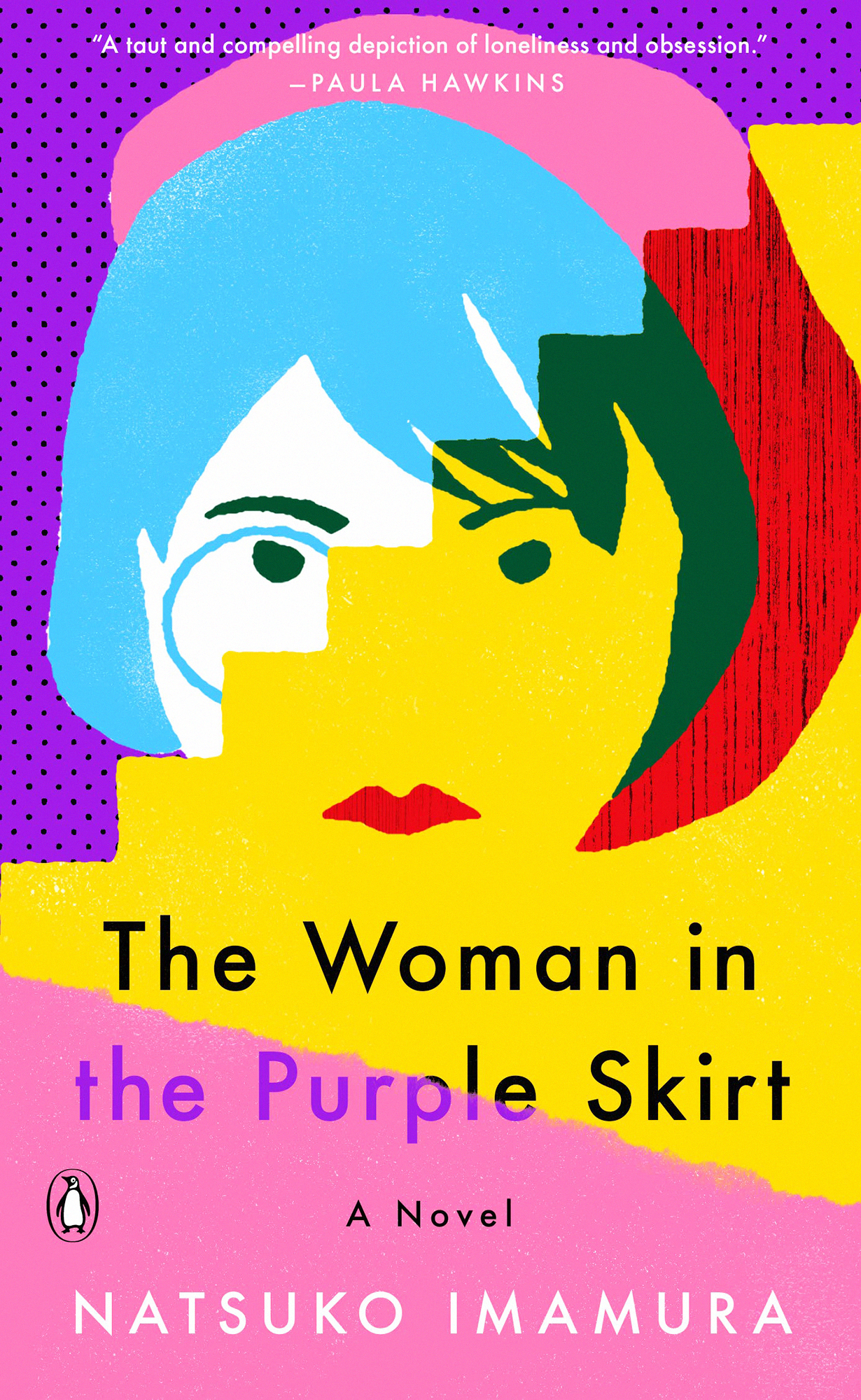
The Woman in the Purple Skirt isn’t suspense, necessarily, and it’s certainly not the “thriller” that the publisher seems to be trying to market it as, but the experience of reading this story is unsettling. The novella won the prestigious Akutagawa Prize, which is awarded to work from emerging writers that pushes boundaries and has a certain air of being “literary.” Despite the stylish chick lit cover of the American edition, the plot of The Woman in the Purple Skirt is almost depressingly mundane.

After a series of temp jobs that she quits after only a few days, the Woman in the Purple Skirt finds employment as member of the cleaning staff at an upscale hotel. She seems to be having an affair with one of her supervisors, and rumors spread that her salary is disproportionately high. At the same time, certain imbalances in inventory cause her coworkers to suspect that she is stealing. As the atmosphere at work becomes more hostile, the woman’s relationship with her supervisor also deteriorates. Meanwhile, the narrator, who is also a supervisor on the hotel’s cleaning staff, continues to glide through the life of the Woman in the Purple Skirt like a shadow.

This story is banal, but the subtle uncanniness of the narration forces the reader to view these normal events in normal lives with a sense of unease. The prose is sparse, the language is simplistic, and the affect is almost completely flat. Lucy North’s translation is reminiscent of Raymond Carver, especially in terms of dialog. Like Carver’s short fiction, the themes that emerge from beneath the placid surface of the narration are distressing: economic precarity, alienation, and the dangers of aging without a social network or financial safety net.

Despite its engagement with contemporary social issues, there’s nothing about The Woman in the Purple Skirt that requires specialist cultural knowledge, as the experience of struggling with loneliness while making minimum wage is equally shitty everywhere. I’d recommend this novella to anyone who enjoyed (or was at least moved by) Convenience Store Woman, as well as anyone concerned with urban anomie who entertains doubts about the ethics of low-wage work.

Because of the intriguing questions it raises and the unfortunate relatability of the discussion it’s likely to inspire, I would also recommend The Woman in the Purple Skirt as a text in a class on contemporary Japanese fiction. In addition, I think the novella might work well as a text for upper-level Japanese language classes, as its polished yet accessible prose evades the deliberate opacity of most Akutagawa Prize-winning work. Imamura has a field day with the narrative ambiguities made possible by the Japanese language, so it might be interesting to read the original side-by-side with North’s translation, which makes a number of tough decisions that nevertheless read as smooth and effortless.

Acclaimed author Natsuko Imamura’s first work to appear in English translation is short enough to be read in the span of an hour, but it’s worth spending time with. It’s difficult to say that a book as genuinely creepy as The Woman in the Purple Skirt is an enjoyable read, but the novella is a darkly shining jewel of literary fiction that invites and rewards analysis and introspection.

Colorful

Japanese Title: カラフル (Karafuru)
Author: Eto Mori (森絵都)
Translator: Jocelyne Allen
Publication Year: 1998 (Japan); 2021 (United States)
Publisher: Counterpoint
Pages: 224

A fourteen-year-old boy named Makoto Kobayashi has committed suicide, so a nameless and formless soul is granted a second chance at life by doing a “homestay” in his body. While inhabiting Makoto’s body, the soul must also occupy his life while guided by an angel named Prapura.

As if being in middle school weren’t difficult enough, the soul soon realizes that Makoto’s life is a mess. His family initially appears to be warm and loving, but it soon becomes apparent that nothing is as simple as it seems. To begin with, Makoto’s phone is completely free of contacts, which Prapura gleefully explains is because Makoto doesn’t have friends. The only girl who’s ever been nice to him visits love hotels with an older man, which Makoto knows because he saw her – at the same time he saw his mother leaving with her dance instructor.   

Although the soul now occupying Makoto’s body is given a year to figure out its past crime, there’s very little sense of narrative urgency involved in solving this mystery. Instead, the forward momentum of the story comes from “Makoto” gradually realizing that life isn’t so black and white, and that every person has different colors. As he explains it…

The idea of the Kobayashi family I’d had in my head gradually began to change color. It wasn’t some simple change, like things that I thought were black were actually white. It was more like when I looked closely, things I thought were a single, uniform color were really made up of a bunch of different colors. That’s maybe the best way to describe it. (149)

Although Colorful is YA fiction, some of the “colors” of its characters may require an unusual degree of empathy for many American readers, but I would argue that it’s precisely this exercise of empathy that makes the experience of reading the novel so powerful and moving.

To give an example, Hiroka, the fourteen-year-old girl who is “dating” an adult man for money, is represented as being in control of her body and decisions. When Makoto attempts to rescue her from the doorway of a love hotel, she initially goes along with him, but it doesn’t take long for her to make it clear that she doesn’t appreciate his heroic gesture. She actually enjoys having sex with a considerate and experienced older partner, she says, and she appreciates the money he gives her. When Makoto asks if she can’t just wait until she’s older, Hiroka doesn’t hesitate to explain her reasoning, telling him that she wants to be able to buy nice things while she’s still the appropriate age to appreciate them. She wants to enjoy her body, and she wants to enjoy her life, and she doesn’t want to date Makoto, whom she considers to be a friend.

Later in the story, Hiroka admits to occasionally feeling depressed, confessing to Makoto that she’ll want to have sex on six days of the week but then want to join a convent on the seventh. By this point, Makoto has matured enough to accept Hiroka’s decisions. He assures her that it’s normal to feel confused sometimes, and that there’s nothing wrong with her. This conversation does not lead to romance, but rather to Makoto’s self-awareness that he has grown enough as a person to accept Hiroka on her own terms.

This is what is expected of the reader as well – a willingness to accept the characters not as stereotypes or idealizations, but as they actually exist. Colorful does not place any value judgments on Hiroka’s personality, desires, or decisions. She does not decide to stop having sex with her older partner, nor does she realize that the things she spends the money on are childish and shallow. She is not diagnosed with any sort of mental illness or personality disorder, and she does not decide to “get help.”

It’s extraordinarily refreshing to see teenage female sexuality discussed with honesty and sensitivity without being punished. Hiroka is not a slut or a victim, but rather a normal young woman who enjoys having sex with people who enjoy having sex with her. She’s not 100% emotionally mature, and she doesn’t entirely understand who she wants to be or what she’s doing with her life, but that’s okay. The point of Colorful is that human beings are complicated.

Makoto’s father is another example of a relatable character whose story requires empathy to appreciate. When Makoto tells him that, as an aspiring artist, he prefers to draw landscapes because he dislikes people, his father confesses that he dislikes people too. Although he’s a talented designer, he was bullied at the company where he works. He thought he was highly positioned and highly respected enough to be able to speak up about the CEO’s mismanagement of the company, which was causing real and serious harm. This backfired, and he was ostracized for two years by his former friends and colleagues even though they knew he was right. He explains to Makoto that, although he was promoted when the CEO was eventually forced to step down after a public scandal, he will never get back those two years of his life, nor will he be able to return to his former easy friendships with his colleagues.   

This is a difficult lesson – that “doing the right thing” is not always going to be appreciated. Many times, in fact, speaking out against something that is clearly wrong will turn you into a social pariah. Even worse, this damage can linger for years, perhaps even for the rest of your life. Doing the right thing can ruin your career, and you might become so focused on damage control that you don’t notice that you’re sacrificing your relationships with the people who are close to you.

In so many stories, young people who do the right thing despite the hardships involved are rewarded for their uncompromising bravery. Meanwhile, the “absent father” figure has to make difficult and complicated decisions and ends up being positioned as the villain. As with Hiroka, being able to hear Makoto’s father’s side of the story is refreshing, not to mention validating to me as an adult reader.

The beauty of Colorful rises from the novel’s ability to take simple stereotypes and explode them into rich and detailed character portraits as Makoto comes to understand and empathize with people who aren’t perfect but are doing their best to live their lives with dignity. Along with Hiroka, Makoto is able to forge friendships with two other classmates; and, along with his father, he’s also able to better understand his mother and brother. The fantasy bits about souls and angels and resurrection are little more than props for an extremely character-driven story that doesn’t feel like a fantasy at all.

Colorful doesn’t go out of its way to be gritty or nasty or unpleasant. It’s honest and sincere, and it handles serious topics with gentle nuance and an occasional touch of humor. As the author describes her intentions in the Afterword,  

I chose to write about a serious subject with a comical touch. I chose to depict it lightly. I wanted kids who liked reading and those who didn’t have fun with it to start. I wanted them to laugh and roll their eyes and relate to everything the characters did. I wanted them to enter the world of the book and be free of their everyday lives. And then, when they closed the book at the end, I wanted the weight on their hearts to be just a little lighter. (210)

I believe that Mori succeeded marvelously, and I could not write a better summary of her novel.

I should also mention that Colorful received a high-profile anime adaptation in 2010 that was later released in North America in 2013 by Sentai Filmworks. The movie makes a number of interesting choices regarding plot and characterization that help keep the story moving forward at a brisk pace. It also includes a charming interlude into Japanese train fandom as a means of showing Makoto’s growing friendship with one of his classmates. Although it might be difficult to find a copy of the officially licensed DVD version, it’s definitely worth the effort to seek out a way to watch the movie. Colorful is on par with slice-of-life Studio Ghibli movies like Whisper of the Heart and From Up on Poppy Hill, and its art, animation, and voice actor performances are all lovely.

Jocelyne Allen’s translation of the original novel is equally fun and lively, with an especially good ear for the dialog of the teenage characters. Over the years, many of my international students have told me that Colorful meant a lot to them as they were growing up, and that it sparked their interest in Japanese fiction. I’m delighted that Colorful is finally available in translation, and it’s my hope that this heartfelt coming-of-age story inspires readers with a sense of joy and appreciation for the rich and vibrant colors of the world.

I want to extend my gratitude to Counterpoint Press for sending me an advance review copy. Colorful will be released in paperback on July 20, 2021. You can learn more about the book on their website (here), and you can find a set of pre-order links on the book’s page at Penguin Random House (here).

The Cat in the Coffin

Japanese Title: 柩の中の猫 (Hitsugi no naka no neko)
Author: Mariko Koike (小池 真理子)
Translator: Deborah Boliver Boehm
Publication Year: 1990 (Japan); 2009 (United States)
Publisher: Vertical
Pages: 190

According to the back cover copy, The Cat in the Coffin is “a gem of a modern update on the governess genre immortalized by Jane Eyre and ‘The Turn of the Screw’ [and a] hypnotic thriller that lures the reader into the darkness of the human heart,” which is as good of a description as any. The Cat in the Coffin is a story about family, desire, love, malice, and a cat at the center of a chilling murder.

Masayo, an aspiring artist from Hokkaido who has just turned twenty, moves to Tokyo to be a live-in housekeeper and caretaker for Momoko, the eight-year-old daughter of a semi-famous artist and college professor named Goro Kawakubo. The year is 1955, and Goro has embraced a modern American lifestyle of cocktails and garden parties after the tragic death of his wife. Masayo cares little for fashion or the glamor of high society, but she is enchanted by Momoko, who speaks to no one except her white cat Lala. Masayo bonds with Momoko through their shared love of Lala, and they become fast friends.

Everything goes well until a startlingly beautiful woman named Chinatsu shows up at one of Goro’s parties. Chinatsu worked as a translator and lived with her husband in America before becoming a widow and returning to Japan. Despite her air of cosmopolitan sophistication, Chinatsu is thoughtful and kind. Goro is clearly in love with her, but both Masayo and Momoko are ambivalent. After all, if Goro marries Chinatsu, there will be no need for Masayo to remain in the house as Momoko’s caretaker.

All of the characters in The Cat in the Coffin are good people, but they’re imperfect in small but significant ways. Goro takes his relationship with Chinatsu slowly so that his daughter will be comfortable with the woman who will replace her mother, but he is perhaps a little too willing to leave his daughter entirely to Masayo’s care. Momoko understandably misses her mother and craves her father’s affection, but her grief has caused her to become isolated and antisocial. Masayo tries her hardest to do what’s best for Momoko, but her crush on Goro causes her to give Chinatsu a cold shoulder.

The comparisons to Jane Eyre and “The Turn of the Screw” are apt, as Masayo’s idealized longing for Goro and Momoko’s aggressive strangeness create a difficult situation for Chinatsu, whose only flaw is that she isn’t able to conceal her dislike of Lala. Chinatsu gradually succumbs to a delusion that everything will work out if she no longer has to compete for Momoko’s affection with a cat, and she ends up taking drastic action in secret. Masayo witnesses her terrible act, which creates a terrible psychological burden she is unable to bear. The suspense of The Cat in the Coffin thus lies in witnessing a modestly happy household’s slow dissolution in a boiling pot of misdirected passion and ice-cold rage.

The Cat in the Coffin can also be read as a sustained exploration of Masayo’s fear of growing up as she longs for independence but still clings to childhood, sinking herself into a codependent relationship with Momoko and Lala instead of building a working friendship with Chinatsu, who represents her anxiety of adult sexuality. Meanwhile, although Chinatsu is only a secondary character from Masayo’s perspective, her life history is fascinating, and its eventual revelation is quite dramatic. Chinatsu’s story is reminiscent of The Great Gatsby in her ambition and failed pursuit of the American dream, and it’s precisely because of her progressive American approach to Momoko that their relationship is so disastrous.  

The Cat in the Coffin begins at a somewhat leisurely pace, but the suspense is slowly amplified throughout the novel, which is neatly structured and short enough to be read in one or two sittings. The ending is highly satisfying, as is the frame narrative, in which Masayo, now a famous artist, relates the story of Momoko, Chinatsu, and Lala to her own housekeeper. The well-edited and well-executed translation keeps the action moving at a brisk pace, making The Cat in the Coffin an enjoyable book to binge. This psychological thriller is lean and sharp and almost painfully insightful, and I especially recommend it to fans of Japanese cat novels who are interested in something domestic that still has its claws.   

Where the Wild Ladies Are

Author: Aoko Matsuda (松田 青子)
Japanese Title: おばちゃんたちのいるところ (Obachan-tachi no iru tokoro)
Translator: Polly Barton
Publication Year: 2016 (Japan); 2020 (United States)
Publisher: Soft Skull Press
Pages: 271

Where the Wild Ladies Are collects seventeen short stories about the everyday lives of ghosts, demons, and yōkai in contemporary Japan. Although all of these stories are a bit strange, their tone is light and comedic, and all the hauntings are consensual.

My favorite story in the collection is “Quite a Catch,” which is about a young woman named Shigemi who has found herself in a romantic relationship with the ghost of a skeleton she inadvertently pulled out of the Tama River in Tokyo while fishing with a friend. The ghost, Hina-chan, appears outside of Shigemi’s apartment to thank her for dredging her bones from the riverbed. Shigemi is alarmed at first, but before long she and Hina-chan are chatting while watching television, not to mention bathing and sleeping together. Hina-chan’s nightly visits are a best-case scenario for the narrator, who has always wanted companionship without having to live with a spouse or roommate.

As the story notes in the back of the book explain, “Quite a Catch” is based on the comedic folktale Kotsutsuri (Skeleton Fishing) about a man who, after having heard a friend’s story about being thanked by the beautiful ghost of a drowned skeleton, goes to the river in an attempt to snare himself a supernatural girlfriend of his own but ends up fishing up the skeleton of the villain of a famous kabuki play.

Other stories in the collection feature other well-known figures from Japanese drama, lore, and legends narrated from unusual perspectives. “On High,” for example, is about a ghostly princess who haunts the beautiful hilltop Himeji Castle while it’s in the process of undergoing extensive renovations in the name of “historic preservation.” Meanwhile, “Enoki” is narrated by a sacred tree that is both frustrated and amused by the humans who insist on praying to it for various blessings, while “A Fox’s Life” is about a woman who’s been told she resembles a fox so often that she finally decides to go up into the mountains and become one.

“Smartening Up” is the first story in the collection, and it’s an excellent introduction to the author’s playful voice as she expresses the central theme of learning to embrace your weirdness and imperfections. The narrator begins the story obsessed with the darkness of her hair, spending a considerable amount of time and money on hair removal treatments while wishing she were born blond. On returning home after a rigorous session at an aesthetic salon one evening, she finds her aunt waiting for her in her apartment. This is something of a surprise, as her aunt had committed suicide in the wake of a failed love affair. Even more shocking, this aunt tells the narrator that she knows all about how she’s come to hate her appearance after being dumped. There’s nothing wrong with her hair, her aunt insists, especially since the fault lies with the piece of trash who cheated on her. The aunt assures her that her black hair is gorgeous, and that there’s no need for her to feel gross and ugly.

This story is loosely based on the Dōjōji legend, specifically the kabuki play Musume Dōjōji (The Maid of Dōjō Temple). The original story, in which a lustful woman is spurned by a celibate monk and turns into a giant snake to pursue him, is almost laughably misogynistic. The kabuki version, on the other hand, celebrates the woman’s serpentine transformation as an act of beauty and magic, with the dancer twirling in a robe that shines silver with the gorgeous gleam of scales.

The narrator’s aunt reminds her of the time they saw this play together and then admits that she’s still figuring out what her own secret power is. As the narrator considers the matter, she realizes that her own power is indeed in her hair. She begins eating hair-fortifying foods like liver and seaweed, helping her hair to become as monstrous and powerful as the snakes commanded by Medusa. She hides her demonic hair during the day but allows it to come out at night, brushing it to a high sheen and thinking about what sort of special skills she will learn in the future as she grows more comfortable wielding her magical power.

This may sound sentimental and a bit self-helpy, but the tone is actually very tongue-in-cheek and down to earth. The narrative voice, which is expertly captured through Polly Barton’s translation, is highly engaging. Many of the stories in Where the Wild Ladies Are were inspired by rakugo comedic storytelling, which is meant to be a bit salty and ridiculous. A set of brief notes concerning sources and inspirations is provided at the end of the book, but it’s absolutely not necessary to be familiar with the original legends to appreciate and enjoy the stories in the collection.

Although many of the stories in Where the Wild Ladies Are revolve around the theme of supernatural female empowerment, there’s no man-hating here – far from it. There are plenty of interesting male characters, including a time-traveling and dimension-hopping wizard who was inadvertently roped into the job and decided, like any good salaryman, just to stick with it. Although the reader doesn’t figure this out until late in the collection, all of the stories are loosely linked, with the various male and female characters managing to get along with each other in relative harmony.

Between the creative contemporary re-imaginings of folklore, the strong female friendships, the queer monster romance, and the general disdain for boring office jobs and awful bosses, the target audience of Where the Wild Ladies Are is specifically me, and I feel very seen and catered to. Still, Where the Wild Ladies Are should resonate with a broad readership. I suspect that a lot of anime fans and yōkai enthusiasts will be highly entertained by the collection, and the stories will appeal to anyone of any gender who enjoys clever comedy about how wild it is to live in the modern world.

People From My Neighborhood

People from My Neighborhood
Japanese Title: このあたりの人たち (Kono atari no hitotachi)
Author: Hiromi Kawakami (川上 弘美)
Translator: Ted Goosen
Publication Year: 2019 (Japan); 2020 (United Kingdom)
Publisher: Granta
Pages: 121

The unnamed first-person narrator of People From My Neighborhood lives in a town that was rural when they were a child but has since developed and gentrified as farmers sold their land. Young people now commute to Tokyo, but a number of interesting people – and creatures – remain in the area. Some of the stories in this collection of microfiction are about the supernatural, but many are about people who are just a little odd or different.

There’s the taxi driver, for example, who spends all night driving around the ghosts of three women who supposedly died in the old tenement housing he refuses to vacate. There’s the self-appointed principle of a dog training program who spends all day loafing around the local park and sharing gossip. A child named Hachirō rotates between families in three-month intervals determined by lottery, as his parents already have fourteen kids. An elderly man who lives in a dilapidated mansion on the outskirts of town is called “Grandpa Shadows” by the local children because he has two shadows, one of which is rowdier than the other.

Then there is the mysterious diplomat who comes to town and provokes panic by going fishing in a lake that doesn’t exist. A princess keeps a beautiful garden and may or may not be responsible for a handful of murders and mass poisonings. One day a temporary mountain of sand appears along with a temporary god, and one day gravity simply disappears for a few hours.

My favorite story is “The White Dove,” in which a high school student picks up a peculiar avian creature during a fieldtrip. She takes the creature home, and it undergoes several metamorphoses before transforming into a sweet-tempered middle-aged man. He has a great destiny to fulfill, but this is largely irrelevant to the girl, who has a healthy sex drive and can think of far better uses for the man-shaped creature who now lives in her house. Although I’m always a fan of monster romance, what I love about this story is the way it sidelines the spectacular in order to focus on the drama of the mundane.

Some characters appear in more than one story, such as the narrator’s friend Kanae, who has a strong personality and goes on to live a storied life. Kanae’s sister, whose dream is to become a psychic medium, also finds herself at the center of several strange occurrences, as do a number of the narrator’s friends and acquaintances. The progression of stories jumps backwards and forwards through time, but the reader is nevertheless able to develop a sense of the social landscape of the small town and its population.

Since each story is only about two to six pages long, it’s fun to dip into the collection a bit at a time to see what’s new in town. By the end of the book, you almost feel as though you live there yourself. If you’re in the mood for a vacation to a place where anything could happen, People From My Neighborhood is your ticket to a bizarre yet relaxing experience.

Strange Tale of Panorama Island

Strange Tale of Panorama Island
Japanese Title: パノラマ島奇談 (Panorama-tō kitan)
Author: Edogawa Ranpo (江戸川 乱歩)
Translator: Elaine Kazu Gerbert
Publication Year: 1927 (Japan); 2013 (United States)
Publisher: University of Hawai’i Press
Pages: 113

Strange Tale of Panorama Island is a short novel about murder, misdirected passion, and artistic delusion that climaxes with an explosive conclusion.

The story’s antihero, Hirosuke Hitomi, is a writer who is neither living his dream nor making a living. His life is horribly bleak until he receives news that a college friend named Genzaburō Komoda has passed away from a rare illness. Although Hirosuke was never close to Genzaburō, he knows that he was the sole heir of a wealthy family. He also knows that he resembled the recently deceased young man to such a strong degree that he could have been his doppelganger.

Hirosuke sees his chance, and he takes it. He fakes his death by leaping from a ship, an act interpreted as a suicide by the newspapers that report the event. He then disinters Genzaburō’s body, destroys it, and crawls to the Komoda family estate, claiming to have experienced a miraculous recovery. As Genzaburō, he blames his disorientation and seeming loss of memory on the trauma, knowing that the family’s doctors will be too embarrassed by their “mistake” to interrogate him.

Hirosuke is not content to live an easy life of luxury in the company of Genzaburō’s beautiful widow Chiyoko, however. Instead, he uses the vast wealth of the Komoda family to buy an island and fill it with aesthetic marvels, creating a sensualist utopia outfitted with near-future technology. The wonderland he names Panorama Island is both a museum of the fantastic and an amusement park for adults.

The short translator’s introduction explains the cultural context of the novel, specifically the public interest in panoramas during the 1920s in Japan, but none of this information is necessary to appreciate the marvelous imagery Edogawa dreams up to dazzle the reader as Hirosuke leads Genzaburō’s widow across the island. If Chiyoko knows Hirosuke’s secret, which she almost certainly does, what will become of her? Like Chiyoko, the reader can only be amazed by the island while disturbed by the troubled genius that created it.

Edogawa is interested, like his namesake Edgar Allan Poe, in the precise mechanics of how Hirosuke’s series of crimes might be possible. The novel contains a touch of the pulpy adventure story, as well as an earnest foray into the realm of medical science. Thankfully, the narrative never becomes mired in superfluous details, with most of the science remaining staunchly fiction. Hirosuke’s degeneration as a human being receives much more attention, as does his erotic and grotesque fascination with the confused and powerless widow of his former friend.

Although it’s published by a university press, Strange Tale of Panorama Island is a pleasure to read. The introduction and endnote sections are short, discrete, and quite interesting. If you’ve read and enjoyed any of the books in the Penguin Horror Classics series, including the handsome reprints of the work of Edgar Allan Poe and H.P. Lovecraft, you’ll more than likely have a lot of fun with Strange Tale of Panorama Island. The novel was originally written for a broad but intelligent audience, and it’s aged extremely well, partially thanks to the excellent translation.

I also want to recommend the manga adaptation drawn by Suehiro Maruo and published in English translation by Last Gasp Press. Maruo, a gekiga artist who has adapted numerous other works of dark mystery fiction, delights in the lurid imagery of the story, which he depicts with his signature detailed linework and bold panel compositions. Readers should be cautioned that, although this is a “classic” that’s taught in university classes, it is most definitely not safe for work.

Overlord: The Undead King

Overlord, Volume 1: The Undead King
Japanese Title: オーバーロード 1 不死者の王 (Ōbārōdo 1: Fushisha no ō)
Author: Kugane Maruyama (丸山くがね)
Translator: Emily Balistrieri
Illustrator: so-bin (@soubin)
Publication Year: 2012 (Japan); 2016 (United States)
Publisher: Yen Press
Pages: 246

Overlord is about a normal man from near-future Japan who becomes trapped in an MMORPG. It’s a typical isekai story, but there’s a twist. Instead of valiant hero who must learn to fight monsters, the protagonist is the monster, and his goal is nothing less than to take over the world.

The premise of Overlord is fairly standard. An MMORPG called Yggdrasil that was developed to take advantage of an immersive “neuro-nano interface” is scheduled to go offline after a successful twelve-year run, but a max-level player and guild master who calls himself Momonga (after a supremely adorable species of flying squirrel) decides to stay logged in until the last second. Momonga is not forced out of the system but remains inside the virtual world, and he quickly realizes that he’s unable to leave. He has no friends or family outside of Yggdrasil, so this is not as distressing for him as it could be. Nevertheless, he decides to “take over the world” in an attempt to find other players who may have become similarly trapped inside the game.

I’m not sure I can recommend Overlord to someone looking for a more literary type of fantasy. To begin with, there’s a fair amount of geeky talk concerning game mechanics like quickcasting and debuffer immunities, especially early in the novel. Overlord assumes that its reader is already familiar with MMORPG culture and the conventions of the isekai genre. If none of this is new to you, however, the way the novel fast travels through issues that aren’t pertinent to the immediate plot (such as “where am I” and “how did I get here”) is a welcome change of pace.

This novel is an unabashed power fantasy. Not only is Momonga inhumanly strong on his own terms, he now possesses all of the magical treasures left behind by his guildmates. On top of that, all of the powerful level bosses in the dungeon formerly occupied by his guild are tripping over themselves to swear allegiance to him. Momonga can heal the sick, raise the dead, summon dragons, and make all of his subordinates (male and female) swoon at his very presence.

There’s a bit of boob grabbing and panty wetting, but it’s very silly and feels perfunctory, almost as if it’s something that the author felt he needed to check off a list. For the most part, Momonga is a decent person who’s not particularly interested in romancing the (dubiously?) sentient NPCs who were originally created by his friends. He’s a “demon king” in title and appearance only – although he doesn’t hesitate to kill an entire battalion of mercenary soldiers who attack a civilian village later in the novel.

The real power fantasy explored by Overlord has very little to do with swords and sorcery, however. Rather, the novel is essentially a story about what it means to be a good boss. All of the fantasy-themed gaming business aside, what Momonga needs to figure out is how to become an effective leader who is able to work efficiently while maintaining the respect of his subordinates. The decisions he makes concerning matters such as when to intimidate people and when to let things slide are interesting, and they form the core of the story, whose conflicts have fairly low stakes – at least in the opening volume.

The Overlord light novel franchise has sold millions of copies in Japan. It was also adapted into an anime series in 2015, with its third season airing in 2018. The illustrator, @soubin, has a massive following on social media, not in the least because of his stylish fan art for anime like Neon Genesis Evangelion and Attack on Titan. The first volume of Overlord was originally serialized online, and it reads a bit like fanfiction with the serial numbers filed off. If you enjoy this type of writing, Kugane Maruyama’s novel is a decadent treat.

I should add that I’m extremely impressed by the quality of the hardcover edition of this book. Yen Press always does a fantastic job with its physical publications, but Overlord is something special. There’s a beautiful pull-out map at the beginning, character profiles at the end, and a full-color illustration on the cover page of every chapter. I have to admit that I’m not sure why Overlord has been singled out for this sort of “collector’s edition” treatment – aside from its massive popularity, of course – but I’m not complaining. Yen Press has currently published twelve volumes in the series, and each is as devilishly handsome as the last.

(Image from the Yen Press official Twitter account)

Final Fantasy V

Final Fantasy V
Author: Chris Kohler
Publisher: Boss Fight Books
Publication Year: 2017
Pages: 165

Final Fantasy V is a book about the experience of growing up in the 1990s and discovering Japan by way of video games. This story is familiar to many people who came of age along with the internet, and Chris Kohler, who was born in 1980 and currently works as an editor at Kotaku, is the perfect person to tell it.

The book opens with a history of the early Final Fantasy series narrated from the perspective of the author, an American who has to glean bits and pieces of knowledge from magazines like Nintendo Power. Kohler also had access to computer industry trade magazines with ads in the back, which is how he came to acquire a Japanese copy of Final Fantasy V. His account reads like a child detective story, and I especially enjoyed how he dramatizes the process of “unlocking” the Japan-specific cartridge by manually prying off a set of small plastic tabs.

Kohler later coauthored the first fanmade English-language Final Fantasy V FAQ guide. This expansive document was meant to help Final Fantasy fans make sense of the Japanese-language game, which was circulated online as a ROM file that could be played on any number of software programs that emulated the Super Nintendo gaming console. Kohler discusses how the content of the game was officially and unofficially translated and retranslated, as well as why it was worth translating. Kohler also goes into rich and fascinating detail about the online cultures that have formed around Final Fantasy V, as well as many other Japanese RPGs that were slow to receive an English-language release.

Final Fantasy V is about a specific video game, but it’s also about how the gaming subculture of the 1990s explored and embraced the potential for communication across linguistic and cultural barriers. Even if you’re not particularly interested in the Final Fantasy series or video games in general, this short book is a lovely memoir of the early internet era. Final Fantasy V stands alongside Leigh Alexander’s Breathing Machine as a representative example of the excellent narrative nonfiction created by the generation of people between Gen X and the Millennials who grew up along with the internet, with all the weirdness and thrill of discovery that entails.

Chris Kohler is also the author of Power-Up: How Japanese Video Games Gave the World an Extra Life. Although it shows its age (in a dignified manner, of course) as a book that was written during an earlier period of gaming history, Power-Up is still an immensely fun read, and it contains a wealth of treasure for fans of the Final Fantasy series and people interested in how Japanese pop culture has been translated, localized, and interpreted by a global audience.

The Aosawa Murders

The Aosawa Murders
Japanese Title: EUGENIA (ユージニア)
Author: Riku Onda (恩田 陸)
Translator: Alison Watts
Publication Year: 2005 (Japan); 2020 (United Kingdom)
Publisher: Bitter Lemon Press
Pages: 315

In 1973, in a small seaside town on the west coast of Japan, the prominent Aosawa family and their guests were poisoned with cyanide during a birthday party, an incident resulting in the death of seventeen people. Makiko Saiga, who was a child at the time, later interviewed people connected to the family for her senior thesis, which ended up becoming a true-crime bestseller titled The Forgotten Festival. Makiko never published another book and refused to give interviews, and the sole survivor of the Aosawa family, a young woman named Hisako, married and moved to the United States. When the man who delivered the poisoned alcohol to the party committed suicide, the police closed the case.

Thirty years after the incident, however, it becomes apparent that there may be more to the story. There are fourteen chapters in The Aosawa Murders, each narrated from the perspective of someone once connected to the Aosawa family or the publication of The Forgotten Festival. Makiko Saiga is polite yet evasive. Her research assistant knows that there are small departures from reality in her account but doesn’t know what to make of them. The detective who investigated the case is convinced that Hisako Aosawa is responsible for the murders but can’t quite prove it. Someone who knew the supposed culprit believes the young man was manipulated by a mysterious woman. A handful of other people, such as Makiko’s brother and the daughter of the Aosawa family’s housekeeper, offer additional intriguing anecdotes.

The Aosawa Murders is a slow burn. For the first two-thirds of the novel, the reader has no choice but to take each separate account as it comes while trying to pick out the connecting threads, which initially seem to be few and far between. The Aosawa Murders respects the intelligence of its reader by presenting information impartially and without cliffhangers, false leads, or red herrings. The circumstances surrounding the mystery are compelling enough to warrant sustained attention, but the carefully measured narrative pace allows the reader to take time with each account without being driven to rush forward.

When things begin to come together in the last hundred pages, the true brilliance of the story becomes apparent. The final two chapters focus on Hisako Aosawa (now Hisako Schmidt) and Makiko Saiga, and I couldn’t help but fall in love with both of them. After hearing so much about them from secondhand accounts, the down-to-earth reality of their actual personalities is refreshing. Regardless of what each of them may or may not have done, the author reminds us that both of these women are far more than archetypes in someone else’s story.

Although an astute reader will have formed several theories about what happened, the novel never presents a simple and neatly packaged explanation. The ending is fragmented and recounted in a jarring manner that serves as one of the strongest clues concerning the identity of the narrator who has presumably assembled the accounts that appear in the story. I can imagine that some people may find this sort of open-ended conclusion anticlimactic, but it was extremely satisfying to me.

I have to admit that I enjoy formulaic murder mysteries in which everything is neatly arranged and fits together perfectly at the end. The Aosawa Murders is not that type of story, however – not by a long shot. Instead, the novel is a sprawling puzzle that rewards the reader’s active attention and engagement. This is not a book that can be read in an afternoon. Thankfully, the strength of the writing and the quality of the translation encourage sustained reflection and speculation. I had an enormous amount of fun with The Aosawa Murders, and I would happily recommend it to anyone looking for an uncommon mystery written by a mature and confident storyteller.

To anyone concerned about such things, there is no overt violence, sexism, or misogyny in The Aosawa Murders. In addition, aside from a minor subplot involving a Buddhist priest, the story doesn’t contain any particularly “Japanese” elements, and it’s not necessary to be familiar with Japanese society or police procedure in order to fully appreciate the characters and plot. In fact, I think The Aosawa Murders would make an excellent addition to a reading list of contemporary international mystery fiction.

A review copy of this book was kindly provided by Bitter Lemon Press. The quality of the publication is excellent, and I’m thrilled and delighted that Riku Onda’s work has made such a stunning debut in English translation.

Parade

Parade
Japanese Title: パレード (Parēdo)
Author: Hiromi Kawakami (川上 弘美)
Illustrator: Takako Yoshitomi (吉富 貴子)
Translator: Allison Markin Powell
Book Design: Wah-Ming Chan
Publication Year: 2002 (Japan); 2019 (United States)
Publisher: Soft Skull Press
Pages: 82

Parade is a short story that takes place during Hiromi Kawakami’s 2001 novel Strange Weather in Tokyo, which is about a woman in her late thirties who falls in love with her former high school teacher, whom she still refers to as “Sensei.” Parade stands on its own, and it’s not necessary to be familiar with Strange Weather in order to appreciate Parade, which is strange and delightful.

Parade opens with the narrator, Tsukiko Omachi, preparing noodles at Sensei’s house. He asks her to tell him “a story of long ago,” and she responds by relating something that happened during her childhood as they spend a lazy afternoon together.

When she was a kid, Tsukiko woke up one day to find two small people sitting beside her bed. They were about her size, and they had long noses, small wings, and bright red skin. Tsukiko decided that they were probably creatures from Japanese folklore called tengu. The two tengu followed Tsukiko to school, but no one seemed to notice them.

When Tsukiko arrives at school, however, she realizes that a few of the other children are accompanied by creatures of their own, such as a badger and a long-necked rokurokubi. The children followed by these creatures can see them, but they remain invisible to everyone else. None of the children find this odd, and Tsukiko’s mother – who once had a fox of her own – treats the issue in a matter-of-fact manner.

These creatures turn out to have less of an impact on Tsukiko’s life than a bullying incident in which Tsukiko’s classmate Yuko is ostracized by the other girls at their school. Yuko has a healthy response to this, ignoring her classmates while still being friendly with other kids her age outside of class. Tsukiko is uncomfortable with the situation, however, and her tengu begin to fall ill.

The situation resolves itself, but there’s no sentimental moral or life lesson to the story, just children behaving in the way that children tend to behave. Instead, the otherness of the tengu serves as a means by which Tsukiko begins to understand her own subjectivity as someone who has never thought of herself as “a tengu person” yet has somehow come to be associated with them. At the same time, she becomes more aware of the subjectivity of other people who are paired with mythological creatures of their own, as well as the subjectivity of people who can’t see them but have no trouble accepting that they exist. There’s no direct allegory implied, but the imagery of Parade is compelling enough to resonate on multiple levels.

Soft Skull Press’s paperback publication of Parade is a lovely physical object, with a velvet-touch cover and finely textured pages. It also features creative interior design work by Wah-Ming Chan and a gallery of abstract illustrations by Takako Yoshitomi (who has also published work in a number of josei magazines, although you won’t see any manga influences in Parade). The book measures about 4 by 6 inches, the perfect size for a short commute or a small gift. Although younger children may not understand the implications of the frame story (namely, Tsukiko and Sensei’s relationship), Parade is suitable for all ages, and I can imagine that it might inspire a few fledgling writers to tell “a story from long ago” of their own.