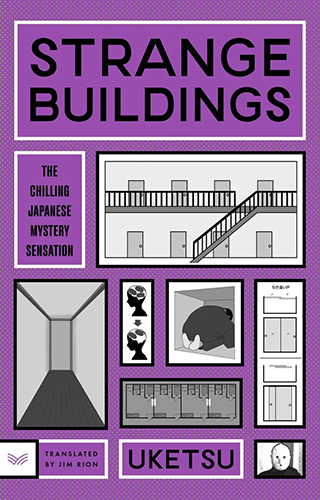
Strange Buildings, the 2023 follow-up to Uketsu’s smash hit Strange Houses, collects eleven illustrated stories about horror-themed architectural riddles followed by a lengthy exposition that reveals how these mysterious places are connected.
One of my favorite stories is “The Mousetrap House,” in which the wealthy heir to a large construction firm builds a luxurious mansion in order to kill a disabled elderly woman. If he puts a steep stairway next to the bathroom, he reasons, the woman will eventually lose her footing and tumble down the stairs.
When this eventuality fails to come to pass, he bullies his daughter into creating exactly the right set of conditions to make it happen. This horrible story is recounted decades later by the girl’s childhood friend, who was there on the night the old woman finally fell to her death.
I also enjoyed “The Watermill in the Woods,” which is presented as an old travelogue that recounts a curious building in the woods that’s nowhere near water. Its mechanical wheel instead powers the movement of an interior wall, but why would anyone need that?
This question is answered in the story “The House Where It Happened,” in which the frame narrator (who is styled as Uketsu himself) visits the old watermill in its current form as a remodeled modern house. When the village residents illuminate the shadows of the area’s history, the sinister purpose of the watermill becomes clear.
As in Uketsu’s other books, the overarching conspiracy is extremely silly. I don’t consider this a flaw, as there’s a certain sense of satisfaction in how delightfully outlandish the scenario is.
It should probably be said, however, that Uketsu is playing with acute cases of human misery as if they were Lego blocks. If one were to stage a gendered critique of this book, for instance, the ground is fertile. Still, I think it’s probably fair not to expect nuanced character portrayals from the weird architecture guy.
I enjoyed Strange Buildings, and I flew through this book as quickly as I could turn the pages. Jim Rion’s translation is compulsively readable, and I appreciate how Rion’s minor reconfigurations smooth over the “info dump” awkwardness of the original Japanese.
If you’ve never read Uketsu, Strange Buildings is a great introduction to the writer. If you’re already a fan, this is four hundred pages of the same, and it’s fantastic. Uketsu has found his niche, and it gives me joy to know that he’s out in the world being strange and living his best life.
 Contemporary Japanese Literature