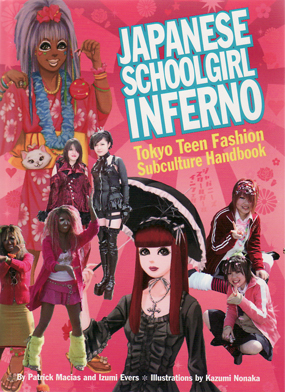
Japanese Schoolgirl Inferno

Title: Japanese Schoolgirl Inferno: Tokyo Teen Fashion Subculture Handbook
Authors: Patrick Macias and Izumi Evers
Illustrations: Kazumi Nonaka
Publication Year: 2007 (America)
Pages: 147

When a friend gave me this garishly pink little book as a present, I saw the name “Patrick Macias” on the cover and immediately prepared to be disappointed. Macias has authored and co-authored numerous books on Japanese popular culture. Two that might be familiar are Cruising the Anime City: An Insider’s Guide to Neo-Tokyo (2004) and TokyoScope: The Japanese Cult Film Companion (2001). These books are not only boring but were also outdated on the day they were published, primarily because Macias’s fascination with Japan’s popular culture during the seventies and early eighties fails to hold the attention of those of us who want to know what’s going on in Japan right now. In fact, I might even go so far as to say that Macias’s earlier books might have been better served if they were marketed as cultural histories instead of as guides to contemporary popular culture.

While it’s true that Japanese Schoolgirl Inferno is only up-to-date as of around 2005, and while it’s true that this book contains quite a bit of cultural history, I found it to be one of the most entertaining books I’ve read in a long time. Maybe it’s because of all of the bright and eye-popping photography. Maybe it’s because of Kazumi Nonaka’s fun and plentiful illustrations. Maybe it’s because of the concise prose and scandalous quotations. Or maybe it’s because of all the pink. In any case, once I picked up this cute and trim guidebook, I had a hard time putting it down.

One thing that I found especially charming about this book were all the suggestions the authors offer as to how to achieve these schoolgirl looks yourself. Far from being helpful, these sections actually serve to pinpoint how outrageous the fashions are. Another fun, recurring segment are the illustrated “A Day in the Life” inserts, which usually end with captions like “Mom says, ‘Take a shower! You two smell awful!’”

So, if you’ve always wanted to know what’s going on inside the heads of the Gothic-Lolita princesses, or if you’ve always been curious about how exactly the Mamba girls put on their makeup, this is the book for you. Even if you’ve never had the leisure to wonder about those things but have spent time in Tokyo, this is also probably the book for you. And if you really, really love pink, then I honestly can’t recommend this book enough. Go out and get it before it goes out of print. For the win. I’m serious.
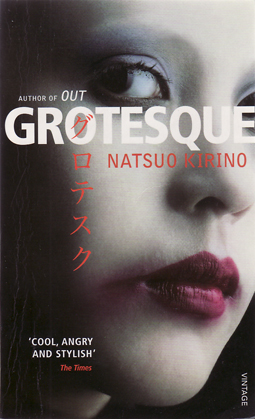
Grotesque

Title: Grotesque
Japanese Title: グロテスク
Author: Kirino Natsuo (桐野夏生)
Translator: Rebecca Copeland
Publication Year: 2008 (America); 2003 (Japan)
Pages:467

First of all, I would like to say that Grotesque is a very, very dark novel. It’s also filled with descriptions of all sorts of physical and emotional abuse, as well as numerous scenes of disgusting, extremely upsetting sex. In short, this novel is not for the faint of heart.

The novel essentially consists of the nameless narrator’s account of the murder of her younger sister, Yuriko, and her pseudo-friend from high school, Kazue, each of whom were marred by deep psychological imperfections. These emotional deficiencies were exacerbated by the harsh and competitive nature of the exclusive private high school that the two attended. In the end, both Yuriko and Kazue became prostitutes and were both ultimately murdered by the same unsavory client.

Putting the sensationalism of the novel aside, perhaps the most chilling aspect of Grotesque is the voice of the narrator. The reader quickly becomes inured to the sex and violence, but the cold and bitter tone of the narrator, as well as her pronounced disgust with her fellow human beings, continue to add a tinge of horror to the novel until the very last page. The narrator occasionally interrupts herself to present “evidence” concerning the two murder cases: the diary of her sister, the testimony of the murder suspect, and a letter from her old classmate. These stories within the story allow the reader to experience the voices of the novel’s other main characters, each of whom is just as disturbing as the main narrator.

In America, Kirino is mainly known for her first translated work, a massive chunk of a murder novel called Out (アウト, translated by Stephen Snyder). Like Out, Grotesque is long and depressing, and it would be a stretch to call any of the characters sympathetic. Unlike Out, however, Grotesque has a much smoother style, courtesy of translator Rebecca Copeland, and is therefore much easier to read. Also, compared to Out, the characters of Grotesque are much more artistically presented. Namely, in this novel, Kirino chooses to explore her characters’ depravity instead of merely wallowing in it. Moreover, I found the portion of the book that concerns the narrators’ experiences at their high school to be extremely entertaining. As I said earlier, Grotesque is not for the squeamish, but those readers who can deal with the darkness will be pleased to find an occasional glimmer of good writing and entrancing character study.

I should note that the version of Grotesque I reviewed is the British version, which I purchased in Japan. The American version of the book has been edited to remove all references to male child prostitution. Don’t let this deter you from reading the novel, though – the passages that were cut aren’t particularly riveting or important.