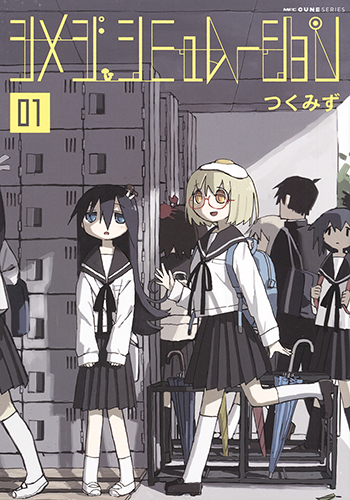
Shimeji Simulation

Shimeji Simulation (シメジ シミュレーション) is a gentle but deeply surreal slice-of-life manga about two teenage girls living through the end of the world – or perhaps not “the” world, necessarily; but rather, an artificial world that they happen to inhabit. The focus of the manga isn’t on the apocalypse, which passes mostly unremarked and unexplained. Instead, the core of the story is the friendship (and understated romance) between the two girls, Shijima and Majime. 

Shijima Tsukishima has spent the past two years of middle school quietly living inside a closet, and the manga opens when she decides to begin attending high school at the beginning of the school year. Why Shijima became a hikikomori is something of a mystery, but her primary personality trait is that she dislikes being bothered. She plans to spend her time in high school silently reading books at her desk.

This plan is interrupted by a classmate named Majime, who aggressively demands that Shijima become her friend. Since a pair of shimeji mushrooms sprouted from the side of Shijima’s head during her period of isolation, Majime immediately gives her the nickname “Shimeji,” an appellation that quickly becomes as pervasive and persistent as Majime herself.

Majime bluntly inserts herself into Shijima’s life and persuades her to join the school’s Hole Digging Club, which is managed by an art teacher named Mogawa. Majime assumes that the club is little more than an excuse to hang out after school, but Mogawa is oddly committed to the endeavor, especially when encouraged by the quiet presence of a second-year student named Sumida who only communicates through abstract drawings. Meanwhile, Shijima’s older sister has dropped out of college to devote herself to the ongoing construction of a bizarre machine with an inexplicable function.

For the most part, the girls engage in mundane slice-of-life adventures. They chat in the classroom, visit one another’s houses, and attempt a study session at a family restaurant. Mogawa teaches her art lessons. Majime catches a cold. A group of girls in their homeroom start a rock band. Shijima meets a super-senior named Yomigawa who’s decided to stay in high school just to hang out in the library and read philosophy books.

What makes this manga interesting are the strange glitches in the world surrounding the characters. The mushrooms sprouting from Shijima’s head are a good example, but there’s also the fact that Shijima and her sister occupy one of the only two tenanted apartments in a giant danchi housing building that’s falling apart yet still somehow livable. 

As the story progresses, more glitches begin to manifest. Everyone wakes up to a snowstorm in the middle of summer, for example. One day, the school building is flipped vertically and becomes a pocket dimension with a separate axis of gravity. Another day, water loses its mass and floats in the air. Suburban streets twist into optical illusions, and fish swim through the sky.

Although small glitches seem to be innate to the world, they’re exacerbated by Shijima’s sister, who’s been building and experimenting with various devices that alter the fabric of reality. Each of the first three volumes of the manga concludes with a longer narrative segment that shows the consequences of these experiments for Shijima and Majime, who are briefly thrown into the gaps between the cracks of reality.

The cumulative damage caused by Shijima’s sister is countered by a godlike entity who presents as a young girl and calls herself “the Gardener.” The Gardener’s role is to ensure that the reality experienced by the characters doesn’t mutate too wildly from one day to the next, but her power is curbed by the features of the universe’s code intended to keep its residents safe. She might be able to repair gaps in reality, but she has no means of forcing her will onto humans, even if it’s for their own good.  
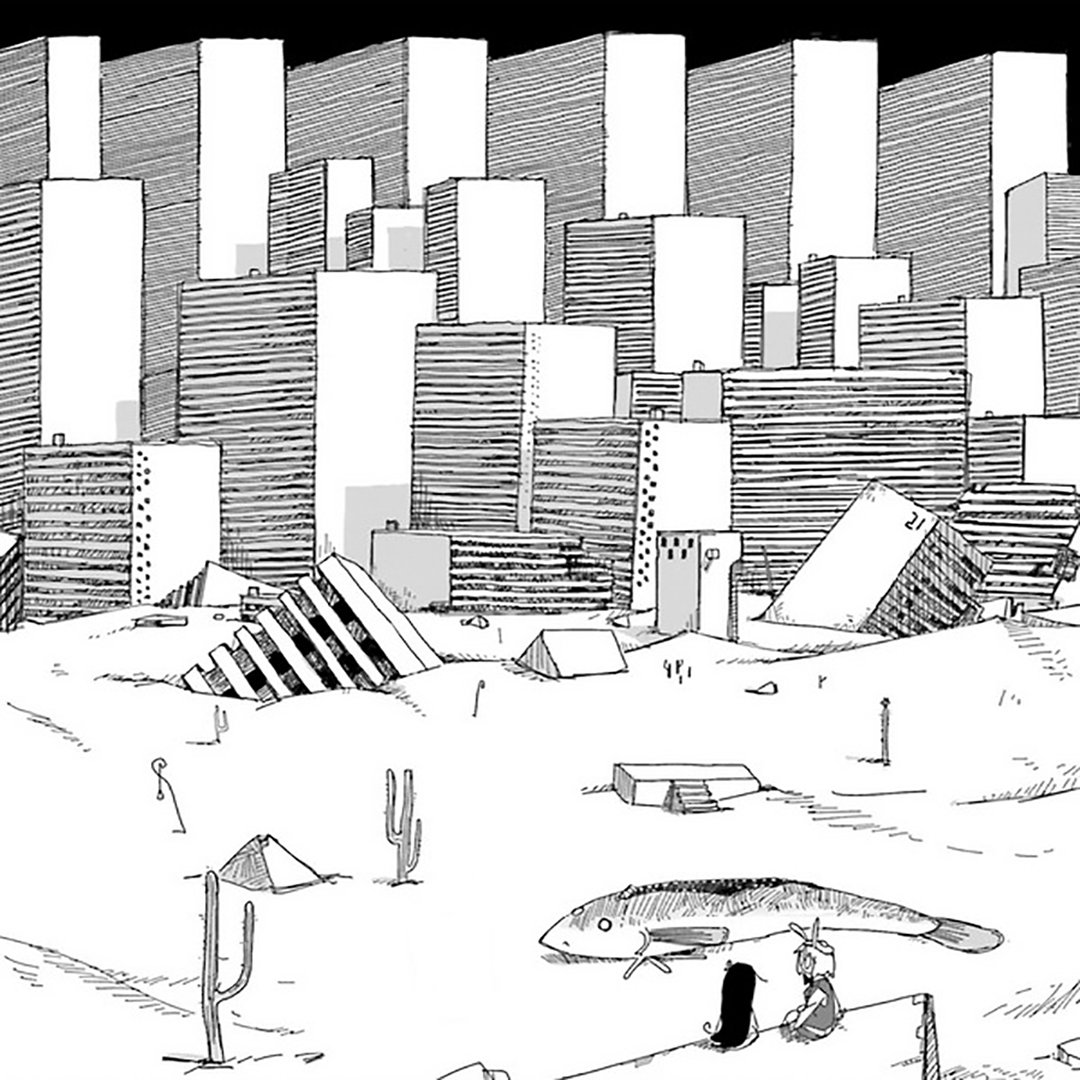
Like Tsukumizu’s previously serialized manga, Girls’ Last Tour, it’s difficult to say that Shimeji Simulation is “about” anything. There’s no plot to speak of, and the only real conflict is between the characters and the entropy eating away at the edges of their slowly decaying world. In addition, it’s never explained how this constructed universe and the characters who inhabit it came to exist. Instead, I think it’s probably fair to say that the manga’s primary concern is existential ontology. In other words, what does it mean to be human, and why do we exist?

I recently read an interesting essay (here) whose author argues that Shimeji Simulation is about the barriers between people, why we need them, and what happens when they disappear. If everyone were able to get exactly what they want, what happens when the desires of separate individuals come into conflict? If there were a world perfectly tailored for one person alone, could anyone else live there? And, if you retreat into complete solipsism, what’s the point of being alive?

Toward the end of the manga, Shijima finds herself in a situation very much like her self-imposed hikikomori isolation in the beginning, when she lived entirely in the darkness of her closet. In the simulated world she comes to occupy through her sister’s rewriting of the universe’s code, Shijima doesn’t bother anyone, and she never has to deal with any external input that she doesn’t choose for herself. Still, can we really say that such pristine loneliness is preferable to the messiness of human relationships?

I read Shimeji Simulation as a story about the various ways that people communicate and connect with one another. Shijima never becomes a “normal” or friendly person, but she still manages to find joy and meaning in her interactions with other people, even if most of these interactions are nothing special. This is why, in the fifth and final volume of the manga, Shijima breaks the boundaries of her personal universe to find Majime, wherever her friend might exist in the fractured constellation of simulations.
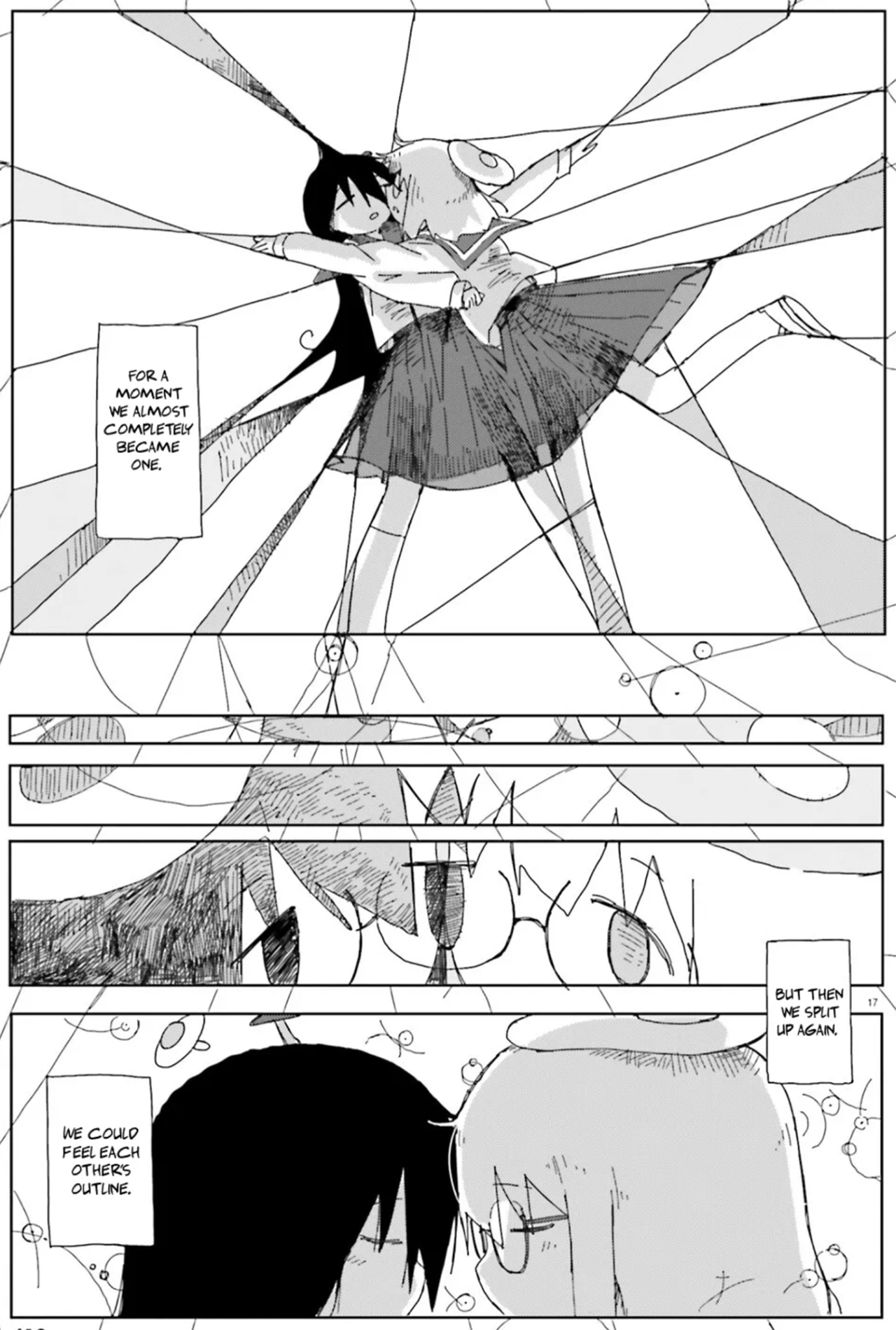
“The meaning of life is to understand love” may seem cliché; but, given how strange and surreal her story becomes, Shijima’s realization feels significant and well-earned. Life is a constant shifting and melding of interpersonal boundaries, and communication and companionship are worth the pain and trouble of being human.

Shimeji Simulation is a remarkable work of science fiction. The manga may seem to have an unassuming beginning, but its narrative structure gradually builds, loops back in on itself, and continually starts over from a weirder and more nuanced position. Likewise, Tsukumizu’s art may initially feel sketchy, but this style is perfectly suited to express the uncanny glitches and fluid malleability of the setting. Shimeji Simulation is gentle and quiet, but also immensely intelligent and creative, and it’s a manga to contemplate and enjoy slowly while allowing yourself to be transformed alongside the characters and their strange but fascinating world.

Shimeji Simulation hasn’t received an officially licensed English translation, but a fan translation is currently available to read on Dynasty Scans (here). If you’re interested in a small taste of the manga’s tone, I’d also like to recommend the short fan anime adaptation of the opening chapter on YouTube (here).
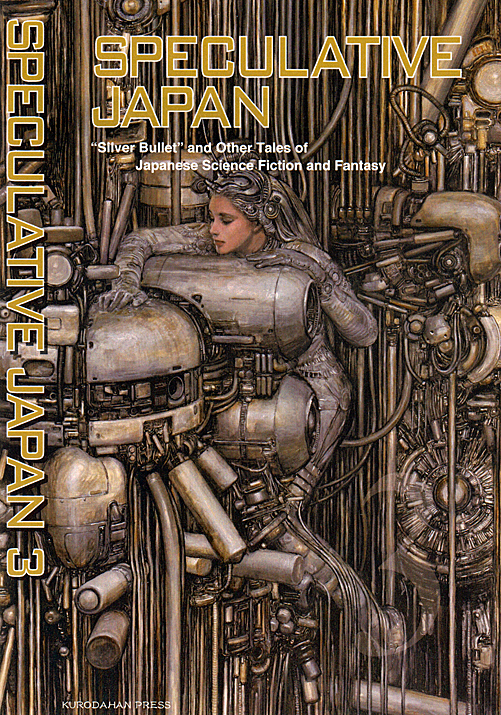
Speculative Japan 3

Title: Speculative Japan 3: “Silver Bullet” and Other Tales of Japanese Science Fiction and Fantasy
Editor: Edward Lipsett
Publication Year: 2012
Publisher: Kurodahan Press
Pages: 270

In my review of Speculative Japan 2, I said that I loved the anthology and couldn’t wait until the next installment was released. Speculative Japan 3 is finally here, and it’s everything I hoped it would be: a diverse collection of intelligent and beautifully translated short stories.

Speculative Japan 3 opens with several shorter pieces. These shorter pieces, which range in length from five to twenty pages, run the gamut from hard science fiction to magical realism to fantasy with a sci-fi twist to elegiac horror. Fujita Masaji’s “Angel French” is about the romance between two deep space robotic probes who began life as two college students hanging out in Mister Donut. “To the Blue Star,” written by Ogawa Issui (whose novels The Lord of the Sands of Time and The Next Continent are published in translation by Haikasoru), is another story about a self-aware technological entity. This entity, whose name is X, is a collective intelligence made up of a fleet of robotic star cruisers that represent the last remnants of human civilization. X tells its own story as it travels through the universe, watches civilizations rise and fall, fuses with other advanced life forms, and finally meets God. Matsuzaki Yuri’s “The Finish Line” is a thought experiment in the form of a short story and features a quiet but chilling scenario of the end of all life on earth. Kamon Nanami’s “A Piece of Butterfly’s Wing,” which is probably my favorite story in the collection, is a beautifully creepy ghost story in the literary tradition of writers like Kurahashi Yumiko and Kanai Mieko. Like the work of these masters of the poetics of horror, Kamon’s story is filled with beautiful, atmospheric imagery and resonant symbolism. It also features a delightfully disturbing twist at the end.

The longer stories of Speculative Japan 3 shine just as brightly as the shorter pieces. Even though none of these stories are more than thirty-five pages in length, they’re long enough to allow nuanced character development as they explore their premises in greater depth. Suga Hiroe’s “Five Sisters” is about a woman named Sonogawa Hanako who meets four clones of herself that have all been raised in different households. Each of these women has a different personality, and it’s fascinating to see how each has lived her life with the knowledge that she is a clone created to be harvested for organs. Ueda Sayuki’s “Fin and Claw” is a window into a future where humans have been genetically modified to be more adaptable to an environment covered in seawater. “Fin and Claw” is sort of like Jurassic Park with enormous sea creatures, and the moral of the story is the same. The last three pages of Ueda’s nightmarish vision are particularly terrifying in their visual imagery.

The title story, Yamada Masaki’s “Silver Bullet,” is a Japanese Cthulhu mythos story (more of which are collected in Kurodahan’s Night Voices, Night Journeys). In my experience, there are two main types of Cthulhu mythos stories: pseudo-Victorian and classy, and unabashedly pulpy. “Silver Bullet” belongs to the latter category. Its protagonist is sufficiently hard boiled, and the story contains more cheap sexuality than you can shake a flagella at. Still, all of the story’s thematic elements mesh together nicely, the ending is well earned, and the method used to summon Cthulhu is awesome (as is the instrument used to stop the summoner).

If there’s one story in the collection that feels out of place, it’s “Green Tea Ice Cream,” which is written by Mark Schultz. Perhaps it feels out of place because it’s merely good instead of excellent, but perhaps this is also because it bears the traces of awkwardness that often afflict stories written about Japan in English (a few of which have been recently collected in The Future Is Japanese). It’s difficult to pinpoint what the exact causes or sources of this awkwardness are, but it probably has to do with the writer feeling the need to explain certain “Japanese” things to the reader, as well as with the unstable balance between Japan as a real place and Japan as a fictional creation in these stories. “Green Tea Ice Cream” also revolves around a science fiction trope that I personally find silly and boring, namely, the unnecessary sexualization of a young woman who embodies fears concerning the changing relationship between human beings and technology. If the non-consensual impregnation and subsequent abduction of mindless machine girls is your cup of tea, though, knock yourself out. There are also some uncomfortably sexual father-daughter issues on display, if you’re into that sort of thing. That being said, the unsavory nature of the scenario and the characters of this story gives it greater depth and impact as a speculative commentary on contemporary bioethics.

To counter the sour taste of “Green Tea Ice Cream,” Mori Natsuko’s “It’s All Thanks to Saijō Hideaki” is made of pure sugar. To give a summary would be spoiling the fun, so let it suffice to say that this is one of those stories that you can’t believe you’re reading while you’re reading it and then can’t believe you’ve read once you’re finished. The experience of reading this story filled me with joy. If you’re a fan of yuri or bara stories (or brilliant parodies of such stories), then this is the story of the elegant, fabulous apocalypse you’ve been waiting for.

As in Speculative Japan 2, the translation is smooth and even throughout, with each story retaining the individual characteristics and quirks of its author. It’s a pleasure to read the stories in this anthology not just for the freshness and wonder of their ideas but also for the high quality of their writing and translation. As both an anthology of contemporary science fiction and an anthology of contemporary Japanese literature, Speculative Japan 3 succeeds brilliantly in collecting not the newest or the most popular, but rather the most interesting and the best written. Speculative Japan 3 is an excellent collection of short stories, and I highly recommend it to anyone looking for intelligent and exciting new fiction, speculative or otherwise.

Review copy provided by Kurodahan Press

Bad Girls of Japan

Title: Bad Girls of Japan
Editors: Laura Miller and Jan Bardsley
Publication Year: 2005
Publisher: Palgrave Macmillan
Pages: 222

Every once in awhile I will demand, in my ignorance, why no one has published an article about some facet of Japanese culture that really deserves an article. It usually turns out that, in fact, someone has published an article; and, occasionally, it turns out that all of the articles I have ever wanted to read have been published in one book. My most recent of such discoveries is Bad Girls of Japan, which was published in hardcover in 2005 and paperback in 2007. Why hadn’t I read it before this past weekend? That’s a good question. Perhaps I had thought to myself, what do I care about Abe Sada or Yoshiya Nobuko? Perhaps I had thought to myself, how academically rigorous can a short collection of twelve-to-fifteen page essays actually be? Did I mention that I can be extremely ignorant sometimes?

Bad Girls of Japan is a compilation of eleven short articles (plus a separate introduction, conclusion, and bibliography) about, as the title suggests, Japanese bad girls, with “bad” meaning “defying mainstream notions of proper female conduct” and “girl” being a term of female empowerment, apparently. Rebecca Copeland begins the collection with an essay about the demonic women of Japanese folklore, such as the yamamba, or carnivorous mountain witch, and the jilted lover turned giant snake monster from the Dōjō-ji myth that has come down to us by way of a famous Nō play. Other essay topics include geisha, Meiji schoolgirls, kogal, and shopping mavens like Nakamura Usagi – as well as the aforementioned Abe Sada (whose erotic escapades were sensationalized by films like In the Realm of the Senses) and Yoshiya Nobuko (whose Hana monogatari – flower tales – more or less established the shōjo narrative style).

In short, Bad Girls of Japan is all about women who have become the vortexes generating major cultural currents in modern and contemporary Japan. As such, it reads like an alternate cultural history informed by various academic focuses and disciplines. Since the essays are short, each writer has been forced to say the most important things about her topic in the most efficient way possible, but none of these essays sacrifices theoretical nuance (or footnotes). Furthermore, in a book designed to upset common ideas concerning Japanese culture, it is appropriate that none of the essays makes any sort of culturally essentializing overgeneralizations, either.

Because of its essay length and broad range of topics, Bad Girls of Japan does feel a bit like an introductory textbook, but it’s a very intelligent textbook, and the excellent editing ensures that it’s easy to read, as well. As a result, I think this essay collection is one of the rare academic books that will appeal to non-academics, and it would be an excellent choice of reading material for someone who doesn’t know very much about Japan but wants to learn more. I especially recommend this book to pop culture fans interested in moving beyond archetypes and stereotypes. It’s a quick, fun read, and it paints a lively and vivid picture of the past one hundred years of Japanese cultural history. To respond to my own initial doubts concerning this book, then, one should care about women like Abe Sada and Yoshiya Nobuko not merely because they were interesting people who told interesting stories, but also because of what their stories reveal about Japan and its relation to the rest of the world as it made its way through the twentieth century.

By the way, that hypothetical essay I always wanted to read about sex in josei manga is in here too, and I think Gretchen Jones does a great job of addressing the possibility of female pleasure and agency lurking within all the graphic rape. I just wish her chapter were longer, which I suppose is something I could say about everything in the book…