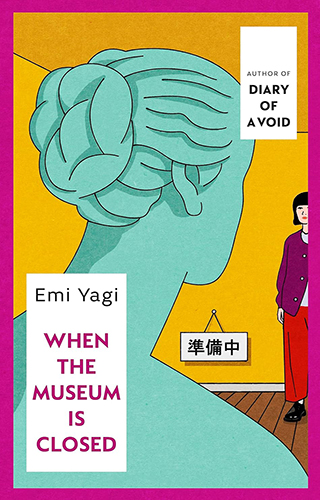
When the Museum Is Closed

Emi Yagi’s 2023 novel When the Museum Is Closed is a refreshing work of magical realism about a shy young woman who falls in love with a statue of Venus. The twist is that the statue loves her back, and – even more miraculous! – their love story has a happy ending.

Rika is a recent college graduate who works in the freezer department of a warehouse for processed food. She sees this as the perfect job for three reasons. First, she never has to talk to anyone. Second, she can take pre-prepared food home from her job, so she rarely has to cook. And third, an invisible yellow raincoat suddenly appeared over her clothing in elementary school, and she’s found it almost impossible to remove in public. The heavy vinyl fabric keeps her body temperature high, but that’s not a problem in an industrial freezer.

The only variation in Rika’s days comes from her part-time job. Once a week, Rika takes the bus to a local museum to have an hour of conversation with a statue of Venus. Venus only speaks Latin, but Rika enjoys a freedom with the dead language that she’s never found in Japanese. Though Rika is shy at first, she and Venus become friends, and they eventually fall in love.

Unfortunately, there’s a bit of a situation with a man named Hashibami, the museum curator in charge of the statue. He wants Venus all to himself, and he never wants her to change – he doesn’t want her to learn modern languages, and he certainly doesn’t want her to learn about the world outside the museum.

Venus therefore makes a deal with Hashibami. If he can get Rika to fall in love with him, she’ll allow him to fire Rika from the conversation job. Regardless, Rika isn’t interested in men, nor does she allow Venus to push her away. What Rika wants is something else entirely, and her relationship with Venus has given her the courage to chase their mutual joy.

The fantastic elements of When the Museum Is Closed are presented as entirely mundane, and it’s easy to take them at face value. At the same time, the love story between Rika and Venus resonates at an allegorical level with the experience of having a queer crush on someone who’s friendly and flirtatious yet seemingly unattainable. It’s the crush you have on an older coworker, or the crush you have on an internet friend, or the crush you have on the gayest girl you’ve ever met who is, inexplicably, married to a man. It doesn’t really matter that Venus is a statue, as anyone who’s experienced queer longing can relate to Rika’s situation. At the same time, Emi Yagi’s Venus is animated by her own distinct personality and undeniably lovely.

I’m sure that When the Museum Is Closed could also be read as an allegory for how women tend to be treated in male-dominated artistic and curatorial spaces, but the story is far more concerned with Rika’s subjective experience of her own individual life. I especially enjoyed the subplot involving Rika’s friendship with her landlord, a quirky but kind elderly woman who needs home care assistance, and I appreciated the understanding Rika develops with the neglected young boy who lives next door. Though Rika’s invisible yellow raincoat is unique to her, she’s far from the only person carrying unseen baggage, and it’s not necessarily the case that this is a problem that needs to be fixed.

When the Museum Is Closed is a short but expertly paced novel that moves quickly yet still allows the reader enough time to appreciate each scene. Its premise is intriguing and well-executed, and Yuki Tejima’s delightful translation captures the author’s tone perfectly, both in Rika’s deadpan observations and Venus’s mature flirtations. Readers who enjoyed Emi Yagi’s novel Diary of a Void will be pleasantly surprised by When the Museum Is Closed, which features the same sharpness and clarity of writing augmented by lovely moments of sweetness.

Lost Souls Meet Under a Full Moon

Lost Souls Meet Under a Full Moon brings together five interconnected short stories about people seeking to contact the dead. Though this book falls firmly into the category of “relaxing” fiction, it’s more plot-driven than most, and it distinguishes itself through its worldbuilding, especially its willingness to test the parameters of its magic system.

The central character of the novel is a handsome and stylishly dressed teenage “go-between” named Ayumi who can facilitate meetings between the living and the dead. The catch is that a person can only have one of these meetings in their lifetime, and each dead person is only allowed to return once. 

This is why the choice of the focal character of the first chapter, “The Rule of the Idol,” is so unusual. Manami asks the go-between to connect her with, of all people, a performer named Saori who made her living as a tv personality appearing on various talk shows and quiz games. When Manami was at the lowest point in her life, alone in Tokyo and bullied by her coworkers, she had a random encounter with Saori, who encouraged her to get back on her feet. Manami wants to use Saori’s death as an opportunity to thank her personally, which she never would have been able to do while Saori was still alive.

The third chapter, “The Rule of the Best Friend,” is far less wholesome. A first-year high school student named Arashi wants to be cast into leading roles in the plays performed by her school’s drama club, and she’s not shy about making her intentions known. Her biggest supporter is her best friend Misono, who joins the drama club in solidarity. Misono’s introverted grace has an alluring appeal that Arashi overlooks in her brash ambition, and she ends up losing a starring role to her best friend.

Arashi takes this poorly and stops talking to Misono. She assumes this will be a punishment, but she quickly realizes that her friendship was holding Misono back from achieving her own dreams. When Misono dies in a cycling accident, Arashi desperately wants to apologize, but she hasn’t yet developed the maturity to say what really needs to be said. I have to admit that I was surprised by the final meeting between the two friends, which is steeped in a complexity otherwise absent in these stories, and “The Rule of the Best Friend” ended up being my favorite part of the book.

In the final chapter, “The Rule of the Go-Between,” we see the characters from the previous stories from Ayumi’s perspective as he goes on his own journey during the process of inheriting the role of go-between from his elderly grandmother. Ayumi’s parents died under mysterious circumstances when he was a child, and his grandmother has carried a sense of guilt for years. Unlike his unfortunate classmate Arashi, however, Ayumi is able to break the barrier of silence and offer comfort and closure to his grandmother while they’re both still alive.

Despite a few brief moments of darkness, Lost Souls Meet Under a Full Moon presents little emotional challenge to the reader. There are very few subversive or self-reflective elements in these stories, and the characters occasionally behave like two-dimensional constructs who act solely in service to the plot. This isn’t a bad thing, of course. Lost Souls moves quickly and follows its internal logic so impeccably that the reader’s suspension of disbelief is never broken. As a result, each of the chapters is great fun to read.

Mizuki Tsujimura has taken the five-chapter cozy fiction formula and polished it to a high sheen. As far as the genre goes, Lost Souls Meet Under a Full Moon is as good as it gets, largely thanks to the author’s willingness to explore the more nuanced implications of the stories’ premise. Yuki Tejima’s translation is lovely and uses a light touch to bring the energy of Tsujimura’s prose to English-language readers. I’d recommend Lost Souls Meet Under a Full Moon to anyone looking for a good comfort read, not to mention a welcome reminder of the importance of saying what needs to be said while you’re still alive.