Out

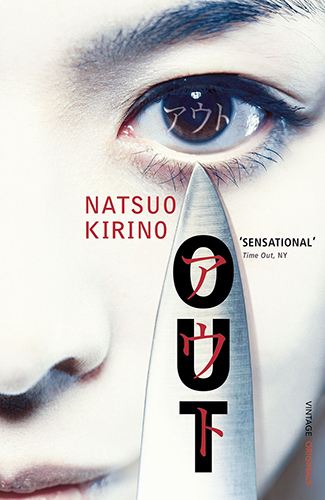
Natsuo Kirino’s 1997 novel Out is a story about four women who get away with murder… sort of. Though they manage to fly under the radar of the police, the women inadvertently come to the attention of several dangerous figures on the fringes of organized crime. Each of the women manages to find a way “out” of the situation, but none of them escapes unchanged. 

Masako Katori used to work at a corporate bank; but, despite her intelligence and competence, she was forced to leave her job due to severe gender-based discrimination. After devoting so much of her life to her work, she doesn’t know what to do with herself when she’s at home with her emotionally distant husband and shut-in son, so she works the night shift at a food processing plant that assembles bento lunches for convenience stores. 

Masako has formed a friendly group with three women who work the same shift. Yoshie is a widower who’s forced to care for her bedridden mother-in-law, Kuniko is obsessed with fashion and burdened by debt, and Yayoi is the mother of two young children who works at the factory to compensate for her husband’s gambling addiction. When Yayoi finally snaps and kills her abusive husband, she confesses to Masako, who enlists Yoshie and Kuniko to help her conceal the crime and dispose of the body.

Given that the women work in a food processing plant, it’s not as difficult as you might expect for them to drag the body into the bathroom, chop it into compact bits, and then neatly double-bag it for disposal. Masako’s plan to cover up the murder works so well that it might not have been discovered at all if Kuniko hadn’t discarded some of the bags in a public park.

The police quickly identify a suspect: Satake, a former yakuza who opened a nightclub and a dubiously legal gambling den in Shinjuku after a stint in prison. Several witnesses saw Satake get into a fight with Yayoi’s husband on the night he disappeared, so he’s taken into custody and held for questioning. By the time he’s released, there’s no way he’d be able to reopen his businesses, and he becomes obsessed with revenge.

Meanwhile, a yakuza-adjacent loan shark named Jumanji figures out the women’s secret by connecting the dots between the loan he granted to Kuniko and Yayoi’s signature on the paperwork as a guarantor. Instead of going to the police, Jumanji sees the potential for a black-market business opportunity. He approaches Masako, who isn’t entirely against the possibility of coming into possession of enough money to escape her current life completely. Unfortunately, the yakuza are far more difficult to escape than the police.

The premise of Out was inspired by a real-life unsolved crime known as the Inokashira Park dismemberment incident, which occurred in 1994 and has since achieved the status of an urban legend, particularly in relation to the relative absence of public trashcans in Tokyo. As in her novels Grotesque and Real World, Kirino is interested in the individual human lives behind sensationalist news stories, especially in terms of how actual people might be driven to commit horrible crimes when pressured by the severe social issues erased in mass-media coverage.

Economic and emotional precarity are major themes in Kirino’s writing, and nowhere are they more visible than in Out. Yayoi has no one to turn to for help dealing with her abusive husband, especially not with two young children to care for, and matters eventually move beyond her control. Masako has spent her entire professional life being told that her work isn’t good enough, so she jumps at the opportunity to take care of business in a concrete way that will actually benefit someone. Meanwhile, Kuniko is saddled with crushing debt, while Yoshie works herself to the bone to care for her mother-in-law and teenage daughter. Neither Kuniko nor Yoshie wants to help Masako execute the grim task of disposing of a body, but they need money and feel they have no choice.

At the food processing plant where they work, all four women are dehumanized. The labor they perform is mechanical and mindless, and they’re only valued for their bodily cleanliness, which is checked and double-checked during various workplace inspections. Working at night pays more and grants the women time to manage their caretaking responsibilities during the day, but the graveyard shift unfortunately serves to create an even greater sense of distance between the women and mainstream society. Perhaps ironically, the only person who sees Masako and her work friends as actual people is a Brazilian migrant worker who barely speaks Japanese. Otherwise, they have only each other to rely on in a society that has no sympathy for adult women who need to work to earn money.

For better or worse, each of the women finds a way out of her unfortunate circumstances, although probably not in the most optimal way. Not all of the characters survive to the end of the novel; but, on the bright side, they do manage to get away with murder. And good for them, honestly.

Out is on the longer side of Japanese fiction in translation – 400 pages in the American edition, and close to 500 pages in the UK edition. Still, not a single page is wasted, and the threads of the plot are neatly untied and sheared away until the core of the story is exposed as the women’s fundamental struggle for survival. What Kirino manages to do with this story is to begin with a horrific premise and then gradually bring the reader over to the side of the criminals, complicated and (deeply) flawed people though they might be.

I’ve read Out four or five times since I first discovered it in English translation, and this book still manages to surprise me every time I return to it. Natsuo Kirino is an absolute master of suspense fiction, and Out is social critique at its finest. It’s difficult to believe that this novel is almost thirty years old, because it still feels incredibly sharp and relevant.
The Night of Baba Yaga

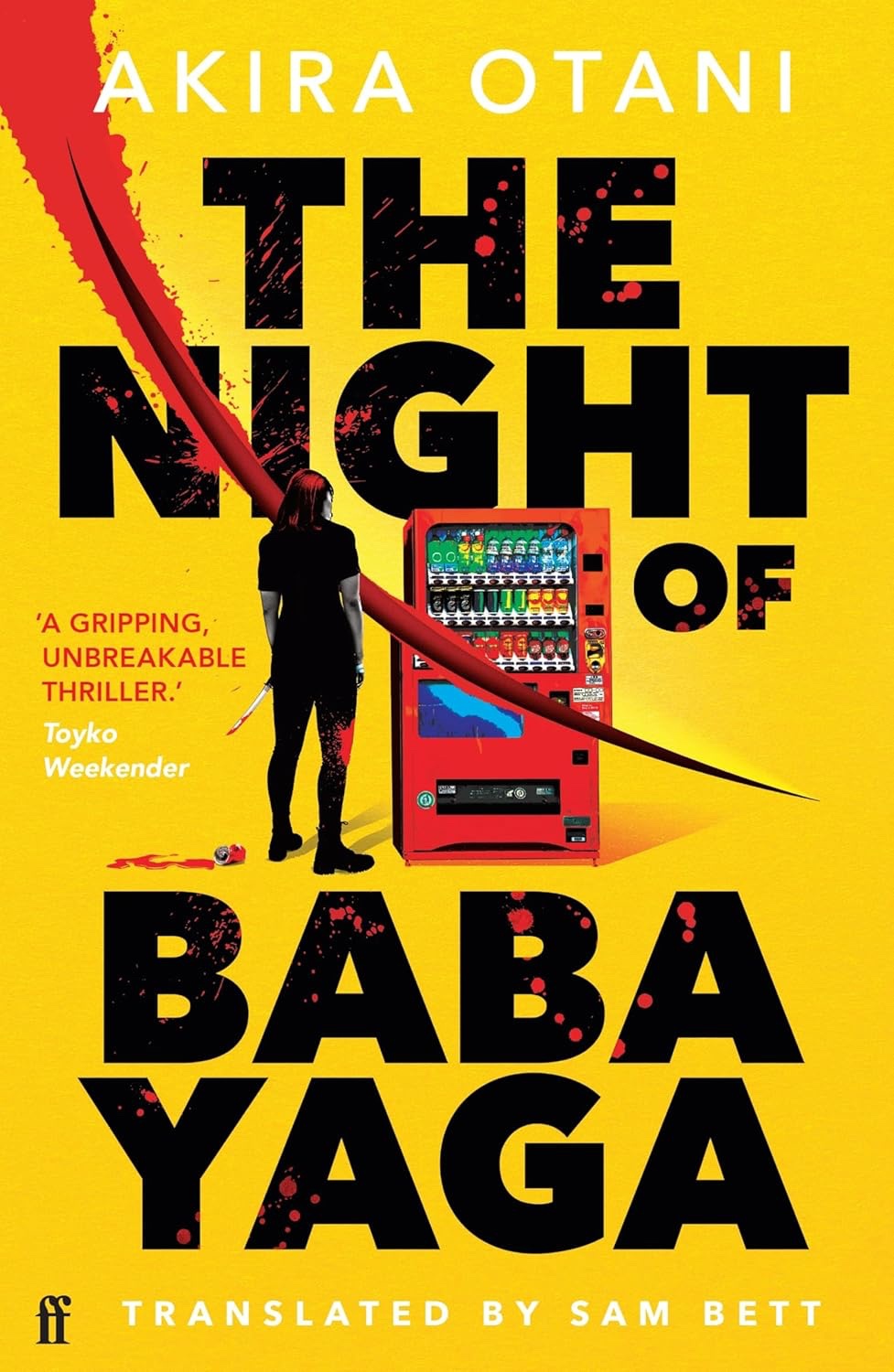
The Night of Baba Yaga is two hundred pages of violence, torture, and rape. All of the novel’s descriptions of violence, torture, and rape are graphically explicit; and again, there are two hundred pages of them. I enjoyed this book, but it’s not for everyone.   

The bulk of The Night of Baba Yaga is set in Tokyo in 1979. A 22yo street brawler named Yoriko Shindo is pressed into the service of a notorious yakuza crime syndicate whose boss has ordered her to become the chauffeur for his precious only daughter, a prim-and-proper college student named Shoko. The yakuza boss assumes that, because Shindo is female, she won’t attempt to romance Shoko, but of course the two women fall in love and help each other escape the family.

I’d like to say that The Night of Baba Yaga is a love story, but it’s more of a series of fight scenes occasionally broken by scenes of torture and rape. The novel begins and ends with Shindo getting the shit beaten out of her, and most of the gaps in the fighting are created by the aforementioned torture and rape. I’m not saying this is a bad thing. The Night of Baba Yaga is what it is, which is a lesbian BDSM hurt/comfort fantasy in which male characters enact hurt so that female characters can provide comfort. Aside from the brief comfort scenes, there’s not much romantic chemistry or character development.

The Night of Baba Yaga is empowering for the woman who wrote it, no doubt, and I get the sense that there will be queer readers (such as myself) who will be amused to see this sort of openly horny fantasy in print. The Night of Baba Yaga isn’t empowering for any of the characters, however. Short interstitial chapters jump ahead in time, but I hope it’s not a spoiler to say that nobody gets a happy ending. Not in this sort of story. The tragedy is so over-the-top it’s Shakespearean.

Personally, I thought the ultraviolence was a lot of fun. The action is so gory and exaggerated that it’s difficult to take seriously, and The Night of Baba Yaga feels silly and campy in the same way that Takashi Miike movies like Ichi the Killer do. If you (like me) are a fan of the horror movie mindset that inspires you to cheer with delight when somebody’s hand gets chopped off, The Night of Baba Yaga delivers.

The translator, Sam Bett, has done an amazing job. Fight scenes are notoriously difficult to write, yet the translation is snappy and remarkably fast-paced. The character voices aren’t “natural” by any means, but they’re pitch-perfect for the genre. When it comes to descriptions of rape and violence, Bett doesn’t pull any punches. It’s an incredible translation, and I am in awe.  

I’ve seen social media reviews hailing The Night of Baba Yaga as “an inspirational queer romance,” and it 100% most definitely is not that. Nobody does any learning or growing in this story, which has exactly zero social commentary. Rather, The Night of Baba Yaga is an adrenaline-laced lesbian power fantasy about being the most badass fighter you can be until you die. If you’re not the target audience, The Night of Baba Yaga probably isn’t for you. Like Wolverine, it’s the best at what it does, and what it does isn’t very nice. This short and compulsively readable novel gets in, gets messy, and gets what it came for.

Vibrator

Vibrator

Title: Vibrator
Japanese Title: ヴァイブレータ (Vaiburēta)
Author: Akasaka Mari (赤坂 真理)
Translator: Michael Emmerich
Publication Year: 2005 (America); 1998 (Japan)
Publisher: Soft Skull Press
Pages: 155

Vibrator is not an easy book to read.

In the first twenty pages, the 31-year-old bulimic narrator describes her strategies for throwing up after meals. Apparently, the trick is to not allow the food to digest. Soda water helps too, it seems. Alcohol complicates matters, but it’s difficult to give up entirely, because it makes the voices go away.

As you might imagine, the narrator of Vibrator has Issues. The first third of the novel is occupied by her nerve-wracking, stream-of-consciousness jabber. What’s perhaps most disturbing about the narrator’s ranting is not that it so accurately reflects narratives of self-hatred and self-doubt, but that the circumstances she describes make her anxieties and self-destructive behavior seem entirely justified. Being an independent woman in a man’s world is hard, and the narrator knows that her beauty will fade as she grows older, thus depriving her of her only advantage over her male colleagues. Moreover, as a female journalist, the narrator is placed in situations in which she must comment not as a professional but as a representative member of her gender, which she finds banal and insulting. To anyone – male or female – who’s ever resented her job or lamented her relative lack of professional success, the narrator’s complaints will be painfully familiar.

One snowy night, after buying a liquid dinner in a Family Mart on her way home, the narrator almost runs headlong into a tracker-trailer on the edge of the convenience store parking lot. The driver, a twenty-something named Okabe, invites her into the cab. The narrator wants to spend more time observing the white world generated by the snow flurry, and she feels as if she has nothing to lose, so she accepts his offer. They talk while drinking, and before long they’re on the road to the northern Tōhoku region. Sex is involved, but more interesting than the smut is the intimacy of Okabe’s story about dropping out of high school to become a low-ranking member of a yakuza clan.

Vibrator is not quite a love story. At the end of the book, there’s no indication that the sudden relationship between the narrator and Okabe will amount to anything beyond the single ride they share. Still, it’s lovely to witness the garbled voices in the narrator’s head slowly fade as she is calmed by vibrations of the truck’s engine (the “vibrator” of the title) and Okabe’s placid self-assurance. Even if the narrator is unable to achieve any deep or permanent connection with Okabe, her escape from her own head and engagement with the landscapes flashing past the truck’s windows is satisfying and meaningful.

Vibrator may not an easy book to read, but it’s certainly worth reading, if only to witness the skill with which the translator, Michael Emmerich, has rendered its narrator’s many voices.

If you live in the United States, Hiroki Ryūichi’s 2003 cinematic adaptation of Vibrator is streaming on Netflix. The film features gorgeous long shots of the Japanese countryside, and the director effectively removes the characters from the narrator’s incessant stream-of-consciousness commentary, which creates an entirely different atmosphere for the story. Tom Mes highly recommends this movie, and it’s a beautiful interpretation of the novel.

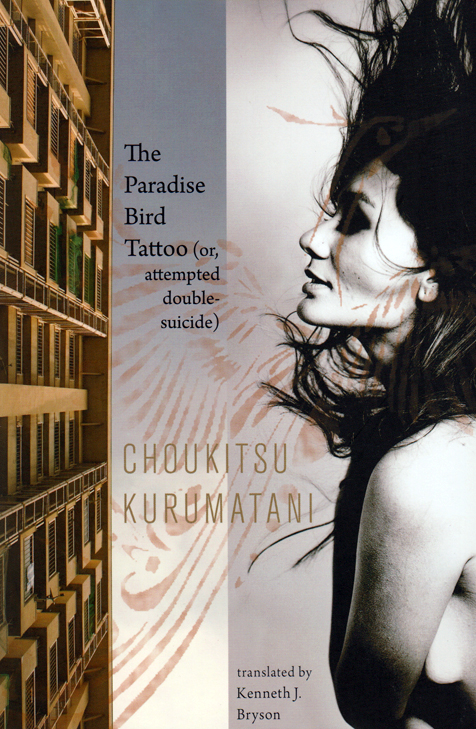
The Paradise Bird Tattoo

The Paradise Bird Tattoo

Title: The Paradise Bird Tattoo (or, Attempted Double-Suicide)
Japanese Title: 赤目四十八瀧心中未遂 (Akame Shijūyataki shinjū misui)
Author: Kurumatani Chōkitsu (車谷長吉)
Translator: Kenneth J. Bryson
Publication Year: 2010 (America), 1998 (Japan)
Publisher: Counterpoint
Pages: 225

I’m not going to lie – the first twenty pages of this book didn’t make me want to continue reading. The narrator of The Paradise Bird Tattoo, Ikushima Yoichi, is a graduate of an elite university who dropped out of society for reasons unknown, and he has all the charm of a thirty-three year old Holden Caulfield, which is to say not very much charm at all. Life sucks, he can’t get his shit together, he has no money, he goes from train station to train station with no rhyme or reason, people are disgusting, nobody likes him, he wants to assault salesgirls with scissors, and he might as well jump off a cliff.

On page twenty-one, Ikushima sits down for coffee with the woman who has agreed to temporarily employ and house him at the request of one of the narrator’s old friends. This woman, whom Ikushima refers to as “Seiko Nēsan,” owns a pub called Igaya in the Higashi-Naniwachō district of Amagasaki, an industrial suburb of Osaka located west of the Yodo River. As Seiko Nēsan tells Ikushima about how she used to be a pan-pan girl during the American occupation, the story begins to shift away from the narrator’s existential crisis and outwards to the other people who occupy the seedy little neighborhood where Ikushima now lives in a cheap backstreet apartment building.

Down the hallway is a room for by a prostitute for couplings that are oddly accompanied by what sounds like religious chanting. Across the hallway is a gruff tattoo artist named Horimayu who occasionally bursts into Ikushima’s apartment. An elementary school aged boy named Shimpei wanders around mostly unsupervised and alternately befriends and bullies Ikushima. A woman named Yi Mun-hyong, who goes by Ayako, lives in an apartment on the first floor and attracts Ikushima’s attention before entering into sexually charged yet emotionally complicated relationship with him.

As a an employee of Seiko Nēsan, Ikushima’s job is to sit in his apartment all day and skewer raw offal meat to be served later in her pub. Ikushima does so without complaining or seeking any sort of meaningful connection to the world around him, but he still ends up unwittingly getting pulled into the lives of the other people in the apartment complex and becomes trapped in relationships that he doesn’t fully understand. Seiko Nēsan asks him to retrieve a large amount of cash from the phone book in a public telephone booth, Horimayu pressures him into holding onto a mysterious sealed box, and Ayako enters his apartment one evening to have her way with him. By the second half of the book, Ikushima is way over his head into affairs about which he knows nothing.

The Paradise Bird Tattoo is a slow burning novel fueled mainly by the grungy atmosphere of the greater Osaka area of the late seventies. Ikushima’s narration contains details about his life in Amagasaki that make the book a pleasure to read. There’s a small sundries store in the same alley as Ikushima’s apartment that he doesn’t shop at because it’s too creepy for him, and the lady who runs it always gives him the evil eye from inside the store when she sees him. A group of cab drivers who spend most of the day gambling park their cars in an alley, but a woman whose house fronts the alley calls the police and has them tow all of the cars. Shimpei finds a toad and keeps it as a pet in one of the apartment drainage pipes until it dies. Seiko Nēsan comes over on a rainy day to have a beer, and she sings old Osaka folk songs rife with double entendre.

Kenneth Bryson’s tone and word choice captures the grittiness of the narrator’s style and attitude:

All I did day after day was cut up beef and pork organs and stick them on skewers. Sooner or later they would wind up in someone’s mouth, be digested inside his organs, and vanish into the toilet as excrement. I wasn’t sure what happened after that, but I assumed the reside would eventually be washed out into the ocean. It was just the same with the glamorous goods lining the shelves in the department stores and supermarkets; someday they would all become rubbish or shit. This was the essence of all human activity; this was why I could tell Seiko Nēsan in all honesty that I had no need for pleasurable pursuits.

The Paradise Bird Tattoo is a walk through the lives of people who live on the margins of society in a neighborhood that is as dangerous and desperate as those who inhabit it. Although the narrator can be a bit of a bore sometimes, the mindset that has led to his decision to abandon a middle class life is fascinating, as are the experiences he describes to the reader in full dirty detail.

Gold Rush

Title: Gold Rush
Japanese Title: ゴールドラッシュ (Gōrudo Rasshu)
Author: Yū Miri (柳 美里)
Translator: Stephen Snyder
Publication Year: 2002 (America); 1998 (Japan)
Publisher: Welcome Rain Publishers
Pages: 286

I recently stumbled across an article titled Reading List: Books to Help You Understand Japan, which is a transcript of a conversation between NPR’s Neal Conan, the Brooklyn-based poet Kimiko Hahn, and Donald Keene, who recently retired from Columbia University in order to live in Japan. When Hahn and Keene were asked to list their top five works for understanding Japan in the wake of the recent disasters that have beset the country, they fired off titles like The Pillow Book of Sei Shōnagon and Essays in Idleness. This bothers me for three reasons.

The first reason is the blatant cultural essentialism, or the idea that one can understand everything about contemporary Japan by reading texts written in the Heian period, as if nothing has changed in the past thousand years. It’s like saying that one can understand everything about contemporary America by reading Jonathan Edwards’s 1741 sermon “Sinners in the Hands of an Angry God.” The Japanese people live (and have always lived) in harmony with nature and posses (and have always possessed) an innate understanding of the beauty of impermanence – and Americans are all God-fearing Puritans who stifle their artistic creativity and capitalistic interests in order to serve their small agricultural communities.

The second reason is the academic elitism. The Tale of Genji is indeed a great monument of Japanese literature. It is also more than a thousand pages long, written in a style that is frustratingly elliptical, and set in a time period and society that are fairly alien to anything a contemporary American (or Japanese) reader would be familiar with. Reading The Tale of Genji is hard, and reading it without guidance is even harder. To assume that even a highly educated and intelligent reader could just pick it up and understand the unadulterated beauty of every word is somewhat presumptuous. Hahn’s recommendation of two literary anthologies is even more baffling. It’s like saying, hey, if you can’t crack open a 421-page anthology of medieval literature and read it in one sitting, there must be something wrong with you.

The final reason is the utterly bizarre assumption that, in order to understand the contemporary Japanese imagination of disaster, one need not read anything either written or set later than 1945. This is doubly strange to me, as Donald Keene recently published an excellent translation of Oda Makoto’s 1998 novel The Breaking Jewel (Gyokusai), which depicts a Japanese soldier’s harrowing experiences during the last few weeks of the Pacific War. Moreover, even if tales of firebombings and severe food shortages and suicide attacks and two atomic bombs and total defeat and occupation by a foreign power wouldn’t give us any insight into postwar and post-earthquake Japanese society, perhaps something like Murakami Haruki’s After the Quake, written in the wake of the devastating Kobe earthquake of 1995, presumably would. To suggest that we can best understand Japanese anxieties regarding nuclear power by reading the poetic travel diaries of Bashō is, quite frankly, ridiculous.

I think Yū Miri’s novel Gold Rush is a perfect antidote to the sort of essentialist thinking demonstrated in the conversation on NPR. Gold Rush is set in Yokohama’s Kogane-chō neighborhood, a wrong-side-of-the-tracks sort of neighborhood filled with small bars, cheap restaurants, pachinko parlors, and love hotels. When most people think of Yokohama, they probably picture the swanky and high-tech Minato Mirai waterfront area or the upscale Motomachi shopping and residential district that serves as the setting of several Tanizaki and Mishima novels. Kogane-chō, however, is a grungy, run-down pleasure quarter that has seen better days, as is the neighboring Isezaki-chō. The streets are dirty, the Ōoka River is dirty, the karaoke bars are dirty, the train station is dirty, the cheap hotels under the railway bridge are dirty, and I imagine that even the many soaplands that dot the area are dirty. Gold Rush begins when four middle school boys pick up a high school girl in this neighborhood. They get her drunk, have her come with them to one of their houses, and then rape her. To be more precise, three of them rape her, and one of them watches.

The one who watches is the book’s fourteen-year-old protagonist, Kazuki, and abetting a rape is just the beginning for him. If trigger warnings were applied to mainstream fiction, Gold Rush would be slapped with all of the big ones. Rape, violence, child abuse, murder, more rape, more child abuse, substance abuse, abandonment, sexism, self-harming behavior, eating disorders, more child abuse, and then more rape. There is also a particularly nasty scene in which Kazuki kills a dog with a golf club. One might question the existence of a plot buried under all of these triggers, but the plot isn’t really the point of the novel. The reader is instead engrossed in following Kazuki’s slow psychological deterioration from the perspective of an omniscient third-person narrator. Kazuki is like Holden Caulfield on crack, and the reader can’t help but identify with his adolescent frustration at the realization that his life and his destiny are not entirely his own, even if he continually takes his rage one step too far. The people who surround Kazuki aren’t much better than he is in terms of acting like decent human beings, and the world they all live in is a bitter, nasty place. In a way, though, Gold Rush is also a twisted sort of love letter to Kogane-chō and the low city charm that permeates it.

Reading Gold Rush is like reading a full-length Ionesco play like Rhinocéros (or a Bret Easton Ellis novel like American Psycho) in that it’s trenchant and biting and brilliantly absurd, but difficult to actually read for the very same reasons. It doesn’t help that Gold Rush is two hundred and fifty pages of ultraviolence unmitigated by chapter breaks. If there’s a reason the novel won the Akutagawa Prize, however, it’s because the writing is excellent. Perhaps it’s also because the physical and psychological spaces written by Yū Miri are more than a little familiar to Japanese readers. So yes, classics like The Tale of Genji are very Japanese, but so is Gold Rush, which is written by a zainichi Korean telling a story about juvenile delinquency in a decaying neighborhood of a seedy commuter city. Yū is a good writer, she tells a good story, and Gold Rush is good Japanese literature. It might even give the reader some small insight into contemporary Japan as well.