Title: The Word Book
Japanese Title: 単語集 (Tango-shū)
Author: Kanai Mieko (金井美恵子)
Translator: Paul McCarthy
Publication Year: 1979 (Japan); 2009 (America)
Publisher: Dalkey Archive Press
Pages: 148
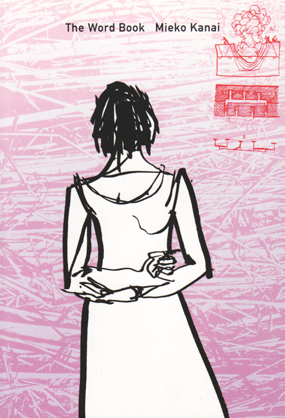
The pink cover of this small paperback might lead one to think that it’s a short collection of chick lit. While it’s true that Kanai Mieko is female, and while it’s true that she has often been classified as a “women writer,” The Word Book is just about as far away from chick lit as you can get. The twelve short stories in this collection are perhaps not so much “stories” as they are prose poems, or perhaps even essays written in the form of short stories. Kanai’s language is gorgeous, and the way she presents her ideas is fascinating. The stories themselves are very loosely structured and don’t follow established narrative patterns.
Kanai’s preoccupation in The Word Book is the writing self, or the self who is speaking, or telling a story. Many of the narrators in this collection are writers, and many of them are trying to explain something that happened in the past. Kanai almost fetishizes her narrators as they write about writing and constantly question their ability to tell a story. Perhaps it happened like this, perhaps it happened differently. Who is writing? Who is telling the story? Is the narrator of the story the same person as the protagonist of the story? Many of these stories have multiple narrators within the span of less than ten pages. A reader is faced with two choices – to either puzzle out who the narrators are and what their relationship to one another might be, or to let the narrative flow wash over him or her and simply accept that the narrator of a story is never a stable or unquestionable entity.
In that each of Kanai’s stories resembles something of an intellectual puzzle, I am reminded of Borges’s Labyrinths. In that Kanai’s stories are filled with a multitude of unreliable narrators who may or may not actually be the same person, I am reminded of Faulkner, especially As I Lay Dying. However, since Kanai is still able to infuse her stories with a sense of place and beauty, I am reminded of Furui Yoshikichi (Ravine and Other Stories, translated by Meredith McKinney), another Japanese writer of mysterious short fiction.
An interesting aspect of Kanai’s prose that I think is undeniably characteristic of her and no one else, however, is her play on gender. Kanai is a woman, but all of her narrators are men. To be more precise, Paul McCarthy has translated all of her narrators as men. I have only read a handful of Kanai’s stories in the original Japanese, but it is my impression that the writer takes full advantage of the ability of the Japanese language to not differentiate gender. Why does Kanai write with exclusively male narrators? Or are her narrators all men? Is she intentionally writing within a masculine narrative realm? If this book did not have a pink front cover and an “about the author” blurb on the back cover, would the reader even know that the author of this collection is a woman? Does it matter?
Meta-textual issues aside, I really enjoyed reading The Word Book because of its narrative sophistication, dreamlike atmosphere, and poetic touch. To illustrate what I like so much about this book, I would like to end with a passage from a story entitled “Fiction:”
But after awhile, I changed my mind: my guest’s words were as vague as they were clear, spoken by one who expresses by looks or by his whole weak body the scintillating talent of a born poet. Realizing this, I trembled with envy. Bitter as it was to admit, I was envious of those empty words, not understood even by the man who uttered them, those empty words that shone with a soft, rose-colored radiance. Words such as these, shining words bathed in a soft, rose-colored radiance, precisely because of their emptiness lusted after a shameless ecstasy of the sort one can only experience in dreams. And I thought, feeling a kind of despair, “Long ago my words, too, trembled violently in this shining, soft, rose-colored radiance.”

 Contemporary Japanese Literature