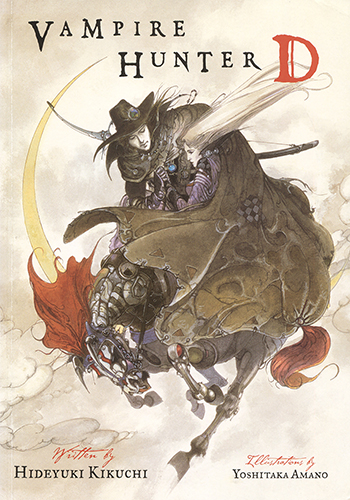
Vampire Hunter D

Vampire Hunter D is the first in a (still-ongoing) series of science fantasy novels written by Hideyuki Kikuchi and illustrated by the legendary Yoshitaka Amano. This first volume was published in 1983; and, in 1985, it was adapted into a film-length, direct-to-video animation that became a cult classic in the 1990s, when circles of genre fiction fans discovered ultraviolent sci-fi anime like Akira and Ghost in the Shell.   

I will admit that I was never able to get into the anime, whose art style doesn’t appeal to me personally, but I recently became interested in the novel series after rereading Gene Wolfe’s The Book of the New Sun. Wolfe’s tetralogy is perhaps the defining work of the “dying earth” genre of speculative fiction, in which human civilization has decayed to a medieval level after a global disaster in the far future.

Vampire Hunter D is set roughly ten thousand years in the future, when what remains of humankind lives in isolated settlements supported by barely-functional robots and occasionally policed by traveling bounty hunters sent from the Capital, which is filled with ruins but nevertheless seems to be the last city of any size. The story takes place on the Frontier, which has a pseudo-American “Weird West” sort of atmosphere that will perhaps be familiar to fans of Stephen King’s Dark Tower series.

Lurking above the ranches and saloons and cowboys are the remnants of a European-style aristocracy, who live in gigantic castles fortified by hypermodern surveillance technology. The Nobility, as they’re called, are immortal. Through various genetic alterations, they’ve come to resemble mythical vampires, and they’re proud to refer to themselves as such. Though the scattered Nobility are capable of artificially manufacturing their own nutrition, they have grown cruel and proud, and some terrorize humans for sport.

Doris Lang, a seventeen-year-old girl who manages her late father’s ranch outside of a small and dusty town on the Frontier, has fallen victim to the attention of the local vampire lord, Count Magnus Lee. Knowing that it’s only a matter of days before she’s either taken by the vampire or exiled by her fellow townspeople, Doris stands on the highway and waylays travelers in hopes of finding a professional hunter who specializes in handling monstrous mutants.

In a brilliant stroke of luck, the first hunter Doris encounters is one of the greatest, a vampire hunter who goes simply by the initial “D.” Though he appears to be a beautiful young man, D is a mixed-species dhampir who possesses the superhuman powers of vampires without most of their weaknesses. For his own mysterious reasons, D consents to be “hired” by Doris for no other payment than room and board.

The ancient Count Magnus, who is backed by his beautiful but deadly daughter Larmica, will not be easy to defeat. To make matters even more complicated, vampires are the least of the dangers threatening the humans who live on the Frontier, and D will also have to contend with werewolves, witches, outlaws, and lynch mobs if he hopes to keep Doris safe. There are eight chapters in Vampire Hunter D, and each presents its own unique set of villains. All of these threats eventually converge into a perfect storm of danger; but, in the end, it all comes down to a battle between D and the vampire lord.    

There’s a great deal of action in Vampire Hunter D, all of which is translated in a quick and punchy style by Kevin Leahy. There’s a somewhat shonen manga style to the action scenes, in which each of the characters performs a series of special attacks that have a rock-paper-scissors way of canceling one another out. I’m not generally a fan of action scenes in prose fiction, but Kikuchi’s sense of pacing is excellent, as is the creativity devoted to D’s opponents.

I’m also impressed by how lowkey horny this book is. Stories about vampires are infamously erotic, but Vampire Hunter D has a more universal Frank Frazetta style of sexualization. Gender, age, and even species don’t matter; everyone gets the same “Vaseline on the camera lens” treatment. As with the monster-of-the-week action scenes, I found this 1980s pulp fiction style of writing to be extremely charming.

It’s perhaps because of the nostalgic charm that I didn’t mind the story’s relative lack of psychological depth or complexity. Though she’s capable of defending herself against lesser monsters, Doris is a classic damsel in distress, and D remains mysterious from start to finish. D’s opponents seem to be evil simply because they’re evil, and even Count Magnus doesn’t have a personality that goes deeper than the usual vampire tropes. His daughter Larmica is granted a modicum of character development, but this is sadly limited. Still, the gothic expressions of the “dying world” setting are fantastic, and I appreciate that the world itself has far more character than the actors who drive the plot. 

I’m given to understand that, as a series, Vampire Hunter D leaves behind its formulaic action-oriented structure after the first few volumes. I read the first volume around the time it was originally published in English translation in 2005 and didn’t think much of it, but I find it far more compelling now that I’m older and have a better understanding of the story’s genre tropes, as well as how Hideyuki Kikuchi fits into a timeline of Japanese dark fantasy that’s recently come to wider international attention with the 2022 video game Elden Ring.

Dark Horse Books has published the first thirty books in translation, which are currently being collected into ten omnibus volumes. The first novel stands alone, and it’s a relatively quick read. I’d definitely recommend Vampire Hunter D to dark fantasy genre fans, as well as to anyone curious about the roots of JRPG video game tropes and imagery.

A Small Charred Face

Title: A Small Charred Face
Japanese Title: ほんとうの花を見せにきた (Hontō no hana o mise ni kita)
Author: Kazuki Sakuraba (桜庭 一樹)
Translator: Jocelyn Allen
Publication Year: 2014 (Japan); 2017 (United States)
Publisher: Haikasoru
Pages: 239

A Small Charred Face is a collection of three interconnected stories about vampires and the humans who love them. These vampires sleep during the day, fly by night, feed on human blood, can’t see their reflections, and never age during their 120-year lifespan. They also smell like grass and burst into bloom at the end of their lives, and they are called Bamboo. Their laws forbid them from befriending humans, but sometimes an outsider, alone and destitute on the margins of society, manages to catch the attention and the heart of a Bamboo.

The first and longest story, which frames the other two stories in the book, is “A Small Charred Face.” The story begins with horrific violence, with the narrator, a boy named Kyo, trying to escape a criminal organization that has just raped and killed his mother and sister. A Bamboo appears, hoping to feed on the bodies, but it ends up rescuing Kyo instead. The Bamboo, a young man named Mustah, takes him home to a seaside cottage where he lives with his partner Yoji. Kyo, who has grown up in wealth and privilege, is forced to adapt to life in the impoverished community, and Mushtah and Yoji convince him to disguise himself as a girl so that the people who killed his family won’t find him. Growing up as a girl in a household with two vampire fathers in a neighborhood ravaged by economic inequality, Kyo actually manages to enjoy a relatively normal childhood, but problems arise when a period of adolescent rebellion brings him to the attention of other Bamboo, who will not tolerate their existence becoming known to humans.

The second story (and the title story of the original Japanese publication), “I Came to Show You Real Flowers,” follows Marika, a female Bamboo from “A Small Charred Face,” several decades after her life intersects with Kyo’s story. Marika was transformed into a Bamboo when she was a teenager, so her mind and body remain those of a young woman. Marika adopts a human girl named Momo who has nowhere else to go, and together the two of them enact revenge on the men who prey on the weak and defenseless, which Momo luring them into a secluded spot so that Marika can swoop down, break their necks, and eat them. As Momo grows older, however, she begins to grow weary of being constantly on the run and surrounded by violence.

The third story, “You Will Go to the Land of the Future,” is the origin story of Ruirui, who will go on to lead a group of Bamboo immigrants from China to Japan. This story is narrated from the perspective of Ruirui’s older sister, the fifth child of the Bamboo royal family. This nameless young woman describes how the Bamboo are respected and revered in the small and isolated rural community that surrounds their castle in the mountains, and how the princes and princesses are carefully brought up according to Confucian tradition. All of this changes with the Cultural Revolution, however, which brings outsiders to the village and spreads distrust among the villagers. Anyone who deviates from the narrow ideology of the Communist Party must be struck down for the good of the people, so even the seemingly invincible Bamboo find themselves is terrible danger.

Kazuki Sakuraba began her career by writing light novels; and, although A Small Charred Face contains scenes of graphic violence and sexual assault, it still feels like young adult fiction in many ways. The narrators are children (or have the minds of children), and their worldview is correspondingly myopic. Although the third story occurs during the Cultural Revolution, it’s difficult to ascertain when the first two stories are set. They might be set in the present, or in the near future, or at the end of the twenty-first century. Technology is never mentioned, nor are any events that would have led to the circumstances under which Kyo and Marika lost their families. What is “the Organization” that goes around murdering and raping women and children, and why doesn’t anyone have a cellphone? Is the story set in an alternate universe in which Japan descended into chaos at some point during the twentieth century; and, if so, what happened? Unfortunately, the narrators are not interested in anything other than their own teenage emotional drama, so they don’t even hint at the state of the society outside of their own circle of acquaintances. Meanwhile, they simply take it for granted that the people around them are routinely raped and murdered as a matter of course. The stories also decline to explore the nature and culture of the Bamboo, and there’s only a bare minimum of worldbuilding and trope exploration.

As frustrating as these limitations may be, I think they’re fair. The reader can only speculate about what happened to Japan in this fictional universe, but the Cultural Revolution was very real, and there’s no reason a fourteen-year-old who survived something like that would be able to understand the larger geopolitical currents that resulted in everyone around them being suddenly being dragged out into the street and killed. Perhaps it’s not so farfetched to think that something like this could happen in Japan – or that it could happen anywhere, for that matter.

What A Small Charred Face does – and what it does very well – is to allow the reader to share the experience of living on the absolute margins of society as an outsider. The vampires in these stories are a metaphor for difference, of course, but this metaphor is far from abstract. The Bamboo are openly in same-sex relationships, and they are openly immigrants, openly working awful night-shift jobs, and openly in economically precarious positions. Mustah is Brazilian, Yoji is Chinese, and Ruirui is a political refugee. Although these characters live in hand-to-mouth circumstances, none of them threatens Japanese society. On the contrary, they provide the love, hope, and comfort that Japanese society is not able to offer to its own children. Yes, the Bamboo are literal vampires who feed on the blood of humans, but the majority of them obtain the blood they need by working in healthcare-related industries, especially those that force people to work awful hours and don’t pay well. Given Japan’s aging population and the severity of its healthcare crisis, I don’t think this is a coincidence.

I’m not generally a fan of young adult fiction, especially when it intersects the genre of supernatural romance, and I was not expecting to be as deeply moved by A Small Charred Face as I was. Sakuraba stages a trenchant social critique within the dystopian environment she has created for her vampires, but her characters are beautifully realized and full of heart. Their flaws are relatable, their kindness is believable, and their unhappy endings are a consequence of the profound injustices of our own world. If you believe in the transformative potential of young adult novels like The Hunger Games and Divergent, then I cannot recommend A Small Charred Face highly enough. And if you love monsters and see their difference as a reflection of your own, please rest assured that the gay romance in these stories is treated with sensitivity, as are feminist politics and gender fluidity.

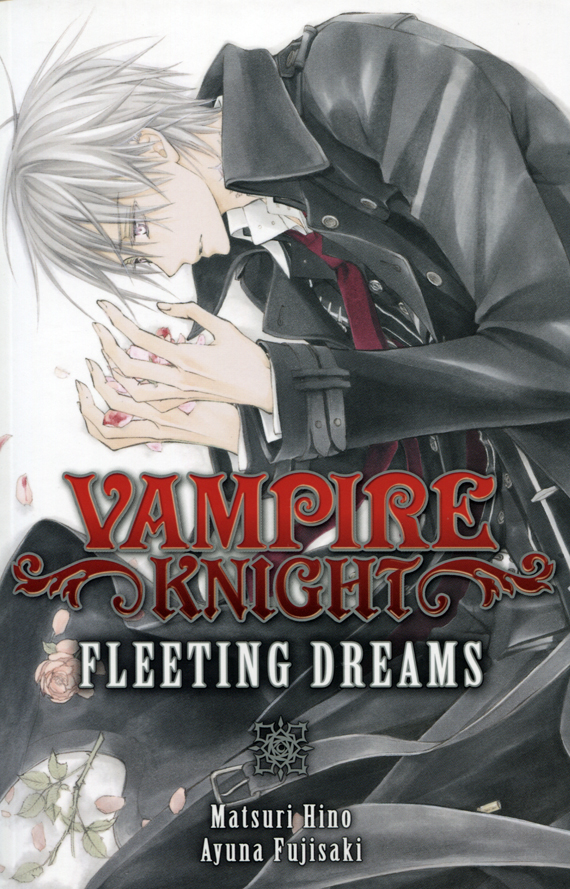
Vampire Knight: Fleeting Dreams

Vampire Knight Fleeting Dreams

Title: Vampire Knight: Fleeting Dreams
Japanese Title: ヴァンパイア騎士 煌銀の夢 (Vanpaia naito: Fureiru no yume)
Author: Fujisaki Ayuna (藤咲 あゆな)
Original Story: Hino Matsuri (樋野 まつり)
Translator: Su Mon Han
Publication Year: 2014 (America); 2013 (Japan)
Publisher: Viz Media
Pages: 273

Yesterday I blew through this book in one sitting, and I was like, “Why am I reading this garbage?”

Today I’m sitting in front of my computer, and I’m like, “Why am I reviewing this garbage?”

Vampire Knight: Fleeting Dreams is like a McDonald’s Oreo McFlurry: it’s cheap, it has absolutely no substance, it’s terrible for you, and yet it’s bizarrely compelling.

If you’ve never heard of Hino Matsuri’s Vampire Knight, it’s a shōjo manga supernatural soap opera starring Kurosu Yūki (Yuki Cross in the translation), a high school girl who is the object of the obsessive romantic interest of both Kiryū Zero, a vampire hunter who was bitten and turned as an adolescent, and Kuran Kaname, an older (much older) Pureblood vampire who has known Yūki since she was a small child. While Zero and Kaname glower and brood, Yūki is the embodiment of pure-hearted sweetness. She’s clumsy, she’s stupid, she’s ineffectual, and everyone adores her. Many necks are bitten.

Sexuality is the big theme in the first half of the nineteen-volume manga series, while the intersection of politics and bioethics is the major concern of the latter half (in which everyone is still sexy, of course). Although things happen to Yūki, and although the reader learns more about her background, her character doesn’t really change over the course of the story; and, at the end of the manga, she is just as trusting and cheerful and willing to sacrifice herself for others as she was at the beginning. In essence, although she’s surrounded by adults, she herself never really grows up. It’s from this characterization that the third major theme of the series arises, namely, the preservation of innocence.

What’s really interesting to me about Vampire Knight is that the fantasy the reader is most expected to identify with is not related to being the object of sexual desire or being physically young and healthy forever; rather, the fantasy of Vampire Knight; is all about being protected. Unlike the Twilight novels, in which Bella begins as Sleeping Beauty and ends up as Jean Grey, Yūki does not become a symbol of love or immortality. Instead, the reader comes to associate her with being shielded. Yūki fails at everything she does, but she is always given a second chance, and then a third, and then a fourth. She experiences hardship, certainly, but nothing is ever her fault. Although Yūki’s complete lack of development can be frustrating to the reader, one might say that her true talent lies in not being tainted by the evils of the adult world.

Vampire Knight: Fleeting Dreams is a collection of six short stories written by Fujisaki Ayuna, one of the scriptwriters for the Vampire Knight anime series. Although the book does contain a dozen illustrations by Hino Matsuri, the smoldering eyes and parted lips of the manga are largely (but not entirely) absent, as are all but the briefest references to the political games and secret technologies that dominate the latter volumes of the series. What Fleeting Dreams focuses on is the fantasy of being protected and sheltered, whether it’s Yūki finally succeeding in her studies after being assigned a private tutor, Zero becoming a temporary bodyguard for a female vampire named Shien, or the human students of Yūki’s high school finding a sense of community through a school festival.

My favorite story in the collection is “A Maiden’s Melancholy” (Otome no yūutsu: Aru hi no Howaito Ririi), which is narrated by Zero’s horse, White Lily. Describing herself as “the maiden of the snowy white blossoms,” White Lily is devoted to Zero and will allow no other rider to approach her, a temperament that has resulted in her being labeled as “difficult.” One day, when Headmaster Cross (Yūki’s adoptive father) proposes that White Lily be “matched” with a stallion named Black Sword, she becomes enraged but is unable to communicate her displeasure to Zero, who doesn’t oppose the arrangement. It turns out that the only person who is able to understand White Lily’s feelings is Yūki, who reassures the horse that Zero and Headmaster Cross would never do anything to make her unhappy. What I like about this story is that it highlights Yūki’s narratively underutilized ability to protect those around her because of her empathy, not in spite of it.

Of course, I also enjoyed the fact that the narrator of “A Maiden’s Melancholy” is a horse who proclaims her love for Zero in twenty-point font. It’s a ridiculous situation, and the writer plays it for all it’s worth. To be honest, everything in Fleeting Dreams is way over the top, and its dark heart pumps purple prose. The text is double-spaced and sits in the center of enormous margins, so not even the layout editor is trying to trick you into thinking it’s serious. Although the stories are intended for an audience that has already completed the manga (or Ayuna’s previous three-part novelization of the manga), you really don’t have to have read even a single volume of the series to appreciate the appeal; Fleeting Dreams is like the best (and worst) fanfiction in that the source text almost doesn’t matter.

If you don’t go into this book expecting camp, or if you don’t enjoy campy romance fiction to begin with, I guarantee that you will dislike Fleeting Dreams. As I wrote at the beginning of this review, it’s garbage. Regardless, I’m overjoyed that Viz Media has published it in lovely physical and digital editions, because it’s always good to see more light novels for girls in English. Yen Press has the boys spoiled for choice, and we really need some pointy boy bits (look at those fingers on Hino’s cover illustration!) to balance out all the bouncing breasts currently on offer. Bring on the trashy young adult chick lit!