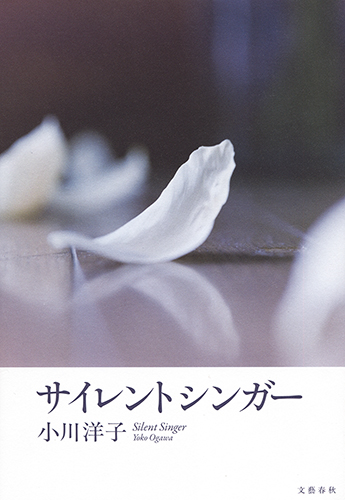
Yōko Ogawa’s 2025 novel Silent Singer (Sairento Shingā) is a bittersweet story about a woman named Ririka who lives alone in a mountain forest near a community of people devoted to silence. Ririka is a professional singer, but she never makes a name for herself, only taking freelance jobs that require a performer with an anonymous voice. Though the singer and the silent community eventually fade into obscurity, Ogawa celebrates the beauty and dignity of their lives, as well as the significance of creativity that never finds an audience.
On an isolated mountain in the countryside, a group of people calling themselves “The Introverts’ Club” have bought a parcel of land and formed a community named Acacia Fields, which is devoted to quiet and simple living. The Acacia Fields community isn’t a religious organization; rather, they’re normal people committed to the philosophy that “silence soothes the soul.” Anyone can join as long as they’re content never to speak in the presence of others.
Ririka lives in an old house next to a forest adjoining Acacia Fields, where her grandmother is employed as the gatekeeper. The gatekeeper’s job is to communicate with people from the outside world while also managing a small store that sells produce, pastries, and other items produced by the community, which raises livestock and maintains extensive gardens.
While her grandmother manages in the gatehouse, Ririka has the run of Acacia Fields. She spends hours with the aging doctor of the community’s small clinic, who isn’t bound by a vow of silence and reads to her while teaching her “finger language,” a simple form of sign language used by the community. Though her mother committed suicide after being abandoned by her father, Ririka enjoys a happy childhood divided between the public school in the town below the mountain, the doting care of her loving grandmother, and the quiet but genuine affection of the people living at Acacia Fields.
Ririka discovers her path in life during a sheep shearing session at Acacia Fields, when she’s asked to sing a simple lullaby to help keep the animals calm. She performs beautifully and enjoys herself immensely. A town official who attended the event is impressed by Ririka’s singing, and he asks her to record a similar song to be played over the municipal loudspeakers every evening at 5pm. Though no one knows the singer is Ririka, the song is so well-received that the tradition continues indefinitely.
Shortly after she graduates from high school, Ririka’s grandmother passes away. Ririka remembers her grandmother by visiting her Puppet Garden, which the old woman created after a child went missing in the mountain forest one summer. To soothe the boy’s spirit, Ririka’s grandmother fashioned five dolls from discarded household objects and placed them at the center of a small grove. For Ririka, the Puppet Garden serves as a place of quiet meditation.
Ririka takes over her grandmother’s position as the Acacia Fields gatekeeper while supplementing her income through various freelance jobs passed along by her voice instructor. In each case, Ririka is recommended because of her relative anonymity. Ririka sings jingles for television commercials, performs anime theme songs, records vocal tracks for idol groups, and even provides the voice of a talking children’s toy. Though she doesn’t seem to realize it, Ririka is quite successful as a professional singer, but she never leaves her home on the mountain.
As an adult, Ririka strikes up a romance with the security guard at the parking lot where she keeps her car. On their first date, Ririka takes him to the Puppet Garden, whose dolls are in a severe state of decay. Instead of being creeped out, the security guard is charmed. He’s a good match for Ririka, as he has an odd hobby of his own – piecing together carefully curated scrapbooks devoted to the lost works of famous authors.
The only shadow over the relationship is that Ririka finds herself unable to sing for her boyfriend. She can only sing, she explains, if her audience isn’t a living human. Meanwhile, with few young people moving to the mountain, the Acacia Fields community is in danger of being claimed by entropy and senescence.
Silent Singer resonates with echoes of the Studio Ghibli charm of Mina’s Matchbox; but, as is often the case with Yoko Ogawa’s work, a major theme of the novel is the gentle beauty of decay. Ririka’s house is slowly falling apart, as are the dolls in her grandmother’s Puppet Garden. The agricultural holdings of Acacia Fields are gradually diminishing, and the members of the community are growing old. Regardless, the village remains peaceful, as does the surrounding forest, especially in contrast to the absurdities of the freelance work Ririka takes as a singer.
In many ways, Silent Singer reminds me of Haruki Murakami’s 2023 novel The City and Its Uncertain Walls, especially in its aggressive refusal to engage with contemporary technology. It could be the case that the nostalgic settings of the two novels are simply a product of the preoccupations of two aging writers, but that’s not how these stories feel to me.
At this point in the death spiral of our capitalist hellworld, I’m bone-tired of “progress” that dehumanizes everything it touches. Meanwhile, Murakami’s narrator leaves his corporate job to work in a small-town library in Fukushima prefecture, while Ririka remains loyal to her home in a quiet mountain forest, which provides a refuge from the profit-driven demands of the entertainment industry. And good for them! I am here for characters who do not give a single fuck about social media or self-branding.
While it might be a stretch to call Silent Singer “anticapitalist,” this is a story about the value of creativity at the margins, as well as the beauty of art without an audience. Ogawa’s obsession with the decay that creeps in at the edges of isolated communities and individual lives can sometimes feel uncomfortable, but let it be uncomfortable! There’s nothing cozy about the richness of human experience, and the care and attention Ogawa devotes to the slow endings of her stories is one of the great pleasures of her work. The work of Ogawa’s “silent” creatives may be unremarked, but it’s far from unremarkable.

 Contemporary Japanese Literature