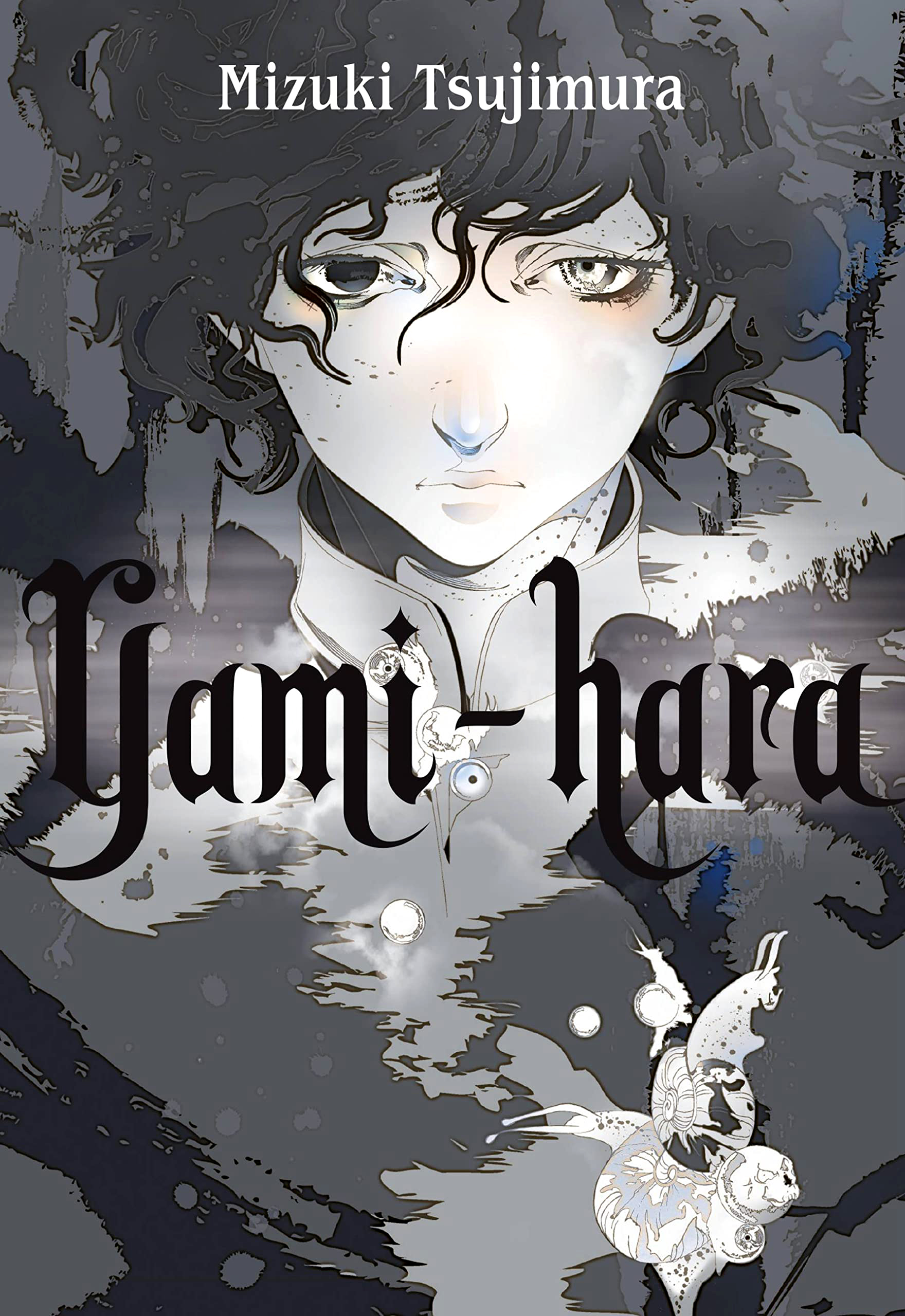
Mizuki Tsujimura’s Yami-hara is a collection of four disturbing stories about toxic social dynamics connected by a fifth chapter about the sinister force at the center of each of the conflicts. Although Yami-hara eventually reveals itself as supernatural horror, it’s entirely possible to read this linked story collection as a viciously cutting work of social satire.
The “yami-hara” of the title means “shadow harassment,” a term that indicates ostensibly benevolent behavior employed in such a way as to target a victim with gaslighting, self-doubt, and eventual social ostracization. Because there’s nothing technically “wrong” with the bullying, it’s not only tolerated but also actively facilitated by the broader community.
The first story, “New Student,” is about a toxic romantic relationship between two high schoolers. Straight-A student and class representative Mio is thrilled when her crush offers to walk her home from school, but his “protection” quickly escalates to constant texts and accusations that she isn’t taking their relationship seriously. Mio has trouble talking about her discomfort with her friends, because isn’t this just what boyfriends do? Isn’t this what she wanted? And what reason does someone who presents herself as “perfect” have to complain? Shouldn’t she be happy?
The fourth story, “Group Leader,” is an even better example of shadow harassment. In a class of elementary school students, there’s an obnoxious rich kid named Toranosuke who constantly causes trouble and gets away with it. A seemingly friendly but very intense boy named Niko transfers into the class but has little patience for the rich kid’s nonsense. Niko therefore volunteers to spend time with Toranosuke after school to help him study.
Toranosuke soon becomes the target of the “help” of the entire class, clearly against his will. No one does anything to prevent this, because none of the students are technically doing anything wrong. Isn’t it good to help someone study? Especially since Toranosuke was having trouble to begin with? And wouldn’t it be wrong, actually, to tell his classmates to leave him alone? Isn’t this for Toranosuke’s own good?
The third story is about “secret” workplace harassment that everyone sees, while the second story is about the lowkey passive-aggressive harassment between the women who live in the same posh apartment complex. This latter story, “Neighbor,” is particularly disturbing in its exploration of the many ways adult women can be evil to one another.
Speaking personally, I don’t think the final chapter that ties everything together is necessary. While it’s amusing to think that this sort of bad behavior is caused by literal monsters, nothing that any of the characters do is all that out of the ordinary.
Regarding the chapter about workplace harassment, I’ve unfortunately seen variations of this exact situation any number of times with my own eyes. It would be lovely if a troubled but handsome teenage exorcist could show up and fix everything, but real life is never so simple. After all, it’s notoriously difficult to confront abusers who are clever enough to keep their harassment in the shadows, especially when the larger community tacitly supports them.
Yami-hara is by the same author who wrote Lonely Castle in the Mirror, a YA novel that explores the concept of bullying from the genre angle of escapist fantasy. Unlike Lonely Castle in the Mirror, however, Yami-hara is quite bleak in its outlook. If I hadn’t already been familiar with the author’s work, I’m not sure it would have occurred to me that these two books were written by the same person.
Despite the anime-style illustration on the book’s cover and the “handsome teenage exorcist” plotline that emerges at the end of the story, I wouldn’t classify Yami-hara as YA fiction. This is a very smart and very sharp horror novel that requires the reader to think critically about all of the characters while rarely providing a sympathetic viewpoint.
Although the story contains no explicit violence or assault, I can’t deny that parts of Yami-hara are deeply uncomfortable. At the same time, it feels refreshingly cathartic to see a taboo subject like shadow harassment discussed openly and with such a high degree of sensitivity. If nothing else, I was morbidly fascinated by the panoply of bad behavior on display in this book, and I’d recommend Yami-hara to any fan of social horror looking for a strange and unique story that’s specific enough to be intriguing but relatable enough to be introspective – often painfully so.
 Contemporary Japanese Literature