A Treasure Hunter’s Guide to Dōjinshi

Or, how to find dōjinshi in Tokyo. Here is what you need to know before you set out:

First, stores specializing in dōjinshi tend to fall into two categories, dansei-muke (for men) and josei-muke (for women). Dansei-muke dōjinshi are usually highly pornographic, and it is far from uncommon for them to feature the graphic rape of minors (or characters drawn to look like minors). The term josei-muke refers to the genre of boys love (BL), but the majority of the dōjinshi found in josei-muke stores aren’t BL at all but rather humor, parody, drama, or light heterosexual romance. You can usually tell what you’re getting from the cover, but every dōjinshi is enclosed in a plastic slipcase that you can’t (and shouldn’t try to) open until you actually buy the thing. Most general-audience dōjinshi are ¥210, and a good rule of thumb is that, the more expensive the dōjinshi, the more pornographic its content. There are exceptions to this – the dōjinshi in question may be particularly rare, or particularly good, or by a particularly well-known artist – but again, you can usually make an educated guess on the content based on the cover.

Second, you need to know how to read Japanese. It goes without saying that all dōjinshi are written in Japanese (regardless of whether English is used on the cover). More importantly, no English is used in any of the stores. Dōjinshi are organized in kana order by the title of whatever work they’re based on and grouped according to genre (ie, video games, shōnen manga, Western television shows, Korean boy bands, etc). Dōjinshi based on more popular series (such as Hetalia or Final Fantasy VII) are further organized by pairing or dōjin circle. You’re therefore going to need to be able to read Japanese in order to navigate the stores. The staff at these stores is generally happy to help you find what you’re looking for, but you need to tell them the title of the gensaku (original work on which the dōjinshi is based) in Japanese before they can help you. If you’re not confident about your Japanese, it might be useful to bring a friend to help you navigate and to visit the stores as soon as they open (so they won’t be crowded).

With that in mind, here we go!
Ikebukuro

Ikebukuro, and more specifically Otome Road, is the mecca for fujoshi. It should be the first and last place that any female dōjinshi hunter visits. If you’ve never been here before, let me promise you that it’s anything beyond your wildest dreams. Bring lots of money.

Ikebukuro Station is absolute chaos, and it’s very easy to get lost. In general, though, you want to head towards the Seibu side of the station. There are several exits out of the JR portions of the station; but, if you follow the yellow signs for “Sunshine” (which are referring to Sunshine City), you should be headed in the right direction. The specific exit you want to take out of the station is Exit 35.

You’ll emerge from chaos into chaos. There will be a huge Bic Camera to your left and an enormous throng of people directly in front of you. Follow the throng straight ahead and then to the left to a street crossing. On the other side of the street will be a Lotteria on the left and a Café Spazio on the right. Cross the street and pass in between these two restaurants to enter an enormous shopping street called Sunshine Plaza. Walk all the way down the street until you reach a highway overpass. Cross the road under the overpass on the right side and then turn right in front of the Toyota Auto Salon. Walk until you reach a Family Mart, and then take a hard left all the way around the corner building. You should see an Animate in front of you. Congratulations! You’ve reached Otome Road.

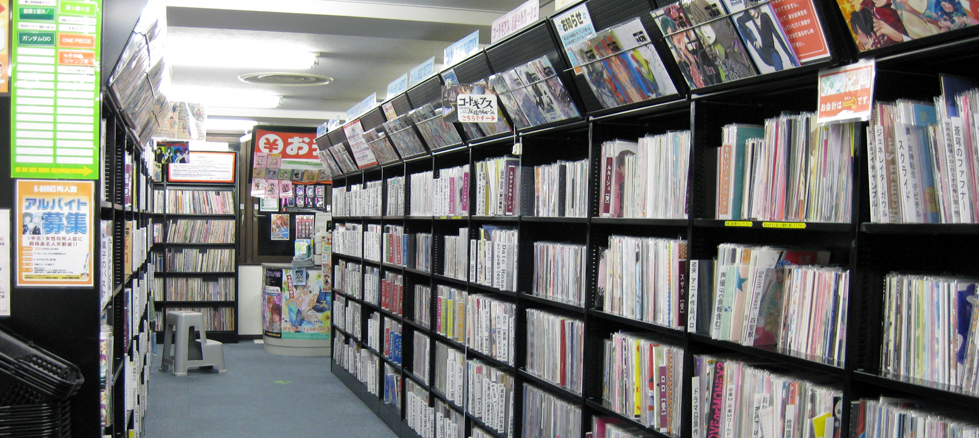
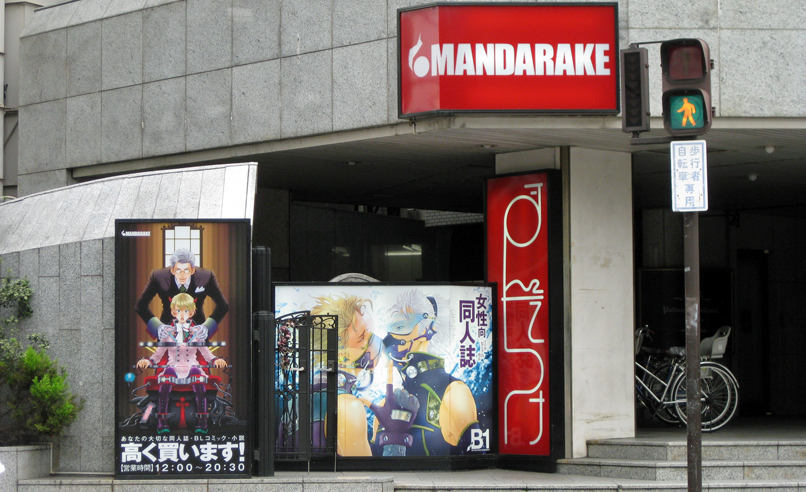
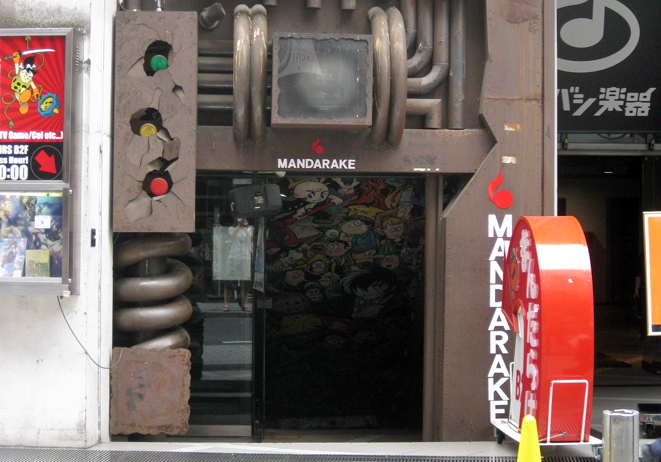
Otome Road begins at the Animate and ends at the three-story K-Books Dōjin-kan. This K-Books is probably the single best dōjinshi store in all of Tokyo. They have dōjinshi for every conceivable fandom, and they usually have the same dōjinshi for less money (¥210 as opposed to ¥420) than at the Mandarake you passed on the way. They also have tons of original dōjinshi and dōjinshi sets (all of the dōjinshi in a series, or a dōjinshi packaged with extras like fans or postcards). Keep in mind that all of the dōjinshi on the second floor are new and can usually be found for a fraction of the price on the third floor, where they sell used dōjinshi. What I like about this particular store is that they have a lot of general interest dōjinshi that have nothing to do with yaoi. The previously mentioned Mandarake has a much stronger focus on BL dōjinshi, and it’s a good place to find original dōjin artbooks as well.

There are two different branches of Café Swallowtail (a famous butler café) on Otome Road, one next to the Mandarake and one next to the K-Books. If you’d like to visit, make sure that you’re familiar with the process of attaining a reservation before you go. The two locations have two different reservation procedures, and you can only make a reservation for a thirty-minute time slot. Don’t be afraid of trying one out, even if your Japanese isn’t perfect, but it’s way more fun to go with a friend (especially since the cafés are geared towards parties of two).

On your way through Sunshine Plaza from the station to the highway overpass, you can turn right at any point to enter a maze of manga stores, maid cafés, and cat cafés. Also, if you’re really into Japanese youth culture and fashion, try entering Sunshine City (you’ll know it when you see it), which is the size of a small city – a small city filled with clothing and accessories for teenagers (and an aquarium). Finally, the cinemas lining Sunshine Plaza are the best places to go to see an animated movie, whether it’s the new Ghibli film or the latest feature-length spin-off of a popular franchise like K-ON. They’re also good places to pick up all the guidebooks and merchandise that accompany these movies. If you need to chill out and kill time before a show, you can always take advantage of one of the many many many kitschy love hotels (which are cheap and clean and more than likely have a nicer shower than your apartment or hotel) right off the main street.

Akihabara

Akihabara is where you go to get porn. The end.

Okay, seriously. Akihabara specializes in dansei-muke dōjinshi. There are tons of small dōjinshi stores located several floors up or several floors down from the narrow side streets that twist through the main electronics district. Many of these smaller stores cater to specific fetishes, and some of these fetishes might be extremely disturbing to some people. I will therefore leave the true exploration of this area to the truly adventurous. Thankfully, the Akihabara branches of K-Books and Mandarake are fairly mainstream (although still filled with porn).

Take the Akihabara Electric Town exit out of the JR station. Straight ahead you’ll be looking at several columns and a storefront, so head to your left to exit. Once outside the building, turn to your right. A few dozen feet down the left side of the street you’ll see the Radio Kaikan. There are several entrances into this building, but you want to take the escalator that goes directly from the storefront up to the second floor. (It’s right next to the display of electronic dictionaries. Incidentally, this is the single best place in Japan to get an electronic dictionary, as it has all the latest models at 40-60% off the list price.) Once off the escalator, go up the stairs to the third floor and then turn to your right to enter the K-Books dōjinshi store. Whatever fandom you’re interested in, from Evangelion to Azumanga Daioh, they have porn of it. They also have tons of fresh dōjinshi from the latest comic markets at reasonable prices, as well as other dōjin goods such as Vocaloid albums and body pillow covers.

[ETA: As of July 1, 2011, the Akihabara branch of K-Books has relocated to the “Akiba Cultures Zone” (AKIBAカルチャーズZONE). To get there, use the directions for Mandarake but turn to your left before the Sumitomo Fudōsan instead of after it. In other words, turn left at the Daikokuya electronics store (you should see the K-Books storefront reflected in the glass windows of the Sumitomo building). The first floor houses used manga, and the dōjinshi are on the second floor.]

The other big dōjinshi store in Akihabara is the Mandarake complex, which has separate floors for dansei-muke dōjinshi and josei-muke dōjinshi (as well as other floors for other things, like used manga and cosplay supplies). To get there, go straight past the Radio Kaikan until you reach a large street. This road is Chūō-dōri. Cross over to the other side of the street and turn to your right. Walk for about two blocks until you read the Sumitomo Fudōsan Building. Turn to your left after this building onto a small street, and you should see the Mandarake complex ahead on the right. The fourth floor has josei-muke dōjinshi, and the third floor had dansei-muke dōjinshi. The selection on both floors isn’t the best, but you can sometimes find stuff here that you can’t find anywhere else, such as the dōjinshi of a popular circle called CRIMSON, which publishes print versions of its dōjin visual novel games.

On the way to Mandarake, you will have seen the main branch of Tora no Ana on the other side of Shōwa-dōri. Tora no Ana publishes its own art books and dōjinshi (and a few mainstream manga like Fuku-Yomo), but its third floor is a fujoshi paradise of BL manga, manga magazines, and dōjinshi. Even if you’re not into porn, it’s worth visiting the Tora no Ana in Akihabara just to check out the culture.
Shibuya

The main attraction of Shibuya is the Mandarake, which specializes in used pornographic manga and figurines but has a sizeable josei-muke dōjinshi section with a unique selection. Since this Mandarake is somewhat removed from Otome Road, the dōjinshi in stock here aren’t the newest or the freshest that you can get your hands on, but this can work to your advantage if you’re looking for dōjinshi based on older titles like Sailor Moon, Revolutionary Girl Utena, Nodame Cantible, Hellsing, Wild Arms, Final Fantasy IV, or the next-to-latest incarnation of the Pokémon franchise. Also, if you’re looking for dōjinshi based on manga by CLAMP or the films of Studio Ghibli, this is the place to go. If you’re looking for original dōjinshi drawn by an artist like Ono Natsume or Yoshinaga Fumi, this is also the place to go. This particular store also has the friendliest and most helpful staff I’ve yet encountered.

To get there, take the Hachikō exit out of the JR station and orient yourself so that you’re facing the Tsutaya building with the Starbucks café. Head down the left side of the big road passing to the right of this building (the 109 Men building will be on the other side of the road). In about a block the Seibu department store will be on your left. Turn left to pass in between the two Seibu buildings (there will be bridges above you). Go straight on that street until it splits at a kōban (police box) and take the right fork. The Mandarake will be a block down on the left side of the street, directly across from a Choco Cro café. You’ll need to go down several flights of stairs to reach the actual store. (For the record, there is another entrance into the store, but this is the one that leads directly to its dōjinshi section.)

While we’re on the topic of Shibuya, I should also mention the Tsutaya I referred to in the directions. In my opinion, this particular branch of the chain is the single best place to buy new manga in Japan. They have multiple copies of all the volumes of all of the latest manga in stock, and they have really cute displays created by the staff to highlight interesting and notable titles. This is the place to go to find out what is popular in Japan right now, and you can take to elevator down to the basement to do the same trick with video games before progressively working your way up through music, movies, and literature.

If you find yourself spending a lot of money, go ahead and apply for a T-Point card, which also works at Book-Off (and Family Mart convenience stores and Excelsior coffee shops, for what it’s worth). Book-Off is a chain of used book stores known for its ridiculously low prices and the excellent condition of its used merchandise. In essence, after using your point card for the first two or three volumes of a manga at Tsutaya, you can get enough points to get a used copy of the next volume for free at Book-Off. And speaking of Book-Off, the one across the street from the Shibuya Tokyu Hands is a manga lover’s paradise. They also have tons of used light novels, art books, and video game strategy guides that you won’t even find in Akihabara.
Nakano

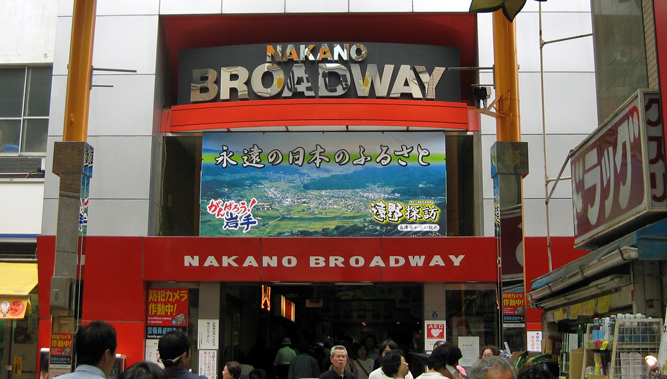
Nakano is a bustling, working-class shopping area a few stops out of the Yamanote loop on the JR Chuo line. The area is a bit out of the way of just about everything, but it’s home to Nakano Broadway, a rundown warren of manga stores and hobby shops. The top three stories of this indoor shopping complex are a hive of Mandarakes. If you have any sort of hobby related to anime or manga or video games, whether it’s cel collecting (fourth floor), cosplay (third floor), or researching Taishō-era children’s magazines (second floor), Nakano Broadway is where you go to spend all of your money. There are also tiny stores specializing in Ninja Turtles action figures from the nineties, old Japanese coins, and prayer beads and power crystals. There is even a Mandarake store called Hen-ya that, as its name implies, is a treasure hoard of the weird, baffling arcana of postwar Japanese pop culture.

From the JR Nakano station, take the north exit for Sun Plaza. Head around to your right past the turnstiles to exit the station, where you’ll see an open-air bus station in front of you. Beyond the bus station and to the right is the entrance to a shopping arcade called the Nakano Sun Mall, which is marked by yellow arches. Enter the shopping arcade and walk straight back all the way to the end to reach Nakano Broadway.

There’s nothing to see on the first floor, but you can take the escalator up to the third floor to reach the most awesome used manga store ever (run by Mandarake, of course). Whether you’re looking for editions of manga like Rose of Versailles from the eighties or the whole back catalog of a manga magazine like Monthly Cheese, they’ve more than likely got it stashed away somewhere. If you want to go straight to the dōjinshi stores, skip the escalator and take the stairs to the right of the escalator up to the second floor. Turn left from the stairs and then left again around the corner, and you should reach a dansei-muke store and a josei-muke store right across from each other a bit down the corridor.

Since Nakano is so out of the way, and since Mandarake keeps a lot of its excess stock up on the fourth floor, you can find old dōjinshi at these stores that have disappeared from just about everywhere else (such as those based on Harry Potter). The josei-muke store in particular specializes in anthologies, and you can strike real gold here if you don’t mind paying significantly more than the usual ¥210 – dōjinshi anthologies are huge and beautiful but can cost up to ¥5,000 (although ¥1,050 is more common). It takes a bit of work to get out to Nakano, and you’ll probably get seriously lost in Nakano Broadway, but it’s definitely worth the trip for a true treasure hunter.

***

All of the directions I have given take it for granted that you’re using one of the JR lines (such as the Yamanote-sen). Be aware that these directions may not apply if you’re using one of the Tokyo Metro lines (or another private line like the Keio-sen).

K-Books, Tora no Ana, and Animate all have point cards. These cards are free and allow you to accumulate points with each purchase. You can use these points to either take a discount off future purchases or to get limited edition goods that can only be bought with points. If you’re going to be spending a long time in Japan or are planning on spending a lot of money during a short visit, it might be worth your while to ask for one of these cards. (In the case of K-Books, you might want to just get one anyway, since they give you a choice of really cute, collectible cards.) You can just ask your cashier for a card at K-Books and Tora no Ana, but you’ll need to fill out an application form with your address in Japan at Animate.

All of the stores I have mentioned by name accept Visa and Mastercard. The only caveat about using a credit or debit card is that you may not be able to get points on your point card for that purchase. The policy on accumulating points for credit purchases differs from store to store (especially in Akihabara), but you shouldn’t have a problem anywhere in Ikebukuro.

Finally, if this guide has made you giddy with excitement, please consider investing in the book Cruising the Anime City. It’s a bit dated (just as this guide is probably going to be in a year or two), and it betrays a strong masculine bias, but it’s still awesome.
The Lake

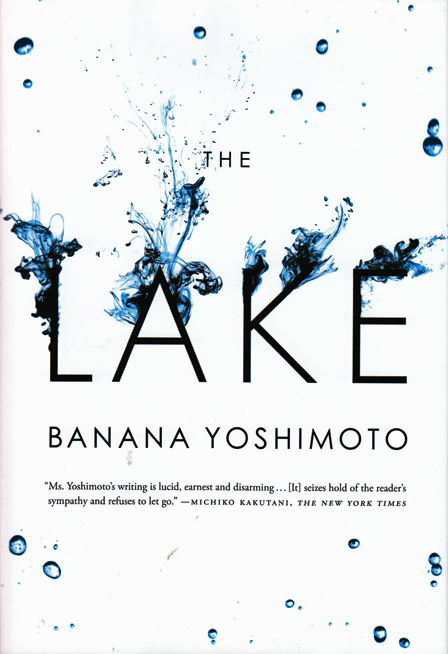
Title: The Lake
Japanese Title: みずうみ (Mizuumi)
Author: Banana Yoshimoto (吉本 ばなな)
Translator: Michael Emmerich
Publication Year: 2011 (America); 2005 (Japan)
Publisher: Melville House
Pages:188

I have been waiting for this book to come out for months. When it finally did, I read it in one sitting. As with many of Yoshimoto’s novels, it was occasionally frustrating, but I liked it. I guess one could say that The Lake is typical Yoshimoto. Allow me to explain.

The novel’s protagonist and first-person narrator, Chihiro, comes from a non-traditional family, works in a non-traditional profession, never worries about material things like money or the future even though she’s almost thirty, and seems to float through life, although she has hidden depths:

It’s like when you decide to build a house: some people want to go and find the land first, then hire an architect to help them draw up plans, and then choose the materials for the walls and everything on their own. I’m not like that. I prefer to wander around until I stumble across something, then I do the best I can with it, scrutinizing this thing I’ve discovered, getting to know it for what it is.

The heroine meets her love interest in an offbeat and untraditional way – in this case, he lives across the street from her, and they wave to each other from their respective windows until he talks to her on the street and casually starts showing up in her apartment. This love interest, Nakajima, is a grad student (first warning sign) and a stereotypical herbivore male:

I got the sense that he wasn’t really into sex, and he was shockingly thin, and although there were days when he would consume an astonishing amount, ordinarily he ate almost nothing, so overall he didn’t seem very energetic.

Nakajima is a little weird. Besides not having any friends and never wanting to sleep with our protagonist, he also exhibits behavioral quirks, such as his insistence on keeping detailed tallies of the money he owes Chihiro for using water and electricity when he stays over at her place. But Chihiro is still in love with him:

Whenever Nakajima said my name, every single time, it sparkled like a treasure. I had no idea why. Wow – did you see how that flashed? Say it again for me, please!

Chihiro gradually comes to realize that there is something seriously wrong with Nakajima; but, since she’s become attached to him, she decides to take it slow. As she ever so articulately explains to a friend:

“Anyway, he’s not like other people at all, it’s like, I don’t know how to describe it, like he’s living in the clouds, maybe. Like when people talk about someone having transcended it all – he’s like that, I guess. So part of me thinks it’s just in his makeup, and he would have been this way even if nothing had happened. For the time being I’ll just keep watching, I won’t rush it.”

Finally, Nakajima asks Chihiro to go with him to visit two old acquaintances who live in a cottage by a lake. Chihiro has been worried that Nakajima will leave her, either physically (by suddenly disappearing from her apartment) or psychically (by entering a long-term catatonic trance). She’s also bothered by his plans to leave Japan and study in Paris, which don’t seem to include her at all. She thinks about her anxieties as she walks around the lake with a trembling and profusely sweating Nakajima, but she still supports him, because:

He was an adult, perhaps thirty-five or so, and yet he was extremely small, like a child. His face seemed kind of shrunken, giving him the look of a bulldog. His eyes were sparkling, though, and there was something noble in the way he carried himself.

Do you feel like you’re reading a shōjo manga yet?

The narrative is driven forward by a twinned pair of mysteries: who are the people who live on the lake, and what is Nakajima’s damage? Both mysteries are solved when Chihiro returns to the lake on her own around thirty pages before the book ends; and, to give the author credit, they are resolved quite nicely and sufficiently satisfied my morbid, look-at-the-car-wreck curiosity. Still, I wasn’t too terribly invested in figuring out what was going on (the blurb on the book jacket sort of spoils it with its overt mention of religious cults), and I didn’t really care about the relationship between Chihiro and Nakajima, which was more hurt/comfort than actual romance.

What was interesting to me were the descriptions of small-town politics. The majority of the story is set in Tokyo, but Chihiro comes from a small town where her father wasn’t allowed to marry her mother, who worked as the mama-san of a small bar. Chihiro’s assessment of her father’s family, the patrons of her mother’s bar, and the atmosphere of the town in general are acerbic and insightful. Also, Chihiro works as a muralist, and one of her friends commissions her to create a mural on one of the walls of a run-down community center in a small neighborhood in Tokyo in an effort to save the structure from being demolished. The interplay between Chihiro, the community center, the local government, and a potential sponsor of the project is dramatic in a quiet sort of way, and Chihiro’s explanations of her creative process as she interacts with the people who watch her work are also interesting.

If you like Banana Yoshimoto for her quirky characters, fragmented yet loving families, and universes almost like our own but one step closer to the supernatural, then you’ll like The Lake. If you dislike Banana Yoshimoto for the lack of adult judgment in her characters and her rambling, juvenile prose (which is tight like a handful of squirming hamsters), then you probably won’t like The Lake. For the record, I like the book, and I also think Michael Emmerich did an excellent job of translating it.

Getting Wet

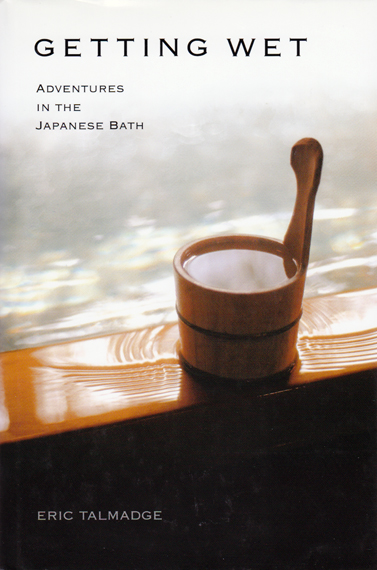
Title: Getting Wet: Adventures in the Japanese Bath
Author: Eric Talmadge
Publication Year: 2006
Publisher: Kodansha International
Pages: 255

For the past two weeks, the internet has been deluged with people talking about how Tokyopop is going out of business. Somehow, in all the confusion, it seems that it’s slipped everyone’s mind that Kodansha International is closing its doors as well. At least, it’s ceasing all operations at the end of April. Which was yesterday, I realized a few hours ago – to my considerable dismay.

In my startled panic, I thought about writing a brief retrospective highlighting the excellent work the publisher has done with regards to promoting Japanese literature in America. I thought about how the company has put out the early novels of Murakami Ryū (such as Coin Locker Babies and Almost Transparent Blue) and the murder mystery novels of Miyabe Miyuki (such as The Devil’s Whisper and Shadow Family). I thought about how the company has published offbeat classics like Natsume Sōseki’s Botchan and Kawabata Yasunari’s House of the Sleeping Beauties. I thought about how the company has taken financial risks to publish niche-interest period dramas such as Ariyoshi Sawako’s The River Ki and Fujisawa Shūhei’s The Bamboo Sword, and then I thought about how the company has taken on even greater financial burdens to collect contemporary avant-garde short fiction in anthologies like Monkey Brain Sushi and Inside.

But really, I think what I’m going to miss the most are Kodansha International’s intelligent and beautifully published books about Japanese culture, like Diane Durston’s Old Kyoto, Kiyoko Morita’s The Book of Incense, and Jay Rubin’s Making Sense of Japanese. And of course Eric Talmadge’s Getting Wet, which is probably my favorite “foreigner writing about Japan” book ever.

As its title suggests, Getting Wet is about baths in Japan. Private baths, public baths, bathing resorts, and bathing theme parks. And of course you can’t talk about baths in Japan without talking about onsen, or hot spring baths. Talmadge covers onsen in Hokkaido, onsen in Nagano, onsen right in Tokyo, and onsen in the Izu Islands south of Tokyo. There are onsen with mineral water, onsen with radioactive water, onsen with electrified water, onsen on the lips of volcano craters, onsen so acidic that your eyes hurt for days afterward, and onsen with snow monkeys.

There are plenty of books on Japanese baths floating around, but what I like about Getting Wet is that it’s not a traveler’s resource like A Guide to Japanese Hot Springs or a coffee table design book like The Japanese Bath. It is instead a collection of eleven journalistic essays unified by the theme of bathing. These essays aren’t travel literature, per se, but rather memoirs (if such a stodgy word is actually appropriate) of life in Japan cradling a core of interesting contextual information. For example, the fourth chapter, “Under the Bridge,” is about a trip to the Oedo Onsen Monogatari theme park in Odaiba. Talmadge begins by admitting his reluctance to don a yukata (he claims that they always flip open at the front at inopportune moments – which they do) and then walks his readers through the park before comfortably sliding into an essay about the Arima springs in Kobe, where emperors and the Heian nobility used to bathe. Talmadge then compares the Japanese history of bathing to that of the West, storied as it is with the opulence of the Greeks and Romans and Moors. Elsewhere, when Talmadge talks about mineral springs, for instance, he explains how our skin works and how our bodies retain water. When he talks about the onsen in the north of Japan, he writes about economic depression and the drive towards international and regional tourism (and why these initiatives never work). All of this writing, both travelogue and journalism, flows together smoothly, as if it were a feature in National Geographic.

Except Getting Wet is a lot more interesting than National Geographic. The way its author writes reminds me of the way my favorite grad student drinking buddy tells stories. His vocabulary is colorful but not ostentatious, he’s done his research and knows his facts, and he’s not afraid to laugh at something that’s ridiculous or unpleasant. Talmadge’s language is crisp and clean and for the most part professional, but every once in awhile he’ll let a colloquialism slip in (“The bath was – excuse me – fucking hot. It was really fucking hot.”), which adds both spice and warmth to his narrative. To put it simply, Getting Wet is a pleasure to read. Even if you don’t care about hot springs or bathing. Even if you don’t care about Japan. In terms of interesting and enjoyable essays, Eric Talmadge is right up there with John McPhee and Annie Dillard.

The book is a pleasure for other reasons as well. What I have always loved about Kodansha International is the attention and care they put into each publication, from the font to the page layout to the beautiful cover and binding. Most of these small touches are up to the reader to discover, but I should mention, in the case of Getting Wet, that the photographic illustrations are especially stunning. I don’t mean “stunning” in the sense of “created by a professional photographer with professional software,” but rather that the pictures are unusually sharp, printed in soft yet high-contrast greyscale, and perfectly positioned beside the text. In other words, the high quality of the images is something that you don’t find often even in art books published by specialty presses.

Kodansha International’s Japanese parent company has recently invested quite a great deal of money in Vertical, so I think that perhaps it’s not unreasonable to assume that their fiction licenses will change hands at some point. I’m not so sure what will happen to their non-fiction, though. Kodansha International put out beautiful books, and it will be a shame to see publications like Getting Wet disappear. I have loved Kodansha International and its books for many years, and I’m going to miss them now that they’re gone. Thankfully, the international arm of the company is resurrecting itself as a high-profile manga publisher, so this story may just have a happy ending after all.

The Summer of the Ubume

Title: The Summer of the Ubume
Japanese Title: 姑獲鳥の夏 (Ubume no natsu)
Author: Kyōgoku Natsuhiko (京極夏彦)
Translator: Alexander O. Smith and Elye J. Alexander
Publication Year: 1994 (Japan); 2009 (America)
Publisher: Vertical
Pages: 320

Reading The Summer of the Ubume was like being in a trance. Honestly, it feels weird to not be reading the book right now, but I imagine that I’m going to be reading it again soon. I haven’t been this engrossed in a book since I read Harry Potter and the Deathly Hallows

Which is not to say that Summer of the Ubume is in any way like the Harry Potter series, aside from its sheer literary addiction quotient. On the surface, the book presents a simple “sealed room” murder mystery. Underneath, however, is mystery upon mystery upon mystery. Running through these mysteries is a current of Japanese folklore, especially folklore concerning spirit possession. The “ubume” of the title is the ghost of a woman who died in childbirth and carries out her grudge against still-living mothers by stealing their infant children. This trope is connected to the household of a family that is just about as gothic as they come, with frail maidens and hereditary curses and hidden murders set on the stage of an almost abandoned hospital, which was designed by an insane architect and almost destroyed during the wartime firebombing of Tokyo.

The Summer of the Ubume is set in 1952 in the Nakano area, which used to be a residential district on the northwest periphery of Tokyo, a stone’s throw away from the prisons, insane asylums, and black markets of Ikebukuro. Its narrator is a man in his early thirties named Sekiguchi, a freelance writer who specializes in essays on supernatural incidents. Sekiguchi is friends with the brilliant yet antisocial proprietor of the Kyōgokudō used bookstore (which is the name his friends use to refer to him). Sekiguchi is the Watson to Kyōgokudō’s Holmes, and a great deal of the book is devoted to their conversations concerning metaphysical matters, which end up having a great deal to do with the mystery at hand.

In the course of his work (which borders on yellow journalism), Sekiguchi has stumbled upon a rumor of a woman who, having been mysteriously deserted by her husband, has been pregnant for eighteen months. After asking several magazine editors about the source of the rumor, Sekiguchi becomes more intrigued. Due to a strange series of coincidences, the writer has the opportunity to meet the woman’s family, which is deeply dysfunctional in every possible way. As Sekiguchi learns more about these people, it turns out that his ties to them are deeper than he initially suspected.

The first chapter of the novel is a forty-page discussion of the supernatural between Kyōgokudō and Sekiguchi. Each page is dense with ideas and metaphysical language (not to mention text – the book’s margins are practically nonexistent), and neither Sekiguchi nor Kyōgokudō is presented in a particularly sympathetic light – Sekiguchi comes off as rather dense while Kyōgokudō is supremely abrasive. If the reader can weather this initial chapter, however, he or she will be rewarded with a deliciously convoluted mystery populated by a genuinely fascinating cast of characters. The action of the story reaches its climax 230 pages into the novel, which leaves 90 pages for the explanation of the mystery. Although this may seem like poor pacing, the explication is well-plotted, engrossing, and bizarre, reaching its own climax at the end of the novel.

The Summer of Ubume is Kyōgoku’s debut novel, and at times it does feel unpolished. The momentum of the story more than makes up for any flaws in the narrative’s structure, however. The occasional clichés implicit in the mystery (such as the uncertainty that is inevitably created when there are two almost identical sisters in a fictional family) are balanced by the writer’s unique take on the gothic genre. The novel’s setting in 1950’s Tokyo is fully taken advantage of by Kyōgoku, who skillfully renders the city as a sinister gothic landscape.

Although, as I mentioned, there is a greater emphasis on talking heads in this novel than is strictly necessary, the characters and setting are superbly handled, and the mystery is just about as addictive as they come. I can only hope that more of Kyōgoku’s work is translated into English as soon as possible.

Dōjinshi (Part One)

In a short series of essays, I would like to discuss Japanese dōjinshi (hereafter unitalicized) based on the work of Japanese director Miyazaki Hayao. I would also like to examine the relationship between fan works and the concept of auteurship. First I will give a brief explanation of what dōjinshi are and the place they occupy in Japanese subculture. Second, I will provide examples of several dōjinshi based on Spirited Away (千と千尋の神隠し), Howl’s Moving Castle (ハウルの動く城), and Ponyo on a Cliff by the Sea (崖の上のポニョ). Finally, I will explore the hermeneutical relationship between these dōjinshi and the original texts on which they are based, as well as the relationship between auteurs and fan creators.

Dōjinshi (同人誌), a word that might be glossed as “fan works,” or “fan manga,” are self-published, small-scale publications written by fans and for fans of a particular work (be it a movie, a book, a television series, or a video game) or of a particular romantic pairing possible within that work. For example, there are many dōjinshi based on J.K. Rowling’s young adult fantasy series Harry Potter, and many of these Harry Potter dōjinshi focus on a specific romantic couple, such as that formed by Harry’s two friends Ron and Hermione. As in the realm of American fan fiction, many dōjinshi explore the possibility of an alternate outcome of the events in the story of the original work. This leads, for example, to dōjinshi dealing with the formation of a romantic relationship between Harry and Hermione, or perhaps between Harry and his male rival Draco. Unlike American fan fiction, however, the vast majority of Japanese dōjinshi employ both the form and the conventions of manga. In the rare case that fan fiction is published as a dōjinshi, it is often accompanied by illustrations that are either drawn by the writer or by an artist commissioned by the writer.

Since the production of manga is a labor-intensive process, most dōjinshi artists operate within what are called “circles” (サークル), or groups. Although there are a number of “individual (個人) circles” consisting of only one person, most circles are made up of two or more people. The division of labor takes different forms within different circles. In some cases, the work of two or more artists operating separately from each other will appear in the same publication, while in some cases, secondary artists will help the primary artist with things like background detail and the application of screen tone. In many other cases, different teams of artists will publish different dōjinshi under the same circle name. In any case, a dōjinshi is just as likely to be attributed to a circle as it is to be attributed to a specific artist. On the back cover of this dōjinshi, we can see both the circle name and the names of the two artists who contributed to this particular work.

One of the main reasons why artists who create dōjinshi continue to operate within the circle system despite the prevalence of labor-saving digital artistic tools like Photoshop and individual-centered communication networks like deviantART is the continuing popularity of conventions like Comiket (コミケット), short for “comic market,” a three day event held biannually at Tokyo Big Sight. The first Comiket was held in 1975; and, since then, attendance at each event has risen from several thousand to several hundred thousand. Comiket is primarily an event for the purchase and selling of dōjinshi. Since there is a limited amount of space for dealers, many fledgling artists participate in events like Comiket as members of a circle, which gives them a greater chance of acquiring a dealer’s table. Although Comiket is the largest convention of its kind, numerous dōjinshi conventions occur throughout the year all over Japan. A notable example is the Comic City convention in Osaka.

Aside from these conventions, dōjinshi may be acquired year-round at chain stores specializing in used manga (such as Mandarake) and dōjinshi specialty stores, which tend to be located in major urban shopping districts, like Ikebukuro and Akihabara in Tokyo and Den Den Town in Osaka.

Dōjinshi specialty stores like K-Books tend to fall into two divisions, which reflect the preferences of the two main demographic groups of dōjinshi consumers. These two divisions are “meant for boys” (男性向け) and “meant for girls” (女性向け). Dōjinshi meant for boys are typically heavily pornographic in nature, and dōjinshi meant for girls generally focus on homosexual romantic relationships between male characters. This genre of dōjinshi (and, increasingly, mass market manga) is known as “B.L.,” which is an acronym for “boys’ love.” The line dividing “meant for boys” and “meant for girls” is not sharply drawn, however, are there does exist a large category of general audience dōjinshi that does not expressly cater to the conventions of either category.

Part Two
Part Three

The Makioka Sisters

Title: The Makioka Sisters
Japanese Title: 細雪 (Sasameyuki)
Author: Tanizaki Jun’ichirō (谷崎潤一郎)
Translator: Edward G. Seidensticker
Publication Year: 1948 (Japan); 1957 (America)
Publisher: Vintage International
Pages: 530

In his introduction to Shimazaki Tōson’s The Broken Commandment (破壊), translator Kenneth Strong lists Tanizaki’s The Makioka Sisters as one of the five most famous works of Japanese literature in the West (along with Kawabata’s Snow Country, Sōseki’s Kokoro, Abe’s Woman of the Dunes, and Mishima’s Temple of the Golden Pavilion). Strong wrote this essay in 1972, and, since then, I would say that Naomi has replaced The Makioka Sisters as the Tanizaki text that is most frequently taught. The formation of national identity in the pre-war period is a hot topic in Japan-focused scholarship these days, especially when the evils of modernity are represented by a sexy young woman. Regardless, The Makioka Sisters is still an excellent novel.

As the English title suggests, the novel is about four sisters who live in a suburb of Osaka. Tsuruko and Sachiko, the two older sisters, are married, but the two younger sisters, Yukiko and Taeko, are not, and therein lies the main conflict of the novel. Eldest sister Tsuruko moves to Tokyo after her husband gets transferred, so the task of marrying off third sister Yukiko falls to second sister Sachiko and her (Tanizaki stand-in) husband Teinosuke, who remain in Osaka. The problem is that they can’t find a suitable husband for the shy traditional beauty, who has entered her thirties under the shadow of rebellious youngest sister Taeko, who cares nothing for the family’s reputation.

After Tsuruko and her family move to Tokyo, they all but disappear from the story, which is fine, since the author has more than enough material to work with concerning the three sisters who stay behind. Each of the three is an interesting and fully developed personality in her own right, and they have plenty of floods, illnesses, and secret love affairs to keep them busy. Taeko especially falls into the role of Tanizaki’s trademark femme fatale, with her modern clothing, flirtatious attitude, lies, ridiculous expenditures, and so on. Although the reader can’t help but share her sisters’ attitude of frustration towards her, Taeko adds spice to the novel and generally drives the plot forward.

Not that the novel has much of a plot. Nothing grand happens, no one important dies, no major secrets are revealed, and all conflicts are eventually resolved to everyone’s satisfaction. Instead of focusing on dramatic action, Tanizaki has instead created a world within his novel and invited the reader to visit it for five hundred pages. Although I wasn’t able to read the book for long stretches at a time, I was happy with its length and would have even been happy if it were longer. Even though the story takes place during the opening years of the Pacific War, the characters occupy a comfortable environment rich with detail, culture, and tradition. In other words, this is a novel not to be enjoyed for its forward impetus but rather for its description of a family outing to Kyoto to see the cherry blossoms. Any fan of traditional Japanese culture, and especially the tension between tradition and the modern lifestyle, should enjoy this novel – there’s a reason why an earlier generation of Japan scholars considered The Makioka Sisters to be one the defining works of modern Japanese literature.

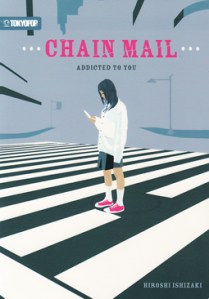
Chain Mail: Addicted to You

chain-mail

Title: Chain Mail: Addicted to You
Japanese Title: チェーン・メール―ずっとあなたとつながっていたい
Author: Ishizaki Hiroshi (石崎洋司)
Translator: Richard Kim
Publication Year: 2007 (America); 2003 (Japan)
Publisher: Tokyopop
Pages:209

Okay, I’ll admit it: when I came back home from Japan this past summer, I got really into Stephenie Meyer’s Twilight series. I know that many people like to complain about how the books are poorly written, misogynistic, heterocentric, painfully conservative, blah, blah, blah (I’m surprised no one has ever called them “phallogocentric” – that’s my personal favorite). First of all, the Twilight books are not poorly written; anyone who’s actually seen “poorly written” can attest to that fact. Second, I like to turn my feminist switch off when I read sparkly teenage vampire romance novels.

In any case, the Twilight series alerted me to the existence of the American genre of young adult fiction in a way that Harry Potter never did. (I think this is partially because I wouldn’t be caught dead reading “young adult fiction” when I was actually a “young adult,” but kids were a lot cooler seven or eight years ago.) I went to my local Borders and started doing market research, finding that, indeed, young adult fiction is a thriving genre, even though the vast majority of it is absolute crap. Perhaps the only good thing about the sudden popularity of the genre is that manga publishers like Tokyopop have started translating and publishing Japanese light novels.

A light novel is the Japanese equivalent of young adult fiction. These short, middle-school reading level books read like the plot of a manga, are often illustrated by noted manga artists, and are generally serialized like manga. Many popular anime, such as Slayers (スレイヤーズ) and The Melancholy of Haruhi Suzumiya (涼宮ハルヒの憂鬱) are adaptations of even more popular light novel series. Just as is the case with America, most light novels are absolute crap, and you will find a good selection of these less-than-stellar light novel series in Tokyopop’s catalog. Thankfully, the company has chosen to publish a few good light novels, even if they don’t have brand-name recognition.

One of my favorite offerings from Tokyopop is Ishizaki Hiroshi’s Chain Mail. Ishizaki has penned the text of several manga, most notably Miss Black Witch’s Halloween (黒魔女さんのハロウィーン), but he is also quite famous in Japan as an author of realistic fiction for young women. Although the plot of Chain Mail is somewhat far-fetched, this novel focuses on the development of its characters and their daily life as high school students in Tokyo.

What attracted me to this novel was its narrative structure. The narrative is divided between three narrators: Mai, Sawako, and Mayumi. These three girls, who may or may not know each other in real life, play a game in which they collaborate on a murder-mystery novel via posts made to an online message board on their cell phones (the internet is widely available on Japanese cell phones and has been for years). Thus, the narrative switches between the main story and the story that the girls are writing. Each girl is in charge of a certain character in the online story, and things get interesting when the events that happen to the characters in real life start to mirror the events they write into the story. There is never a hint of anything supernatural, but the blurred identities and real-life mysteries are quite uncanny.

Although only one of the three characters can be called sympathetic, I did feel a great deal of sympathy for each of them. Ishizaki doesn’t pull punches in his characterization and shows each of the three girls at her weakest moments. These three girls, who have been damaged by their families and the pressures forced on them at school, seek real friendship and connection through a cell phone game that had initially been created as a joke. Is the story pathetic? You bet. But it’s also touching and exciting, with lots of Nietzsche and Shibuya thrown in for good measure.

I would highly recommend Chain Mail to anyone interested in young adult literature, contemporary Japanese popular culture, or even Japanese literature in general. It’s a fascinating book, even if it doesn’t have pictures. Other fiction I would recommend from Tokyopop includes the Twelve Kingdoms series (by Ono Fuyumi), Kino’s Journey (by Sigsawa Keiichi) and anything written by Otsuichi, like Calling You or Goth. Tokyopop has recently taken down the “novels” section of its website, which makes me worry that the company doesn’t see a future for them, but I will go ahead and provide a link to their light novel catalog:

Tokyopop Catalog

Kafka on the Shore

kafka-on-the-shore

Title: Kafka on the Shore
Japanese Title: 海辺のカフカ
Author: Murakami Haruki (村上春樹)
Translator: Philip Gabriel
Publication Year: 2005 (America); 2002 (Japan)
Publisher: Vintage International
Pages: 467

Kafka on the Shore is another Murakami novel about disappearing women. That, and penises – or, to be faithful to Gabriel’s translation, cocks. The “Kafka” of the title, “the world’s toughest fifteen year old,” gets a handjob from his (maybe) sister, has sex with his (maybe) mother, and fondles himself (maybe) half a dozen times in between. There are a lot of pages in this book, but there are a lot of cocks, too. Be forewarned.

If you can get past all that, Kafka on the Shore is an utterly charming book. In 2005, when Gabriel’s bestselling translation of the book was released in America, Kafka on the Shore was given a place on the New York Times’s “Ten Best Books of the Year” list and received the World Fantasy Award. I can’t help but wonder how much of this attention was simply a manifestation of the guilt and embarrassment of the American publishing industry, which failed to recognize Murakami’s genius as displayed in such monumental novels as The Wind-Up Bird Chronicle (ねじまき鳥クロニクル, 1995); but, in any case, a lot of people found this book to be utterly charming.

The plot of the novel is long and convoluted, and I see no need to go into it. I would much rather talk about what exactly I found charming about the novel. What I enjoyed the most were the parallel plot lines. Every odd-numbered chapter focuses on the fifteen-year-old runaway Kafka, and every even-number chapter focuses on the sexagenarian Nakata, a likable man who has been rendered mentally deficient by a strange incident in his childhood. Although the two plot lines never meet in anything but the most indirect and metaphysical way, Murakami handles the structure just as skillfully as he did in his earlier novel Hard-Boiled Wonderland and the End of the World (世界の終りとハードボイルド・ワンダーランド, 1985), and I found the experience of following the two stories to be very enjoyable.

The overall atmosphere of the novel was also quite enjoyable. Over the course of his career, Murakami has become more skillful at depicting the small details of everyday life in contemporary Japan, and the attention to setting in Kafka on the Shore should dispel any lingering doubts as to Murakami’s status as a “literary” writer. Particularly enjoyable were the early Nakata chapters, in which the fuzzy-headed old man wanders around Tokyo’s Nakano Ward looking for a lost cat. Nakata apparently has the ability to talk to cats, so he is employed in his neighborhood as a finder of missing pets. Following the details of his life through his muddled but quaint way of looking at the world is, as I have said before, utterly charming. Kafka’s experiences at a small, private library in Takamatsu are rendered in loving detail and will probably send bibliophiles directly to the internet, where they will compare prices on plane tickets to Shikoku. As a side note, the Komura Library described in the novel actually exists and is apparently every bit as pleasant and charming as Murakami makes it out to be.

I hope that I have been able to convince you that this novel is “utterly charming.” Indeed, despite some bizarre cameo appearances by Colonel Sanders and Johnnie Walker, Kafka on the Shore is not as dark as many of Murakami’s other novels and actually manages to break out of the Murakami cycle of privileging the world inside one’s own head above living in the real world. Miss Saeki, the disappearing woman of Kafka on the Shore, is elegantly mysterious and achingly eloquent concerning love, life, childhood, and memory. Her final fate is one of the many mysteries the reader must solve on his or her own, as, like the other supernatural elements in the novel, Murakami never quite satisfactorily explains it. Thankfully, this is another one of the charming points of Kafka on the Shore.

Dance Dance Dance

dance-dance-dance

Title: Dance Dance Dance
Japanese Title: ダンス・ダンス・ダンス
Author: Murakami Haruki (村上春樹)
Translator: Alfred Birnbaum
Publication Year: 1994 (America); 1988 (Japan)
Publisher: Vintage International
Pages: 393

One of my favorite passages in Dance Dance Dance is the ending of one of the last chapters in the novel:

When I was little, I had this science book. There was a section on “What would happen to the world if there was no friction?” Answer: “Everything on earth would fly into space from the centrifugal force of revolution.” That was my mood.

Indeed, that is the mood of this entire novel, which is perhaps the strangest, most nihilistic, and most off-center Murakami novel I’ve read.

Dance Dance Dance is the sequel to Murakami’s popular 1982 novel A Wild Sheep Chase (羊をめぐる冒険). It concerns the unnamed narrator’s quest to return to the Dolphin Hotel and rescue his former girlfriend Kiki, who had disappeared at the end of A Wild Sheep Chase. Upon returning to Sapporo, the narrator finds that the old, run-down, mystery-haunted Dolphin Hotel of his memory has disappeared, and the Sheep Professor is nowhere to be found. A large, modern, high-class resort hotel, also called “The Dolphin Hotel,” has gone up in the same neighborhood, but the managers and staff claim to know nothing of the former hotel. One receptionist, however, responds the inquiries of narrator by telling him about a cold, pitch-black phantom floor at which the hotel’s elevator sometimes stops. In order to recover Kiki, and, in doing so, save the part of himself that had been damaged by the events in A Wild Sheep Chase, Murakami’s protagonist attempts to pursue these mysteries, albeit in a somewhat half-hearted way.

Of course, this being Murakami, there are many side stories that need to be explored along the way. The narrator catches a glimpse of Kiki acting in a bit part in a high-school romance movie alongside an actor named Gotanda, who had been an acquaintance of the narrator in high school. This connection leads our protagonist to a series of misadventures with his former classmate, who has been accused of killing a call girl rented out by a mysterious organization. Also, during his first stay at the new Dolphin Hotel, the narrator encounters and befriends a thirteen-year-old girl named Yuki, who has for all intents and purposes been abandoned by her famous artist mother and her famous novelist father, who have their own ties to shady organizations. Yuki is charmingly cynical, one of her best lines being, “I don’t give a damn what people say. They can be reptile food for all I care,” and she leads the narrator all over Tokyo, Yokohama, Enoshima, and Hawaii.

Do these plot points ever come together? Are the mysteries presented by the novel ever solved? If you’re familiar with Murakami’s fiction, you can probably guess the answer.

Even though this novel is dark and rambling and bears very little thematic resemblance to A Wild Sheep Chase, it should be an interesting and enjoyable read for Murakami fans. Although Dance Dance Dance is only a loose sequel to A Wild Sheep Chase, there are many things that don’t make sense without knowledge of the events of the previous novel. That being said, I also don’t think Dance Dance Dance should be read immediately after A Wild Sheep Chase, as it isn’t so much a sequel as an appropriation of characters and places for the purpose of creating an entirely different story. Alfred Birnbaum is, as always, a fantastic translator, and his rendition of Murakami’s prose makes this novel a fun, if somewhat gloomy, read.

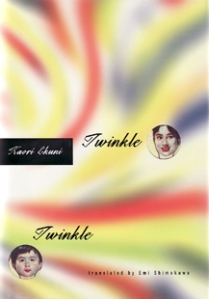
Twinkle Twinkle

twinkle-twinkle

Title: Twinkle Twinkle
Japanese Title: きらきらひかる
Author: Ekuni Kaori (江国香織)
Translator: Emi Shimokawa
Publication Year: 2003 (America); 1991 (Japan)
Pages: 171

About thirty pages into Twinkle Twinkle, I thought to myself, “Are all contemporary Japanese books written by women this depressing?” It’s an interesting literary trend. In America, writers like Kim Edwards (The Memory Keeper’s Daughter, 2005) and Sue Monk Kidd (The Secret Life of Bees, 2004) craft literary paeans to female sisterhood, hope, and endurance, while contemporary Japanese female authors seem to be losing the struggle to gaman, or to deal with the hardships presented to them by Japanese society until they are able to claim some immaterial reward in the far-off future. In short, the new breed of Japanese women writers seems to be cracking under the strain of contemporary Japanese society, which has been slow to acknowledge new gender roles, even as the economic structures that have supported these gender roles have crumbled. Ekuni Kaori’s novel Twinkle Twinkle perspicuously demonstrates the effects of this societal paradox.

Twinkle Twinkle follows the fortunes of the newlywed couple Shoko and Mutsuki. Mutsuki is gay and quite in love with his boyfriend. Shoko is highly emotionally unstable and is quite open about the fact that she doesn’t want to be in a romantic relationship with anyone. Although the pair lives together, and although they are quite affectionate towards one another, their marriage is nothing more than a legal convenience. In fact, the only reason they agreed to marry in the first place was to escape from the pressure imposed upon them by their parents. Through the first months of their married life, Shoko and Mutsuki make friends and lose friends, battle their respective families, and learn how to live with one another in the strange situation they’ve created.

Because Shoko and Mutsuki take turns narrating the chapters, the reader is able to gain a very interesting perspective into their relationship and their individual personalities. I found myself becoming frustrated with the characters and sympathizing with them in turn. Mutsuki is kind, but passive and somewhat clueless. Shoko displays the classic symptoms of borderline personality disorder, which occasionally devolves into depression and alcoholism, but she is honest, true to her herself, and genuinely means well in her interactions with others. Both of the two main characters, as well as the cast of supporting characters, are expertly realized, and I felt that I came to know them quite well over the course of the novel, as if perhaps they were friends of mine in real life.

This is both a good thing and a bad thing. Yes, the characters occasionally have fun and enjoy each other’s company, but the challenges they face are quite real, extremely frustrating, and never entirely resolved. Although the novel has something of a happy ending, I found myself fearing for the fate Shoko and Mutsuki several years down the road. Also, I found it hard to accept Shoko’s extreme behavior at times, and the all too accurate portray of her emotional instability was difficult to deal with. The hardheadedness of her traditional Japanese parents was even worse.

Overall, though, I think Twinkle Twinkle provides a welcome antidote to the bubblegum fluff of shōjo manga, “light novels,” and the works of novelists like Yoshimoto Banana. Don’t let the bright cover of this book fool you – Ekuni’s novel contains more insight into the dark side of contemporary Japanese society than you may find comfortable.