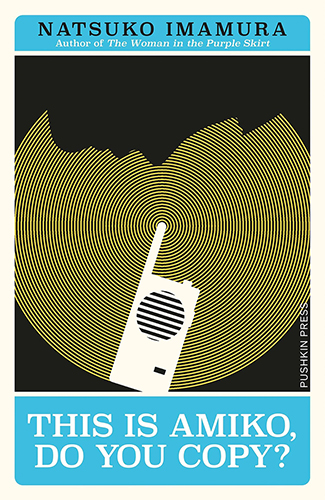
This Is Amiko, Do You Copy?

Natsuko Imamura’s novella This Is Amiko, Do You Copy? is about a neurodivergent preteen girl who’s neglected by her family and bullied at school. Though Amiko herself is quite charming, Imamura asks serious questions about the society that denies her support and understanding.

Amiko is ten years old and extremely friendly, but she has trouble fitting in. She speaks and behaves like someone much younger, and she often wanders away from class to read manga in the library. Her classmates avoid her when they can, but she’s oblivious to her alienation and remains cheerful and outgoing.

When her mother (who is actually her stepmother) has a miscarriage, Amiko does her best to comfort her, but her well-intentioned efforts are misinterpreted as malicious by both of her parents, who begin to neglect her. Without anyone to feed or bathe her, Amiko goes slightly feral, and she spends her early teenage years in almost total social isolation despite still attending school every day.

To protect Amiko from bullying, her older brother Kota toughens up, eventually joining a gang so that his reputation can shield his little sister. Kota loves Amiko and does his best to care for her, but he doesn’t have the emotional resources to deal with his clinically depressed stepmother or the lack of concern demonstrated by his workaholic father.

By the time she’s fifteen, Amiko still hasn’t matured, and she can barely read or write. She has trouble communicating and expressing herself, and she takes to singing made-up songs loudly and off-key whenever the mood strikes her. Torn between a child he can’t understand and a wife who never leaves the bed so that she’ll never have to see her stepdaughter, Amiko’s father sends her to live with her grandmother in the countryside.

The walkie talkies that Amiko’s parents give her as a gift at the beginning of the story are a chillingly direct analogy for her situation – she’s transmitting, but nobody’s responding. On a broader level, you can’t help but wonder why nobody ever reaches out to help Amiko or her parents.

This Is Amiko, Do You Copy? is narrated from a limited third-person perspective that shows the world as Amiko might see it, and Amiko is so happy and good-natured that it’s easy to skim through this short novella without really understanding the profound anger that Natsuko Imamura is expressing through the story. Amiko is a sweet and happy-go-lucky girl, but I could almost feel the author writing with clenched teeth. 

I’ve seen multiple reviews of this novella (and its 2022 cinematic adaptation Amiko) that shy away from identifying Amiko as being on the autism spectrum, maintaining instead that she transcends labels. I feel like a bit of critical thinking might be necessary here. Specifically, does not labeling Amiko as autistic help her (or her family) in any way? Because it sure seems like the lack of a formal diagnosis has resulted in nothing but neglect and abuse. On the other hand, would a greater awareness of neurodiversity, as made concrete through an imperfect but still useful label, perhaps help Amiko’s community understand and support her?

I enjoyed Imamura’s novel The Woman in the Purple Skirt, whose meaning also dwells in the seemingly empty spaces of what its alienated and unreliable narrator doesn’t say. Just as the label of “autistic” would presumably make life much easier for Amiko, I imagine that a formal diagnosis of “schizophrenia” would probably help the Purple Skirt narrator get the help she needs. Imamura’s project in these two stories is not to normalize neurodivergence, necessarily, but to demonstrate that neurodivergent people aren’t abnormal. It’s only when neurodivergent people are denied community support and resources that unfortunate things happen.

This isn’t to say that This Is Amiko is didactic or unpleasant. It’s actually quite lovely, and I hope it doesn’t make me sound like a bad person to say that I genuinely enjoyed this book. Still, Natsuko Imamura is staging a serious critique through what may initially seem like a light and breezy story, and it’s important not to ignore the subtext.   

Kudos to Hitomi Yoshio (and her seven-year-old daughter) for creating a fantastic translation of the distinctive narrative voice of this novella, and much love to Pushkin Press for bringing it to a wider audience. I’ve got my fingers crossed that Imamura’s 2017 novel Hoshi no ko (Child of the Stars), which is something of a sibling to This Is Amiko, finds a home in translation too.

とんこつ Q&A

とんこつ Q&A collects four stories by Natsuko Imamura, the author of The Woman in the Purple Skirt. Each of these stories is built on a cute and wholesome premise that develops in a dark and strange direction.

The title story is about a woman with social anxiety who creates a written script to help her navigate her job as a server at a small diner called Tonkotsu. Her efforts are aided by the recently widowed owner and his young son, who teaches the narrator to speak in Osaka dialect like his late mother.

The narrator’s script gradually expands beyond professional dialogue into everyday pleasantries, and she ultimately becomes a ghostwriter for the diner owner’s new wife. This scenario seems like a perfect set-up for a sweet and gentle romantic comedy, but it gradually becomes more disturbing as the narrator cheerfully crafts the diner owner’s new wife into a living doll.  

The three other stories in the collection are about middle school bullies whose punishment is far worse than their crime, an aggressively clueless wife who gets away with murder, and a very sketchy coworker. Imamura’s prose is smooth but cuts like a knife, and the situations she crafts are never what they seem. I wouldn’t say that these stories have twist endings, necessarily, but the way their wholesome coziness slowly sinks into social horror is fascinating to watch.

The Woman in the Purple Skirt

Japanese Title: むらさきのスカートの女 (Murasaki no sukāto no onna)
Author: Natsuko Imamura (今村 夏子)
Translator: Lucy North
Publication Year: 2019 (Japan); 2021 (United States)
Publisher: Penguin Books
Pages: 216

The Woman in the Purple Skirt begins as a charming set of observations about a woman who lives in a quiet neighborhood. It soon becomes clear, however, that there is something creepy about the narrator, who calls herself The Woman in the Yellow Cardigan.

The specificity of the narration raises many questions. Why is the narrator so obsessed with the Woman in the Purple Skirt? How is she able to observe her so closely? Is she stalking this woman? Or is she perhaps talking about herself in third person? Is she making up a fantasy version of herself, or is she projecting her personality onto a real woman? If so, why? Who is the Woman in the Purple Skirt? Who is the Woman in the Yellow Cardigan?

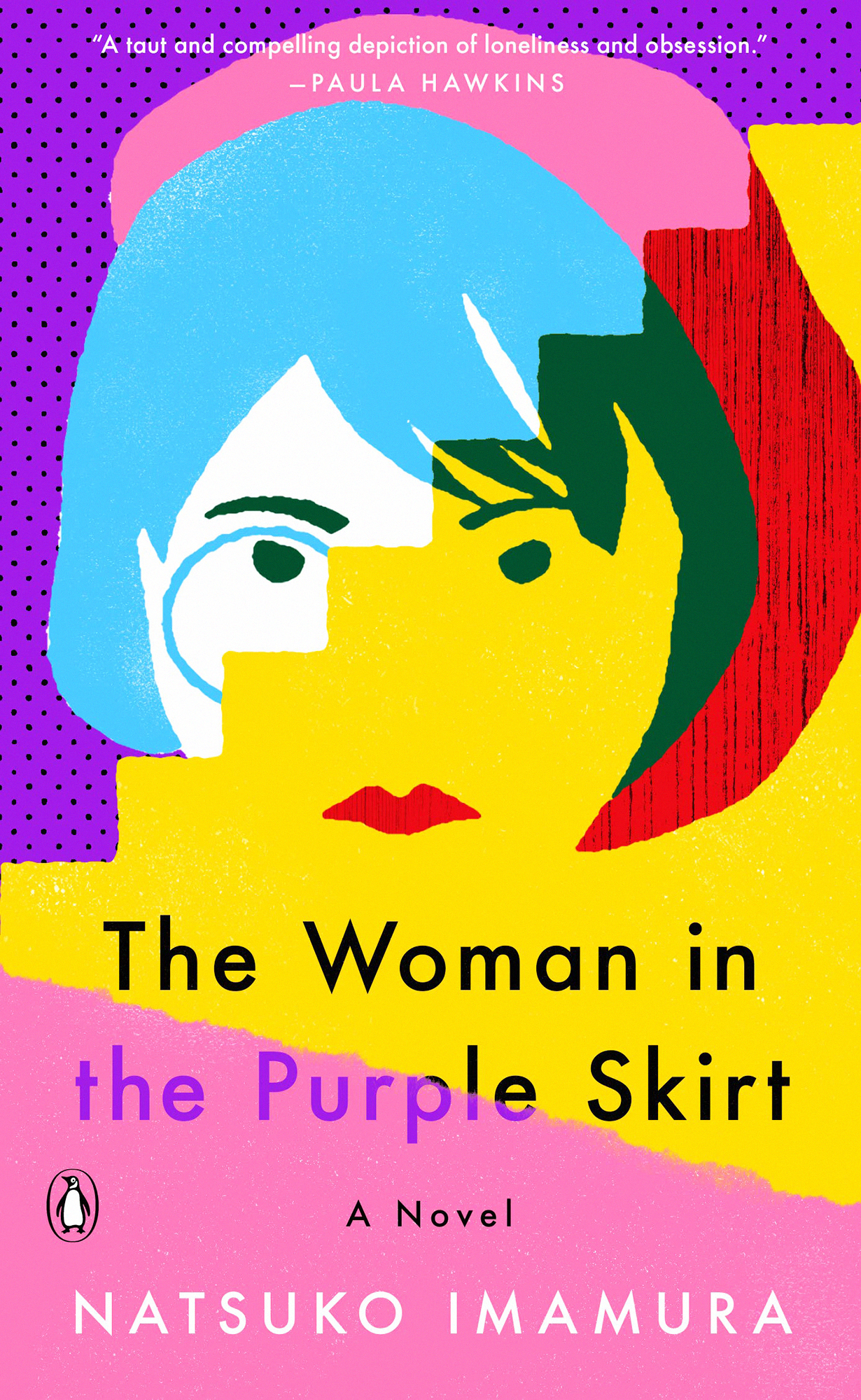
The Woman in the Purple Skirt isn’t suspense, necessarily, and it’s certainly not the “thriller” that the publisher seems to be trying to market it as, but the experience of reading this story is unsettling. The novella won the prestigious Akutagawa Prize, which is awarded to work from emerging writers that pushes boundaries and has a certain air of being “literary.” Despite the stylish chick lit cover of the American edition, the plot of The Woman in the Purple Skirt is almost depressingly mundane.

After a series of temp jobs that she quits after only a few days, the Woman in the Purple Skirt finds employment as member of the cleaning staff at an upscale hotel. She seems to be having an affair with one of her supervisors, and rumors spread that her salary is disproportionately high. At the same time, certain imbalances in inventory cause her coworkers to suspect that she is stealing. As the atmosphere at work becomes more hostile, the woman’s relationship with her supervisor also deteriorates. Meanwhile, the narrator, who is also a supervisor on the hotel’s cleaning staff, continues to glide through the life of the Woman in the Purple Skirt like a shadow.

This story is banal, but the subtle uncanniness of the narration forces the reader to view these normal events in normal lives with a sense of unease. The prose is sparse, the language is simplistic, and the affect is almost completely flat. Lucy North’s translation is reminiscent of Raymond Carver, especially in terms of dialog. Like Carver’s short fiction, the themes that emerge from beneath the placid surface of the narration are distressing: economic precarity, alienation, and the dangers of aging without a social network or financial safety net.

Despite its engagement with contemporary social issues, there’s nothing about The Woman in the Purple Skirt that requires specialist cultural knowledge, as the experience of struggling with loneliness while making minimum wage is equally shitty everywhere. I’d recommend this novella to anyone who enjoyed (or was at least moved by) Convenience Store Woman, as well as anyone concerned with urban anomie who entertains doubts about the ethics of low-wage work.

Because of the intriguing questions it raises and the unfortunate relatability of the discussion it’s likely to inspire, I would also recommend The Woman in the Purple Skirt as a text in a class on contemporary Japanese fiction. In addition, I think the novella might work well as a text for upper-level Japanese language classes, as its polished yet accessible prose evades the deliberate opacity of most Akutagawa Prize-winning work. Imamura has a field day with the narrative ambiguities made possible by the Japanese language, so it might be interesting to read the original side-by-side with North’s translation, which makes a number of tough decisions that nevertheless read as smooth and effortless.

Acclaimed author Natsuko Imamura’s first work to appear in English translation is short enough to be read in the span of an hour, but it’s worth spending time with. It’s difficult to say that a book as genuinely creepy as The Woman in the Purple Skirt is an enjoyable read, but the novella is a darkly shining jewel of literary fiction that invites and rewards analysis and introspection.