Mimi ni sumu mono

Yoko Ogawa’s 2024 short story collection Mimi ni sumu mono (耳に棲むもの) is about quiet endings and the unremarked deaths of small things. The tone of these five stories ranges from gentle and elegiac to genuinely shocking.

I’d like to begin with the latter, as Kyō wa kotori no hi (今日は小鳥の日) is one of the most subtle yet surprising horror stories I’ve read in some time. The nameless narrator of this story addresses the reader directly as she welcomes us to the annual gathering of the Small Bird Brooch Society. Small bird brooches can be made in a variety of ways, she explains, but she crafts hers using the real beaks and talons of dead birds. There’s something truly sublime about watching their tiny bodies decay, she muses.

The narrator then explains how her predecessor, the first president of the Society, met his untimely end. His death involves the still-living bodies of small birds, but I dearly wish it did not. After recounting one of the more gruesome scenes I’ve encountered in literary fiction, the narrator cheerfully invites the reader to sit down and enjoy the banquet. She then points out a few notable members of the Society, each of whom has their own method of constructing small bird brooches. Perhaps you, dear reader, will feel right at home in their company.

The collection’s final story, Senkōsho to rappa (選鉱場とラッパ), is about a young boy who lives with his mother in the company housing of a rural ore processing plant. His mother works both the day shift and the night shift at the plant’s cafeteria, leaving him to his own devices. During the summer festival at a local shrine, the boy becomes enamored with a toy bugle offered as a prize at a carnival game. Without any money to play, he’s reduced to lurking at the corner of the tent and praying that, if he can’t win the bugle, then no one else does either.

The next day, the boy takes out his frustration on a stray dog begging for scraps near the back entrance of the cafeteria where his mother works. He kicks the poor animal so hard that he ruptures its stomach, and it dies. Later he returns to the festival, where he witnesses the sudden death of the old woman running the carnival game. He steals the bugle in the confusion and returns home only to realize that the toy is nothing more than cheap plastic that has been spraypainted gold. In his shame, the boy buries the bugle in a closet, just as he buried the dog he killed between the roots of an old tree.

Still, as he sits on the apartment balcony while waiting for his mother to come home, the boy fashions constellations from the lights of the processing plant and imagines the songs he would play in their honor if his bugle were real.

Mimi ni sumu mono reminds me of Ogawa’s first work to appear in English translation, The Diving Pool (2008). Although it’s difficult to classify these stories as “horror,” they’re all subtly but effectively unsettling. When we’re exposed to the small cruelties that hide in the hearts of normal people, we begin to see reflections of their inner darkness in the details of the world that surrounds them. Ogawa’s characters are people who have lost their sense of belonging. The world has moved on without them, leaving a quiet air of desperation and neglect in its wake.

Mimi ni sumu mono is twenty-first century gothic fiction at its finest, but it’s not all bleak. Like the boy in Senkōsho to rappa and the president of the Small Bird Brooch Society, Ogawa remains fascinated by the beauty that gleams through the horrors. At 132 pages, Mimi ni sumu mono is relatively slim, but I believe this collection’s brevity is to its credit. The book is like an art gallery that encourages the reader to take their time with each piece, lingering as long as they like without any pressure to rush forward.

Mimi ni sumu mono was written in collaboration with Koji Yamamura, an Academy Award nominated animator. Yamamura created the companion piece My Inner Ear Quartet, which is described as “a literary VR animated film with an interactive storyline” on its page on Steam (here). This interactive animation was showcased at a number of international animation festivals and won several awards in Japan and abroad. As Yamamura’s animation requires a VR headset to view, I can’t offer any comments, but its trailer on YouTube (here) and the expanded excerpt (here) suggest that Yamamura was successful in capturing the eerie tone and uncanny beauty of Ogawa’s stories.

Hotel Iris

Title: Hotel Iris
Japanese Title: ホテルアイリス
Author: Ogawa Yōko (小川洋子)
Translator: Stephen Snyder
Publication Year: 2010 (America); 1996 (Japan)
Publisher: Picador
Pages: 164

Hotel Iris is the third work by Ogawa Yōko to appear in print in America, following The Housekeeper and the Professor and The Diving Pool. Having read several of her works now, I think I am starting to get a feel for her style of writing, which is beautifully conveyed by translator Stephen Snyder. Ogawa takes the everyday and imbues it with a sense of strangeness. Nothing overtly fantastic happens in her stories, but everything is always a little unsettling. Something is always a little bit off. There is always a sinister current running underneath the mundane. In Ogawa’s novels, the petty cruelty of human beings is on full display, but it is up to the reader to uncover the mystery of a deeper cruelty. The questions that aren’t answered are more upsetting than the questions that are.

In Hotel Iris, a seventeen-year-old young woman named Mari has been forced to drop out of high school by her mother, who needs her to work at the family’s seaside hotel. Since Mari’s father has died, Mari’s mother has taken on a kleptomaniac housekeeper, who not-so-secretly steals from Mari. When, one night, a prostitute flees from one of the rooms in the hotel, Mari finds herself attracted to the older man from whom the woman flees. This older man, who lives by himself on an offshore island, is a translator of Russian. He falls in love with Mari, who craves the sexual masochism he displays when the two are alone. The specter of the man’s dead wife, whom he is rumored to have killed, haunts their relationship, which is further strained when the translator’s tongueless, college-age nephew stays over for a few days.

These relationships develop over the course of this short novel, which is narrated by Mari, who hints at her desires, frustrations, and rich inner world through anecdotes and observations instead of through direct statements. The novel unflinching depicts all manner of sexual acts, but its eroticism and sensory imagery are focused not on the meeting of bodies but rather on the depictions of small, everyday things, like a stain on a scarf, the music of an amateur, or the dripping of pizza grease. The narrative tension created by the almost constant yet varied reiteration of certain themes, like the fear of something hidden being uncovered or the uncertainty of how far violence can go, prevents the reader from ever settling into complacency concerning Mari’s life and her relationships.

In the end, I think, this is a novel about growing up, and all the psychological baggage that goes along with the process. Ogawa warps many psychological tropes (like the Oedipus complex) through her protagonist, however, and Mari’s loss of innocence is neither celebratory nor unproblematic. In many ways, Hotel Iris is something of an antidote to feel-good chick lit novels like Yoshimoto Banana’s Goodbye Tsugumi. It’s dark and it’s disturbing. Its themes and imagery are understated; and, although it has quite a great deal of forward momentum, it is never driven by its plot, much of which is left vague. In my opinion, this is a perfectly constructed and beautifully written novel. Please buy this. Please read it. Please tell all your friends about it. Ogawa has numerous novels translated into various European languages, and we really need more of her work translated into English.

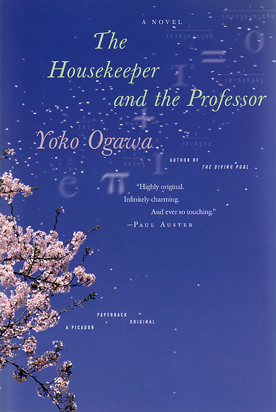
The Housekeeper and the Professor

The Housekeeper and the Professor

Title: The Housekeeper and the Professor
Japanese Title: 博士の愛した数式
Author: Ogawa Yōko (小川洋子)
Translator: Stephen Snyder
Publication Year: 2009 (America); 2003 (Japan)
Publisher: Picador
Pages: 180

Yay! I’m so happy! Finally, another Ogawa Yōko translation! Ogawa Yōko is one of the most interesting writers working in Japan right now, and her popularity only increases with each passing year. A recent search on Amazon.fr yielded more than a dozen translations of Ogawa’s work into French, and I understand that there are just as many translations of her books into German. I feel a little jealous, but, in any case, it’s better to have two books in English than none at all. Ogawa’s prose is hyper-intelligent yet subtle, and her narratives are very Raymond Carver: very simple at first glance, but oh what wonders lurk under the surface. As he did in The Diving Pool, veteran translator Stephen Snyder renders Ogawa’s Japanese into lucid yet multilayered English.

I consider The Housekeeper and the Professor to be close to the perfect “Japanese” novel. There is a bit of drama, but it is notable only for its understatement, and there is almost no plot to speak of; the novel simply ends when one of the main characters dies. The character development is what keeps the narrative going; and, in fact, it’s actually hard to put down. Quite simply, a single mother, who works as a housekeeper to make ends meet, is given an assignment by her agency to take care of a retired math professor, who lives in a small house by himself at the edge of his family’s property. The catch is that the professor’s short-term memory only lasts for eighty minutes. Despite this, the housekeeper manages to establish a good relationship with the professor, whose abbreviated life is enriched by his two great passions, math and baseball. When the professor learns that his housekeeper has a son who must wait for her return from work alone at home, he insists that she brings the boy with her to his house. The professor bonds with the housekeeper’s son over their mutual interest in baseball, and both the boy and his mother come to share an appreciation for numbers and equations with the professor. And that’s it, at least on the surface.

Under the surface, there are a significant number of interesting yet unstated relationships that will intrigue the reader, as well as an implicit question concerning the constantly developing meaning of family in postmodern society. The professor’s mini-lectures on prime numbers, amicable numbers, perfect numbers, and so on are actually quite interesting, as is the way that the old man uses number games to deal with the stress and awkwardness caused by his memory disorder. Just as the housekeeper and her son come to place a great value on these numbers and number games, the reader cannot help but start to see numbers as protagonists of sorts, or at least as oblique symbols concerning the relationship of human beings to one another. Really, like The Diving Pool before it, The Housekeeper and the Professor is good literature and a good read, and Picador has ensured that the paperback as a physical object is quite beautiful as well. I can’t recommend this book enough. Go get it! And, if you haven’t read The Diving Pool yet, go get that one, too!