Strange Houses is a four-part horror mystery novel about houses with strange and uncanny floor plans.
Each of the four chapters takes the form of a series of conversations between the narrator, their architect friend, and various people who have been involved with the houses. The first three chapters explore three different houses with extra rooms and inexplicable gaps in the walls. These explorations are liberally illustrated with diagrams in which certain sections of the floor plan are highlighted and annotated to clarify the text.
Each of these stories is like a locked room mystery. Over the course of the chapter, the narrator’s architect friend performs a close reading of a floor plan while gradually building a theory concerning what sort of upsetting behavior that type of strange space might enable.
In the final chapter, it’s revealed that these houses are connected to an old and wealthy family with a terrible secret. I have to admit that I found this situation highly improbable, so much so that it comes off as almost cartoonish. The author is great at architectural walkthroughs but skimps on the character development, which contributes to the conclusion of the book feeling somewhat hollow. Still, there’s a lot of fuel for the reader’s imagination, and fans of gothic horror will have a lot to play with here.
I flew through Strange Houses and loved every page. The speculative conversations between characters are easy to follow; and, thanks to the diagrams, the spaces are easy to visualize. I enjoyed the slow build of the overarching mystery, and the revelations about the bizarre family at the center of the strangeness were beyond anything I expected.
It’s worth noting that the first story in Strange Houses was originally written as a script for a twenty-minute video on YouTube, which you can find with English subtitles (here). There’s also a manga adaptation, which has been scanlated and is available to read (here). And finally, I’d like to share a more substantial review of the original Japanese book that was posted on one of my favorite blogs (here).
I tend to think that Uketsu’s earlier novel Strange Pictures (which I reviewed here) is somewhat more successful as a work of fiction with three-dimensional characters whose bad behavior stems from understandable motives. In comparison, Strange Houses feels more like a puzzle box than a novel. Strange Houses is less a character-driven story than it is an imaginative architectural mystery, but its eerie atmosphere and clever narrative structure make it a fascinating read for fans of speculative horror and uncanny design.
Michi Ichiho’s Tsumidemic (ツミデミック), which won the prestigious Naoki Prize for popular fiction in 2024, collects six stories about the atmospheric strangeness of the Coronavirus pandemic. While everyone’s attention was focused elsewhere, Ichiho wonders, what sort of intriguingly antisocial behavior might have been enabled by isolation?
The opening story, Chigau hane no tori (違う羽の鳥), has all the grim fascination of a viral urban legend. Yūto moved to Tokyo only to drop out of college, and now he works as a barker for a bar in Shinjuku. Unfortunately, business isn’t going well due to the pandemic. During another eerily quiet night, Yūto sees someone he knew back from middle school in Osaka, Nagisa Inoue. This is a shock, as Nagisa is supposed to have committed suicide by jumping onto the train tracks. As she and Yūto get drinks together, Nagisa explains her devious plot to flee from the grasp of her overbearing mother, which was far from a victimless crime. Yūto is no saint himself, and he inadvertently reveals why he immediately recognized someone he never talked to when they were classmates.
Romansu (ロマンス☆) is about a bored housewife named Yuri who develops a serious online gambling addiction of an unusual nature. Yuri hasn’t been able to find a new job since she left her previous position to give birth to her daughter, and the pandemic isn’t helping. She channels her frustration into a food delivery app called Miideri, which she treats like a gacha game. Will the person who makes her next delivery be one of the handsome men rumored to be employed by the service? While gambling on the slim possibility that a prince will arrive at her door bearing a bag from McDonald’s, Yuri attracts the unwanted attention of an unhinged delivery driver who has read exactly the wrong message into her frequent orders.
Rinkō (憐光) is narrated by the ghost of a high school student named Yui who, strangely enough, can’t recall how she died. Having materialized back into the world fifteen years after her death, Yui finds herself confused and alienated by the loneliness of the Tokyo streets and train stations during the pandemic. She therefore returns home to her mother’s house in the country. Her arrival coincides with a memorial visit from her friend Tsubasa, who is accompanied by their old homeroom teacher, Sugita. As Yui eavesdrops on their conversation, she learns that she died after mysteriously falling into a river during a rainstorm. Sugita knows what Yui was doing and where she was going, and Tsubasa wants him to know that she knows, too.
The collection takes a slightly more positive turn in the fourth story, Tokubetsu enkosha (特別縁故者), in which Kyōichi, the unemployed and impecunious father of a young son, attempts to weasel himself into the good graces of an elderly man whom he suspects is a money hoarder. Kyōichi, an affable himbo who has no business scamming anyone out of money, volunteers for the daily task of picking up a takeout lunch from one of the many bentō stores in the neighborhood. The old man knows exactly why Kyōichi approached him, and he resents him for not pursuing his ambition to enter the food service industry. Harsh words are exchanged; but, when push comes to shove, even a relationship built on ulterior motives is better than living alone as an elderly shut-in during a pandemic.
Shukufuku no uta (祝福の歌) is about a happily married middle-aged man facing a new direction in his life. Despite being a high school student, his daughter is pregnant, and she intends to keep the baby. Meanwhile, the man’s mother seems to be entering the permanent brain fog of senile dementia. His daughter, who has been gossiping with the other mothers in her grandmother’s apartment building, gets the sense that there’s something else going on. With any luck, it’s a problem that can actually be solved.
Sazanami Drive (さざなみドライブ) follows the IRL meetup of five people who connected on Twitter after their lives were disrupted by the pandemic. As they drive out to the country in a minivan, they share their stories of abandonment and alienation. Little do they know that one of their number has a secret agenda. He’ll do whatever it takes to disrupt the group’s grim plan for the trip – and hopefully save their lives in the process.
As indicated by the book’s title, the two themes guiding this collection are “crime” and “the pandemic.” Each of the characters is hiding something, and the reader never knows where anyone’s true intentions lie. Michi Ichiho, who began her writing career as an author of BL romance novels, isn’t unduly focused on creating mimetic fiction, and the scenarios are improbable at best. Still, the twist at the end of each story is a lot of fun, and the fantastical plot elements accurately convey the feeling of just how weird and unreal everything felt during the pandemic.
It appears that the English-language publication rights for this collection are currently up for grabs (more info here). Tsumidemic is a fast-paced and emotionally cathartic book, and it would benefit from a tone-sensitive translation that renders Ichiho’s dialogue-filled writing into snappy, Stephen King style prose. I hope someone picks it up.
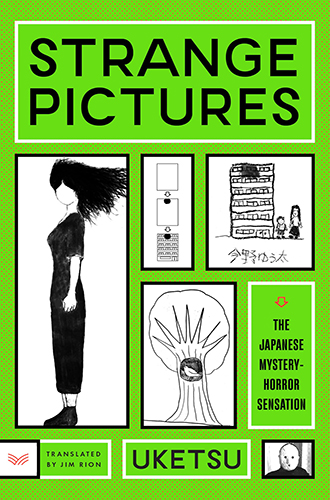
Strange Pictures is a compulsively readable horror mystery novel first published in 2022 by Uketsu, a mysterious masked YouTuber. This book is addictive, so much so that I accidentally spent an entire afternoon and evening reading it. So be warned – Strange Pictures is indeed strange, and it will hold you hostage.
In the five-page prelude that introduces the book’s premise, a psychology professor shows her class a photo of a picture drawn by a girl who killed her mother. The drawing is a childish self-portrait that shows the girl standing between her house and a tree. Although the picture seems completely normal at first, the professor zooms in on four small details that illuminate the girl’s inner state of mind. She makes the argument that, despite the abuse the girl suffered, she’s essentially a good person who never meant to hurt anyone. In retrospect, you can’t help but wonder how you didn’t notice these details of the drawing yourself.
This trick is an incredible sleight of hand. The same can be said of the following two chapters, both of which can be read as stand-alone short stories.
In the first chapter, “The Old Woman’s Prayer,” two college students in a small Paranormal Club discuss a curious blog they’ve found online. The blog is filled with cheerful observations of its writer’s everyday life. After a three-year hiatus, however, the blog closes with a mysterious post stating, “I can never forgive you.”
How did such a happy-go-lucky blog author arrive at such a mysterious statement? The five illustrations drawn by the author’s wife might just hold the key to the mystery. By themselves, they’re nothing special, but if you put them together in the right way…
The second chapter, “The Smudged Room,” features one of my favorite tropes, a creepy drawing made by a small child.
Five-year-old Yuta’s father recently passed away, and his preschool teacher is worried about the drawing he created for Mother’s Day. The picture shows a dark cloud hovering over the apartment building where Yuta lives with his mother, who is doing her best to care for Yuta with no family support. The matter comes to a crisis when Yuta suddenly disappears, and his teacher suspects that his mother may be keeping an unpleasant secret. What was Yuta trying to draw, exactly?
These two seemingly unrelated mysteries begin to coalesce in the third chapter, “The Art Teacher’s Final Drawing,” in which two sidelined newspaper employees become obsessed with the murder of a high school art teacher. The police dismissed the case due to a lack of evidence, but there is (of course) a drawing found in the teacher’s possession that was never fully analyzed. The younger reporter starts interviewing people who knew the teacher, thereby putting himself in grave danger.
Somewhere around the middle of this chapter, the story begins to strain credibility, but at this point I was fully invested and happy to be along for the ride. Uketsu has a gift for enabling the reader to suspend disbelief, and the Sherlock moment in the fourth and final chapter is incredible.
Strange Pictures is a bestselling cult hit in Japan and across Asia. I first heard about this book through word of mouth and read it in Japanese when it was first published. I was impressed by the clarity of Uketsu’s writing, which is simple and informative without being childish or condescending. Jim Rion has done an amazing job translating Uketsu’s distinctive style, with short declarative sentences pushing the reader forward at a brisk pace.
A large part of the mystery depends on the information that the narrative withholds from the reader, some of which is highly dependent on how Japanese works as a language. I’m impressed by how Rion manages to employ English to the same effect without the slightest trace of awkwardness. Reading Rion’s translation, I felt like I was encountering Uketsu’s story for the first time.
As long as you don’t mind losing a few hours to the addictive quality of the writing, I’d recommend Strange Pictures to anyone who enjoys puzzle box mysteries, creepy urban legends, and satisfying Sherlock Holmes style walkthroughs. I can’t overstate how much fun I had with this book, and I’m very much looking forward to Jim Rion’s upcoming translation of Uketsu’s debut novel, Strange Houses.
Rio Shimamoto’s 2018 novel First Love is a psychological mystery about a beautiful college student who has been arrested for the murder of her adoptive father. Although it tackles serious themes, this story is compulsively readable. All of the characters bring emotional baggage to the table, and Shimamoto teases out the reader’s sympathy as each of their histories is revealed.
Yuki Makabe is a clinical psychologist who specializes in parenting and childcare. She’s ambitious, and she’s on the verge of making a career transition to media appearances and popular audience articles. When Yuki’s brother-in-law, Kasho, is assigned to the high-profile case of Kanna Hijiriyama, a college student accused of killing her father, he asks Yuki to help him interview the young woman in order to ascertain her motive. Yuki’s prospective editor at a major publisher, a friendly young man named Tsuji, asks her to write about the case, so she agrees.
Yuki is happily married to an internationally famous photographer who supports her career by shouldering the majority of the responsibilities involved in the care of their son. Despite her loving relationship with her husband, Yuki has a troubled past with Kasho that neither of them is willing to discuss. While she and Tsuji work together on Kanna’s case, Yuki must navigate her strained relationship with Kasho, who is very charming but a bit of an asshole.
Kanna presents Yuki with another set of challenges. To begin with, Kanna can’t explain why she wanted to hurt her father, or even whether she intended to hurt him in the first place. But, if she never meant to attack him, what was she doing with a knife? To make matters more complicated, one of Kanna’s college boyfriends gives an interview to a tabloid magazine and says that Kanna went crazy after they broke up. Even Kanna’s own mother claims the young woman is crazy.
Yuki is convinced that Kanna is far from “crazy,” but the truth of the matter is elusive. Kanna is traumatized by the death of her father, and Yuki quickly realizes that the young woman’s trauma is much more extensive.
Based on the title of the novel and the relationship between Kanna and the person she may or may not have killed, a reader might suspect that there is underage incest involved. I hope I can be forgiven for spoiling the story by saying that, thankfully, this is not the case. Regardless, Kanna didn’t have a happy home life as a child.
I’m afraid that some readers may find Kanna frustrating, but her portrayal feels extremely realistic to me. I definitely knew people like this in high school and college. Generally speaking, these girls (and occasionally boys) were intelligent and competent, but they had a habit of saying whatever they needed to say to diffuse an awkward situation.
This behavior wasn’t “lying” or “being dishonest” so much as it was a manifestation of fawning, an alternative to the “fight or flight” response that’s common in young people who live in hostile home situations. Instead of fighting their parents or running away from home, “well-behaved” children and teenagers will contort their speech, emotions, and understanding of reality to ease tension. Issues often arise when this behavior carries over to romantic and professional relationships that would benefit from honesty.
Although this element of the story isn’t presented as a mystery to be solved, Yuki is confronted with the issue of whether Kanna truly consented to sex with two of the key romantic partners in her life. I can completely understand how the men involved might have understood Kanna’s words and behavior as expressing consent, but I also understand how Kanna could later admit that sex isn’t what she wanted, and that she was just going along with what was expected. As the author demonstrates, Kanna’s inability to understand her own boundaries is directly related to the emotional abuse she endured as a child.
Shimamoto doesn’t lean into an overtly feminist message, but there are multiple points in the story when Yuki comes into contact with the sort of ambient misogyny that might compel a vulnerable young person like Kanna to second-guess her own emotions and sense of self-worth. At the beginning of the novel, for example, Yuki reflects on a conversation between a male television producer and his younger female colleague that she overheard as she entered the studio.
As I was getting my makeup done, I examined my own features: not bad, but not particularly beautiful either. A face with no distinctive features. The only thing that stood out was my collarbone, protruding above my shirt.
I’d met that male producer several times previously, but he’d never once made eye contact with me. There were men like that everywhere in the television industry – men who wouldn’t engage in conversation with women they’d give less than an eight out of ten on looks. Men who thought nobody would notice this behavior. Or maybe they just thought it didn’t matter. These were men who had never suffered a single setback in their lives.
This is the sort of observation that, while eminently relatable to many people, would have Yuki called crazy if she spoke it out loud. It’s not “misogyny” or “sexism” if the male producer isn’t doing anything wrong, right? It’s not like he actually said anything offensive to Yuki, or to his younger colleague. This man’s behavior is rancid, but no one will ever call him out on it. Yuki has a supportive family and professional colleagues who aren’t human garbage, so she can cope. But what about Kanna, who hasn’t yet found a support network to replace her abusive family?
What Shimamoto criticizes in First Love are the gendered aspects of a social system that allows toxic men to flourish. First Love doesn’t offer easy solutions, but Shimamoto demonstrates that we can all be allies in pushing back.
Yuki’s husband is a prince from start to finish, and her editor Tsugi is able to see what happened to Kanna with clear eyes while re-evaluating his own perspective and never apologizing for the bad behavior of other men. Kanna’s defense lawyer Kasho has issues of his own due to childhood abuse at the hands of his mother, but he’s an adult who is capable of realizing his limitations – which is why he arranges for a series of meetings between Yuki and Kanna in the first place.
Without spoiling too much of the plot, First Love connects the stories of a number of characters who begin to question their past behavior in light of Kanna’s upcoming trial, and Shimamoto helps the reader to sympathize with these characters even when they behave badly. The point is not that men are evil or that women are innocent victims. Rather, it’s important to extend empathy instead of overlooking questionable behavior.
Putting the social relevance of the novel’s themes aside, First Love is a fun book to read. I got sucked into the story immediately. Like Yuki, I was instantly intrigued by the mystery presented by the death of Kanna’s father. Kasho’s defense argument during Kanna’s trial felt like a major revelation unfolding before my eyes, and I admire how carefully Shimamoto laid each brick in the wall. Louise Heal Kawai’s translation is featherlight and flawless and sets the tone perfectly.
I’d recommend First Love not just to fans of mystery and suspense, but to any reader interested in a compelling character drama that offers a number of different perspectives on family, mental health, and the darker aspects of everyday interactions that often go overlooked.
Japanese Title: 柩の中の猫 (Hitsugi no naka no neko) Author: Mariko Koike (小池 真理子) Translator: Deborah Boliver Boehm Publication Year: 1990 (Japan); 2009 (United States) Publisher: Vertical Pages: 190
According to the back cover copy, The Cat in the Coffin is “a gem of a modern update on the governess genre immortalized by Jane Eyre and ‘The Turn of the Screw’ [and a] hypnotic thriller that lures the reader into the darkness of the human heart,” which is as good of a description as any. The Cat in the Coffin is a story about family, desire, love, malice, and a cat at the center of a chilling murder.
Masayo, an aspiring artist from Hokkaido who has just turned twenty, moves to Tokyo to be a live-in housekeeper and caretaker for Momoko, the eight-year-old daughter of a semi-famous artist and college professor named Goro Kawakubo. The year is 1955, and Goro has embraced a modern American lifestyle of cocktails and garden parties after the tragic death of his wife. Masayo cares little for fashion or the glamor of high society, but she is enchanted by Momoko, who speaks to no one except her white cat Lala. Masayo bonds with Momoko through their shared love of Lala, and they become fast friends.
Everything goes well until a startlingly beautiful woman named Chinatsu shows up at one of Goro’s parties. Chinatsu worked as a translator and lived with her husband in America before becoming a widow and returning to Japan. Despite her air of cosmopolitan sophistication, Chinatsu is thoughtful and kind. Goro is clearly in love with her, but both Masayo and Momoko are ambivalent. After all, if Goro marries Chinatsu, there will be no need for Masayo to remain in the house as Momoko’s caretaker.
All of the characters in The Cat in the Coffin are good people, but they’re imperfect in small but significant ways. Goro takes his relationship with Chinatsu slowly so that his daughter will be comfortable with the woman who will replace her mother, but he is perhaps a little too willing to leave his daughter entirely to Masayo’s care. Momoko understandably misses her mother and craves her father’s affection, but her grief has caused her to become isolated and antisocial. Masayo tries her hardest to do what’s best for Momoko, but her crush on Goro causes her to give Chinatsu a cold shoulder.
The comparisons to Jane Eyre and “The Turn of the Screw” are apt, as Masayo’s idealized longing for Goro and Momoko’s aggressive strangeness create a difficult situation for Chinatsu, whose only flaw is that she isn’t able to conceal her dislike of Lala. Chinatsu gradually succumbs to a delusion that everything will work out if she no longer has to compete for Momoko’s affection with a cat, and she ends up taking drastic action in secret. Masayo witnesses her terrible act, which creates a terrible psychological burden she is unable to bear. The suspense of The Cat in the Coffin thus lies in witnessing a modestly happy household’s slow dissolution in a boiling pot of misdirected passion and ice-cold rage.
The Cat in the Coffin can also be read as a sustained exploration of Masayo’s fear of growing up as she longs for independence but still clings to childhood, sinking herself into a codependent relationship with Momoko and Lala instead of building a working friendship with Chinatsu, who represents her anxiety of adult sexuality. Meanwhile, although Chinatsu is only a secondary character from Masayo’s perspective, her life history is fascinating, and its eventual revelation is quite dramatic. Chinatsu’s story is reminiscent of The Great Gatsby in her ambition and failed pursuit of the American dream, and it’s precisely because of her progressive American approach to Momoko that their relationship is so disastrous.
The Cat in the Coffin begins at a somewhat leisurely pace, but the suspense is slowly amplified throughout the novel, which is neatly structured and short enough to be read in one or two sittings. The ending is highly satisfying, as is the frame narrative, in which Masayo, now a famous artist, relates the story of Momoko, Chinatsu, and Lala to her own housekeeper. The well-edited and well-executed translation keeps the action moving at a brisk pace, making The Cat in the Coffin an enjoyable book to binge. This psychological thriller is lean and sharp and almost painfully insightful, and I especially recommend it to fans of Japanese cat novels who are interested in something domestic that still has its claws.




 Contemporary Japanese Literature