Higashi Tokyo Machi Machi

Keita Katsushika’s manga Higashi Tōkyō Machi Machi (東東京区区) is a leisurely walking tour of East Tokyo. As suggested by their pen name, the artist lives in Tokyo’s Katsushika Ward, which is known for the retro ambiance of its Shibamata district and its green and pleasant riverside walking paths. Keita Katsushika is keen to show the reader the quiet charm of the area while exploring the depth of its history and the diversity of its communities.

Higashi Tōkyō Machi Machi follows the adventures of three focal characters. 21yo Sarah is a college student majoring in Urban Studies, and 8yo Selam is the daughter of an Ethiopian immigrant who runs a small restaurant near her university. While Sarah and Selam are out on a walk one afternoon, they meet 13yo Haruta, a homeschooled student pursuing his interest in Tokyo’s history. The friendship between these three characters is sweet and uncomplicated, and their personalities facilitate different approaches to urban exploration.

The trio’s first walk together takes them to the Tokyo Skytree, where they’re able to look out over the neighborhood while studying a reproduction of an Edo-period artwork that depicts the region as it appeared in the past. Another adventure takes them to the former site of the Venice Market, a postwar black market that was created by laying boards over a drainage canal. Since then, a normal street was built over the water, and the area hosts a number of stores and restaurants catering to Tokyo’s immigrant populations. If you’re interested in the history of the Venice Market, you can check out a two-page preview of this section of the manga (here).

All three characters were born and raised in Japan, and no one ever treats them with anything less than kindness and respect. As Sarah writes in the opening to her senior thesis, the formerly depopulated areas of Northeast Tokyo have gradually become home to many immigrant communities, who have revitalized the neighborhoods where they settle. Instead of resenting the growth of their communities, many older residents are happy to share their knowledge and memories with curious young people.

For what it’s worth, this portrayal of gregarious retirees is true to my own experiences walking around Tokyo with friends. Whether you’re a visitor or a long-term resident, it doesn’t matter what your face looks like or how you dress. As long as you’re willing to listen, there will always be people willing to share their stories. The manga’s scenes of immigrant community gatherings are equally warm and friendly. It’s lovely to see the diversity of people and life experiences in Tokyo shown as what it really is – not as a social issue to be discussed when something bad happens, but rather as a normal and pleasant aspect of everyday life. 

In many ways, Higashi Tōkyō Machi Machi reminds me of Kiyohiko Azuma’s manga Yotsuba&!, which follows the wholesome everyday adventures of a translator, his friends, and the young girl he adopted abroad. Just as in Yotsuba&!, the art of Higashi Tōkyō Machi Machi places simple and stylized characters into meticulously detailed backgrounds, thus helping the reader feel immersed in the cityscape of Tokyo and its suburbs.

The main difference is that Keita Katsushika’s manga is dense with text and reads more like a collection of illustrated essays than a story. Thankfully, the writing follows the standard shōnen manga convention of glossing the kanji with their hiragana pronunciations. As you might imagine, this is especially helpful with place names.

I’d recommend Higashi Tōkyō Machi Machi to anyone who’s interested in the history and culture of Tokyo. If you’ve read Jorge Almazán’s study Emergent Tokyo and are curious about how the urban design principles Almazán charted in West Tokyo neighborhoods have been adapted to the older neighborhoods in the east of the city, this manga was published for you specifically. Higashi Tōkyō Machi Machi is a treasure, and it’s a joy to explore Tokyo alongside its characters.

Kanda Gokurachō Shokunin Banashi

The first volume of Akihito Sakaue’s manga Kanda Gokurachō Shokunin Banashi, which won the Tezuka Osamu New Creator Prize in 2024, collects five stand-alone short stories about the everyday lives of artisans during the Edo Period. As might be expected from a manga about craftsmanship, Sakaue devotes meticulous care and attention to creating an accurate visual depiction of the tools and techniques used in these traditional arts. 

Shokunin Banashi opens with a twelve-page account of a day in the life of a carpenter who creates and repairs wooden buckets. Although the work may seem unglamorous, the skill involved is readily apparent. An additional layer of accuracy lies in the fact that this story’s star craftsperson is female, as were many of the artisans who kept Edo period society functioning.

The next two stories feature a blacksmith who specializes in swords and an indigo dyer who dreams of creating her own fabric pattern designs. My favorite of these opening stories is the fourth, which follows a young but talented seamster who sews and binds the edges of tatami mats. Along with the rest of his team, he’s been hired to replace the tatami in a high-end establishment in the Yoshiwara red light district. The courtesans are impressed by the craftsman’s skill with his hands, but he remains focused on his craft and maintains an appropriate professional distance. Once he’s finished the job, however, he allows himself to be a little flattered. This is a cute story that’s also very sympathetic to the craft of the women who work in Yoshiwara.

The three-chapter story in the second half of the volume is a workplace drama about a company of contractors who specialize in laying plaster walls. This is intense physical labor that requires a good eye, a steady hand, and careful group coordination. The leader of the team, Chōshichi, is an undisputed master of her craft, but a new recruit, Jinsaburō, soon learns that there’s trouble among the ranks of her subordinates. A master craftsman himself, Jinsaburō supports Chōshichi during the construction of a townhouse. For the reader, this is a marvelous opportunity to get an inside look at each stage of how these houses were built.

I’d recommend Shokunin Banashi to anyone who enjoyed Fumi Yoshinaga’s Ōoku series, especially for the high quality of its historical representation and the subtlety of its human drama. I might also recommend Shokunin Banashi to any illustrator who’s interested in studying hands depicted in a variety of positions while manipulating all sorts of specific tools. The art in Shokunin Banashi is something special, as is the physical book itself, which was designed to be a beautiful object.

Edited to add: This manga has been licensed by Yen Press as Neighborhood Craftsmen: Stories from Kanda’s Gokura-chou. Excellent!

Dragon Goes House-Hunting

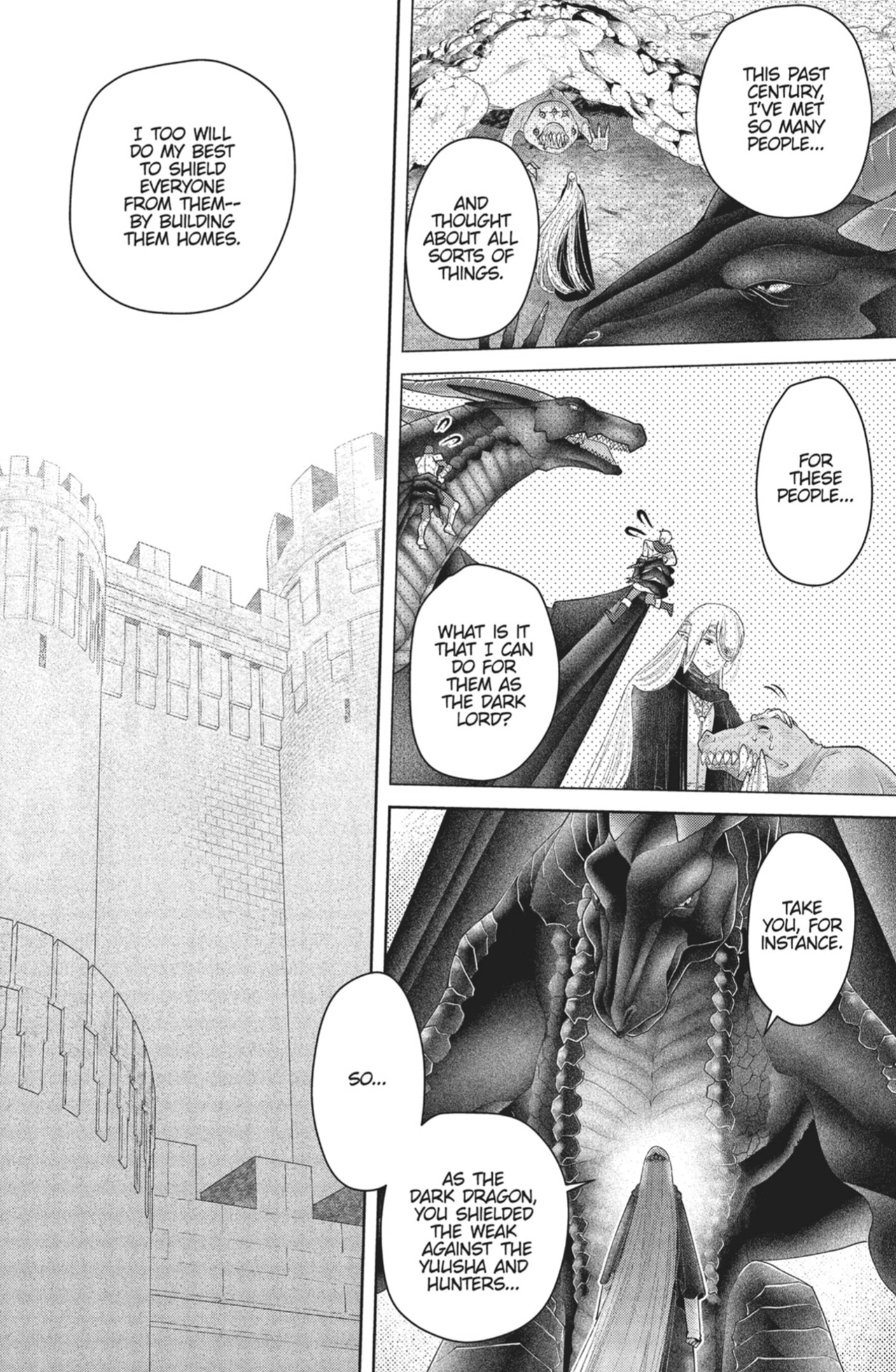
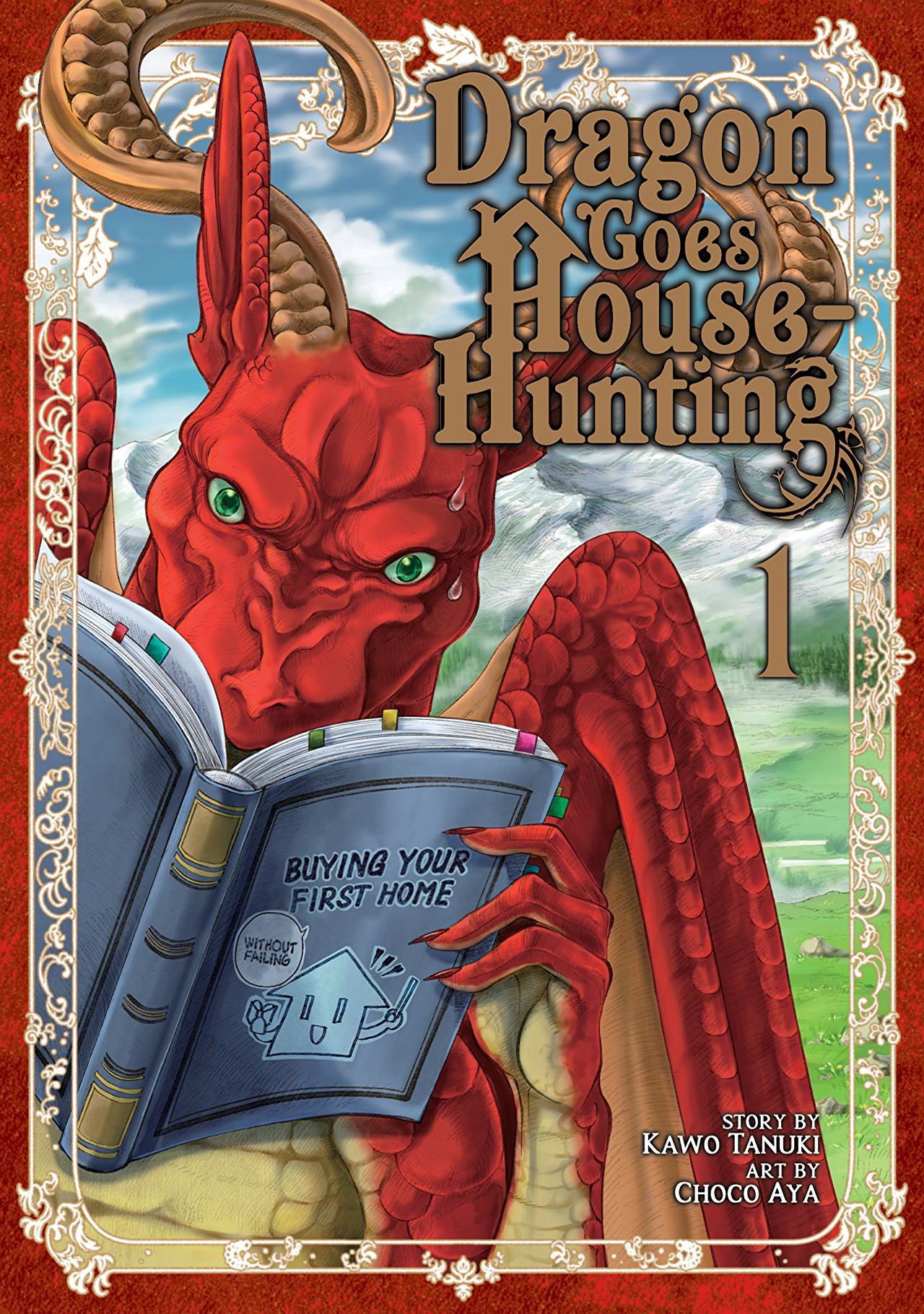
Earlier this year, Seven Seas released the tenth and final volume of Kawo Tanuki and Choco Aya’s fantasy series Dragon Goes House-Hunting. This manga follows the misadventures of a gentle but cowardly dragon named Letty and his real estate agent Dearia, a massively powerful and inhumanly beautiful dark wizard. Letty is searching for a comfortable house that will accommodate his size while also protecting him from the pesky adventurers trying to hunt him for crafting materials. While Letty pictures himself in a cozy cottage, Dearia encourages him to be more pragmatic and dungeon-minded.

What makes Dragon Goes House-Hunting stand out in the “slice-of-life fantasy” genre is the consistently high quality of its art, which references the detailed monster designs from video game manuals of the 1990s while still feeling fresh and contemporary. For video game fans especially, it’s quite entertaining to look at dungeon design from the perspective of the monsters, who are just trying to make it through the day without being harassed by heroes. The manga’s situational humor is gentle and sweet, but each volume still managed to surprise me with at least three or four devilishly sharp jokes.

Perhaps the easiest way to describe Dragon Goes House-Hunting is to say that it’s the high fantasy version of the wholesome yakuza comedy The Way of the Househusband. Like The Way of the Househusband, Dragon Goes House-Hunting is designed to be accessible to all ages, but it will resonate most strongly with readers old enough to have some experience with real estate (even if that experience is limited to looking for a student apartment). For a more action-oriented and kid-friendly take on the concept of “building homes for monsters,” I’d also like to recommend the ongoing shōnen series Soara and the House of Monsters, which is a gorgeously creative celebration of fantasy architecture.  

Screenshot

Yotsubato!

Title: よつばと!(Yotsuba to)
Artist: あずまきよひこ (Azuma Kiyohiko)
Publication Year: 2003 (Volume 1) – 2009 (Volume 9)
Publisher: 電撃コミックス (Dengeki Comics)
Pages: 225 (per volume)

Let me get this out of the way first: Yotsubato! has no story. It is not “about” anything. There is no point. It does not go anywhere. The manga could be classified as falling within the genre of comedy, but it doesn’t really try to be funny. The reader never really learns anything about the characters, and the relationships between the characters show almost no development. Nothing important or exciting happens.

Let me also get this out of the way: Yotsubato! is one of my favorite manga in the whole wide world.

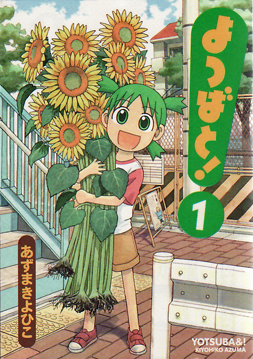
I have been fond of Azuma Kiyohiko’s four-panel manga Azumanga Daioh ever since the translation was released in America in 2002. I also enjoyed the anime based on said manga. When defunct American manga publisher ADV Manga started releasing translations of Yotsubato!, Azuma’s new project following the completion of Azumanga Daioh, I picked up the first volume immediately. Unfortunately, I found myself disappointed. It wasn’t a fun manga to read. I didn’t get it. The dialog was translated in a way that was supposed to be wacky and zany, but I didn’t think the manga itself was that funny. The art was a little weird, too. A year later, in 2007, I went to Japan to find Yotsubato! featured prominently at almost every major bookstore in Tokyo and Yokohama – most memorably at the Tsutaya in Shibuya, which had an entire wall devoted to Yotsuba paraphernalia. The cover of the Japanese publication of the manga was approximately five hundred times more appealing than the cover of the translation, so I picked up a copy. While reading it on the train home, I fell in love.

Yotsubato! follows the daily life of a five-year-old girl named Yotsuba. Having been orphaned on an island somewhere outside of Japan (the circumstances are never made clear to the reader), Yotsuba has been taken in by a man named Koiwai, who seems to be in his late twenties or early thirties and makes his living as a translator. At the beginning of the first volume of the manga, Yotsuba and her adopted father move into a new house in the suburbs of a city assisted by Koiwai’s friend Jumbo, a florist with a preference for Hawaiian shirts whose name reflects his comically enormous stature. After moving in, Yotsuba and Koiwai (and Jumbo, who visits from time to time) become friends with the family living next door, which consists of a mother, a daughter in college, a daughter in high school, and a daughter a year or two older than Yotsuba (the father of the family never makes an appearance). Although other friends of Koiwai and the next-door neighbors are occasionally introduced, Yotsubato! mainly revolves around this core set of characters and their interactions. The manga moves slowly from day to day. Over the course of nine volumes, its leisurely pace has taken it from the middle of summer to the very beginning of fall.

What I love about this manga is this very slowness. I wouldn’t describe this work as “contemplative,” however; Yotsuba herself is very curious and energetic, and her adopted father is something of a character as well. There is nothing boring about the manga, but its focus on the mundane allows the reader to take a step back from his or her own presumably hectic life and enjoy an endless summer full of daytrip adventures and small discoveries. This is not to say that Yotsubato! somehow resembles something like My Neighbor Totoro. The manga is written from an adult perspective, and the reader is constantly encouraged to identify with the people who surround Yotsuba rather than with the girl herself. The occasional jokes that the manga makes are sophisticated, and the adult speech and relationships are not sanitized or downplayed.

The attention to detail expressed in every aspect of the manga finds its most visible outlet in its gorgeous artwork. As I noticed when I first read the manga in America, it takes Azuma several chapters to settle on his character designs, which are drawn in his unique style. The rest of the visual realm, however, is drawn in an almost photorealistic way, from the tiniest detail of the interior architecture of Yotsuba’s house to the products lining the shelves of a neighborhood convenience store. Aside from the shade of Yotsuba’s unique hair, there is almost no screen tone used in the manga; everything is conveyed in understated ink work, which miraculously never clutters the page or busies the panels. The slightly cartoonish characters provide a pleasing contrast to this sort of detailed background. I feel like the background art in this manga captures the essence of a Japanese suburb far away from Tokyo; so, even while I was reading this manga in Yokohama, it made me feel nostalgic for living in Japan.

I suppose you could say that I enjoy this manga because of its pace, its narrative tone, and its art. I’m not really sure, though, what makes Yotsubato! different from any other “slice of life” manga, but it is different. I have said before that I think manga can be considered literature, but Yotsubato! is not literature. It is a masterwork of an entirely different medium of artistic expression. Really, I think Yotsubato! stands alongside the works of Urasawa Naoki and Asano Inio as an exemplar of what manga is capable of.

Although I am a great believer in translation, I feel that Yotsubato! is much more enjoyable in the original Japanese. Thankfully, even beginning students of Japanese should not find the dialog in the manga to be prohibitively difficult. For those readers who have no Japanese language background, however, a new English translation of the manga is currently being published under the title of “Yotsuba&!” by Yen Press.

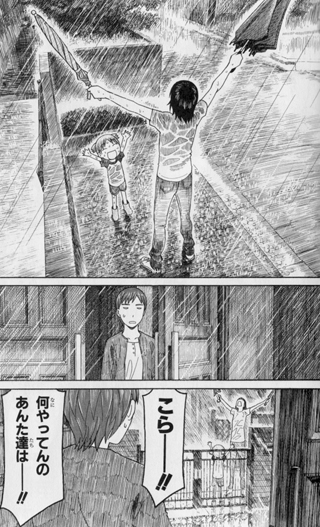
I think the following two pages demonstrate the style of the manga. In the middle of a late summer typhoon, Yotsuba runs into the storm to warn her next door neighbors to be careful. In her haste, she forgets her umbrella, so her adopted father runs after her to give it to her. Upon catching up with her, he finds her already drenched, so….