Memento Bento is a 65-page chapbook created by the Italian artist Alessandra Criseo. The chapbook, which is structured like an annotated sketchbook, chronicles Criseo’s trip to Japan with her partner Andreas in April and May of 2014. Over the course of two and a half weeks, the pair visited Tokyo, Kyoto, Nara, and Yokohama.
At the time, Criseo was working in London as a freelance character designer and concept illustrator for video game development studios. Criseo’s primary interest in Japan lay in its culture of cuteness, and the pages of Memento Bento are filled with sketches of clothing, characters, and street fashion. This fascination with cuteness is supplemented by photos of cute food, such as strawberry-themed pastries and the popular Tokyo Banana souvenir cakes.
Despite her stay in the popular tourist destinations of Kyoto and Nara, Criseo cares less about traditional Japanese architecture and handicrafts than she does about common urban cityscapes and mundane everyday objects. “I love taking the train. [It’s] one of the pleasures of life, especially in a country with such pretty houses as this one,” she writes next to an ink drawing of herself sketching on a commuter train.
Along with the urban tangle of telephone poles and power lines, Criseo is also fascinated by vending machines, instant ramen packaging, toilets, umbrellas, disposable cameras, and the uniquely non-aerodynamic shapes of domestic Japanese automobiles. Having submerged herself in the visual clutter of Japan, Criseo writes that she’s not looking forward to returning to the “boring and gray” monotony of London.
The heterodox and chaotic aesthetic often decried by older observers of Japan is a source of fascination and delight for Criseo. As an artist and professional designer, Criseo has translated her study of Japanese commercial design to her own clothing and stationery, which she distributes through her independent label, Mezzolume.
When I wrote about Ryōko Nagara’s recent manga about the local material culture of Sapporo (here), I was reminded of how many visual representations of Japan created by Europeans (such as Onibi: Diary of a Yokai Ghost Hunter) often emphasize “Shōwa retro” objects and spaces. In a time when the speed and productivity demanded by neoliberal capitalism leave many people anxious and exhausted, there’s a certain appeal to old and “useless” things, which artists like Criseo present as visually charming and emotionally compelling.
If you’re interested, you can order an English-language edition of Memento Bento (here), and you can follow Alessandra Criseo on Instagram (here).
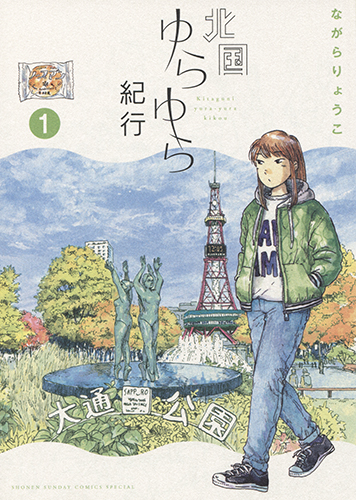
Ryōko Nagara’s Kitaguni yura-yura kikō (北国ゆらゆら紀行) is an episodic travelogue manga that follows a young woman named Tsukiko who left her job to return to her hometown of Sapporo.
Tsukiko is too burnt out to resume full employment, and her savings are running low. Her friend Chitose invites her to move into a Shōwa-era sharehouse co-rented with her flatmate Kensuke and Kensuke’s girlfriend Miwa. Their landlord, a world traveler who no longer lives in Japan, says that Tsukiko can stay if she can manage to clean up all the junk in the spare room.
As Tsukiko recovers from her recent life changes, she and Chitose explore Sapporo at a leisurely pace. Chitose is a writer who aspires to create a magazine celebrating the city’s regional culture. For the time being, she posts articles on her blog and creates zines. Chitose brings Tsukiko along while she scouts for material at small local stores and restaurants. When they’re not out and about, the two women dig through the cardboard boxes left behind by the landlord and uncover all sorts of treasures, from vinyl records to unique Hokkaido woodcrafts.
In my review (here) of Tomoko Shibasaki’s short story collection A Hundred Years and a Day, I touch on the phenomenon of “analog nostalgia,” the fascination with tangible media and the objects of an earlier era. Shibasaki’s collection dwells in a gentle sense of decay, but Kitaguni yura-yura kikō is marked by its youthful energy. As they stroll through beautiful streets lined with old houses and enjoy lively conversations over local cuisine in charming restaurants, it’s clear that Tsukiko and Chitose are thoroughly enjoying themselves.
Despite the fun she has with Chitose and her friends, Tsukiko suffers from depression and anxiety. The tiny apartment she occupies at the beginning of the manga is filled with trash, and she loses track of time while doomscrolling late at night. When Tsukiko considers the possibility of finding a new job, she imagines herself as a defenseless egg yolk sweating and apologizing while surrounded by menacing shadows.
When she invites her friend to move into her sharehouse, Chitose gives Tsukiko something tangible to hold. The manga’s emphasis on analog media, from Chitose’s printed zines to the old Walkman and cassette tapes that Tsukiko digs out of the landlord’s cardboard boxes, isn’t just simple nostalgia. Rather, it’s a concrete solution to a distressingly amorphous problem.
As the anonymous author of one of my favorite video game blogs writes (here) regarding the appeal of retro media, “We weren’t meant to live in an endless feed.” The rituals required by analog media once “gave life a shape that wasn’t constant images on a screen to choose from,” and these rituals serve as an anchor in the flow. Kitaguni yura-yura kikō doesn’t glorify the past or fetishize commodified nostalgia. Instead, tangible objects serve as a visual shorthand for places and relationships that don’t vanish when you close an app.
I don’t mean to suggest that Kitaguni yura-yura kikō is an introspective character study. More than anything, it’s a sweet and gentle travelogue, and it’s very charming. This manga makes me want to visit Sapporo and take long walks and eat delicious food. Still, I appreciate the subtext of the story, which is about readjusting to life lived at a slower pace while relearning how to have a meaningful connection with the place you live, the people who share the space with you, and your own embodied existence.
In October 2024, Matt Alt published an article in Aeon titled “The Joy of Clutter.” Instead of decrying the unsightliness of visual complexity, Alt argues that clutter has its own unique beauty, “an ecstatic, emergent complexity, born less from planning than from organic growth, from the inevitable chaos of lives being lived.”
Alt’s essay is illustrated with photos contributed by Lee Chapman, who captures evocative images of the chaotic interiors of tiny family-owned restaurants located in shopping arcades lined with shuttered storefronts. Chapman’s photos coincide with a trend on social media that expresses nostalgia for the Japan of the late twentieth century, with posts often tagged as “Shōwa Retro.”
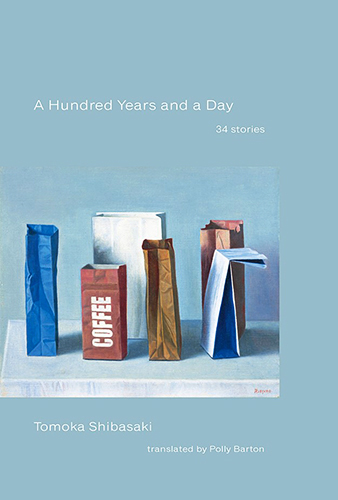
Tomoka Shibasaki’s A Hundred Years and a Day delights in the aesthetic of gentle decline exemplified by Shōwa Retro, and the 34 stories in the collection express nostalgia for people and places left behind in the past. Shibasaki invites the reader to walk through depopulated residential neighborhoods and stroll along abandoned shopping arcades. Half-empty cityscapes are dotted with buildings filled with clutter. Aging adults sift through the belongings of their deceased parents. Siblings who’ve drifted apart make clumsy attempts to reconnect by alluding to half-forgotten memories. Students study and then discard the small artifacts of the people who came before them.
Even reading through the book’s Table of Contents is like flipping through a card catalog in an old library, with each story’s title being a concise description of its premise. To give an example, the first story is titled:
“One summer during a long rainy spell, student number one from class one and student number one from class two discover mushrooms growing in a flower bed next to a covered walkway at their school; two years after leaving school they bump into each other, but after that, ten years pass, twenty years pass, and they don’t meet again”
“One summer” is a translucently beautiful piece of writing with imagery so clean and clear that I could almost feel the seasonal humidity on my skin. The story conveys the delicate specificity of a single moment captured in time. The moment dissipates and disperses as the world moves on, but the memory lingers.
An intriguing play on this theme is in the nineteenth story…
“I feel like I want to see the places that someone else saw, he said; I like thinking about places I’ve been to once but no longer know how to get to, or places that you can only access at certain times, I feel like there must be some way of visiting the places that exist only in people’s memories”
…which is about a woman who travels to a small seaside town to give a presentation at an academic conference. While walking back from the local shrine, she has a brief conversation with a child who will be the last ever student to graduate from the municipality’s junior high school. Years later, the child (now grown) encounters an artistic diorama that recreates a fictional version of their hometown that appeared in an old novel written by the academic’s deceased mother. While studying the artwork, this person (referred to by the story as “the last child”) is surprised by the liveliness of the reconstructed memory:
The last child crouched down and peered into the alley running between the wooden houses. It looked a lot like the alleyways that they knew from their childhood. They felt as though it was a path they’d been down before. As the last child was still staring down the passage, a cat ran across the alleyway where the stone steps were. The last child gasped in surprise, and stood up. A cicada flew in through the window, attached itself to the wall, and began to screech.
“I feel like I want to see” is a wandering ramble across time and memory, but most of the vignettes in A Hundred Years and a Day are much more focused on the history of a specific place. One of my favorites is the twenty-second story…
“A man opens a café in a shopping arcade, dreaming that it will become like the jazz café he used to frequent as a student; the café stays open for nearly thirty years, then closes down”
…which, despite the title, is about the young woman who takes over the original café by the university. The interior of the café is almost comically outdated, as are the records left behind by the previous owner. The new owner isn’t familiar with the musicians whose posters still hang on the walls. Regardless, the café is still lively, and the new owner finds herself thinking, at the end of the story, that “this is what I wanted to do.”
If I had to guess, I’d say that the reason why this sort of Shōwa Retro story has such a strong appeal is because it rejects the performative glossiness of mass media while embracing the beauty of real, everyday settings. The aesthetic also disrupts the modern myth that progress is not just desirable, but inevitable. Things don’t always get “better,” Shibasaki demonstrates, nor do endings always happen with a bang.
A cursory reading might suggest that Shibasaki is trafficking in low-effort cultural nostalgia, but I don’t think that’s the case. The imagery presented by each story in A Hundred Years and a Day feels very deliberate, like it’s smashing a smartphone screen with a hammer. This is fiction to be enjoyed slowly, and I appreciate the contemplative space Shibasaki has opened for the reader.
When discussing the texture of Shibasaki’s writing, it’s important to acknowledge the artistry of Polly Barton’s English translation. Japanese literary writing is notorious for its nested sentence structure, which can feel unintentionally Proustian if translated literally. It takes a keen eye and a delicate touch to understand whether Japanese sentences are interminably lengthy because the language is simply written like that; or whether a sentence like one of Shibasaki’s story titles is a deliberate stylistic choice. Barton has done truly amazing work with A Hundred Years and a Day at a sentence-by-sentence level, allowing the reader to enjoy Shibasaki’s distinctive style while still maintaining a casual, conversational tone.
Most of the stories in A Hundred Years and a Day occupy fewer than ten pages, and they read like accounts passed from one person to another by word of mouth. Spending time with this collection feels like calling an elderly relative and listening to them talk about a restaurant closing in your old neighborhood, or about how they saw someone that you once knew as a child in the newspaper. There’s no real beginning or end to the stories, nor is there any discernible sense of structure. Still, the theme of human connection runs through Shibasaki’s work like a gentle current, drawing the reader forward along on the steadily flowing stream of time.
I’d like to extend my gratitude to Stone Bridge Press, which provided an advance review copy of this book. A Hundred Years and a Day will be published on February 25, 2025. You can learn more and read a preview on the book’s webpage (here).

 Contemporary Japanese Literature