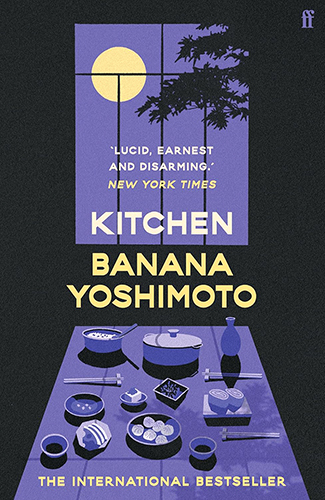
Banana Yoshimoto’s landmark 1988 novella Kitchen once inspired a great deal of heated discussion as a miserable chain of respected literary critics dismissed it as shallow and frivolous. Haters gonna hate, but I loved Kitchen when I first discovered it in high school, and I still think it’s a beautiful book that’s well worth reading.
After her parents died in a car accident, Mikage Sakurai was raised by her grandmother, who suddenly passes away when Mikage is in college. Now Mikage feels that she has well and truly become an orphan, and she doesn’t know what to do.
Yuichi Tanabe, a young man who was friendly with Mikage’s grandmother, invites her to stay with him and his mother at their apartment while she gets her life sorted out. Though Mikage has never met either of these people, Yuichi’s kindness is exactly what she needs, and she’s so stressed out and dispirited that she takes him up on his offer.
The apartment turns out to be gorgeous – it’s bright and sunny and spacious, and also outfitted with a thoroughly modern kitchen and a giant sofa that Mikage immediately falls in love with. Yuichi’s mother Eriko is just as friendly and charming as she is beautiful, and Mikage instantly feels at home. Though she knows she’ll have to leave eventually, she makes the best of her time in a warm and comfortable space in the care of two lovely people.
Eriko is clearly the star of this story, especially as she relates her own experience of loss to Mikage. Yuichi’s mother was the only woman she would ever love, she says, and she didn’t know what to do when her wife died after a long illness. She felt like the only reasonable course of action was to take on the role of “mother” by changing her name, getting surgery, and becoming a woman herself. She still misses Yuichi’s birthmother, but life goes on, and she couldn’t be happier. As Mikage describes Eriko at the end of the story:
Her hair rustled, brushing her shoulders. There are many days when all the awful things that happen make you sick at heart, when the path before you is so steep that you can’t bear to look. Not even love can rescue a person from that. Still, enveloped in the twilight coming from the west, there she was, watering the plants with her slender, graceful hands, in the midst of a light so sweet it seemed to form a rainbow in the transparent water she poured.
Kitchen is full of similar passages in which Mikage takes in the beauty of her surroundings while reflecting on her feelings. These moments are refreshingly light, and it’s as if the writing is washing over you in a gentle shower. Yoshimoto says that her goal is to create precisely this sense of peace, writing in her Afterword to Kitchen that “I know no greater happiness than that it may have cheered you, even a little.”
Kitchen includes a continuation of the story, “Full Moon,” which begins with Eriko’s murder. Mikage has gotten back on her feet, moved out of the Tanabes’ apartment, and become an assistant to a celebrity chef. Now that tragedy has visited Yuichi, it’s her turn to comfort him.
Mikage is comforted and supported by Chika, a transwoman who has taken over the cabaret club that Eriko managed. Chika helps Mikage to understand that, despite being disowned by her family, Eriko lived a full life, and she encourages Mikage to find her own happiness with Yuichi. Chika’s advice feels like the central thesis of Yoshimoto’s writing: the world can be dark and confusing, so you have to actively create your own sanctuary alongside the people you love.
All of this feels very much like shōjo manga created for teenagers, from the quiet and nonsexual love story between Mikage and Yuichi to the way that everyone seems to sparkle. The normalization of queer identity also has its roots in shōjo manga, as does the mundanity of the supernatural events depicted in “Moonlight Shadow,” the short companion story included at the end of the book. Yoshimoto’s language is filled with onomatopoeia and other cute expressions that feel directly lifted from manga, so much so that Megan Backus’s natural-feeling English translation is a genuine miracle.
If you’re not in the target demographic for Kitchen, it would make sense that Yoshimoto’s manga-inspired style of writing might not resonate with you. And that’s okay! Lord knows that there are enough works of literary fiction written by and for older adult men.
When I discovered Kitchen as a teenager, though, this book was definitely for me. In fact, it felt like the first book I’d encountered that took me seriously as a person. Having run the gauntlet of Ernest Hemmingways and William Faulkners and John Steinbecks in my high school English classes, I felt extremely alienated by fiction as a medium. I can’t even begin to describe what an amazing stroke of good fortune it was to find that Banana Yoshimoto had reached out with her writing and spoken to me specifically.
It’s not an exaggeration to say that the pop culture of the 1990s and early 2000s was a toxic slurry of homophobia and misogyny. In that sort of cultural environment, the independent young women and kind men and gentle queer sexuality of Kitchen were nothing short of revolutionary. I’m sure it was easy for older male literary critics to say that Yoshimoto’s writing was empty pablum, but it was something else entirely for me to encounter my first fictional depiction of gay adults who were treated as real human beings instead of stupid jokes or beleaguered minorities.
It felt like a revelation to see people being openly gay and also completely normal, and it would be disingenuous to say that this realization wasn’t political. Banana Yoshimoto showed me the rainbow, and sure, it was magical. How could it not be? But also, when I put this book down, I felt like I’d gained a sense of identity and purpose. When Chika tells Mikage that you have to fight for a world that accepts you, I took that advice to heart.
I was far from alone in being moved by this story. Kitchen was an instant bestseller in Japan, and it went on to gain fame overseas during the 1990s. In the 2000s and 2010s, Banana Yoshimoto enjoyed a degree of international recognition on the same level as Haruki Murakami. And she deserved it. She still does, honestly. I may have aged away from Kitchen, but that doesn’t mean I don’t respect it immensely.
Admittedly, Mikage sometimes seems as though she lives in a different world, and it can occasionally be a bit painful to look back on the prosperity and optimism of the 1980s. Still, Kitchen feels as fresh as the day it was written, and maybe you’re exactly the person who needs to read it now.
 Contemporary Japanese Literature