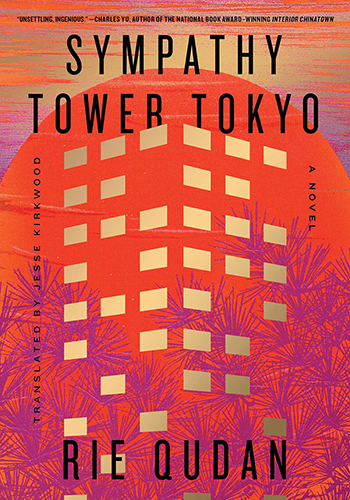
Sympathy Tower Tokyo

Rie Qudan’s short novel Sympathy Tower Tokyo, which was awarded an Akutagawa Prize in 2023, is a story about language, generative AI, and the culture war discourse surrounding the construction of a fictional prison facility in a high-rent area of Tokyo’s Shinjuku district. 

Sara Machina is an artist and architect who wants to win the bid to design and build the eponymous “Sympathy Tower Tokyo,” a prison right in the middle of metropolitan Tokyo that will operate according to a utopian vision of providing state-mandated shelter to “homo miserabilis,” or people driven by economic precarity to commit crimes because they had no other options, Les Misérables style.

The main problem, in Sara’s eyes, is the name of the building, which is written in English and a mouthful to pronounce: Shinpashii Tawaa Toukyou. It’s also somewhat meaningless, Sara reflects, as are a number of other politically correct English terms that have replaced native Japanese expressions. Amusingly, she provides a list that includes examples such as negurekuto (neglect), which has replaced the formal term ikuji hōki (child abandonment) in public discourse.

Most of these loanword expressions don’t really change the meaning or public perception of the concept itself, but some do. “Homo miserabilis” is one such (fictional) example, having replaced the word hanzaisha, meaning “criminal.” Which is all well and good, Sara admits, but she still can’t envision a structure called “Sympathy Tower Tokyo.” If the building were to have a name that was more euphonic in Japanese, that would be a different story.

An appropriate name is provided by a beautiful young man who goes by “Takt,” a loanword from German used for an orchestra conductor’s baton. Takt became Sara’s casual boyfriend after she saw him through the display window of a luxury fashion store in Aoyama and point-blank asked him out; and, despite the difference in their ages, he does genuinely care for her.

While Sara frets over the intricacies of language, Takt has no qualms about using AI-built, the novel’s version of ChatGPT, to address any questions he might have. Despite his casual use of AI to understand the world and communicate with other people, Takt naturally and organically comes up with the expression Tōkyō-to Dōjō-tō (Tokyo City Sympathy Tower), which rolls off the tongue “like a spell from Harry Potter” and turns out to be exactly the inspiration Sara needs. 

Sara’s design wins, and the tower is built on prime real estate for everyone to see. It is, she says, “the answer to the question posed by Zaha Hadid’s Olympic Stadium.” 

Sara narrates the first and fifth chapters of the novel, while Takt narrates the second and fourth. The third chapter belongs to Max Klein, an American journalist covering Japan who’s gone freelance after being accused of making racist cultural generalizations. Takt is charmed by Max and begins adopting his speech patterns, while Sara (bless her heart) is mainly concerned about Max being fat and stinky and sweaty.

Max himself is a budget version of Hunter S. Thompson who seems to want to “tell it like it is” but unfortunately doesn’t possess the political acumen to make it as a mainstream reporter. In particular, Max is frustrated by what he sees as the tendency of Japanese officials (and Japanese people in general) to use smooth and politically correct language to mask their actual views and agenda.

While Max’s tirade is admittedly gauche, it seems to partially echo the author’s own views regarding excessive linguistic masking, which she expressed succinctly in an interview with The Guardian (here):  

“There are people all around you who you would never think hold discriminatory views but actually do hold those views. A lot of Japanese people, on the surface, they know how to act in a way that makes them seem welcoming of diversity. And this discrepancy between what people think on the inside and what they say is a very distinctive feature.”

In other words, language is political, but the degree to which “correct” language can shape or reshape society is debatable. This question calls to mind the online conversations in 2022 surrounding Tetsuya Yamagami, the man who assassinated Shinzō Abe and attracted immediate widespread sympathy. While the murder itself was shocking, Yamagami’s motives were faultless. How, then, would it be appropriate to talk about him? Is someone like Yamagami truly a “criminal,” or rather a “homo miserabilis”? Regardless, the language we use to refer to people who commit crimes doesn’t change the fact that we feel compelled to incarcerate them, “Sympathy Tower Tokyo” though their prison may be. 

Sara Machina was the victim of an assault that was never punished or even acknowledged, and she can’t quite reconcile herself to rhetorical towers built with politically correct language. Max goes five steps farther and expresses open disdain for the sort of wokeness that dictates that people who caused so much suffering to others aren’t properly treated like criminals but are instead allowed to live rent-free in a gorgeous luxury tower.

In the middle is Takt, the son of a high-profile “homo miserabilis” who ultimately decides to become a PR representative for the tower. Perhaps because he’s so used to consulting AI-built, his speech soon becomes just as smooth and beautiful as his face. When he begins to write about Sara Machina’s architectural genius, however, he finds that AI is insufficient, yet he can find no words in himself. This is fine with Sara, who (relatably) doesn’t wish to be perceived after becoming the target of sustained abuse on social media. 

The plot summary I’ve given here doesn’t begin to do justice to the actual conflict of Sympathy Tower Tokyo, which revolves almost entirely around language. Both English-language and Japanese-language journalists have made a big deal about how “a portion of this award-winning novel was written by ChatGPT,” but this description is painfully misleading. When characters in the novel engage with AI-built, the program’s text was in fact generated by AI, as is appropriate. Although Qudan never has her viewpoint characters make a definitive statement about LLMs, the “smoothness” of machine-generated text is positioned as a mirror to the sort of “politically correct” language used by public officials to disguise and downplay critical issues in contemporary Japanese society.  

In any case, Jesse Kirkwood’s translation is brilliant, and I very much appreciate the brief and informative “Translator’s Note” at the beginning of the book. Also, for what it’s worth, though the diegetic AI-built text may have been generated by an LLM, I didn’t get the sense that it was translated by one. If there’s any criticism to be directed at Sympathy Tower Tokyo, it’s that its emotional core is ephemeral and difficult to pin down. Perhaps ironically, the characters aren’t sympathetic; rather, their role is to serve as viewpoints along a spectrum of opinion. Still, Sympathy Tower Tokyo is a remarkably playful and intellectually stimulating book, and you can’t help but admire Qudan’s boldness in standing up and speaking to the current moment of culture war discourse.

Tokyo Decadence

Tokyo Decadence

Title: Tokyo Decadence: 15 Stories by Ryu Murakami
Author: Murakami Ryū (村上 龍)
Translator: Ralph McCarthy
Publisher: Kurodahan Press
Publication Year: 2016
Pages: 280

Tokyo Decadence contains fifteen stories drawn from five of Murakami Ryū’s collections published between 1986 and 2003. As translator Ralph McCarthy explains in his acknowledgments, he has been translating his favorite Murakami stories since the late 1980s, and now he’s finally able to publish them thanks to the blessing of the author and the encouragement of Edward Lipsett of Kurodahan Press.

The first story in Tokyo Decadence, “Whenever I Sit at a Bar Drinking Like This,” has a passage at the beginning that reads as follows:

It’s probably safe to say that everyone sitting here is looking for some sort of sin tonight. The circumstances are different for each, of course, but everyone has the same general destination in mind. No one gets drunk in order to raise their moral standards.

It’s probably safe to say that no one opens a collection of Murakami Ryū’s short fiction in order to raise their moral standards. If you’re looking for some sort of sin, you’ve found yourself the right book. All of the stories in Tokyo Decadence are surprising and unique, but they all move toward the same general destination – sex and drugs and blood and tears.

This first story takes the form of an elaborate fetch quest across the seedy underbelly of Shinjuku in which the protagonist must exchange promises for favors. His goal is to get one of his former lovers to testify in court that they were sleeping together so that another of his former lovers doesn’t claim common law marriage and sue him for divorce. The point seems to be that people are terrible and selfish creatures, but it’s a lot more fun arriving at this conclusion than you’d expect.

The second story, “I Am a Novelist,” involves another strange situation in which a man posing as a bestselling writer gets a girl at a hostess club pregnant. When her manager insists that he meet the young woman, she quickly admits he’s not the person she slept with, but the writer still takes her out to dinner. She tells the writer that she’s a fan of his work, so he tries to get her to fall in love with him instead of his impersonator. It doesn’t work (obviously), and the novelist ends up finding out that he was just a minor character in someone else’s story.

In other stories, a trucker loses his wife and his job and becomes a host at a gay club, a guy with no self-esteem invades a woman’s home and smashes her television, and a young prostitute buys herself a topaz ring to remind herself of a musician whose world she can never enter. In “Penlight,” a call girl with serious issues talks about her imaginary friend to a guy she meets at a bar, who is interested in her body, but in the way you think (unless you happen to be thinking of horrific murder and cannibalism). A few of these stories are drawn from Murakami’s 1988 collection Topaz, which became the basis for the 1992 film Tokyo Decadence, which was directed by the author and banned in a handful of countries precisely because it’s the sort of movie you’d expect to have been directed by the author.

If you’ve read Murakami’s work before, you know what to expect. Since all of these stories are twenty pages or less, however, there’s no slow buildup to the carnage. That being said, the violence is tempered with irony, black humor, and intriguing characterizations that elevate the stories above simple splatterfests.

In contrast, the three stories drawn from the 1995 collection Ryu’s Cinematheque are vaguely autobiographical.

In “The Last Picture Show,” the 18-year-old narrator is living in Kichijōji and trying to make it big with his blues band. His upstairs neighbor, who is obviously a yakuza, wants to pay him to pick hydrangea leaves in Inokashira Park to dry and then sell as marijuana to American soldiers. In “The Wild Angels,” the 18-year-old narrator has started a relationship with a woman who works as a hostess, which makes him feel like less of a man, so he starts shooting heroin. In “La Dolce Vita,” the college student narrator hooks up with an older woman who lives in Yokosuka and gets her drugs from the American army base, which doesn’t end well.

To me, these coming-of-age stories were nowhere near as interesting or amusing as the murder stories, but they provide an interesting picture of the 1970s that serves as a counterpoint to the stories of the other Murakami; these stories forgo nostalgia in favor of an emphasis on the grittiness and despair and self-indulgent navel gazing of fringe counterculture.

The last third of Tokyo Decadence eases up on the drug use but maintains its focus on sex and emotional violence. Some of the stories reference each, and I got the sense that I was only being glimpses into a larger narrative. I dearly wish we lived in a world in which Ralph McCarthy was able to publish his translations of entire Murakami collections instead of selected stories, but each piece included in Tokyo Decadence shines brightly enough on its own merits that the reader is not disappointed by the relative lack of context.

I thoroughly enjoyed Tokyo Decadence. The collection portrays the Japan of the bubble and postbubble decades as a place where anything in your wildest dreams and darkest nightmares could happen. Murakami’s fiction is a love letter to the infinite possibilities of urban life delivered with style and panache. Just be warned – Tokyo Decadence is not for the faint of heart.

Tokyo Decadence will be released on March 15, 2016. A complete table of contents can be found on its page on the Kurodahan Press website.

Review copy provided by the noble and selfless people at Kurodahan Press.

The Book of Tokyo

The Book of Tokyo

Title: The Book of Tokyo: A City in Short Fiction
Editors: Michael Emmerich, Jim Hinks, and Masashi Matsuie
Publication Year: 2015
Publisher: Comma Press
Pages: 180

In his introduction to this collection of ten short stories, editor Michael Emmerich writes:

In a sense, you might say that the stories of this anthology unfold within a landscape more imagined than real – that they create a Tokyo of their own by drawing on a rather abstract sense of the moods of certain sections of the city, or on a vision of Tokyo and the smaller areas it comprises that is more conceptual than physical. (x)

This is a perfect description of The Book of Tokyo, which offers the reader less of a detailed illustration of an urban landscape than it does a vivid sense of the energy and potential generated by a city inhabited by 13.5 million people, every one of whom has a story.

In Furukawa Hideo’s “Model T Frankenstein,” a monster that may or may not be a shapeshifting goat escapes one of the Izu Islands on a ferry and makes his way to Tokyo to assume a new identity as a ‘Japanese.’ He has to kill a few people along the way, but he eventually makes a home for himself in Shinjuku. In “Picnic,” Ekuni Kaori sketches a relationship between a disaffected couple whose hobby is to have designer picnics in a park by their house, an activity that makes them marginally less alienated from one another. Kakuta Mitsuyo’s “A House for Two” is an ode to the trendy comforts of urban living. The pleasure the narrator derives from walking through the city has its roots in her relationship with her mother, whom she whom once bonded with over luxurious foreign clothes and who now commands a greater share of her affections than any man ever could.

The cosmopolitanism of Tokyo is on full display in Horie Toshiyuki’s “The Owl’s Estate,” in which the male narrator, a sushi chef and secondhand book dealer, finds himself in a strange rundown building in West Ikebukuro inhabited by foreign girls of dubious employ. In the end, though, there’s nothing particularly French or Australian or American about the way these girls enjoy drinking and laughing and being silly with each other. The single father protagonist of Yamazaki Nao-Cola’s “Dad, I Love You” must navigate his way through a maze of foreign brand names, cuisines, and business owners over the course of his day before coming home to his daughter, who encourages him to keep going with the joy she finds in things that transcend culture, such as how large the full moon looks in a clear night sky. The young woman who narrates Kanehara Hitomi’s “Mambo” doesn’t even care where she’s going when she gets into a taxi with a stranger; she’s just looking for adventure in the city.

Yoshimoto Banana’s “Mummy” encapsulates the theme of the entire collection, which is that every random encounter between strangers is accompanied by a galaxy of possibilities. A female undergrad agrees to be walked home by a male graduate student studying Egyptology. He cautions her that there’s a killer loose in the neighborhood, and it would be unsafe for her to go out alone. She suspects that he might be the murderer, but her physical attraction to him is so strong that she resigns herself to her fate. Although the grad student isn’t a criminal, he does turn out to be a complete weirdo, and the narrator has to forcibly restrain herself from judging him and the course his life takes after they go their separate ways. When surrounded by so many potential paths, she asks herself, how do you know that your own is “necessarily the correct and happiest one” (52)?

My favorite story in the collection is Kawakami Hiromi’s “The Hut on the Roof.” The main setting is an izakaya pub, where the divorced narrator, an English teacher, eats and drinks and hangs out with older men from her neighborhood. After becoming close to them through the process of exchanging casual but repeated interactions, she eventually learns the story behind the peculiar living arrangement of a local fishmonger who has befriended her. The story doesn’t have a plot, exactly, but it conveys an almost palpable sense of living your own individual life surrounded by people whom proximity has drawn into a loose yet friendly community.

Don’t let the cover fool you – despite the flying cranes and Shintō gate and temple and Chinese lanterns, the The Book of Tokyo is refreshingly contemporary. None of the stories translated for the collection was published before 2000, and reading them feels like walking through the twenty-first century just as much as it feels like walking around Tokyo. As Emmerich notes, it’s difficult to pin down the “Tokyo-ness” of these stories, but the reader who encounters them can’t help but be drawn into the living and breathing atmosphere of a huge and dynamic city.

The editing and story selection of The Book of Tokyo is excellent. I was so impressed that I ended up ordering several other titles in Comma Press’s “Reading the City” series, which include The Book of Gaza, The Book of Rio, and The Book of Liverpool.

Review copy provided by the wonderful people at Comma Press.

Parade

Parade Novel

Title: Parade
Japanese Title: パレード (Parēdo)
Author: Yoshida Shūichi (吉田 修一)
Translator: Philip Gabriel
Year Published: 2014 (America); 2002 (Japan)
Publisher: Vintage Books
Pages: 230

Do you remember how, maybe around ten years ago, writers like Nick Hornby and Chuck Palahniuk were really cool? You’d read something like Bret Easton Ellis’s American Psycho or Don DeLillo’s Cosmopolis and go, Wow, that’s brilliant! And do you know how now, when you try to pick up one of those writers again, you’re too jaded by movie adaptations trying to make hard-line masculinity and sexual violence seem edgy to really appreciate what the writers were trying to say about urban culture and the weird bonds that form between people and what happens when you’re no longer young and suddenly running out of opportunities to make a fresh start? Have you ever thought it would be kind of awesome to re-experience the excitement of those stories without the nagging annoyance of an ever-present undercurrent of misogyny?

If so, then you need to read Parade. It’s by far the most enjoyable novel I’ve encountered this year. When I first sat down with it, I thought I would read twenty pages and then call it a day; but then, the next thing I knew, I was ninety pages in and terrified that I wouldn’t be able to stop. The novel’s five chapters are recounted by five different characters, each of whom is crazier than the last. I loved all of them, and I had to pace my progress through the book so that I could spend more time in their presence. Like its narrators, Parade is young, and it’s fun, and it’s clever, and it’s psychologically unbalanced (in a good way).

The story is about four people in their twenties who have no idea what they’re doing with their lives. Almost by accident, they’ve found themselves living together in a two-bedroom apartment, where they’ve established an easy and comfortable social space that one of them likens to an internet chat room. In short, each of them is free to be as dysfunctional as he or she wishes without incurring the judgment of the others, and they get along well.

Sugimoto Ryōsuke is a sophomore in college who adores a protective upperclassman and has found himself in a Sedgwickian love triangle with his friend’s girlfriend. When he’s not stalking this girl (with her tacit approval), he’s aimlessly driving around Tokyo in a derelict Nissan March that he’s named Momoko. Ōkochi Kotomi is twenty-three, unemployed, and may or may not be dating an up-and-coming young actor. She spends all day inside the apartment watching tv and waiting for her maybe-boyfriend to call. Sōma Mirai is only a year older than Kotomi but manages a branch of a boutique that sells clothes and accessories imported from places like India and Bali. She’s also an unrepentant alcoholic who frequents gay bars and stays up all night working on digital illustrations based on close-up photographs of male bodies. Ihara Naoki, the apartment’s last remaining original tenant, is pushing thirty and seems the most normal of the group. He works at a small but successful film licensing company and goes on jogs late in the evening while listening to classical music. Every so often Naoki’s nutty ex-girlfriend Misaki appears without warning, has a few drinks, and spends the night on the apartment couch.

One night, Mirai picks up an eighteen-year-old high school dropout named Kokubo Satoru on one of her pub crawls through Shinjuku. Satoru, who does speed in public restrooms and trolls for clients in parks, has no fixed residence and somehow ends up squatting in the shared apartment. His entry into the lives of the four tenants coincides with a string of assaults in the neighborhood that become increasingly violent over the course of the novel. Meanwhile, the unit next door – Apartment 402 – is fairly obviously serving as the headquarters for some sort of shady operation orbited by creepy old men and weeping teenage girls. Despite all this, Ryōsuke, Kotomi, Mirai, Naoki, and even Satoru continue to drift through life largely untroubled by anything that happens outside the confines of their apartment.

For the reader, there is a certain Gothic appeal in unearthing the secrets hidden under the placid comradery characterizing this pseudo-family, but the lack of concern on the part of the people in question drains most of the shock from each revelation. So Ryōsuke is stalking his older male buddy’s girlfriend because he has a weird father complex? It happens. Kotomi is obsessed with an actor not because of lust or emotional emptiness but because of a half-hearted sense of guilt over something that happened when she was a high school student? Whatever, it’s no big deal. By the time the reader uncovers the more sordid secrets of Parade‘s narrators, they’re become more amusing than upsetting; and, if nothing else, knowledge of these secrets only serves to render the continued companionship of the apartment’s tenants all the more touching.

I understand how some people might interpret Parade as a horror story, but it’s really more like an American sitcom about comically mismatched roommates. “Comically mismatched” happens to mean “weaving in and out of the borderlands of sanity” in this case, but the novel still has the potential to generate a lot of warm fuzzy feelings, at least in readers with a healthy tolerance for black humor and antisocial behavior.

Philip Gabriel’s translation is eminently readable, capturing the grit and immediacy of the narrators’ different styles without resorting to easily dated slang or stereotypes regarding urban speech patterns. Yoshida is a popular writer with a distinctive literary voice, which I feel comes across much more clearly in Parade than in Gabriel’s earlier translation of the author’s 2007 novel Villain. That being said, both books are a lot of fun, and I’m looking forward to more of Yoshida’s work appearing in English.

Isao Yukisada, who won a Japanese Academy Prize for his 2005 adaptation of Katayama Kyōichi’s bestselling romance Socrates in Love, directed a movie version of Parade. The film was well-received at the 2010 Berlin International Film Festival, winning a FIPRESCI Award and going on to screenings at festivals all over Europe and North America. I had a chance to catch the movie at a showing during that year’s Philadelphia Film Festival, and it was really good. I highly recommend Yoshida’s original novel, of course; but, if you get an opportunity to see Isao’s cinematic adaptation, go for it!

A review copy of Parade was kindly provided by Vintage Books.

Parade Movie Poster

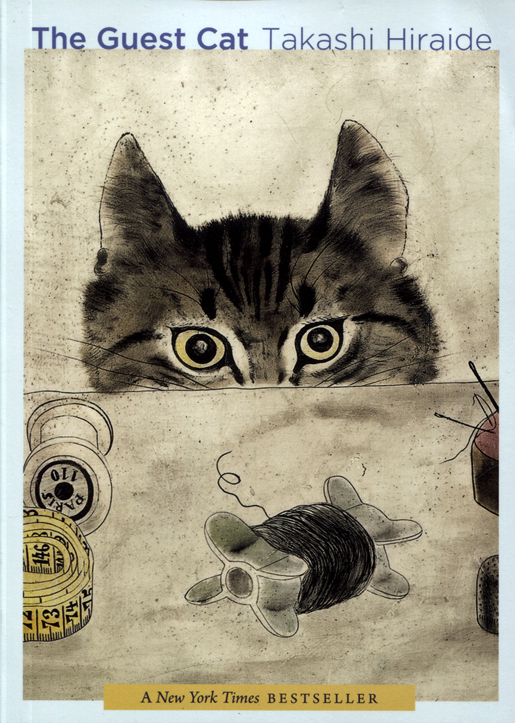
The Guest Cat

The Guest Cat

Title: The Gust Cat
Japanese Title: 猫の客 (Neko no kyaku)
Author: Hirade Takashi (平出 隆)
Translator: Eric Selland
Publication Year: 2014 (America); 2001 (Japan)
Publisher: New Directions
Pages: 140

The Guest Cat is set in 1988 in a residential neighborhood not too far away from Shinjuku Station, where the young narrator lives with his wife in a rented house located on the property of an old estate. The narrator’s house faces a narrow side street that he calls “Lightning Alley” because of its sharp, zig-zagging turns. A young housewife and her son live in a house next door that shares the shade of an ancient zelkova tree with the narrator’s house. A cat wanders into the housewife’s garden, and her son becomes enamored with the creature. Despite the protests of the woman living in the main house of the larger estate, who claims that the neighborhood cats ruin her garden and track dirt inside her house, the boy is allowed to keep the small white-mottled cat, which is promptly given the name Chibi, meaning “little one.”

The novel moves elliptically through several stories, gradually passing from point to point by way of meandering descriptions of the outside alley, the estate garden, and the narrator’s house in relation to the space and weather outside. The narrator has just worked up the courage to quit his job as a literary editor in order to pursue his own writing projects, but he only has enough money to help his wife maintain the household for about a year and a half. The narrator’s close friend dies from cancer, and the narrator worries about his own health as the Shōwa emperor grows ever weaker on his deathbed. The woman who owns the estate lives alone save for her aging husband, and she’s not too young herself; it’s uncertain what will happen to the property when she passes away, as land prices have risen exorbitantly in the bubble economy. Most importantly, Chibi develops new mannerisms and behaviors as she becomes more familiar with the narrator and his wife, who in turn grow and change through their interactions with her. The chapters are short (between three to six pages), each focusing less on any sort of ongoing plot and more on brief and vibrant observations on how the world appears differently when it’s centered around a cat instead of around other human beings.

The style of the novel is naturalistic in its minute attention to the detail of mundane life and reminds me of nothing so much as the short fiction of Shiga Naoya or the realistic fiction of Akutagawa Ryūnosuke (of the kind collected in Mandarins), in which the discomfort caused by writer-narrator’s cold is made palpable by a catalog of what can only be noticed when one is confined to bed but cannot sleep, such as how a lizard crawls into a sliver of shade on the bedroom windowsill to escape the sun, or how Chibi admires herself in the mirror before leaping from the mirror stand onto the top shelf of the closet. As one imperial era transitions into another, the narrator and his wife experience major changes in their life, including a particularly traumatic event involving Chibi whose full impact does not become clear until the very last page of the story. Throughout everything, Hiraide focuses on brief moments and small sensory details such as the pleasant chilliness of a breeze or the pattern of light and shadow cast by the sun shining through tree leaves. While it is possible to glean several layers of meaning from each episode (one scene involving a praying mantis eating a locust particularly rewards analysis), it’s also well within the reader’s right to simply allow herself to be carried by the relaxed current of vivid impressions.

I’ve recently started reading about the Deep Ecology movement, which is above all concerned with animal rights, as well as how respect for these rights can shape the nature of the relationship between human and non-human animals. I’ve become a fan of Marc Bekoff’s blog Animal Emotions, which comments on current events and summarizes scientific research in order to build a case for a more inclusive and compassionate understanding of animal psychology. It’s been interesting to read Bekoff’s work alongside The Guest Cat, in which different characters betray vastly different attitudes towards animals through their interactions with Chibi. I was especially intrigued by the shifting tides of the narrator’s wife, who claims not to be a cat person:

As she finished the poor sparrow’s burial my wife repeated her earlier declaration – “I won’t hold Chibi,” she said. “It’s more gratifying to let animals do whatever they like.”

As April came around, gossamer-winged butterflies covered the garden, dancing just above its surface and coloring it a blue-gray. It seemed impossible for anyone walking in the garden to avoid stepping on them.

What’s interesting about animals, my wife explained, is that even though a cat may be a cat, in the end, each individual has its own character.

“For me, Chibi is a friend with whom I share an understanding, and who just happens to have taken on the form of a cat.”

Even though the narrator’s wife is attached to Chibi, she respects the cat’s autonomy and individual character, thus abstaining from direct interaction. The narrator, on the other hand, becomes fiercely jealous of the cat’s affections at a certain point, and it becomes increasingly apparent that Chibi’s primary caretaker, the housewife next door, also possesses strong emotions concerning the cat.

Although other readers may interpret this autobiographical novel differently, to me, the primary dramatic effect of The Guest Cat is not so much a result of its human characters and the socioeconomic environment they occupy, but rather a process arising from the ideas and emotions animals inspire in humans as they become attached to individual creatures and are refracted into the wider world.

The Guest Cat is equally capable of acting either as a quick pleasure read for cat lovers or as a starting point for applied literary ecocriticism. Either way, it’s a neat little book!

In the Miso Soup

In The Miso Soup

Title: In the Miso Soup
Japanese Title: イン ザ・ミソスープ (In za miso sūpu)
Author: Murakami Ryū (村上 龍)
Translator: Ralph McCarthy
Publication Year: 2003 (America); 1997 (Japan)
Publisher: Penguin
Pages: 217

In the Miso Soup was serialized during 1997 in the Yomiuri Shimbun, the newspaper with the highest circulation in Japan (and perhaps in the world), and it won the 1998 Yomiuri Prize for Literature, an extremely prestigious award given to superlative works of writers who have already established themselves as leaders in their fields. The novel’s North American and Japanese publishers have marketed it as a “psycho thriller,” and its extreme and violent content will more than likely shock anyone who isn’t familiar with Murakami’s oeuvre, especially his other suspense novels from the 1990s, such as Piercing (1994) and Audition (1997).

The twenty-year-old protagonist of the novel, Kenji, is a high school graduate from Shizuoka Prefecture who makes his living by acting as a guide of Shinjuku’s Kabukichō neighborhood, which is internationally famous for its nightlife. Kenji specializes in sex tours for foreigners, who learn about his services through Tokyo Pink Guide, a publication helmed by a man named Yokoyama, who believes it is his calling in life to bring the people of the world together through something all human beings have in common. On the morning of December 29, Kenji is contacted by an American named Frank, who claims to be a distributer of Toyota car parts and meets Kenji while clutching a copy of Pink Guide in his meaty hands.

If you mention In the Miso Soup to anyone who’s read the novel, the conversation will instantly turn to how delightfully creepy Frank is. Frank is a pathological liar, for starters. If one of the bizarre things Frank says is challenged in any way, he becomes suddenly and irrationally furious, his expression transforming into a mask of rage that Kenji soon comes to refer to as “the face.” The skin on Frank’s neck and hands is loose and seems artificial, and a sex worker who services Frank at a peep show says that there is something inexplicably wrong with his penis as well. To make matters even more upsetting, the body of a high school junior named Takahashi Akiko had been found dismembered and distributed across Kabukichō early in the morning of the 27th; and, after Frank goes on a rant about killing homeless people during his first night out with Kenji, the charred corpse of a homeless man is found in Shinjuku Central Park the next morning. By the end of the first of the novel’s three chapters, both Kenji and the reader are supplied with ample evidence to suspect that there is something not quite right with Frank.

Although Kenji is understandably apprehensive about spending more time with Frank, he is even more worried about what Frank might do in retaliation if he were to break their agreement and stand him up. He thus goes out for a second night on the town with Frank, who now makes very little effort to appear normal. After an episode of highly concentrated weirdness at an underground shot bar, Kenji and Frank go to an omiai club, a bar where people hoping to hook up with a stranger can meet. The girls who enter the club are given numbers and chosen by the men, who must pay a cover charge to enter. If a girl is chosen, she will share a table and drinks with the man who selects her. If they hit it off, they can then proceed to a nearby love hotels, and it is understood that money will more than likely change hands after the encounter. It’s not quite prostitution, but the women do have a financial interest in convincing the men to leave the club with them, and they will put everything they have into flirting and appearing attractive. What could be a quirky comedy of errors in another novel becomes an absurdist drama in the bizarro realm of In the Miso Soup, and Frank puts an end to the staged and artificial interactions of the club’s patrons with a lengthy orgy of meticulously narrated ultraviolence. Although Kenji is clearly traumatized by this turn of events, he also takes tentative steps towards an acceptance of what has happened to the other people at the club, who have upset his fundamental faith in humanity with their superficiality:

They were like automatons programmed to portray certain stereotypes, these people. The truth is it bugged the hell out of me just to be around them, and I’d begun to wonder if they weren’t all filled with sawdust and scraps of vinyl, like stuffed animals, rather than flesh and blood. Even when I saw their throats slit and the gore oozing out, it hadn’t seemed real to me. I remembered thinking, as I watched the blood drip down from Lady #5’s throat, that it looked like soy sauce. Imitation human beings, that’s what they were.

Murakami therefore configures Frank’s dispassionate killing spree into a sort of social critique, a theme that comes to fore in the novel’s third chapter. After the bloodbath at the omiai club (which Kenji refers to as “The Great Omiai Pub Massacre,” as if it had happened years ago), Frank shanghaies Kenji into spending the night with him in the abandoned medical facility in which he has ensconced himself. While Kenji shivers in the darkness of the unheated building, Frank regales him with stories from his childhood in America. As might be imagined, Frank’s childhood is dysfunctional and disturbing enough to make Stephen King proud (Frank even grew up in Maine!), as it includes the creepiness of small towns, the killing of small animals, murder, institutionalization, and extreme body horror courtesy of American mental health practices. Frank is obviously a sociopath, and he has already been established as a pathological liar, so it’s not entirely certain that he’s telling the truth, but he does seem to be telling Kenji his life story for a reason. Frank is almost like an overweight Tyler Durden as he explains that society needs terror, discord, and disruption in order to evolve:

“I see myself as being like a virus. Did you know that only a tiny minority of viruses cause illness in humans? No one knows how many viruses there are, but their real role, when you get right down to it, is to aid in mutations, to create diversity among life forms. I’ve read a lot of books on the subject – when you don’t need much sleep you have a lot of time to read – and I can tell you that if it weren’t for viruses, mankind would never have evolved on this planet. Some viruses get right inside the DNA and change your genetic code, did you know that? And no one can say for sure that HIV, for example, won’t one day prove to have been re-writing our genetic code in a way that’s essential to our survival as a race. I’m a man who consciously commits murders and scares the hell out of people and makes them reconsider everything, so I’m definitely malignant, yet I think I play a necessary role in this world.

I won’t spoil what happens to Frank, Kenji, and Kenji’s girlfriend Jun at the end of the novel, as the suspense regarding the fate of the trio lends an air of immediacy to Frank’s metaphysical speculations and the moral decisions Kenji begins to make concerning Frank. Let it suffice to say that the shock horror of the first two-thirds of the novel are compounded by the social horror of its final chapter. In the Miso Soup is a short book and a blisteringly quick read, but it stays with the reader long after it draws to its conclusion on New Year’s Eve, at which point its seemingly nonsensical title takes on chilling connotations. In the Miso Soup is a sublime dose of nihilism and ultraviolence that illuminates the seedy side of Tokyo in its blindingly dark shadow that is sure to please fans of Japanese horror and readers of extreme literature.

Slum Online

Title: Slum Online
Japanese Title: スラムオンライン
Author: Sakurazawa Hiroshi (桜沢洋)
Translator: Joseph Reeder
Publication Year: 2010 (America); 2005 (Japan)
Publisher: Haikasoru
Pages: 210

Slum Online is a short novel about MMORPG gaming. I was skeptical of this concept at first, as I wondered how level grinding, ammunition collection, and/or interpersonal dialog along the lines of “omg n00b pwned” could be any less tedious in fiction than in real life (so to speak). Thankfully, the fictional game in question is a fighting game, and its setup and mechanics are both simple enough to be understood by a non-gamer and complex enough to not lose their freshness after two hundred pages.

I was also worried that, since the novel’s cover (which is a mirror of the original Japanese cover) sports a manga-style illustration, Slum Online would be nothing more than a light novelized plot worthy of an anime (whose plots and dialog tend to not work so well without the animation). Again, my worries were unfounded, since the story more or less eschews anime tropes and works fairly well as fiction that can be read by someone not familiar with the quirkiness of characters like Suzumiya Haruhi and Lina Inverse.

Slum Online follows an older teenager named Etsuro through his real and virtual life. In real life, he is a college student pursued by a classmate named Fumiko who is pursuing a blue cat through the streets of Shinjuku. In his virtual life, he is a karate fighter named Tetsuo who is pursuing a mysterious player known as Ganker Jack while being pursued by a ninja character named Hashimoto. The novel’s chapters alternate between Tetsuo’s real life and his virtual life, but there is little disconnect between the two; and, in the end, they come together quite nicely. It’s equally amusing for the reader to follow Etsuro through the backstreets and arcades of Shinjuku as it is to follow Tetsuo and Hashimoto through the alleyways and watering holes of the gaming world. Moreover, the cast of characters in either world is equally interesting, especially as they interact with each other across both worlds.

I wouldn’t call Slum Online science fiction, necessarily, and it doesn’t quite belong in the realm of cyberpunk, either. I found it quite realistic in its depiction of gaming technologies, their applications, and the cultures that surround them. Nobody is downloading anything directly into their brains or raving about the awesome theoretical potential of cyberspace. The characters go to school and go to work like anyone else, and the only men in black suits are the salary men on the commuter trains. Everyone knows what Google and Wikipedia and Playstation are. I personally found it refreshing to read a story about real kids playing video games. No one is a hacker, and there aren’t any cyber police; it’s just a kid and his game console and his online network.

There’s no nonsense in the book about not being able to tell the difference between the real world and the cyber world either, although Etsuro’s language occasionally betrays how his awareness of the real world is influenced by gaming. He describes hearing things in terms of “sound FX” and perceiving people’s faces in terms of polygons or anime-inspired designs. As he walks around Shinjuku, he remarks how convenient it is to not have to worry about running into invisible walls, and how in real life one can’t just approach someone and start a conversation as if he or she were an NPC. Despite (or more likely because of) his mild geekiness, Etsuro is an amusing and sympathetic narrator.

Slum Online should be a fun read for gamers, and I think it should even be a fun read for non-gamers, who won’t be alienated by any specialist vocabulary. The translation is smooth and readable, the narrative flows quickly and seamlessly, and the layout is professional and engaging. The only bad thing I might have to say about this book is that it tends to come off as male-dominated, but whatever – I enjoyed it anyway.

After Dark

Title: After Dark
Japanese Title: アフターダーク
Author: Murakami Haruki (村上春樹)
Translator: Jay Rubin
Publication Year: 2007 (America); 2004 (Japan)
Pages: 244

I honestly can’t decide whether I like After Dark. With a few major exceptions (like “Barn Burning”), I don’t like Murakami’s short stories. According to several interviews, Murakami considers himself a novelist and primarily uses short stories as practice. Although his short stories are more polished than he gives himself credit for, I can understand why Murakami would say that. Compared to the huge imagination and forceful imagery of his novels, Murakami’s short stories tend to feel somewhat shallow.

To me, After Dark felt more like a short story than a novel. Perhaps the problem is the length of the book. Weighing in at approximately 250 double-spaced pages, Murakami’s latest novel should perhaps be more properly considered a novella. Another consideration might be the novel’s timeframe. The main action of After Dark takes place in the span of seven hours. To be precise, it starts 11:59pm and ends at 6:52am, as the chapter headings (each labeled by hours and minutes) inform us. Within this short period, the reader learns a great deal about the book’s protagonists, including a brief outline of the more sordid highlights of their pasts. Unfortunately, I was so entranced by these characters that I found myself wanting to know more about them. I wanted to see them in action, I wanted to hear their voices, and I wanted to see them standing around cooking spaghetti. I wanted to learn their life histories slowly, and not in bullet points.

My main concern with the book, however, was the treatment of what I like to call the “Murakami myth.” A recurring theme throughout almost every Murakami novel is the woman who disappears into the neverland of her unconscious. After Dark’s disappearing woman takes the form of Eri Asai, the older sister of one of the two protagonists. Eri, who has fallen into a deep sleep from which she will not wake, is the subject of the novel’s even-numbered chapters, which detail the uncanny events which befall her during the night. Although Murakami never resolves the mysteries surrounding his disappearing women, I felt that After Dark’s Eri subplot was more undeveloped than usual. In fact, it left me quite frustrated, and it felt almost randomly thrown into the main action of the story. Although the Murakami myth generally adds a wonderful level of depth to his novels, I felt that, in this case, it was a misguided attempt to flesh out a novella that perhaps should have more properly been a short story.

That being said, the main action of After Dark is more than interesting enough to justify the existence of the book. In short, two lost souls manage to connect in the late night / early morning hours of Shinjuku. Several passages, such as the description of a Japanese Denny’s and the interactions between the employees of a love hotel, stand out like gems. The vast majority of this book doesn’t sparkle, though; it glows softly like street lamps, or eerily like the static on a TV screen. In other words, this isn’t one of Murakami’s masterworks, but it does have a quiet charm that should appeal even to those of you who aren’t necessarily Murakami fans.