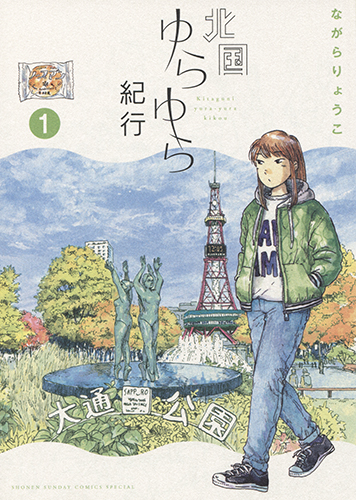
北国ゆらゆら紀行

Ryōko Nagara’s Kitaguni yura-yura kikō (北国ゆらゆら紀行) is an episodic travelogue manga that follows a young woman named Tsukiko who left her job to return to her hometown of Sapporo.

Tsukiko is too burnt out to resume full employment, and her savings are running low. Her friend Chitose invites her to move into a Shōwa-era sharehouse co-rented with her flatmate Kensuke and Kensuke’s girlfriend Miwa. Their landlord, a world traveler who no longer lives in Japan, says that Tsukiko can stay if she can manage to clean up all the junk in the spare room.

As Tsukiko recovers from her recent life changes, she and Chitose explore Sapporo at a leisurely pace. Chitose is a writer who aspires to create a magazine celebrating the city’s regional culture. For the time being, she posts articles on her blog and creates zines. Chitose brings Tsukiko along while she scouts for material at small local stores and restaurants. When they’re not out and about, the two women dig through the cardboard boxes left behind by the landlord and uncover all sorts of treasures, from vinyl records to unique Hokkaido woodcrafts. 

In my review (here) of Tomoko Shibasaki’s short story collection A Hundred Years and a Day, I touch on the phenomenon of “analog nostalgia,” the fascination with tangible media and the objects of an earlier era. Shibasaki’s collection dwells in a gentle sense of decay, but Kitaguni yura-yura kikō is marked by its youthful energy. As they stroll through beautiful streets lined with old houses and enjoy lively conversations over local cuisine in charming restaurants, it’s clear that Tsukiko and Chitose are thoroughly enjoying themselves.

Despite the fun she has with Chitose and her friends, Tsukiko suffers from depression and anxiety. The tiny apartment she occupies at the beginning of the manga is filled with trash, and she loses track of time while doomscrolling late at night. When Tsukiko considers the possibility of finding a new job, she imagines herself as a defenseless egg yolk sweating and apologizing while surrounded by menacing shadows.

When she invites her friend to move into her sharehouse, Chitose gives Tsukiko something tangible to hold. The manga’s emphasis on analog media, from Chitose’s printed zines to the old Walkman and cassette tapes that Tsukiko digs out of the landlord’s cardboard boxes, isn’t just simple nostalgia. Rather, it’s a concrete solution to a distressingly amorphous problem.

As the anonymous author of one of my favorite video game blogs writes (here) regarding the appeal of retro media, “We weren’t meant to live in an endless feed.” The rituals required by analog media once “gave life a shape that wasn’t constant images on a screen to choose from,” and these rituals serve as an anchor in the flow. Kitaguni yura-yura kikō doesn’t glorify the past or fetishize commodified nostalgia. Instead, tangible objects serve as a visual shorthand for places and relationships that don’t vanish when you close an app.

I don’t mean to suggest that Kitaguni yura-yura kikō is an introspective character study. More than anything, it’s a sweet and gentle travelogue, and it’s very charming. This manga makes me want to visit Sapporo and take long walks and eat delicious food. Still, I appreciate the subtext of the story, which is about readjusting to life lived at a slower pace while relearning how to have a meaningful connection with the place you live, the people who share the space with you, and your own embodied existence.  
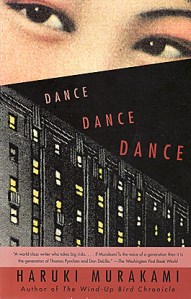
Dance Dance Dance

dance-dance-dance

Title: Dance Dance Dance
Japanese Title: ダンス・ダンス・ダンス
Author: Murakami Haruki (村上春樹)
Translator: Alfred Birnbaum
Publication Year: 1994 (America); 1988 (Japan)
Publisher: Vintage International
Pages: 393

One of my favorite passages in Dance Dance Dance is the ending of one of the last chapters in the novel:

When I was little, I had this science book. There was a section on “What would happen to the world if there was no friction?” Answer: “Everything on earth would fly into space from the centrifugal force of revolution.” That was my mood.

Indeed, that is the mood of this entire novel, which is perhaps the strangest, most nihilistic, and most off-center Murakami novel I’ve read.

Dance Dance Dance is the sequel to Murakami’s popular 1982 novel A Wild Sheep Chase (羊をめぐる冒険). It concerns the unnamed narrator’s quest to return to the Dolphin Hotel and rescue his former girlfriend Kiki, who had disappeared at the end of A Wild Sheep Chase. Upon returning to Sapporo, the narrator finds that the old, run-down, mystery-haunted Dolphin Hotel of his memory has disappeared, and the Sheep Professor is nowhere to be found. A large, modern, high-class resort hotel, also called “The Dolphin Hotel,” has gone up in the same neighborhood, but the managers and staff claim to know nothing of the former hotel. One receptionist, however, responds the inquiries of narrator by telling him about a cold, pitch-black phantom floor at which the hotel’s elevator sometimes stops. In order to recover Kiki, and, in doing so, save the part of himself that had been damaged by the events in A Wild Sheep Chase, Murakami’s protagonist attempts to pursue these mysteries, albeit in a somewhat half-hearted way.

Of course, this being Murakami, there are many side stories that need to be explored along the way. The narrator catches a glimpse of Kiki acting in a bit part in a high-school romance movie alongside an actor named Gotanda, who had been an acquaintance of the narrator in high school. This connection leads our protagonist to a series of misadventures with his former classmate, who has been accused of killing a call girl rented out by a mysterious organization. Also, during his first stay at the new Dolphin Hotel, the narrator encounters and befriends a thirteen-year-old girl named Yuki, who has for all intents and purposes been abandoned by her famous artist mother and her famous novelist father, who have their own ties to shady organizations. Yuki is charmingly cynical, one of her best lines being, “I don’t give a damn what people say. They can be reptile food for all I care,” and she leads the narrator all over Tokyo, Yokohama, Enoshima, and Hawaii.

Do these plot points ever come together? Are the mysteries presented by the novel ever solved? If you’re familiar with Murakami’s fiction, you can probably guess the answer.

Even though this novel is dark and rambling and bears very little thematic resemblance to A Wild Sheep Chase, it should be an interesting and enjoyable read for Murakami fans. Although Dance Dance Dance is only a loose sequel to A Wild Sheep Chase, there are many things that don’t make sense without knowledge of the events of the previous novel. That being said, I also don’t think Dance Dance Dance should be read immediately after A Wild Sheep Chase, as it isn’t so much a sequel as an appropriation of characters and places for the purpose of creating an entirely different story. Alfred Birnbaum is, as always, a fantastic translator, and his rendition of Murakami’s prose makes this novel a fun, if somewhat gloomy, read.