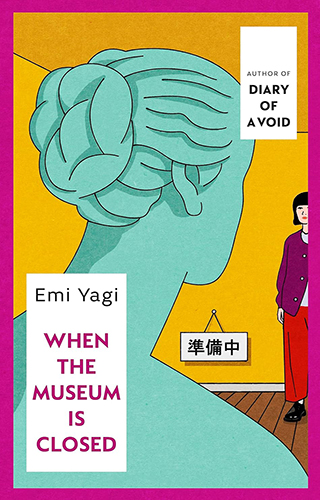
When the Museum Is Closed

Emi Yagi’s 2023 novel When the Museum Is Closed is a refreshing work of magical realism about a shy young woman who falls in love with a statue of Venus. The twist is that the statue loves her back, and – even more miraculous! – their love story has a happy ending.

Rika is a recent college graduate who works in the freezer department of a warehouse for processed food. She sees this as the perfect job for three reasons. First, she never has to talk to anyone. Second, she can take pre-prepared food home from her job, so she rarely has to cook. And third, an invisible yellow raincoat suddenly appeared over her clothing in elementary school, and she’s found it almost impossible to remove in public. The heavy vinyl fabric keeps her body temperature high, but that’s not a problem in an industrial freezer.

The only variation in Rika’s days comes from her part-time job. Once a week, Rika takes the bus to a local museum to have an hour of conversation with a statue of Venus. Venus only speaks Latin, but Rika enjoys a freedom with the dead language that she’s never found in Japanese. Though Rika is shy at first, she and Venus become friends, and they eventually fall in love.

Unfortunately, there’s a bit of a situation with a man named Hashibami, the museum curator in charge of the statue. He wants Venus all to himself, and he never wants her to change – he doesn’t want her to learn modern languages, and he certainly doesn’t want her to learn about the world outside the museum.

Venus therefore makes a deal with Hashibami. If he can get Rika to fall in love with him, she’ll allow him to fire Rika from the conversation job. Regardless, Rika isn’t interested in men, nor does she allow Venus to push her away. What Rika wants is something else entirely, and her relationship with Venus has given her the courage to chase their mutual joy.

The fantastic elements of When the Museum Is Closed are presented as entirely mundane, and it’s easy to take them at face value. At the same time, the love story between Rika and Venus resonates at an allegorical level with the experience of having a queer crush on someone who’s friendly and flirtatious yet seemingly unattainable. It’s the crush you have on an older coworker, or the crush you have on an internet friend, or the crush you have on the gayest girl you’ve ever met who is, inexplicably, married to a man. It doesn’t really matter that Venus is a statue, as anyone who’s experienced queer longing can relate to Rika’s situation. At the same time, Emi Yagi’s Venus is animated by her own distinct personality and undeniably lovely.

I’m sure that When the Museum Is Closed could also be read as an allegory for how women tend to be treated in male-dominated artistic and curatorial spaces, but the story is far more concerned with Rika’s subjective experience of her own individual life. I especially enjoyed the subplot involving Rika’s friendship with her landlord, a quirky but kind elderly woman who needs home care assistance, and I appreciated the understanding Rika develops with the neglected young boy who lives next door. Though Rika’s invisible yellow raincoat is unique to her, she’s far from the only person carrying unseen baggage, and it’s not necessarily the case that this is a problem that needs to be fixed.

When the Museum Is Closed is a short but expertly paced novel that moves quickly yet still allows the reader enough time to appreciate each scene. Its premise is intriguing and well-executed, and Yuki Tejima’s delightful translation captures the author’s tone perfectly, both in Rika’s deadpan observations and Venus’s mature flirtations. Readers who enjoyed Emi Yagi’s novel Diary of a Void will be pleasantly surprised by When the Museum Is Closed, which features the same sharpness and clarity of writing augmented by lovely moments of sweetness.

The Little House

The Little House
Japanese Title: 小さいおうち (Chiisai ouchi)
Author: Kyoko Nakajima (中島 京子)
Translator: Ginny Tapley Takemori
Publication Year: 2010 (Japan); 2019 (United Kingdom)
Publisher: Darf Publishers
Pages: 268

The Little House is a novel that seems prosaic at first but becomes more interesting as mundane events and observations gradually take on a greater sense of weight and meaning. The majority of the story is presented in the form of a diary kept by its narrator, Taki. Taki is writing in the present day, but the events she describes occurred in the 1930s and early 1940s. The Little House is about wartime Japan, but it’s written from the perspective of someone far more invested in keeping a small household running than she is in supporting or celebrating the nation. The war eventually catches up to her, but her story is about resilience, not suffering or victimhood.

At the risk of reducing the novel to its subtext, The Little House is also a queer love story. Taki is employed as a maid in a house in the suburbs of Tokyo, and she enjoys a close friendship with the lady of the house, Tokiko. Tokiko’s son Kyoichi is from a previous marriage, and her current husband is an executive at a toy manufacturing company. He’s a handsome man, but he seems to have no interest in “that sort of relationship” with a woman, which is perhaps why he considers himself lucky to have married someone who already has a child. Kyoichi is bedridden with polio, so Taki has been employed to help Tokiko out around the house. Despite the difference in their ages and social status, they get along marvelously well.

It was clear to me that Taki is in love with Tokiko. I suppose it’s possible that her affection could be read as platonic, but Taki describes Tokiko’s physical appearance with quite a bit more than platonic interest. Taki also delights in her detailed memories of physical contact with Tokiko. These passages may fly under the radar of anyone who’s not attuned to them, but it’s difficult to say that the nature of Taki’s relationship with Tokiko is completely subtextual, especially given that Taki dwells on the fact that one of Tokiko’s closest female friends also had an intense crush on her while they were in school together. To drive the point home, this friend makes direct references to the fiction of Nobuko Yoshiya, who is famous for her stories about young women in intimate relationships.

To Taki’s chagrin, Tokiko is in love with a young artist named Itakura. Under the pretext of arranging a marriage for him, Tokiko meets with Itakura several times, and a romance develops between them. As Japan digs itself deeper into the Pacific War, however, Itakura is drafted. Tokiko is devastated, but Taki prevents her from meeting Itakura a final time before his deployment by means of a small but life-changing act of “housekeeping” that has been foreshadowed from the beginning of the novel.

By March 1944, the Hirai family can no longer afford to employ Taki. She is sent back to her family’s home in rural Ibaraki prefecture, where she becomes a cook and caretaker for a group of children who have been evacuated from Tokyo. This is far less heartwarming than it sounds, and both Taki and the children are utterly miserable.

When the war is over, Taki visits Tokyo again only to find that the Hirai household has been destroyed during the American firebombings. Although she promises to write more about what happened afterward, Taki’s narrative comes to an abrupt end at this point. The reader learns that she stopped keeping her diary because of her declining health, but I suspect that she lost interest in telling a story in which Tokiko could no longer be a central character.

The coda to Taki’s account is provided by her great grand-nephew Takeshi, whom she has mentioned several times, always claiming that he doesn’t believe her story. Takeshi inherits Taki’s diaries after her death, and he ties up several loose ends in the final chapter as he reflects on the nature of the relationships between the various people in Taki’s life. Is it possible, he wonders, that Taki was in love with Tokiko? Takeshi leaves the answer to this question up to the reader’s interpretation, but his careful reevaluation of Taki’s actions in light of this possibility speaks for itself.

Not much happens in The Little House, but the reader is swept along into the family drama of the Itakura household by Taki’s lively and engaging narrative voice. Although Taki’s observations seem trivial at first, the close attention of a patient reader will be rewarded as the details of her story come together to create a portrait of a charming group of people and the historical conflicts that interrupted their lives and relationships. Nakajima handles the legacy of the Pacific War with grace and sensitivity, and The Little House provides a welcome and insightful perspective on the early Shōwa period that is often lost in narratives about wartime Japan.