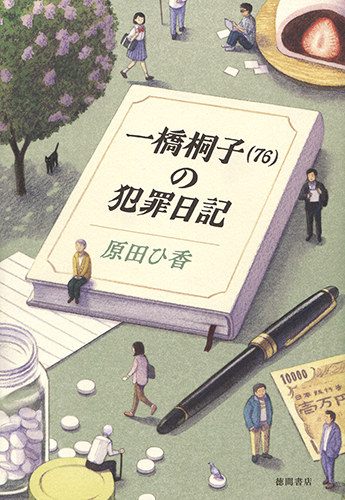
一橋桐子の犯罪日記

Hika Harada’s 2020 novel Hitotsubashi Kiriko (76) no hanzai nikki, which I’ll refer to as “Kiriko’s Crime Diary,” is the story of the eponymous Kiriko Hitotsubashi, who has found herself alone and in trouble at age 76. After her closest friend dies and her life savings are stolen, Kiriko decides that her best option is to spend her remaining years in prison. The only problem is that, before she goes to prison, Kiriko first needs to commit a crime.

Kiriko has been single all her life, but she jumps at the chance to share a house with her best friend Tomo, whose husband has died of a heart attack. Unfortunately, after two years of friendly companionship, Tomo dies of cancer, and Kiriko’s signature seal, bank passbook, and account holdings are stolen by a young man who asks to enter her house to pay respects to Tomo’s memorial. To add insult to injury, Tomo’s two sons treat Kiriko like garbage as they remove the furniture and cookware she shared with Tomo from her house.

Kiriko is left destitute, and she’s forced to use the last bit of money she has left to rent a subsidized apartment in a privately owned building for the elderly. She can barely afford groceries, and her new neighbors are difficult and unpleasant. Despite her age, Kiriko is as healthy as a horse, and she doesn’t seem to be in any danger of dying soon. She decides that being in prison would be preferable to becoming homeless, so she resolves to live a life of crime.

For the most part, Kiriko’s Crime Diary is a comedy that follows a sweet-natured and sensible woman as she does her best to get arrested. Kiriko has standards, and she doesn’t want to commit any sort of crime that might cause actual harm. She tries shoplifting from a chain grocery store, counterfeiting money with a convenience store photocopier, and scouting targets for a dubiously legal moneylender – all to no avail.

Over the course of her attempts to solicit advice regarding how to commit a crime, Kiriko ends up befriending all sorts of people, from the owner of the office building where she works as a janitor to a high school girl who volunteers to be kidnapped to punish her negligent parents. Between one thing and another, Kiriko ends up attracting the attention of a semi-retired yakuza boss, who uses intermediaries to contact Kiriko before finally meeting her in person.

One of the major subplots of the novel involves a man around Kiriko’s age who becomes entrapped in an elaborate “marriage scam” by a younger woman who drains his finances and then disappears. The man is crushed by disappointment, and the members of the poetry club Kiriko once attended with her friend Tomo have to band together to figure out how to help him. Along with Kiriko’s own troubles, this episode highlights the lack of a social safety net for many elderly people in Japan.

The theme of elder precarity becomes especially critical with the approach of Kiriko’s 77th birthday, which marks the start of her formal age of retirement. The janitorial company that employs Kiriko forces her to quit, depriving her of her only means of supporting herself. If Kiriko has no job and no one to serve as a guarantor for her rental contract, what is she supposed to do, exactly? Is her only recourse to start working with the yakuza?

Thankfully, Kiriko’s Crime Diary has a happy ending. All of Kiriko’s friends show up during a climactic scene to offer support and advocacy, and Tomo’s daughters-in-law apologize for the way she was treated by her late friend’s sons. All the loose ends are neatly tied, and Kiriko might even get to have a lovely winter romance with the handsome yakuza boss. I usually shy away from this sort of sentimentality, but why shouldn’t Kiriko have the best of all possible endings?

When I was working on one of my dissertation chapters about Natsuo Kirino’s gritty crime novel Grotesque, one of my readers asked me why Kirino’s characters all have to be so miserable. That was a fair question, and my answer was something along the lines that Kirino’s novels express the reality of the despair faced by many older adult women who find themselves completely devalued by society.

While I still believe that the tonal bleakness of Kirino’s style of critique is necessary and important, I also think that the happy ending of Kiriko’s Crime Diary is a welcome counterpoint. What Harada archives through this gentle comedy is to model one possible solution to elder precarity. Namely, if the neoliberal Japanese state is so utterly useless in providing social welfare, people must aggressively resist twentieth-century social conventions to form communities for mutual aid.

This support benefits not just elderly people, but also multigenerational networks. As much as Kiriko gains from her friendships with the owner of the building she cleans and the teenage girl she “kidnaps,” these characters also benefit from having Kiriko in their lives. It would be a shame, Harada suggests, not to have at least one friend like Kiriko.

Relearning how to make friends while relying on the kindness of strangers isn’t going to be a feasible solution for everyone, of course, but it’s a damn sight better than going to prison. And, if someone like Kiriko is considering prison, what are we even doing as a society? Even with a marvelously happy ending, Kiriko’s Crime Diary offers a social and political critique that’s difficult for even the most conservative reader not to agree with.

Hika Harada has enjoyed a productive career, and she’s won numerous awards for her fiction and screenplays. It’s no surprise that Kiriko’s Crime Diary was a bestseller that has found a place on all sorts of recommendation lists. This story will definitely appeal to readers outside of Japan, and it’s perfect for the same readership that enjoyed Killers of a Certain Age (which is fantastic, by the way).

Harada’s novel Dinner at the Night Library is going to be released in English translation in September 2025, and I’m looking forward to reading it. Kiriko’s Crime Diary is a genuinely fun and charming story, and I’d love to see it appear in translation too.

ツミデミック

Michi Ichiho’s Tsumidemic (ツミデミック), which won the prestigious Naoki Prize for popular fiction in 2024, collects six stories about the atmospheric strangeness of the Coronavirus pandemic. While everyone’s attention was focused elsewhere, Ichiho wonders, what sort of intriguingly antisocial behavior might have been enabled by isolation?

The opening story, Chigau hane no tori (違う羽の鳥), has all the grim fascination of a viral urban legend. Yūto moved to Tokyo only to drop out of college, and now he works as a barker for a bar in Shinjuku. Unfortunately, business isn’t going well due to the pandemic. During another eerily quiet night, Yūto sees someone he knew back from middle school in Osaka, Nagisa Inoue. This is a shock, as Nagisa is supposed to have committed suicide by jumping onto the train tracks. As she and Yūto get drinks together, Nagisa explains her devious plot to flee from the grasp of her overbearing mother, which was far from a victimless crime. Yūto is no saint himself, and he inadvertently reveals why he immediately recognized someone he never talked to when they were classmates.

Romansu (ロマンス☆) is about a bored housewife named Yuri who develops a serious online gambling addiction of an unusual nature. Yuri hasn’t been able to find a new job since she left her previous position to give birth to her daughter, and the pandemic isn’t helping. She channels her frustration into a food delivery app called Miideri, which she treats like a gacha game. Will the person who makes her next delivery be one of the handsome men rumored to be employed by the service? While gambling on the slim possibility that a prince will arrive at her door bearing a bag from McDonald’s, Yuri attracts the unwanted attention of an unhinged delivery driver who has read exactly the wrong message into her frequent orders.

Rinkō (憐光) is narrated by the ghost of a high school student named Yui who, strangely enough, can’t recall how she died. Having materialized back into the world fifteen years after her death, Yui finds herself confused and alienated by the loneliness of the Tokyo streets and train stations during the pandemic. She therefore returns home to her mother’s house in the country. Her arrival coincides with a memorial visit from her friend Tsubasa, who is accompanied by their old homeroom teacher, Sugita. As Yui eavesdrops on their conversation, she learns that she died after mysteriously falling into a river during a rainstorm. Sugita knows what Yui was doing and where she was going, and Tsubasa wants him to know that she knows, too.

The collection takes a slightly more positive turn in the fourth story, Tokubetsu enkosha (特別縁故者), in which Kyōichi, the unemployed and impecunious father of a young son, attempts to weasel himself into the good graces of an elderly man whom he suspects is a money hoarder. Kyōichi, an affable himbo who has no business scamming anyone out of money, volunteers for the daily task of picking up a takeout lunch from one of the many bentō stores in the neighborhood. The old man knows exactly why Kyōichi approached him, and he resents him for not pursuing his ambition to enter the food service industry. Harsh words are exchanged; but, when push comes to shove, even a relationship built on ulterior motives is better than living alone as an elderly shut-in during a pandemic.

Shukufuku no uta (祝福の歌) is about a happily married middle-aged man facing a new direction in his life. Despite being a high school student, his daughter is pregnant, and she intends to keep the baby. Meanwhile, the man’s mother seems to be entering the permanent brain fog of senile dementia. His daughter, who has been gossiping with the other mothers in her grandmother’s apartment building, gets the sense that there’s something else going on. With any luck, it’s a problem that can actually be solved.

Sazanami Drive (さざなみドライブ) follows the IRL meetup of five people who connected on Twitter after their lives were disrupted by the pandemic. As they drive out to the country in a minivan, they share their stories of abandonment and alienation. Little do they know that one of their number has a secret agenda. He’ll do whatever it takes to disrupt the group’s grim plan for the trip – and hopefully save their lives in the process.

As indicated by the book’s title, the two themes guiding this collection are “crime” and “the pandemic.” Each of the characters is hiding something, and the reader never knows where anyone’s true intentions lie. Michi Ichiho, who began her writing career as an author of BL romance novels, isn’t unduly focused on creating mimetic fiction, and the scenarios are improbable at best. Still, the twist at the end of each story is a lot of fun, and the fantastical plot elements accurately convey the feeling of just how weird and unreal everything felt during the pandemic.

It appears that the English-language publication rights for this collection are currently up for grabs (more info here). Tsumidemic is a fast-paced and emotionally cathartic book, and it would benefit from a tone-sensitive translation that renders Ichiho’s dialogue-filled writing into snappy, Stephen King style prose. I hope someone picks it up.

52ヘルツのクジラたち

52ヘルツのクジラたち is a bestselling novel by Sonoko Machida that won the 2021 Japan Booksellers’ Award Grand Prize. In March 2024, the story was adapted into a feature film directed by Izuru Narushima, who worked with LGBTQ consultants in order to portray a key transgender character with the same compassion and sensitivity expressed by Machida’s novel.

Kiko Mishima has left Tokyo to move to a seaside town near Oita on the eastern coast of Kyushu. She’s inherited a house from her grandmother, and she gets along well with the contractors she hired for renovations. It’s difficult to adjust to life in a small community, however, and Kiko begins to withdraw into her house.

During a trip to the grocery store, Kiko encounters a 13yo boy who can’t speak and seems to have nowhere to go. The nameless boy bears undeniable signs of abuse and neglect, so Kiko invites him home and begins caring for him.

As the novel progresses, the reader learns more about Kiko, who was emotionally abused by her mother and stepfather. Circumstances relating to her stepfather’s health prevent Kiko from escaping from her family after high school, and she’s driven to the verge of suicide by her experience of serving as her stepfather’s primary caregiver.

Kiko is rescued by her high school friend Miharu, who also grew up in an abusive family. Miharu introduces Kiko to her colleague Ango, who sympathizes with Kiko and takes responsibility for her emotional support as he helps her move into a sharehouse and begin a new life.

From the beginning of the novel, the reader is confronted by numerous questions. Given how important Ango was to Kiko, what happened to him? Why did Kiko suddenly move to Kyushu without telling anyone? Where is she getting the money to renovate her house? And, most importantly, what can she do to help the abused boy whom the entire town has decided to ignore?

52ヘルツのクジラたち takes its title from the story of 52 Blue, a whale of an unidentified species that has never been sighted but only heard via hydrophones. It sings at a frequency 52 hertz, which is much higher than the calls of other migrating whales. Because of the highly unusual sonic signature of its call, the whale migrates alone.

Kiko compares her isolation during her childhood to that of the 52-hertz whale, and she once listened to recordings of its singing to calm and ground herself after she left her family. She shares these recordings with the seemingly wordless boy she takes under her wing, promising that she’ll wait patiently until she can understand his own 52-hertz voice.   

We live in a society, however, and it’s not strictly legal to assume care of a minor without the permission of the child’s guardians. Thankfully, Miharu manages to track down Kiko and pays her a visit in Kyushu. She once again comes to the rescue, helping Kiko to reach out to the community for the support that she and the boy desperately need. 

Make no mistake, 52ヘルツのクジラたち is an intensely melodramatic novel. Its characters are either saints or devils. It’s never explained why anyone would be abusive toward a child, or why most people who witness child abuse choose to ignore it. In addition, the story’s victims of abuse come off as perfect angels who suffer with dignity and almost never display any of the problematic behavior associated with a history of sustained childhood trauma.

I find this lack of psychological depth frustrating, as it glosses over many of the issues underlying child abuse, which is often known and tacitly tolerated by the larger community. Instead of serving as a meaningful model for how such abuse can be prevented, this novel feels more like a character drama that uses serious social issues for the sole purpose of generating heightened emotions. In addition, although the treatment of the central transgender character is sympathetic, I couldn’t help but shake my head at some of the tired narrative tropes applied to their story.

Still, I can’t deny that 52ヘルツのクジラたち is a lot of fun to read. The pacing is excellent, and I was swept along by the story’s strong forward momentum. Although bittersweet, the ending is emotionally satisfying, as is the conclusion of Kiko’s character arc. I’d especially recommend this novel to fans of Banana Yoshimoto, as it feels like a progressive development of many of the themes explored in Kitchen, from a universal concern with love and loss to a more specific push for the legal rights of minors and transgender people. 

While the message of 52ヘルツのクジラたち might have benefitted from more psychological nuance, Sonoko Machida makes a strong and compelling case for mutual aid and community action in which everyone in a society benefits by actively protecting the marginalized.

The God of Nishi-Yuigahama Station

Takeshi Murase’s linked short story collection The God of Nishi-Yuigahama Station is about four people who lost members of their family in a tragic train derailment. For a year after the accident, the ghost train still makes its fatal run at midnight, giving those who grieve its passengers an opportunity to speak to the loved ones they lost.

The God of Nishi-Yuigahama Station is meant to make the reader cry, and it does so primarily through its improbably melodramatic situations. This short book is relatively light reading, and the level of catharsis it allows you to experience will depend on your tolerance for sentimentality.

Still, as far as this type of fiction goes, I enjoyed The God of Nishi-Yuigahama Station much more than similar titles (such as Toshikazu Kawaguchi’s Before the Coffee Gets Cold). Murase’s stories are grounded in the social realities of contemporary Japan, and the characters are messy and complicated enough to be interesting.

My favorite story is “To My Father, I Say,” which is about a young man named Sakamoto who leaves his rural hometown to work at a large finance corporation after graduating from a prestigious university in Tokyo. Sakamoto is forced to attend mandatory drinking sessions after work, and he’s bullied by his supervisor. He’s tired all the time, and his relationship with his girlfriend has gone stale. Meanwhile, he’s ignoring the calls from his father, who comes from a humble background.

Sakamoto finally snaps and quits his job, but he can’t bring himself to tell his family as his living conditions grow more precarious. Thankfully, he gets a second chance to talk to his father on the ghost train, which is the exact opportunity he needs to reevaluate his life and goals.     

Like a lot of contemporary Japanese popular fiction aimed at young adults in their twenties, The God of Nishi-Yuigahama Station is brutally honest about the emotional damage caused by bullying, which can extend far beyond grade school. Like other authors, Murase doesn’t shy away from stating that the main problem lies with the people who tolerate this behavior, while the solution is for one brave person to step up and offer support to the target.

This is an important and wholesome message, of course, but it’s a little depressing to me that this support can only exist in the form of a magical ghost train. Then again, the purpose of The God of Nishi-Yuigahama Station is not to offer deep insights and critique, but rather to make the reader cry and feel gratitude for their own family and friends. And who knows? This might just be the support you need.

Fujisan

Fujisan

Title: Fujisan
Japanese Title: 富士山 (Fujisan)
Author: Taguchi Randy (田口 ランディ)
Translator: Raj Mahtani
Year Published: 2012 (America); 2004 (Japan)
Publisher: AmazonCrossing
Pages: 191

In her Foreword, Taguchi states that she “wrote this anthology of stories as an expression of my veneration and appreciation for this life-affirming mountain; it is my personal tribute to Fujisan.”

Although Mount Fuji is in the background of each of the four stories collected in this volume, the main theme of these stories is an affirmation of life in the face of fairly extreme social maladjustment and malaise. “The Blue Summit” is about a convenience store worker who begins reflecting on his past experiences as a member of a religious cult after he survives an attempted robbery. “The Sea of Trees” is about three high school students with an interest in the occult who go hiking in the Aokigahara forest and come across a failed suicide. “Jamila” is about a public servant who is tasked with dealing with an old woman who lives in a house overflowing with garbage. “Child of Light” is about a nurse at a small gynecological clinic who ponders a teenage abortion patient she recently cared for as she climbs Mount Fuji with a group of older women. The characters of these stories all face death and the more unpleasant aspects of continuing to live and somehow manage to come out okay on the other side.

I liked the opening story, “Blue Summit,” for its description of the appeal of sanitized and familiar spaces like convenience stores and family restaurants to the broken people who seek refuge there in the small hours of the night. As the narrator says of the convenience store where he works as a night shift manager:

I like it here. This convenience store is my sanctuary. There’s a stillness here that’s like the stillness you find in the snowy, bleak plains of Siberia. […] The store’s open twenty-four hours and it’s menacingly bright. There’s no darkness. It’s all so gloriously digital. While intimacy and a sense of reality are effectively absent in the store, a minimum degree of comfort is always guaranteed. The convenience store is stabilized on a low-energy wavelength: it never betrays you. In a convenience store, you can silently snuggle up to the void. (3, 13)

In this story, the convenience store as a comforting space is juxtaposed against the nightmarish interior spaces of the people who enter it. The narrator is haunted by the memories of a friend he made when he was a member of a religious cult headquartered at the base of Mount Fuji who may have been killed by the group when he tried to defect. Kozue, one of the employees who works under the narrator, suffers from a fascination with dissection and enjoys watching herself bleed. As for the anonymous assailant who unsuccessfully attempts to rob the convenience store at the beginning of the story and later shows up with a baseball bat looking for revenge, the narrator suspects that what he’s ultimately after is a validation of his own existence, a concern that the narrator sympathizes with even as he is attacked.

My favorite story in Fujisan has to be “Jamila,” if only for its colorful descriptions of a gomi yashiki, or “garbage mansion,” in Susono City, a small municipality in the foothills of Mount Fuji. The narrator of the story, a native son who has left a corporate job in Tokyo to take a post at Susono’s Office of Environmental Quality, is tasked with dealing with a local hoarder’s residence. He hasn’t made much progress, partly because he is fascinated by the structure:

When I went to investigate the house of trash for the first time, a part of me was genuinely thrilled. I wanted to see for myself who the old garbage lady was, the one reputed to be a goblin, but when I arrived, the horror of it all simply defied imagination. It was a slice of nightmare lying exposed in the heart of a residential area lined with middle-class houses. What bothered me the most was the drabness of all the visible junk, especially in light of the fact that each and every one of the objects was at one time or another brand new. […] The trash, estimated to be sixty tons’ worth, was spilling over from the premises into the public road, where it bore an uncanny resemblance to the entrails of a road-killed cat. (108)

I really don’t find all this trash-hoarding that objectionable. I find it more interesting than, say, staying inside city hall. As I stood there, gazing vacantly, my eyes registered an entire universe of things: wire hangers, torn umbrellas, broken TVs, antennas, vacuum cleaners, plastic bags, tattered clothes, tricycles, flowerpots, bedpans, bamboo blinds, futons… The trash went beyond trash to become works of fantastic, sculptural art. (100)

As in “Blue Summit,” physical spaces have a close relationship with psychic spaces, and the narrator’s meditation on an old woman’s gomi yashiki reveals the disorganization of his own (possibly deranged) mind and the sociological state of a nation that produces and throws away so much physical, cultural, and human garbage.

If I had to describe these stories in one word, it would be “intense.” There’s a bit of navel gazing going on in Fujisan, but it’s never too cumbersome, and the collection’s four stories move quickly and capitalize on topical issues for emotional impact.

If you’re wondering about the publication quality of Amazon’s new translation publisher, AmazonCrossing, it’s actually fairly decent. The front and back covers of the physical version of Fujisan look like printouts of a mid-resolution PDF document, but the inside text is crisp and clear, and the page layout is clean and uncluttered. During the short promotional period when Amazon was offering the book for about as much money as a cup of tea at Starbucks, I also downloaded the digital version of the book from the Kindle store, and it looked great as well.

Several reviewers on Amazon have complained about the translation, but I didn’t mind it so much. There were a few sentences that were awkward (they mostly involved slang), but overall I think Raj Mahtani did a great job conveying the voices of Taguchi’s characters. I have read (and produced) a great deal of clunky awkward translatorese, and I know just how terrible it is, but nothing of the sort appears in Mahtani’s translation of Fujisan. The vast majority of the translated prose in the collection is clear and serviceable. It’s never going to win any literary awards, but Taguchi herself isn’t exactly a “literary” writer; she writes popular fiction, and her writing reads like popular fiction.

In any case, the translated narrative voices of Fujisan are similar to the translated narrative voice of Taguchi’s previously translated work, Outlet, and readers who appreciated the exploration of hidden spaces and raunchiness of Outlet will definitely enjoy Fujisan.

By the way, the author has her own website, which includes an interview translated into English. If you can read Japanese, her blog is also well worth browsing.