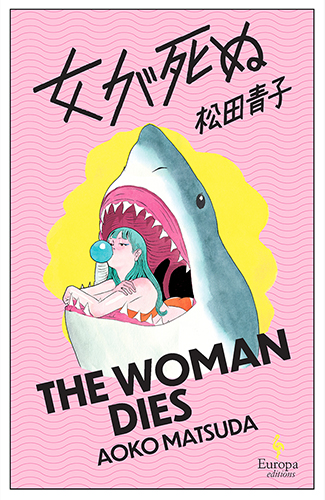
The Woman Dies

The Woman Dies presents 52 pieces of flash fiction by Aoko Matsuda, the author of the short story collection Where the Wild Ladies Are. Each of Matsuda’s small but sparkling stories responds to various aspects of pop culture in clever and surprising ways.

Characteristic of Matsuda’s idiosyncratic approach to the flotsam of contemporary culture is “Hawai’i,” which imagines a heaven for clothes that were thrown away because they did not spark joy. The heaven enjoyed by an unworn sweater sounds like a lovely time of relaxing by the pool while, in the sky, “not far from the rainbow, the pair of skinny jeans owned in similar shades was paragliding together with the dress once worn to a friend’s wedding and never again.”

At the same time, the over-the-top language Matsuda uses to describe this paradise hints at how ridiculous it is to ascribe any sort of teleological meaning to consumerist excess. Still, if this is the world we find ourselves in, why not imagine a heaven where even a discarded sweater is allowed to have a happy ending?

While the topics covered in The Woman Dies are varied, many of the stories playfully confront gender issues in popular media. One of the more intriguing of such stories is “The Android Whose Name Was Boy,” which Matsuda writes “evolved from my thoughts about Neon Genesis Evangelion,” a classic sci-fi anime from 1995 that does indeed inspire thoughts about gender. 

The eponymous android, whose name is in fact “Boy,” begins its life by setting out on an adventure. Over the course of the five-page story, it does its best to disrupt narrative conventions regarding young male characters. Challenging and unending though this task might be, “the android whose name is Boy, developed to heal the wounds of those hurt by boys hurt in the past, is on the move once more.”

While “The Android Whose Name Was Boy” is open to a diversity of interpretations, other stories in the collection are overtly feminist. In “The Purest Woman in the Kingdom,” a prince takes it upon himself to seek out a woman who has never been touched by a man. After a great deal of searching, he finally finds and marries one such woman. On their wedding night, she karate chops him into oblivion. This woman has never been touched by a man; and, thanks to her training and skill in martial arts, she never will be. Absolute queen behavior.

Most of the stories in The Woman Dies are relatively lighthearted, but “The Masculine Touch” (by far my favorite piece in the collection) is out for blood. This story flips the script on gender, casting male writers as delicate greenhouse flowers who need to be supported because sometimes – every so often – their work has cultural and economic value. Matsuda doesn’t pull her punches:

The more radical of the male novelists wrote articles about this turn of events for male magazines, declaring this the beginning of the Male Era. They bolstered their arguments with examples of the other times when the masculine touch had effected changes like this one, thus arguing for men’s continued progress in all areas of society.

“The Masculine Touch” responds to a painfully specific way of talking about female writers and artists in Japan, and I imagine that people in other contexts can relate to frustrations regarding how the publishing industry fetishizes “queer writers,” or “writers of color,” or any number of people whose humanity is compressed into marketing-friendly categories.

Unfortunately, other pieces in the collection lack this specificity. Though we’re all familiar with the trope of fridging female characters, the title story, “The Woman Dies,” is a bit too broad to resonate. Though it’s easy to sympathize with the sentiment underlying “The Woman Dies,” readers may find themselves simply shrugging and moving on. Flash fiction tends to be hit or miss, but this collection offers an array of stories to choose from, and it achieves an admirable balance between heavy hitters and palette cleansers.

The Woman Dies is remarkably cohesive as a collection. There’s a lovely rhythm and flow to the stories, and it’s just as entertaining to read the book in one sitting as it is to dip in and out at your leisure. Matsuda’s writing is sharp and self-aware, and she uses brevity as a weapon to puncture the absurdities of gender, media, and modern life. It’s a pleasure to read her work in Polly Barton’s translation, which is quick and lively and showcases an incredible range of tone and style that’s pure literary pop.

A Hundred Years and a Day

In October 2024, Matt Alt published an article in Aeon titled “The Joy of Clutter.” Instead of decrying the unsightliness of visual complexity, Alt argues that clutter has its own unique beauty, “an ecstatic, emergent complexity, born less from planning than from organic growth, from the inevitable chaos of lives being lived.”

Alt’s essay is illustrated with photos contributed by Lee Chapman, who captures evocative images of the chaotic interiors of tiny family-owned restaurants located in shopping arcades lined with shuttered storefronts. Chapman’s photos coincide with a trend on social media that expresses nostalgia for the Japan of the late twentieth century, with posts often tagged as “Shōwa Retro.”

Tomoka Shibasaki’s A Hundred Years and a Day delights in the aesthetic of gentle decline exemplified by Shōwa Retro, and the 34 stories in the collection express nostalgia for people and places left behind in the past. Shibasaki invites the reader to walk through depopulated residential neighborhoods and stroll along abandoned shopping arcades. Half-empty cityscapes are dotted with buildings filled with clutter. Aging adults sift through the belongings of their deceased parents. Siblings who’ve drifted apart make clumsy attempts to reconnect by alluding to half-forgotten memories. Students study and then discard the small artifacts of the people who came before them.

Even reading through the book’s Table of Contents is like flipping through a card catalog in an old library, with each story’s title being a concise description of its premise. To give an example, the first story is titled:

“One summer during a long rainy spell, student number one from class one and student number one from class two discover mushrooms growing in a flower bed next to a covered walkway at their school; two years after leaving school they bump into each other, but after that, ten years pass, twenty years pass, and they don’t meet again”

“One summer” is a translucently beautiful piece of writing with imagery so clean and clear that I could almost feel the seasonal humidity on my skin. The story conveys the delicate specificity of a single moment captured in time. The moment dissipates and disperses as the world moves on, but the memory lingers.

An intriguing play on this theme is in the nineteenth story…

“I feel like I want to see the places that someone else saw, he said; I like thinking about places I’ve been to once but no longer know how to get to, or places that you can only access at certain times, I feel like there must be some way of visiting the places that exist only in people’s memories”

…which is about a woman who travels to a small seaside town to give a presentation at an academic conference. While walking back from the local shrine, she has a brief conversation with a child who will be the last ever student to graduate from the municipality’s junior high school. Years later, the child (now grown) encounters an artistic diorama that recreates a fictional version of their hometown that appeared in an old novel written by the academic’s deceased mother. While studying the artwork, this person (referred to by the story as “the last child”) is surprised by the liveliness of the reconstructed memory:

The last child crouched down and peered into the alley running between the wooden houses. It looked a lot like the alleyways that they knew from their childhood. They felt as though it was a path they’d been down before. As the last child was still staring down the passage, a cat ran across the alleyway where the stone steps were. The last child gasped in surprise, and stood up. A cicada flew in through the window, attached itself to the wall, and began to screech.

“I feel like I want to see” is a wandering ramble across time and memory, but most of the vignettes in A Hundred Years and a Day are much more focused on the history of a specific place. One of my favorites is the twenty-second story…

“A man opens a café in a shopping arcade, dreaming that it will become like the jazz café he used to frequent as a student; the café stays open for nearly thirty years, then closes down”

…which, despite the title, is about the young woman who takes over the original café by the university. The interior of the café is almost comically outdated, as are the records left behind by the previous owner. The new owner isn’t familiar with the musicians whose posters still hang on the walls. Regardless, the café is still lively, and the new owner finds herself thinking, at the end of the story, that “this is what I wanted to do.”

If I had to guess, I’d say that the reason why this sort of Shōwa Retro story has such a strong appeal is because it rejects the performative glossiness of mass media while embracing the beauty of real, everyday settings. The aesthetic also disrupts the modern myth that progress is not just desirable, but inevitable. Things don’t always get “better,” Shibasaki demonstrates, nor do endings always happen with a bang. 

A cursory reading might suggest that Shibasaki is trafficking in low-effort cultural nostalgia, but I don’t think that’s the case. The imagery presented by each story in A Hundred Years and a Day feels very deliberate, like it’s smashing a smartphone screen with a hammer. This is fiction to be enjoyed slowly, and I appreciate the contemplative space Shibasaki has opened for the reader.

When discussing the texture of Shibasaki’s writing, it’s important to acknowledge the artistry of Polly Barton’s English translation. Japanese literary writing is notorious for its nested sentence structure, which can feel unintentionally Proustian if translated literally. It takes a keen eye and a delicate touch to understand whether Japanese sentences are interminably lengthy because the language is simply written like that; or whether a sentence like one of Shibasaki’s story titles is a deliberate stylistic choice. Barton has done truly amazing work with A Hundred Years and a Day at a sentence-by-sentence level, allowing the reader to enjoy Shibasaki’s distinctive style while still maintaining a casual, conversational tone.

Most of the stories in A Hundred Years and a Day occupy fewer than ten pages, and they read like accounts passed from one person to another by word of mouth. Spending time with this collection feels like calling an elderly relative and listening to them talk about a restaurant closing in your old neighborhood, or about how they saw someone that you once knew as a child in the newspaper. There’s no real beginning or end to the stories, nor is there any discernible sense of structure. Still, the theme of human connection runs through Shibasaki’s work like a gentle current, drawing the reader forward along on the steadily flowing stream of time.

I’d like to extend my gratitude to Stone Bridge Press, which provided an advance review copy of this book. A Hundred Years and a Day will be published on February 25, 2025. You can learn more and read a preview on the book’s webpage (here).

Mild Vertigo

Mieko Kanai’s Mild Vertigo is a slice-of-life novella whose short length belies its Proustian ambitions. The narrator, a housewife living in an apartment in the Tokyo suburbs with her husband and two young sons, engages in extended meditations on her home, family, friends, neighborhood, and place in the world.

I don’t use the word “Proustian” lightly, as Kanai’s prose requires patience and concentration to read and appreciate. The endless sentences gallop and sprawl across pages, sweeping the reader along in a flow of thought and sensation that transcends time and place as the narrator’s focus wanders. This is no breezy stream-of-consciousness nonsense, however, as each sentence is exquisitely crafted and brilliantly translated by Polly Barton.

As with Proust, there’s a certain comfort and emotional satisfaction in the act of paying such close attention to the mundane details of daily life, but Kanai’s narrator has a strong sense of irony. Gendered double standards aren’t a primary concern of this novel by any means, but an underlying frustration still shapes the narrator’s relationships and observations on what it means to be a housewife.

Mild Vertigo (originally published in 2002) doesn’t set out to upset or challenge the reader in the same way as much of Kanai’s earlier writing, but it nevertheless operates with an absolute lack of sentimentality that I find extremely refreshing, especially on the more literary end of the “slice of life” genre. Due to the dense nature of Kanai’s prose, it took me a surprisingly long time to read this short book, but I wouldn’t have it any other way.

There’s No Such Thing As An Easy Job

Japanese Title: この世にたやすい仕事はない (Kono yo ni tayasui shigoto wa nai)
Author: Kikuko Tsumura (津村 記久子)
Translator: Polly Barton
Publication Year: 2015 (Japan); 2020 (United Kingdom)
Press: Bloomsbury Publishing
Pages: 400

There’s No Such Thing As An Easy Job is a collection of five connected stories about the different jobs undertaken by a 36-year-old woman suffering from burnout. After leaving her professional career, she tells her agent at the recruitment center that she wants “an easy job.” True to the book’s title, however, each of her five temp jobs has a catch – or, from the reader’s point of view, an interesting twist.

The setting is never specified, but the narrator seems to live in a suburb where people get around by bus. Based on the name of the (fictional) local football club, as well as the hometown of the author, I suspect that the suburb is somewhere in the vicinity of Osaka. The pace of life is more relaxed than it is in Tokyo. The narrator’s coworkers are friendly, and her supervisors are kind and supportive. She is never asked to do anything dangerous or illegal, and nothing bad happens to her. Her parents are happy to support her while she finds herself, and she’s free to quit at any time. Nevertheless, there is indeed no such thing as “an easy job.”

The fourth story, “The Postering Job,” is the most representative, especially in its revelation that the job the narrator is hired to do is only a cover for what her supervisor actually wants her to do.

Tired of sitting alone in a small office surrounded by reference books, the narrator requests that the next job assigned to her by the temp agency somehow involves being able to go outside. She’s therefore placed at a small office that hangs public service posters in a residential neighborhood. These posters, which are ubiquitous in certain parts of Japan, encourage people to “Make our town greener!” while reminding them to “Check behind you when turning corners!” The narrator’s job is to walk around the neighborhood putting up new posters while taking down the old ones.

The narrator’s supervisor asks her to make an effort to chat with the people in the neighborhood. In doing so, she discovers that some businesses and residences have already hung posters advertising a social group called “Lonely No More.” This group seems to be targeting retired elderly people and young singles, and it hosts free dinners and social gatherings. As the narrator begins to investigate, she learns that Lonely No More is not a cult… at least, not yet. It appears to be heading in that direction, though, and the wife of the narrator’s boss is one of the organization’s leaders. In other words, the narrator wasn’t actually hired to hang posters, but rather to track down and make contact with her boss’s wife.

I love each of the twists in There’s No Such Thing As An Easy Job. It’s difficult to pick a favorite, but the second story, “The Bus Advertising Job,” skims across the glimmering surface of a deep pool of magical realism. The fantastic elements of “The Bus Advertising Job” don’t affect the narrator’s pragmatic attitude or matter-of-fact tone, even as they become progressively stranger. I’m not going to spoil the twist, but it’s wonderful.

The final chapter, “The Easy Job in the Hut in the Big Forest,” was the story that resonated with me most powerfully. At this job, the narrator is tasked with manning a small rest station located along one of the trails in a large suburban nature park next to a football stadium. Tsumura’s descriptions of the park are so vivid that you can almost hear the wind in the trees and see the dappled shadows of leaves fall across the page.

The narrator enjoys her time in the woods, but the catch to this job is that someone is secretly living in the park. The reader is initially led to suspect that this person might be the narrator’s supervisor, who seems to be hiding some sort of secret. As the story progresses, the reader realizes that the supervisor almost certainly knows about the situation, and that he more than likely hired the narrator with the understanding that she would discover this person and hopefully entice them to communicate with her.

At the end of the story, it’s revealed that the narrator was originally a social worker. This information helps the reader make sense of all of the seemingly random positions she was assigned by the temp agency. Tsumura seems to be suggesting that, in many (if not most) service positions, the actual job itself is secondary to human connection and cooperation. Essentially, all work is social work. There’s no such thing as an “easy” job; but, if work culture were more focused on the human connections between local businesses and the communities they serve, then perhaps we could collectively save ourselves from exhaustion and burnout.

There’s No Such Thing As An Easy Job invites comparisons to Sayaka Murata’s Convenience Store Woman. Both novels celebrate individual dignity and encourage a more tolerant understanding of difference, but the tone of There’s No Such Thing As An Easy Job isn’t quite as bleak and nihilistic as that of Convenience Store Woman. Tsumura’s stories advocate for empathy toward alienated social outsiders, but they also serve as a model for how people can help and support each other through the work they do and the social connections they make.

This is not to say that There’s No Such Thing As An Easy Job is sentimental, nor is it always easy to read. The narrator’s flat affect hides an iceberg of psychological damage that’s only revealed in small details. She gets upset about inconsequential things – generally the availability of the specific snacks she enjoys – while shrugging off important things, and she runs away from problems that would be easy to solve with a simple conversation. The story doesn’t flat-out say “this is what burnout looks like,” but it subtly demonstrates the mindset of someone who has reached their limit and exhausted the energy necessary to deal with the intricacies of social interaction.

Although Tsumura’s sensitive treatment of mental illness is important, the broader social implications of There’s No Such Thing As An Easy Job don’t detract from the simple pleasure of how fun and addictive each of the stories is to read. I wanted to learn more about the narrator’s weird jobs, and I couldn’t help being curious about how each of these bizarre situations would turn out. Polly Barton’s award-winning translation is excellent, and I couldn’t be happier that Kikuko Tsumura’s work is finally available in English.

So We Look to the Sky

Japanese Title: ふがいない僕は空を見た (Fugainai boku wa sora o mita)
Author: Misumi Kubo (窪 美澄)
Translator: Polly Barton
Publication Year: 2010 (Japan); 2021 (United States)
Press: Arcade Publishing
Pages: 267

So We Look to the Sky is a compulsively readable collection of connected stories that follow the soap opera lives of five characters, each of whom might be generously described as “a hot mess.” I don’t know what the reviewer from the Japan Times was given to read when they described So We Look to the Sky as “pressingly real” in the blurb that appears on the book’s cover, because each of the stories is an absolute train wreck of improbable situations. This is not a condemnation – far from it! I very much enjoyed So We Look to the Sky. If you’re expecting a sensitive portrayal of real life, though, it might be best to look elsewhere so that you can better appreciate the ridiculous fun this book has to offer.

The events in So We Look to the Sky begin are set into motion when a high school student named Takumi is picked up by a young housewife at a comics convention. She invites him to her apartment for cosplay sex, and things progress from there. The depiction of this sex is unabashedly explicit, with the word “cock” appearing for the first time of many on the fourth page of the book.

Takumi’s mother runs a midwife clinic out of their home; and, after assisting her during a difficult birth, Takumi breaks off his partnership with the housewife because he starts seeing her body as an animalistic sack of flesh filled with minuscule eggs. This is all well and good, except the housewife’s husband has already taped Takumi having sex with her. And then the husband puts the videos online.

This is all according to the plan of the housewife’s mother-in-law, who uses the sex tapes as a tool to pressure her precious baby boy’s otaku bride into going to America for fertility treatments so that she can stop being useless and have children already. Meanwhile, pornographic photos of Takumi’s cosplay sex are circulated throughout his school, much to the dismay of his former girlfriend. It turns out that the girlfriend has a shut-in brother, who left college after joining a cult. It was a sex cult.

All of this transpires in the first fifty pages of So We Look to the Sky, which only becomes more outlandish as it goes along. There’s a new twist about once every fifteen to twenty pages, with the stories tackling themes like poverty, suicide, child abuse, sexual abuse, queer sexuality, and natural disasters with good-natured glee. It’s difficult to take any of this seriously as social commentary, but it’s a lot of fun to read.

So We Look to the Sky opens as a raunchy sex comedy. As a raunchy sex comedy, it is very entertaining. I wouldn’t classify the book as “erotica,” but there’s a lot of explicit fucking. Polly Barton’s lively translation leans into the awkwardness and self-reflexive humor of these scenes, which function as vehicles for character development fortified with relatable secondhand embarrassment. If ever a work of Japanese fiction in translation deserved a cover designed by Chip Kidd, it’s this one.

I don’t mean to hate on the people who contributed the painstakingly sincere promotional blurbs that appear on the book’s cover, but I think it’s important to emphasize that So We Look to the Sky is not “an intricate portrait of women, family, love, and friendship.” If you come to this novel expecting serious literary writing that can be compared to Han Kang’s The Vegetarian, you’re in for an unpleasant surprise.  

As something of a content warning, the fourth story takes a sensationalist and almost Dickensian approach to extreme poverty, with the twist being that the gay man who wants to help at-risk teenagers by starting a scholarship-assisted tutoring program is actually a pedo. As I wrote earlier, the entire book is a big trashy soap opera, so this development makes sense in context, but your mileage may vary.

The fifth and final story, “Pollen Nation,” is a clear standout as the strongest and most interesting in the collection. This story is about Takumi’s mother, who has to deal with the death threats and hate mail being sent to her maternity clinic as she cares for her son, who has become a shut-in. Along with her capable assistant Mitchan, Takumi’s mother manages to keep the clinic running despite the demands of her difficult clients, who run the gamut from first-time mothers obsessed with micromanaging their diets to clueless husbands who blame their ignorance about pregnancy on everyone but themselves.

What I appreciate about “Pollen Nation” is its no-nonsense treatment of the topic of pregnancy in Japan, which is generally stylized as either divine or monstrous in both popular and literary fiction. Regardless of the political discourse surrounding pregnancy, somebody’s got to deliver the babies, and it’s refreshing to see this experience portrayed as a matter of normal everyday life.     

So We Look to the Sky is the sort of outrageous Japanese popular fiction that I’d love to see more of in translation. The book has very little redeeming literary value, but who cares? It’s difficult to look away from the characters as they make terrible decisions while still doing their best. Despite the awful situations these ridiculous people manage to get themselves into, everything somehow works out in the end, and sometimes that’s exactly what you want from a story.

Where the Wild Ladies Are

Author: Aoko Matsuda (松田 青子)
Japanese Title: おばちゃんたちのいるところ (Obachan-tachi no iru tokoro)
Translator: Polly Barton
Publication Year: 2016 (Japan); 2020 (United States)
Publisher: Soft Skull Press
Pages: 271

Where the Wild Ladies Are collects seventeen short stories about the everyday lives of ghosts, demons, and yōkai in contemporary Japan. Although all of these stories are a bit strange, their tone is light and comedic, and all the hauntings are consensual.

My favorite story in the collection is “Quite a Catch,” which is about a young woman named Shigemi who has found herself in a romantic relationship with the ghost of a skeleton she inadvertently pulled out of the Tama River in Tokyo while fishing with a friend. The ghost, Hina-chan, appears outside of Shigemi’s apartment to thank her for dredging her bones from the riverbed. Shigemi is alarmed at first, but before long she and Hina-chan are chatting while watching television, not to mention bathing and sleeping together. Hina-chan’s nightly visits are a best-case scenario for the narrator, who has always wanted companionship without having to live with a spouse or roommate.

As the story notes in the back of the book explain, “Quite a Catch” is based on the comedic folktale Kotsutsuri (Skeleton Fishing) about a man who, after having heard a friend’s story about being thanked by the beautiful ghost of a drowned skeleton, goes to the river in an attempt to snare himself a supernatural girlfriend of his own but ends up fishing up the skeleton of the villain of a famous kabuki play.

Other stories in the collection feature other well-known figures from Japanese drama, lore, and legends narrated from unusual perspectives. “On High,” for example, is about a ghostly princess who haunts the beautiful hilltop Himeji Castle while it’s in the process of undergoing extensive renovations in the name of “historic preservation.” Meanwhile, “Enoki” is narrated by a sacred tree that is both frustrated and amused by the humans who insist on praying to it for various blessings, while “A Fox’s Life” is about a woman who’s been told she resembles a fox so often that she finally decides to go up into the mountains and become one.

“Smartening Up” is the first story in the collection, and it’s an excellent introduction to the author’s playful voice as she expresses the central theme of learning to embrace your weirdness and imperfections. The narrator begins the story obsessed with the darkness of her hair, spending a considerable amount of time and money on hair removal treatments while wishing she were born blond. On returning home after a rigorous session at an aesthetic salon one evening, she finds her aunt waiting for her in her apartment. This is something of a surprise, as her aunt had committed suicide in the wake of a failed love affair. Even more shocking, this aunt tells the narrator that she knows all about how she’s come to hate her appearance after being dumped. There’s nothing wrong with her hair, her aunt insists, especially since the fault lies with the piece of trash who cheated on her. The aunt assures her that her black hair is gorgeous, and that there’s no need for her to feel gross and ugly.

This story is loosely based on the Dōjōji legend, specifically the kabuki play Musume Dōjōji (The Maid of Dōjō Temple). The original story, in which a lustful woman is spurned by a celibate monk and turns into a giant snake to pursue him, is almost laughably misogynistic. The kabuki version, on the other hand, celebrates the woman’s serpentine transformation as an act of beauty and magic, with the dancer twirling in a robe that shines silver with the gorgeous gleam of scales.

The narrator’s aunt reminds her of the time they saw this play together and then admits that she’s still figuring out what her own secret power is. As the narrator considers the matter, she realizes that her own power is indeed in her hair. She begins eating hair-fortifying foods like liver and seaweed, helping her hair to become as monstrous and powerful as the snakes commanded by Medusa. She hides her demonic hair during the day but allows it to come out at night, brushing it to a high sheen and thinking about what sort of special skills she will learn in the future as she grows more comfortable wielding her magical power.

This may sound sentimental and a bit self-helpy, but the tone is actually very tongue-in-cheek and down to earth. The narrative voice, which is expertly captured through Polly Barton’s translation, is highly engaging. Many of the stories in Where the Wild Ladies Are were inspired by rakugo comedic storytelling, which is meant to be a bit salty and ridiculous. A set of brief notes concerning sources and inspirations is provided at the end of the book, but it’s absolutely not necessary to be familiar with the original legends to appreciate and enjoy the stories in the collection.

Although many of the stories in Where the Wild Ladies Are revolve around the theme of supernatural female empowerment, there’s no man-hating here – far from it. There are plenty of interesting male characters, including a time-traveling and dimension-hopping wizard who was inadvertently roped into the job and decided, like any good salaryman, just to stick with it. Although the reader doesn’t figure this out until late in the collection, all of the stories are loosely linked, with the various male and female characters managing to get along with each other in relative harmony.

Between the creative contemporary re-imaginings of folklore, the strong female friendships, the queer monster romance, and the general disdain for boring office jobs and awful bosses, the target audience of Where the Wild Ladies Are is specifically me, and I feel very seen and catered to. Still, Where the Wild Ladies Are should resonate with a broad readership. I suspect that a lot of anime fans and yōkai enthusiasts will be highly entertained by the collection, and the stories will appeal to anyone of any gender who enjoys clever comedy about how wild it is to live in the modern world.

Mikumari

Title: Mikumari
Japanese Title: ミクマリ (Mikumari)
Author: Misumi Kubo (窪 美澄) 
Translator: Polly Barton
Publication Year: 2009 (Japan); 2017 (United Kingdom)
Publisher: Strangers Press
Pages: 30

Mikumari is one of the chapbooks published as part of the Keshiki series, which is intended to showcase “the work of some of the most exciting writers working in Japan today” and is “a unique collaboration between University of East Anglia, Norwich University for the Arts, and Writers’ Centre Norwich, funded by the Nippon Foundation.” A great deal of talent has gone into the creation of these beautiful chapbooks, and it shows in the high quality of the publication, the design, and the translation.

As the “About the Author” blurb at the beginning of this particular chapbook states, Misumi Kubo’s Mikumari “won the R-18 prize for erotic fiction” and then became “the first of five linked stories in her debut novel.” There is quite a bit of smut in this short story, but the translator handles it well, without any stilted phrasing or unnecessary awkwardness. To me, as someone who reads a lot (and I mean a lot) of fanfic, Mikumari didn’t actually strike me as particularly erotic. A kid in high school regularly meets a woman in her late twenties to have sex, and have sex they most surely do, but the story is about the evolution of the young man’s broader understanding of social maturity and adult human relationships. The sex, such as it is, is largely incidental.

The nameless first-person narrator initially encountered his partner, who calls herself Anzu, at the Comiket fan convention, and when they get together for sex they cosplay as characters from Anzu’s favorite anime. Meanwhile, the narrator works a summer job as a lifeguard at a pool, and he has a crush on one of his fellow teenage coworkers, Nana. In my reading of the story, however, the narrator’s strongest relationship is with his mother, a midwife who delivers babies in their apartment. After the narrator’s father left her with a young son, she raised him as a single mother, and she has occasionally asked him to help deliver babies when her regular assistants are unavailable. As it happens, he’s quite good at it.

What seems to be the selling point for Mikumari – namely, kinky otaku sex – is more of a veiled analogy for how the narrator is still in the process of growing up. There are still parts of him that are childlike, like his innocent schoolboy crush on his lifeguard coworker Nana, while there are parts of him that are already admirably mature, such as the fondness and protectiveness he feels for his mother, as well as the care he gives his mother’s clients, whom he views without the slightest bit of disgust. Even for a decent person like the narrator, however, growing up is never a smooth slope, and his final breakup with Anzu dramatizes the bumps along the way.

Lest the reader think that Anzu is nothing more than a narrative device to showcase the male narrator’s character development, however, it’s important to note that she has her own narrative arc, as well as a respectable sense of dignity. Misumi Kubo’s portrayal of her characters is nuanced but sympathetic; and, even though the short story doesn’t end in a way that’s easy draw lessons or even conclusions from, it’s a satisfying work of literary fiction.

Mikumari also has its fair share of bullet vibrators, frenzied against-the-wall sex, detailed accounts tongue-on-clitoris action, and lines like “Put your cock in me,” but who says literary fiction can’t be at least a little fun sometimes?

Kudos to Glen Robinson for the cover illustration and book design, because Mikumari is a really cool little chapbook. It can be ordered directly from Strangers Press, which ships internationally.