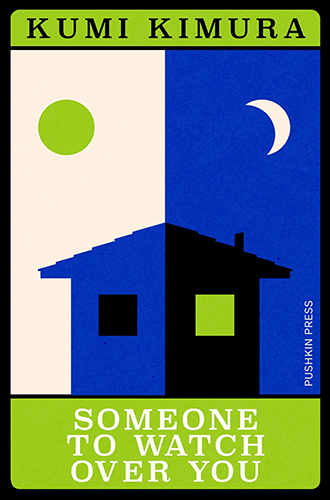
Someone to Watch Over You

Kumi Kimura’s 2021 novella Someone to Watch Over You is a subtly unnerving story about the strangeness of the Covid pandemic.

46yo Tae lives alone in her deceased parents’ house in a small town in northern Japan. She formerly worked as a middle school teacher, but she left the job after the death of one of her students. Now she lives on her inherited savings while leaving the house as infrequently as she possibly can.

Tae’s solitary lifestyle is unaffected by the onset of the Covid pandemic, but the “stay home” orders were followed by three unpleasant incidents in quick succession. An older man who’d just retired is found dead in an apartment on Tae’s street, and someone paints graffiti on the front wall of Tae’s house. Tae also receives an odd message from the father of the deceased student on her answering machine. These three incidents blend together into a paranoid fantasy that convinces Tae that she’s being stalked.

After a handyman named Shinobu treats Tae with kindness while cleaning her bathroom drain, Tae asks him to guard her house. Shinobu, who desperately needs the cash, readily agrees. During the pandemic, he’s been forced to live in the garden shed of his parents’ house, which is currently occupied by his brother’s family. Shinobu’s sister-in-law won’t talk to him, and his niece is weird and creepy in a way particular to young teenage girls.

Tae eventually asks Shinobu to move into her house so he can keep watch full-time, but this arrangement is supremely awkward. Both Tae and Shinobu are deeply damaged people, and Tae’s insistence on maintaining social distancing rules inside her own home stunts the development of any sort of friendly relationship between them. By the end of the novel, the reader wonders if Shinobu is any better off at Tae’s house than he would have been living rough.

To speak personally, a sudden change in employment forced me to scramble to move to a different city in April 2020. Due to social distancing, I had no opportunity to form and renew social connections, and the following two years were intense and unpleasant.

Someone to Watch Over You doesn’t reflect my individual circumstances, but it perfectly conveys the sense of displacement and alienation I experienced during the pandemic. It’s validating to see this sort of surreal experience taken seriously, especially since I definitely wasn’t alone in having a bad time during the lockdowns. I don’t think it’s healthy to dwell in past trauma; but, at the same time, the cultural expectation to pretend that all of this didn’t happen four years ago can sometimes feel maddening.

The back cover of Someone to Watch Over You promises “an unlikely connection” and asks if Tae and Shinobu can “become one another’s refuge,” thus suggesting the possibility of a heart-warming conclusion to the story. This does not happen, not by a long shot. While I fear that some readers may be disappointed by the weirdness of the ending, I appreciate that the author didn’t pull her punches. The Covid pandemic was indeed strange and unpleasant, and Someone to Watch Over You is one of the truest fictional accounts of the pandemic I’ve encountered.

Someone to Watch Over You is well-written and carefully translated, and I found myself fascinated by the dysfunctional characters and pulled along by the downward momentum of their story. This disturbing little book is compelling in its use of the pandemic as a stage for exploring the darker mysteries of mundane life, and I admire how Kimura revisits this particular moment of history without the comforting lens of nostalgia.

ツミデミック

Michi Ichiho’s Tsumidemic (ツミデミック), which won the prestigious Naoki Prize for popular fiction in 2024, collects six stories about the atmospheric strangeness of the Coronavirus pandemic. While everyone’s attention was focused elsewhere, Ichiho wonders, what sort of intriguingly antisocial behavior might have been enabled by isolation?

The opening story, Chigau hane no tori (違う羽の鳥), has all the grim fascination of a viral urban legend. Yūto moved to Tokyo only to drop out of college, and now he works as a barker for a bar in Shinjuku. Unfortunately, business isn’t going well due to the pandemic. During another eerily quiet night, Yūto sees someone he knew back from middle school in Osaka, Nagisa Inoue. This is a shock, as Nagisa is supposed to have committed suicide by jumping onto the train tracks. As she and Yūto get drinks together, Nagisa explains her devious plot to flee from the grasp of her overbearing mother, which was far from a victimless crime. Yūto is no saint himself, and he inadvertently reveals why he immediately recognized someone he never talked to when they were classmates.

Romansu (ロマンス☆) is about a bored housewife named Yuri who develops a serious online gambling addiction of an unusual nature. Yuri hasn’t been able to find a new job since she left her previous position to give birth to her daughter, and the pandemic isn’t helping. She channels her frustration into a food delivery app called Miideri, which she treats like a gacha game. Will the person who makes her next delivery be one of the handsome men rumored to be employed by the service? While gambling on the slim possibility that a prince will arrive at her door bearing a bag from McDonald’s, Yuri attracts the unwanted attention of an unhinged delivery driver who has read exactly the wrong message into her frequent orders.

Rinkō (憐光) is narrated by the ghost of a high school student named Yui who, strangely enough, can’t recall how she died. Having materialized back into the world fifteen years after her death, Yui finds herself confused and alienated by the loneliness of the Tokyo streets and train stations during the pandemic. She therefore returns home to her mother’s house in the country. Her arrival coincides with a memorial visit from her friend Tsubasa, who is accompanied by their old homeroom teacher, Sugita. As Yui eavesdrops on their conversation, she learns that she died after mysteriously falling into a river during a rainstorm. Sugita knows what Yui was doing and where she was going, and Tsubasa wants him to know that she knows, too.

The collection takes a slightly more positive turn in the fourth story, Tokubetsu enkosha (特別縁故者), in which Kyōichi, the unemployed and impecunious father of a young son, attempts to weasel himself into the good graces of an elderly man whom he suspects is a money hoarder. Kyōichi, an affable himbo who has no business scamming anyone out of money, volunteers for the daily task of picking up a takeout lunch from one of the many bentō stores in the neighborhood. The old man knows exactly why Kyōichi approached him, and he resents him for not pursuing his ambition to enter the food service industry. Harsh words are exchanged; but, when push comes to shove, even a relationship built on ulterior motives is better than living alone as an elderly shut-in during a pandemic.

Shukufuku no uta (祝福の歌) is about a happily married middle-aged man facing a new direction in his life. Despite being a high school student, his daughter is pregnant, and she intends to keep the baby. Meanwhile, the man’s mother seems to be entering the permanent brain fog of senile dementia. His daughter, who has been gossiping with the other mothers in her grandmother’s apartment building, gets the sense that there’s something else going on. With any luck, it’s a problem that can actually be solved.

Sazanami Drive (さざなみドライブ) follows the IRL meetup of five people who connected on Twitter after their lives were disrupted by the pandemic. As they drive out to the country in a minivan, they share their stories of abandonment and alienation. Little do they know that one of their number has a secret agenda. He’ll do whatever it takes to disrupt the group’s grim plan for the trip – and hopefully save their lives in the process.

As indicated by the book’s title, the two themes guiding this collection are “crime” and “the pandemic.” Each of the characters is hiding something, and the reader never knows where anyone’s true intentions lie. Michi Ichiho, who began her writing career as an author of BL romance novels, isn’t unduly focused on creating mimetic fiction, and the scenarios are improbable at best. Still, the twist at the end of each story is a lot of fun, and the fantastical plot elements accurately convey the feeling of just how weird and unreal everything felt during the pandemic.

It appears that the English-language publication rights for this collection are currently up for grabs (more info here). Tsumidemic is a fast-paced and emotionally cathartic book, and it would benefit from a tone-sensitive translation that renders Ichiho’s dialogue-filled writing into snappy, Stephen King style prose. I hope someone picks it up.