
The Place of Shells

Mai Ishizawa’s short novel The Place of Shells, which was awarded an Akutagawa Prize in 2021, follows a Japanese woman pursuing her PhD research in European art history at a university in the German town of Göttingen. For a year and a half, she’s shared an apartment with a fellow grad student named Agatha, as well as Agatha’s dog Hector.

Around the late-summer Obon festival, when the spirits of the dead visit the world of the living, the narrator talks to her old classmate Sawata, who studied art history with her as an undergrad at a university in Sendai and currently works as a museum curator. Over Skype, Sawata tells her that their friend Nomiya will be visiting Göttingen for a brief period. This is odd, the narrator admits, as Nomiya disappeared during the March 2011 tsunami and has been presumed dead for nine years.

Nomiya’s sudden appearance isn’t the only strange thing happening in Göttingen. One of the town’s landmarks is its Planetenweg, where memorials representing the sun and planets are placed according to scale. Now that Pluto is no longer a planet, however, its memorial has been sighted in odd places, seemingly at random. In addition, Agatha’s dog Hector has been digging up mysterious bits of rubbish in the forest, and each discarded item is connected to the secret memories of the people in the narrator’s circle of friends. To make matters even more bizarre, the narrator painlessly begins to grow a set of human teeth on her back.

The Place of Shells doesn’t really have a plot, and none of these surreal occurrences are mysteries to be solved. Instead, the narrator reflects on the nature of memory as she comes to terms with the March 2011 tsunami and what she lost in the disaster, as best illustrated by this passage toward the end:

What I had been afraid of was the distortions of memory caused by emotions and the passing of time. That was where forgetting began. What my feet had felt as they went tramping around that seaside town, the scenes my eyes had taken in, the smell of the sea that rushed into my nose – these memories didn’t remain with me as raw sensations, but morphed into a distant narrative. That oblivion concealed more than just the dead who hadn’t returned to land.

As the narrator comes to terms with the constructed nature of her memories of trauma, she encounters a number of ghosts that manifest in cozy apartments and relaxed strolls through the beautiful German town. For most of us, the ghosts of the past have little to do with darkness or shadows; rather, they walk casually beside us during the day. While giving the reader a beautiful environment to explore through careful and attentive prose, Ishizawa encourages reflection on grief as refracted through the passage of time.

I’d also like to mention an aspect of this novel that was immensely appealing to me personally. For various reasons, my frame of intellectual reference is skewed away from Europe, and I’ve always wanted someone who doesn’t assume a thorough knowledge of Christianity to teach me about Western art history. The Japanese narrator (and, I suppose, the academic author speaking through her) presents an accessible discussion of her research on German artistic portrayals of Christian saints that I found fascinating. The Place of Shells is a meditation on art as much as it is on memory, and I feel as though I gained a more grounded and relatable perspective on the sort of medieval European art that I always passed by without understanding in museums.

In doing a bit of research of my own, I realized that each of the women in the narrator’s circle of friends has a connection to her saintly namesake that Ishizawa communicates through imagery both mundane and fantastic. Over the course of the story, the narrator makes something of a pilgrimage through overlapping systems of symbols in a way that mirrors her own academic study of religious art. If a reader were to draw a map of these symbols, I imagine that the constellations would be quite dense, but I found it satisfying simply to follow that narrator’s meanderings without imposing a definitive sense of meaning.

Mai Ishizawa reminds me of Yoko Ogawa in her ability to create a subtle sense of atmosphere through mundane descriptions of calm and lovely places that gradually become eerie through an accumulation of otherworldly imagery. I’m also reminded of the quiet and gentle surreality of Haruki Murakami’s 1982 novel A Wild Sheep Chase, especially in terms of the narrator’s time in the woods and proximity to historical palimpsests overlaid onto daily life.

The Place of Shells is a slow novel to be savored. A spiraling shell is an apt analogy for the style of narration, which only gradually approaches its central theme through ever-smaller circles. Ishizawa’s writing, which Polly Barton has translated with pitch-perfect clarity, is gorgeous and well worth taking a page at a time as the reader, like the narrator, softly explores a world made beautiful and strange through art and memory. 
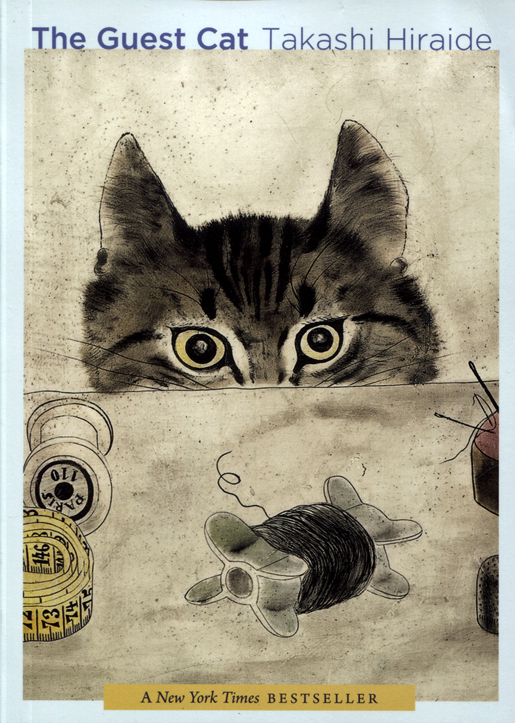
The Guest Cat

The Guest Cat

Title: The Gust Cat
Japanese Title: 猫の客 (Neko no kyaku)
Author: Hirade Takashi (平出 隆)
Translator: Eric Selland
Publication Year: 2014 (America); 2001 (Japan)
Publisher: New Directions
Pages: 140

The Guest Cat is set in 1988 in a residential neighborhood not too far away from Shinjuku Station, where the young narrator lives with his wife in a rented house located on the property of an old estate. The narrator’s house faces a narrow side street that he calls “Lightning Alley” because of its sharp, zig-zagging turns. A young housewife and her son live in a house next door that shares the shade of an ancient zelkova tree with the narrator’s house. A cat wanders into the housewife’s garden, and her son becomes enamored with the creature. Despite the protests of the woman living in the main house of the larger estate, who claims that the neighborhood cats ruin her garden and track dirt inside her house, the boy is allowed to keep the small white-mottled cat, which is promptly given the name Chibi, meaning “little one.”

The novel moves elliptically through several stories, gradually passing from point to point by way of meandering descriptions of the outside alley, the estate garden, and the narrator’s house in relation to the space and weather outside. The narrator has just worked up the courage to quit his job as a literary editor in order to pursue his own writing projects, but he only has enough money to help his wife maintain the household for about a year and a half. The narrator’s close friend dies from cancer, and the narrator worries about his own health as the Shōwa emperor grows ever weaker on his deathbed. The woman who owns the estate lives alone save for her aging husband, and she’s not too young herself; it’s uncertain what will happen to the property when she passes away, as land prices have risen exorbitantly in the bubble economy. Most importantly, Chibi develops new mannerisms and behaviors as she becomes more familiar with the narrator and his wife, who in turn grow and change through their interactions with her. The chapters are short (between three to six pages), each focusing less on any sort of ongoing plot and more on brief and vibrant observations on how the world appears differently when it’s centered around a cat instead of around other human beings.

The style of the novel is naturalistic in its minute attention to the detail of mundane life and reminds me of nothing so much as the short fiction of Shiga Naoya or the realistic fiction of Akutagawa Ryūnosuke (of the kind collected in Mandarins), in which the discomfort caused by writer-narrator’s cold is made palpable by a catalog of what can only be noticed when one is confined to bed but cannot sleep, such as how a lizard crawls into a sliver of shade on the bedroom windowsill to escape the sun, or how Chibi admires herself in the mirror before leaping from the mirror stand onto the top shelf of the closet. As one imperial era transitions into another, the narrator and his wife experience major changes in their life, including a particularly traumatic event involving Chibi whose full impact does not become clear until the very last page of the story. Throughout everything, Hiraide focuses on brief moments and small sensory details such as the pleasant chilliness of a breeze or the pattern of light and shadow cast by the sun shining through tree leaves. While it is possible to glean several layers of meaning from each episode (one scene involving a praying mantis eating a locust particularly rewards analysis), it’s also well within the reader’s right to simply allow herself to be carried by the relaxed current of vivid impressions.

I’ve recently started reading about the Deep Ecology movement, which is above all concerned with animal rights, as well as how respect for these rights can shape the nature of the relationship between human and non-human animals. I’ve become a fan of Marc Bekoff’s blog Animal Emotions, which comments on current events and summarizes scientific research in order to build a case for a more inclusive and compassionate understanding of animal psychology. It’s been interesting to read Bekoff’s work alongside The Guest Cat, in which different characters betray vastly different attitudes towards animals through their interactions with Chibi. I was especially intrigued by the shifting tides of the narrator’s wife, who claims not to be a cat person:

As she finished the poor sparrow’s burial my wife repeated her earlier declaration – “I won’t hold Chibi,” she said. “It’s more gratifying to let animals do whatever they like.”

As April came around, gossamer-winged butterflies covered the garden, dancing just above its surface and coloring it a blue-gray. It seemed impossible for anyone walking in the garden to avoid stepping on them.

What’s interesting about animals, my wife explained, is that even though a cat may be a cat, in the end, each individual has its own character.

“For me, Chibi is a friend with whom I share an understanding, and who just happens to have taken on the form of a cat.”

Even though the narrator’s wife is attached to Chibi, she respects the cat’s autonomy and individual character, thus abstaining from direct interaction. The narrator, on the other hand, becomes fiercely jealous of the cat’s affections at a certain point, and it becomes increasingly apparent that Chibi’s primary caretaker, the housewife next door, also possesses strong emotions concerning the cat.

Although other readers may interpret this autobiographical novel differently, to me, the primary dramatic effect of The Guest Cat is not so much a result of its human characters and the socioeconomic environment they occupy, but rather a process arising from the ideas and emotions animals inspire in humans as they become attached to individual creatures and are refracted into the wider world.

The Guest Cat is equally capable of acting either as a quick pleasure read for cat lovers or as a starting point for applied literary ecocriticism. Either way, it’s a neat little book!