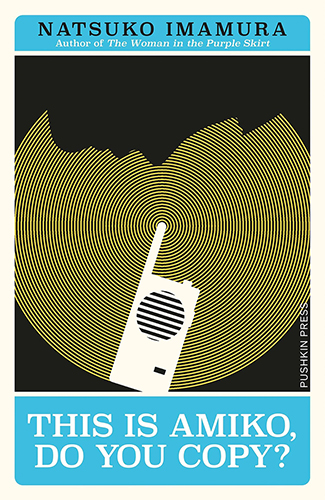
Natsuko Imamura’s novella This Is Amiko, Do You Copy? is about a neurodivergent preteen girl who’s neglected by her family and bullied at school. Though Amiko herself is quite charming, Imamura asks serious questions about the society that denies her support and understanding.
Amiko is ten years old and extremely friendly, but she has trouble fitting in. She speaks and behaves like someone much younger, and she often wanders away from class to read manga in the library. Her classmates avoid her when they can, but she’s oblivious to her alienation and remains cheerful and outgoing.
When her mother (who is actually her stepmother) has a miscarriage, Amiko does her best to comfort her, but her well-intentioned efforts are misinterpreted as malicious by both of her parents, who begin to neglect her. Without anyone to feed or bathe her, Amiko goes slightly feral, and she spends her early teenage years in almost total social isolation despite still attending school every day.
To protect Amiko from bullying, her older brother Kota toughens up, eventually joining a gang so that his reputation can shield his little sister. Kota loves Amiko and does his best to care for her, but he doesn’t have the emotional resources to deal with his clinically depressed stepmother or the lack of concern demonstrated by his workaholic father.
By the time she’s fifteen, Amiko still hasn’t matured, and she can barely read or write. She has trouble communicating and expressing herself, and she takes to singing made-up songs loudly and off-key whenever the mood strikes her. Torn between a child he can’t understand and a wife who never leaves the bed so that she’ll never have to see her stepdaughter, Amiko’s father sends her to live with her grandmother in the countryside.
The walkie talkies that Amiko’s parents give her as a gift at the beginning of the story are a chillingly direct analogy for her situation – she’s transmitting, but nobody’s responding. On a broader level, you can’t help but wonder why nobody ever reaches out to help Amiko or her parents.
This Is Amiko, Do You Copy? is narrated from a limited third-person perspective that shows the world as Amiko might see it, and Amiko is so happy and good-natured that it’s easy to skim through this short novella without really understanding the profound anger that Natsuko Imamura is expressing through the story. Amiko is a sweet and happy-go-lucky girl, but I could almost feel the author writing with clenched teeth.
I’ve seen multiple reviews of this novella (and its 2022 cinematic adaptation Amiko) that shy away from identifying Amiko as being on the autism spectrum, maintaining instead that she transcends labels. I feel like a bit of critical thinking might be necessary here. Specifically, does not labeling Amiko as autistic help her (or her family) in any way? Because it sure seems like the lack of a formal diagnosis has resulted in nothing but neglect and abuse. On the other hand, would a greater awareness of neurodiversity, as made concrete through an imperfect but still useful label, perhaps help Amiko’s community understand and support her?
I enjoyed Imamura’s novel The Woman in the Purple Skirt, whose meaning also dwells in the seemingly empty spaces of what its alienated and unreliable narrator doesn’t say. Just as the label of “autistic” would presumably make life much easier for Amiko, I imagine that a formal diagnosis of “schizophrenia” would probably help the Purple Skirt narrator get the help she needs. Imamura’s project in these two stories is not to normalize neurodivergence, necessarily, but to demonstrate that neurodivergent people aren’t abnormal. It’s only when neurodivergent people are denied community support and resources that unfortunate things happen.
This isn’t to say that This Is Amiko is didactic or unpleasant. It’s actually quite lovely, and I hope it doesn’t make me sound like a bad person to say that I genuinely enjoyed this book. Still, Natsuko Imamura is staging a serious critique through what may initially seem like a light and breezy story, and it’s important not to ignore the subtext.
Kudos to Hitomi Yoshio (and her seven-year-old daughter) for creating a fantastic translation of the distinctive narrative voice of this novella, and much love to Pushkin Press for bringing it to a wider audience. I’ve got my fingers crossed that Imamura’s 2017 novel Hoshi no ko (Child of the Stars), which is something of a sibling to This Is Amiko, finds a home in translation too.
Content Warning: This review contains a frank discussion of child abuse and incest.
If you’ve made it past the content warning, you should also be aware that Earthlings contains extended and explicit descriptions of parental child abuse, incestuous child sexuality, adolescent sexual abuse, severe dissociation, suicidal ideation, mental illness, murder, starvation, and cannibalism. This material is central to the story, which has a truly disturbing ending.
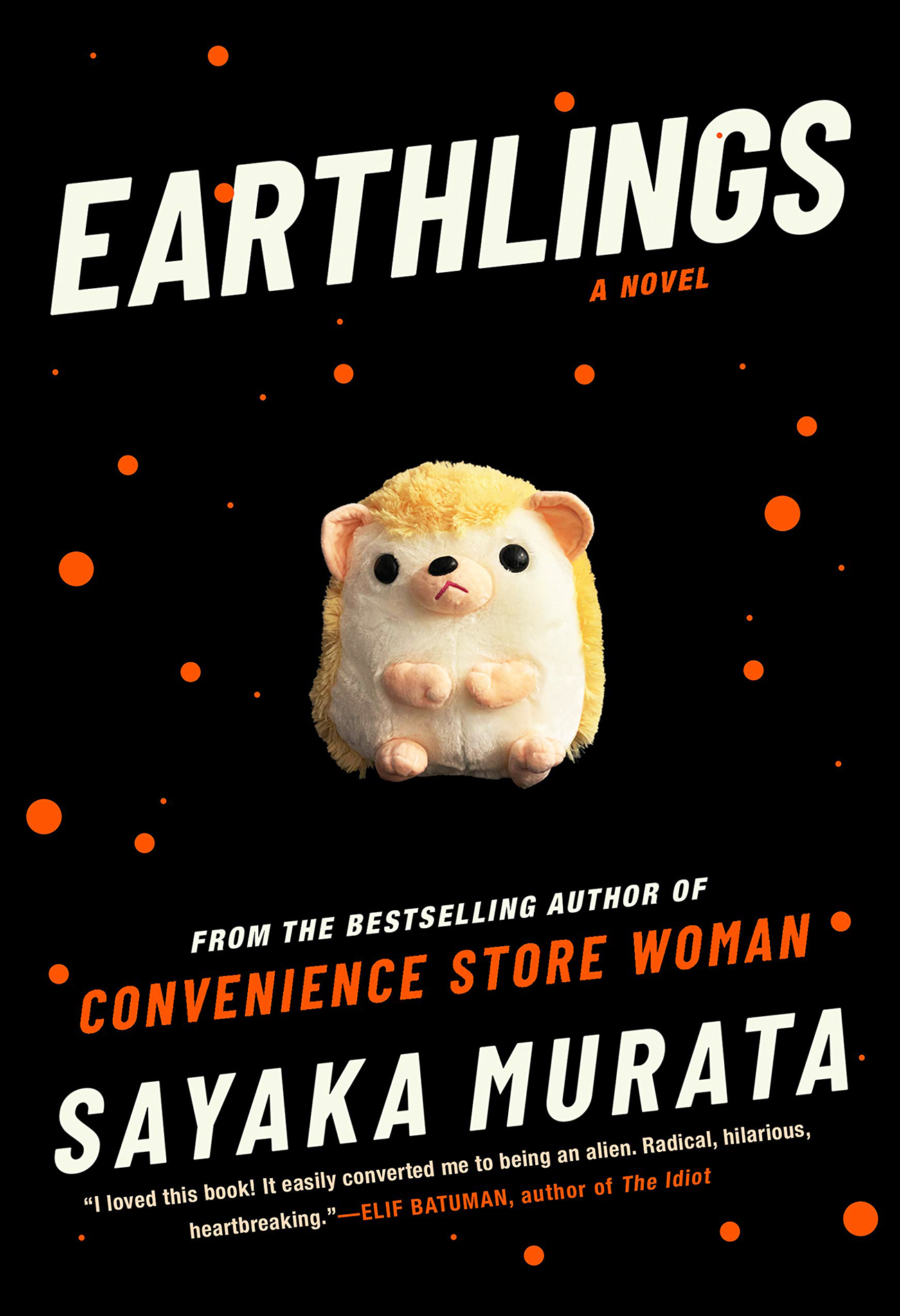
While I would happily recommend Sayaka Murata’s novel Convenience Store Woman to anyone, Earthlings is definitely not for everyone. Elif Batuman calls this novel “hilarious” in the blurb on the front cover of the American edition, and I’m not sure where that’s coming from. Earthlings is deeply sad and upsetting. It’s not the least bit funny, joyous, offbeat, or quirky. The author’s tone may be deceptively light, but the themes of her story are as dark as they come.
Earthlings is a novel about the deteriorating mental state and unfortunate life decisions of a relatively normal girl named Natsuki who is made to feel that she isn’t human because of the sustained abuse she receives at the hands of her parents and teachers. The point of the story isn’t to argue that we need to free ourselves from the normative expectations of an oppressive society. Rather, Earthlings demonstrates just how deeply painful and unhealthy social alienation can be to the people who are arbitrarily designated as outcasts and scapegoats.
The novel begins with the eleven-year-old Natsuki’s confession that she is a special child who was chosen by an alien named Piyyut, who came from Planet Popinpobopia to help her fight evil witches as a magical girl. Although Piyyut looks like a stuffed animal to ordinary people, he’s actually an emissary sent by the Magic Police. This is a secret to everyone except Natsuki’s cousin Yuu, who tells Natsuki that he understands Piyyut’s situation because he’s an alien too.
From the very first page, it’s clear that Natsuki has created a fantasy version of herself in order to escape the neglect of her parents. Neither of Natsuki’s parents attempt to hide their preference for her older sister Kise, who has a codependent Münchhausen-by-proxy relationship with their mother. While Kise can do no wrong and requires special care and attention, Natsuki becomes the scapegoat of her mother, who constantly criticizes her appearance and personality. Instead of defending Natsuki, everyone in her family defers to her mother – everyone except her kind and friendly cousin Yuu, whom Natsuki decides is her boyfriend and future marriage partner.
Because of the strength of her magical girl fantasy, Natsuki is able to survive the abuse she suffers at home. Unfortunately, precisely because this abuse makes her vulnerable, she becomes the sexual target of a young and popular teacher at her after-school tutoring program. The author gets the abusive teacher’s mentality exactly right. He starts with small acts that have plausible deniability, such as using “posture correction” as an excuse to grope Natsuki. When he escalates his behavior in an attempt to test the boundaries of what he can get away with, he does so in a way that Natsuki will be ashamed to talk about, such as fishing her used sanitary napkin out of the trash after she uses the bathroom.
Natsuki knows there’s something wrong with the teacher’s behavior and tells her mother, but her mother takes the teacher’s side and scolds Natsuki for overreacting. She then punishes Natsuki for “making up stories” by forcing her to spend more time with the teacher. Natsuki ends up going to the teacher’s house for a private lesson, which leads to exactly the scenario you’re afraid it will. The sexual assault scene is long, explicit, and extremely difficult to read. Once again, the author depicts the mentality of child abuse with perfect accuracy, in that the teacher forces Natsuki into a situation in which she feels compelled to “consent” to her assault, thus making it seem like her own fault.
Severely traumatized and knowing from experience that no one will believe she’s been raped, the now twelve-year-old Natsuki resolves to commit suicide in the mountain forest surrounding her grandparents’ house during the annual family get-together for the summer Obon festival. Before she dies, Natsuki wants to experience genuine physical affection, so she convinces her cousin Yuu to go out in the woods with her to have penetrative sex, after which she swallows an entire bottle of her aunt’s sleeping pills.
As Elif Batuman says in the blurb on the front cover of Earthlings, the abuse, rape, and attempted suicide of a twelve-year-old girl is “hilarious.”
Except it’s not. Natsuki’s fantasy of being a magical girl is a psychological coping mechanism, and her lack of affect is the result of severe trauma. Not only are the events Murata describes terrible to read, it’s also terrible to hear them recounted in the voice of a twelve-year-old narrator who doesn’t yet possess the emotional maturity to process what’s happening to her. This narrative style isn’t “quirky.” It’s horrifying.
After Earthlings firmly establishes itself as a horror story told by an unreliable narrator, it jumps forward in time to 34-year-old Natsuki, who is currently in her third year of marriage to a man named Tomoya. After her suicide attempt, Natsuki was essentially treated as a prisoner by her family for two decades, and marriage seemed to be the only way for her to escape. Natsuki met Tomoya on a website for people in situations similar to her own, namely, people who need to get married in order to appease their families. The site caters mostly to the LGBTQ+ community; and, while Tomoya’s sexuality is never specified, he seems to be aro-ace, meaning that he does not experience romantic attraction and is disgusted by physical sexual contact.
Tomoya and Natsuki are essentially roommates who sleep in separate bedrooms while sharing an apartment. This arrangement works well for both of them, at least until their families begin to exert pressure about having children. The stress of this pressure weakens the deep fault lines of their respective childhood traumas, and they decide to escape society by fleeing to Natsuki’s grandparents’ house in the mountains. The house is currently occupied by Yuu, who has been acting as a caretaker for the property after having been laid off from a prestigious office job in Tokyo. As you can imagine, what happens to these three characters in an isolated cabin in the woods isn’t great, and the novel’s ending is shocking.
Earthlings is about three broken people whose connection to reality gradually deteriorates as they feed one another’s delusions while in total social isolation. The plot summary I’ve provided is the background necessary for the reader to understand the core of this story, as well as its tone.
In Convenience Store Woman, Sayaka Murata argues for the quiet dignity of menial service jobs and the validity of neurodivergent perspectives. The narrator of Convenience Store Woman enjoys her job as a clerk at a convenience store because she finds the routine comforting and appreciates being able to interact with other people according to a preset script. Toward the end of the novel, she finds herself in a difficult situation because she succumbs to her family’s pressure to find a partner and chooses the first person to make himself available despite his unsuitability. Many readers of this internationally bestselling novel identified with the narrator’s perspective and sympathized with the author’s description of the small pleasures of part-time service industry jobs that are often looked down on by older generations.
Earthlings explores similar material and themes but takes a radically different approach. In this novel, Murata emphasizes her narrator’s social alienation to an extreme degree. The narrator’s unwilling separation from “Earthlings” is not a good thing, nor is it depicted as being relatable. Instead, Murata uses these characters to ask serious questions about what it means for neurodiversity and queerness to be forcibly removed from mainstream society. For instance, why are child molesters protected by their communities while the children they abuse are treated as unbalanced and unclean? Why is traveling overseas to undergo expensive and invasive surgery in order to have children seen as normal, while choosing to remain childless is viewed as antisocial and neurotic?
If you can handle the dark tone and gruesome subject matter of Earthlings, it’s an extremely compelling story. At the risk of calling child abuse “hilarious,” I have to admit that I was entertained, especially once Natsuki starts living in her grandparents’ abandoned house in the woods. For what it’s worth, the ultimate fate of the pedo teacher and the garbage parents who enabled him is unpleasant yet satisfying.
As a fan of social horror, I love Earthlings, but I would caution potential readers to take the content warnings seriously. Sayaka Murata is a brilliant writer who tells strange and complicated stories, and I look forward to seeing more of her sizeable body of work in translation. I just hope that, in the future, she’s treated like the complex and nuanced literary figure she is instead of marketed as an easily digestible product of pop culture.
 Contemporary Japanese Literature