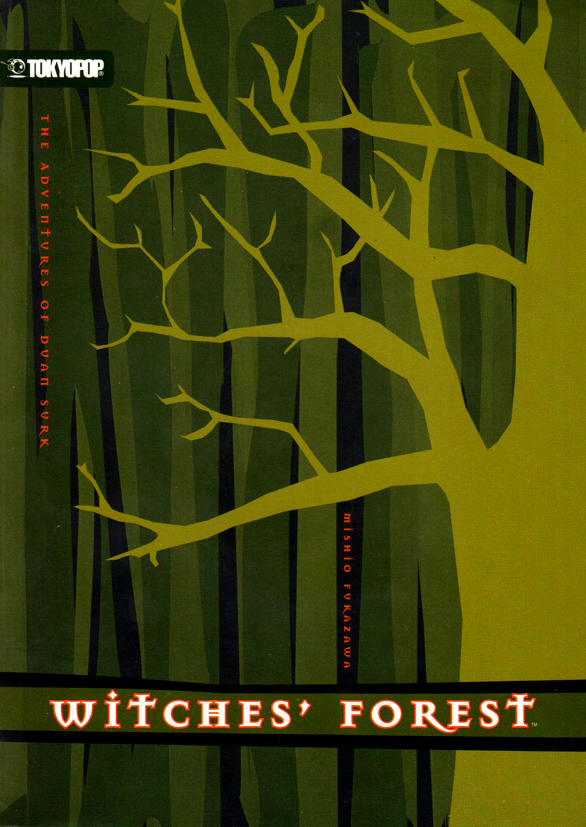
The Adventures of Duan Surk: Witches’ Forest

Witches' Forest

Title: The Adventures of Duan Surk: Witches’ Forest
Japanese Title: デュアン・サーク ― 魔女の森
(Duan Sāku: Majo no mori)
Author: Fukazawa Mishio (深沢 美潮)
Illustrations: Otokita Takao (おときた たかお)
Translator: Catherine Barraclough
Publication Year: 2006 (America); 1996 (Japan)
Publisher: Tokyopop
Pages: 328

This book is kind of stupid. It’s a mess of tropes and clichés liberally borrowed from the early Zelda and Final Fantasy games written in a style aimed at the lowest common denominator. There is no depth to the story, the characters, or the writing. Witches’ Forest is a light novel, and it reads like a light novel: shallow, superficial, and disposable by design.

Nonetheless, I think Witches’ Forest is an interesting and important book, especially in translation. Before I explain why, allow me to give a brief plot summary.

Duan Surk is an orphan in a world plagued not only by vicious man-eating monsters but also by war. He was raised in a small town by his brother Gaeley, a hale young man who took on various odd jobs to order to be able to provide medicine and care for the sickly Duan. The young Duan makes up for his lack of physical strength with an inquisitive mind; and, by the time he is fourteen, Gaeley is confident enough in Duan’s ability to make it in the world that he himself decides to leave the town in order to become a soldier. Gaeley is everything to Duan, so the young Duan decides to become a fighter like his brother. Duan fails the physical portion of the initial test of the Adventurer’s Club guild, but the army will take anyone, so off to the army he goes. After spending a year as a cook’s assistant, Duan returns to camp after spending the day gathering ingredients only to find his entire battalion vanished into thin air, leaving only empty tents and smoldering fires behind. He straps on a sword and rushes into a nearby forest with a vague plan of rescue in mind, but the forest is enchanted, and Duan soon finds himself hungry, lost, and in dire peril.

This is where we find our hero at the beginning of Witches’ Forest, but Duan soon stumbles upon two traveling companions: Olba October, a battle-hardened veteran adventurer in his twenties, and Agnis R. Link, a sixteen-year-old sorcerer with a penchant for fire magic who may or may not be a princess in disguise. Both of these characters are trying to get to the mansion at the heart of the forest, wherein two witches are said to dwell. Olba wants treasure, and Agnis wants revenge. Before they can reach the witches, however, they must brave the dangers of the surrounding forest and the traps set up in and around the house itself.

The adventures of the trio are solidly structured upon a foundation of RPG tropes and gameplay mechanics. Agnis is the perky refugee, Olba is the jaded older guy, and Duan is just about every main player-protagonist to ever appear in a JRPG. The characters randomly encounter monsters drawn directly from D&D dungeon master guides, and they earn experience points when they defeat these monsters. Their Adventurer Cards keep track of their experience points, and, when they earn enough, they gain a level. They are equipped with a full arsenal of Zelda items, from the port-o-lant (which “uses low-cost solid fuel made of Zora oil”) to the coily coily rope (“the definitive version of the hooked rope”), and Agnis in particular has to worry about running out of MP (“magic points,” or magical energy). The trio is accompanied by a flying baby dragon/fire lizard that can talk and use low-level healing spells and is somehow fuzzy despite being reptilian. The only thing the party doesn’t have is a bag of holding, as they’re constantly lugging their adventure gear around with them and getting into petty arguments over who has to carry what.

One of the most engaging parts of Witches’ Forest is Agnis’s backstory, which involves a heartbroken yet politically ambitious stepmother who sinks to Cersei Lannister depths of dastardly scheming. Within this family drama, characters change and grow and are faced with problems that have no obvious solutions. For the most part, though, the novel focuses on the three main characters running around and hitting things with swords and spells. Each of these battles requires some minor element of strategy but is relatively brief. Sentences are short and declarative. Each paragraph contains about three to six sentences. There are no anime-style illustrations, but the text is interspersed with various material drawn from its fantasy world, such as copies of the characters’ Adventurer Cards, advertisements for magical items, and overworld and dungeon maps. At the end of the book is a three-page bestiary of monsters that appear in the story, which is illustrated in a style highly reminiscent of mid-1990s fantasy anime like Record of the Lodoss War or Magic Knight Rayearth.

Witches’ Forest feels extremely dated, which makes sense, as popular culture has moved on in the almost twenty years since the book first came out in 1996. What makes the novel interesting is that it captures the spirit of its age so well. Neon Genesis Evangelion aired during the fall season of 1995 and ended up drastically changing the playing field; but, before that, many popular anime for the young adult demographic were based on light novels such as Slayers and Irresponsible Captain Tylor, which are just as goofy as they are epic. The humor, the fighting, the yelling, the zany adventures, and the group of ridiculously disorganized young people resolving volatile political stalemates entirely by accident are all strongly reminiscent of the anime of the time. It goes without saying that all of this media is closely connected to the themes and stylistic conventions of video games before they made the leap to the 32-bit era. In this way, Witches’ Forest is like a time capsule from a bygone era.

Tokyopop’s release of this book in translation also calls to mind the cultural atmosphere in the United States of a little less than ten years ago. Excitement over Japanese entertainment media such as anime, manga, and video games was almost visibly swelling as new anime conventions popped up every year and bookstores devoted an ever-increasing amount of shelf space to manga. The spark of interest in young adult fiction kindled by the Harry Potter books had leaped into a blazing inferno with the sudden popularity of the Twilight series, and the teenage demographic was on fire in terms of marketing value. Tokyopop was licensing one manga series after another, Viz Media was using its profits as capital to test new markets, and even the mighty Hachette Publishing Group was launching a new imprint devoted to all things manga. Tokyopop had begun to translate light novels, and certain titles, such as Yoshida Sunao’s Trinity Blood series and Ono Fuyumi’s Twelve Kingdoms series, were proving popular with crossover audiences. 2006, the year that Witches’ Forest was published in translation, was the absolute peak of the anime and manga industry in the United States (at least in terms of sales numbers). The market was diversifying and had the support of major retail chains, complaints about internet piracy and entitled fans were few and far between, and it seemed as if anything was possible.

As I wrote at the beginning of this review, Witches’ Forest isn’t written for those seeking a multilayered story, beautiful language, or thematic and allusive depth. Instead, it’s meant to be a quick and enjoyable read, and it serves its purpose admirably. As such, it’s a perfect representative of the literary medium of light novels. The market for light novels in Japan is relatively large, so books like the Duan Surk series, which aren’t particularly brilliant or original, can still thrive and reach a large audience. In the United States, however, the publishing market is tough and the market for young adult novels in translation is infinitely tougher. The crazy manga boom of the last decade was thus necessary for something like Witches’ Forest to appear on bookstore shelves.

Witches’ Forest is therefore an interesting cultural artifact that serves as a window into both the Japan of the 1990s and the United States of the 2000s. Its value as a tangible index of pop lit history aside, the novel is a lot of fun to read, especially for fans of video games and anime. For an older readers, the experience of reading the book may evoke a certain sense of nostalgia, while a younger reader might be able to enjoy the “what was old is new again” thrill of encountering tropes and narrative patterns that now fall slightly outside of the mainstream.

There are four books in the Duan Surk series, and all of them are available in English translation from Tokyopop. Although used copies can be found through various distributors, the best way to get your hands on new copies of all of the books in the series is through the anime retailer The Right Stuf, which is a treasure trove of out-of-print light novels in translation.
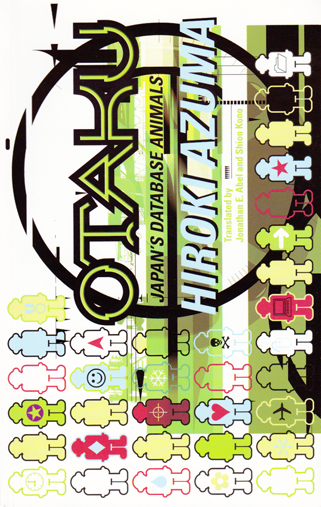
Otaku: Japan’s Database Animals

Title: Otaku: Japan’s Database Animals
Japanese Title: 動物化するポストモダン:オタクから見た日本社会
(Dōbutsuka suru posutomodan: Otaku kara mita Nihon shakai)
Author: Azuma Hiroki (東 浩紀)
Translators: Jonathan E. Abel and Shion Kono
Publication Year: 2009 (America); 2001 (Japan)
Publisher: University of Minnesota Press
Pages: 200

Even though I have read Otaku: Japan’s Database Animals twice in translation (as well as once in the original Japanese) over the past two years, I will readily admit that I’ve had a difficult time trying to understand what its author is trying to say. It turns out that the key to my understanding of Otaku was Marc Steinburg’s translation of an essay called “World and Variation: The Reproduction and Consumption of Narrative” by a Japanese pop culture ethnographer named Ōtsuka Eiji. Reading this essay was something of an extended eureka moment for me, as Azuma has clearly created his model of narrative consumption as a response to Ōtsuka’s own model.

Ōtsuka’s “World and Variation,” originally published in 1989, is ostensibly about Bikkuriman Chocolates, or, more specifically, about the trading cards packaged with the chocolates. It was because of the trading cards that the chocolates were such a phenomenal hit with children around the time that Ōtsuka was writing, even though the character “Bikkuriman” had no television or manga tie-in products. The secret to Bikkuriman’s success was that, on the back of each trading card, there was a short paragraph of information about the character depicted on the front. If a child collected enough cards, he would gradually be able to piece together a larger story and gain a broader perspective on the Bikkuriman universe.

Out of many small narratives, then, children were able to create a grand narrative. The point of Ōtsuka’s discussion of Bikkuriman Chocolates is that “child consumers were attracted by this grand narrative, and tried to gain further access to it through the continued purchase of chocolates.” In other words, “what is consumed first and foremost, and that which first gives these individual commodities their very value, is the grand narrative or order that they hold in partial form and as their background.” The kids who bought the Bikkuriman Chocolates didn’t care about so much about each individual card as they did about the larger story, the mythology, and the worldview – what Ōtsuka calls the “grand narrative.” Ōtsuka argues that the consumption of anime functions in much the same way. Each episode in the anime series Mobile Suit Gundam, for example, is a small narrative. The story of each individual protagonist (such as Char or Amuro) that plays out across the episodes is a small narrative as well. The diagrams and mechanical specs included in many of the toy models of the robots may also be considered small narratives. As these small narratives are accumulated, however, they begin to form the contours of an entire world. Ōtsuka argues that it is this grand narrative that makes long-running series such as Gundam (and, I would add, series such as Lord of the Rings and Harry Potter) so popular – and marketable.

According to Ōtsuka’s model of narrative consumption, then, small narratives, while pleasing in and of themselves, also form pieces of a larger narrative. Ōtsuka argues that, while “the general viewing audience” will only follow one strand of small narratives, what characterizes otaku is their interest in the grand narrative. Otaku are characterized by their interest in gathering bits of information “hidden in the background,” putting these bits of information together, and creating their own small narratives based on their understanding of the grand narrative. Such a model of narrative consumption goes a long way towards explaining fan-made narrative products such as fan fiction and dōjinshi, since “if, at the end of the accumulated consumption of small narratives, consumers get their hands on the grand narrative […] they will then be able to freely produce their own small narratives with their own hands.” Therefore, otaku are otaku because they are invested in narrative consumption and reproduction at the level of the grand narrative.

In Otaku: Japan’s Database Animals, Azuma Hiroki proposes a different model of narrative consumption. The Japanese title of Azuma’s cultural study, Dōbutsuka suru posutomodan: Otaku kara mita Nihon shakai, is revealing. The first word of this title refers to the concept of “animalization” proposed by Alexandre Kojève in The Roots of Postmodern Politics. This animalization involves the degradation of humans (independent subjects capable of reasoning, directed action, and compassion) into animals (mindless consumers who act on impulses such as hunger and the drive for greater comfort). It is Azuma’s thesis that otaku and, by extension, the society that has spawned them are becoming increasingly animalized. Azuma describes the narrative and cultural consciousness characteristic of otaku through what he calls the database model of narrative consumption.

This database model stands in direct contrast to the model proposed by Ōtuska (which he refers to as the “tree model” in his monograph Monogatari shōhiron). To give another example of how Ōtsuka’s model interprets otaku narrative consumption, the character Ayanami Rei of Neon Genesis Evangelion, whose individual story is merely a part of the larger story, is adored by otaku because, for them, she represents the tragedy, epic scale, and political allusiveness of the entire television/film series. Ayanami Rei is not just a girl in a battle uniform, then; she is Neon Genesis Evangelion itself. To “consume” her is to emotionally insert oneself into the apocalyptic, man-versus-god atmosphere of the larger narrative.

Azuma tweaks this model for understanding symbols and narrative in his database model. While Ōtsuka argues that the grand narratives of shows like Evangelion are given weight by their relevance to real-world grand narratives (such as nation and history), Azuma believes otaku narratives are almost completely removed from those of the real world. In the opening chapter of Otaku, he states, “In otaku culture ruled by narrative consumption, products have no independent value; they are judged by the quality of the database in the background.” Thus, although an otaku might be familiar with Ayanami Rei’s age and bust size, be able to quote her dialog, and expound on the quality of various plastic models made in her likeness, he is not invested any larger worldview or grand narratives that may be encompassed by Neon Genesis Evangelion. Instead, the otaku mines the series for information to plug into a mental database that also contains information on similar shows. Because of the absence of the emotional pull of grand narratives, the otaku can substitute one element of his database for another. The light blue hair of a young female character such as Hoshino Ruri from Martian Successor Nadesico or Tsukishima Ruriko from Droplet effectively is the light blue hair of Ayanami Rei. For otaku, grand narratives are nothing compared to the “animalistic” appeal of a character’s cute face or slender waist. Tropes can therefore be transferred from one story and character to another, as can an otaku’s emotional investment.

Azuma claims that, “Compared with the 1980s otaku [on whom Ōtsuka bases his model], those of the 1990s generally adhered to the data and facts of the fictional worlds and were altogether unconcerned with a meaning and message that might have been communicated.” The otaku of the 1990s thus only consumed fragments, or small narratives. These fragments, which could comfortably fit within the small square boxes of a database, could then be easily cross-referenced with other fragments. Because of the ease of referencing these fragments, distinctions between an original and its copies (either through officially licensed spin-off works or fan works) disintegrated. According to Azuma, there was no longer any need to refer these fragments back to the grand narratives of either the original work or the real world. An otaku could float unanchored through the database he created through his consumption of undifferentiated narratives. And this, argues Azuma, is how the cultural phenomenon of moe was born. For otaku, stories don’t matter – it’s all about the cute girls.

In the first section of Otaku, Azuma explains his model. In the second section, he provides examples of how it works. During these two sections, Azuma’s writing is clear and easy to understand. The third and final section of the book, however, is a bit of a mess. In this section, Azuma gets really excited about the internet in a manner that now seems somewhat naïve; but, in Azuma’s defense, he was writing more than ten years ago. Despite the dated feel of this last section, however, Azuma’s ideas are accessible and make a great deal of sense, even to a reader with no prior experience in postmodern philosophy.

Little Boy

Title: Little Boy: The Arts of Japan’s Exploding Subcultures
Editor: Takashi Murakami
Publisher: Japan Society Gallery
Publication Year: 2005
Pages: 300

Little Boy is most definitely the contemporary Japanese art exhibition catalog to end all art exhibition catalogs. It quickly sold out when it was first released, and secondhand copies now sell for ridiculous amounts of money. The Japan Society of New York has finally released a softcover edition, which it sells in its headquarters in New York City. The new edition is just as gorgeous and well put together as the original hardcover version; so, if it’s at all possible for you to acquire one, go for it! Quickly! Do it now! Before you even start reading this review! Yes, it’s that good.

The first one hundred or so pages of this catalog feature full color plates of various artworks, photographs, and screen stills. Through these plates, pop artist extraordinaire Murakami Takashi attempts to demonstrate in images the thesis of his introductory essay “Earth in my Window.” Murakami’s main argument can be summarized in two points. First, the Pacific War, especially the two atomic bombs that ended it, left an indelible scar on the Japanese psyche. Second, the experience of having been defeated in war and thereafter occupied by America has turned multiple generations of Japanese people into perpetual children. The first point is illustrated by plates demonstrating recurring nuclear imagery in films and television serials such as Akira and Neon Genesis Evangelion and various tokusatsu (“special effects”) films released by Tōhō Studios, as well as in the artistic output of artists like Yanobe Kenji and Murakami himself. The second point is easily demonstrable by the overtly cartoonish and childlike work of artists such as Nara Yoshitomo, Ban Chinatsu, and Mr., as well as by the designs of popular and festishized kyara (“characters”) like Hello Kitty. Following these images and explanatory essay is a short manifesto penned by Murakami to support his superflat art movement, which is apparently based on the idea that contemporary Japan needs art that reflects its current cultural status of being awash in meaningless junk.

Next up is a transcription of a conversation between Okada Toshio and Morikawa Kaichirō (two self-proclaimed experts of “otakuology”) moderated by Murakami. Morikawa in particular states that otaku are characterized by an obsession with things that are dame (absolutely useless), whether it’s collecting antique model kits or falling in love with moe (young and innocent) characters. Okada seems to have a somewhat more optimistic view of otaku, who he thinks are simply resorting to childish things in order to escape a meaningless and unforgiving life. This conversation is superbly illustrated by images of the cultural paraphernalia the two men mention, and it also includes several dozen footnotes explaining their various obscure otaku references.

Following this conversation are two academic essays by Japanese scholars, Sawaragi Noi and Matsui Midori. Sawaragi discusses how the Pacific War has filtered through Japanese pop culture in movies like the Godzilla and Space Battleship Yamato series, and Matsui discusses the subculture of kawaii (“cute”) in postwar Japan, especially in terms of how it is connected to art depicting women and art by women artists like Takano Aya and Mizuno Junko. Following these two essays by Japanese authors are two essays by American authors, Alexandra Munroe and Tom Eccles. Munroe offers a history of otaku subculture from the perspective of a Western observer, and Eccles attempts to situate the superflat movement with the history of Western pop art. All of these essays (as well as everything else in the catalog) are presented in both English and Japanese, with a column of English text on the left and a column of Japanese text on the right. Finally, the “Further Readings” section at the end of the book is an invaluable six-page bibliography of related works in both English and Japanese.

In short, Little Boy is gorgeous, fun, and intelligent. The dual language presentation is unobtrusive for readers of one language but wonderful for readers of both. Murakami’s presentation of Japanese culture itself is both extremely interesting and highly controversial. This catalog is a work of art and an object of culture in and of itself. No matter what your field of interest is, I highly recommend picking up a copy before they’re all gone.