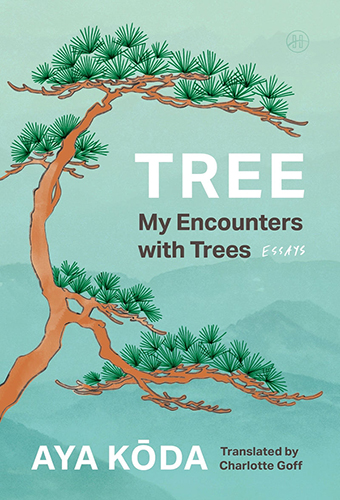
Tree: My Encounters with Trees

Aya Koda’s posthumous 1992 essay collection Tree, which has been translated with sensitivity and grace by Charlotte Goff, brings together fifteen short autobiographical essays about the author’s visits to famous trees and forests in Japan.

Koda, who was born in 1904, was primarily famous as a novelist and short story writer. She was most active in the late 1940s through the 1950s, when she documented the changing family dynamics of the postwar period through her fiction. Koda focused on shifting social mores through the lens of women’s work and material culture, especially clothing.  

Koda brings the same power of observation and gentle good humor to her accounts of her travels across Japan in order to satisfy a long-held curiosity about trees, forestry, and environmental science, as well as the professionals who work in these fields. As she explains her project in her own words…

It has only been a few years since I first started walking through the woods, hoping that as I encountered different trees I would be able to draw inspiration from them. I had been lucky enough to receive support and guidance from experts each time, and so in a few short years I had been afforded the chance to spend considerable time wandering the forest feeling moved by all sorts of wonderful trees.

In “Yakusugi,” Koda visits Yakushima, a World Heritage Site known for its luxuriant vegetation and the mountainous evergreen forest that inspired the Studio Ghibli film Princess Mononoke. Koda is specifically interested in visiting the Jomon Sugi, a cryptomeria cypress tree that’s at least two thousand years old (and may be much older). After braving the muddy mountain slopes, Koda is surprised to find that the tree is far from majestic, but what she calls its “squat ugliness” is impressive in its own way.

In “At Abe Pass,” Koda walks along the Abe Pass hiking trail, which is known for its views of Mount Fuji. Instead of visiting during the peak of the autumn foliage, Koda goes in May, when the leaves of the maple trees will hopefully be fresh and green. Unfortunately, the vicissitudes of nature can’t be predicted, and the maple trees are completely bare when she arrives. Koda still documents her trip with good humor, taking note of the smaller plants that are budding and flowering while also remarking on the river below, which has a tendency to complicate the postcard-perfect scenery by flooding and causing landslides.

For the reader, Koda’s essays can feel like secondhand forest bathing, but it’s also interesting to study the snapshots of cultural and natural history that she has preserved in her writing. For Koda, aesthetic appreciation is just as important as ecological understanding, and she describes her essays as an attempt to pass on a way of seeing nature that she developed as a child…

I grew up in a farm village on the outskirts of Tokyo, which is why there were always plants around. There were crops from the rice paddies, of course, scrubs of various small trees springing up alongside irrigation channels, areas of land cultivated by gardeners, and, as well as all this, just about every house had some form of greenery in or around it. Children could learn about trees and plants without even trying.

What separates Koda’s essays from a shallow appreciation of attractive landscapes is her willingness to address the more violent aspects of nature. The most powerful example is the essay “Volcanic Ash,” in which Koda visits Sakurajima, the location of a small town that has historically benefitted from the hot springs and fertile soil created by the island’s active volcano. After one of the major eruptions in the 1980s, Koda went to observe the effects of the falling ash on the plants. “It must be an extreme nuisance,” she says wryly; but, “as a natural phenomenon, you cannot simply ask it to stop.”

Though discussions of climate change had already begun in Japan in the 1980s, Koda doesn’t address this issue directly. Instead, in a very relaxed and apolitical way, she stresses the importance of learning to coexist with the environment, even when it’s inconvenient or destructive to human enterprise. By imbuing scientific curiosity with emotional warmth, Tree serves as a gentle and welcoming invitation to live attentively alongside the natural world. Aya Koda’s clear-eyed essays offer readers an entertaining and nostalgic tour of Japan’s forests, but they also provide a model for observing nature with respect and resilience.

Tree Spirits Grass Spirits

Tree Spirits Grass Spirits collects twenty-one autobiographical stories about plants by the celebrated Japanese-American poet Hiromi Ito. As the translator, Jon L Pitt, explains in the book’s preface, these stories were originally serialized from 2012 to 2013 in a highbrow Japanese literary magazine, but Ito’s prose is lively and accessible. Each of the stand-alone stories in Tree Spirits Grass Spirits is gentle and thoughtful, and the collection is a breath of fresh and green summer air.

Ito divides her time between the cities of Encinitas in southern California and Kumamoto on the southern island of Kyushu in Japan. Each region has a unique climate and ecosystem, and Ito is fascinated by the plants that grow in both environments, from yucca and agave to camelia and hydrangeas to grass and mold. Ito’s stories touch on botany and natural history, but their primary focus is on humans, especially the humans in Ito’s own family.

Among my favorite of the stories is “Baobab Dream,” which recounts a challenge that many people have experienced with houseplants. As Ito puts it: “They are at their most beautiful when you first purchase them, and they get progressively shabbier and shabbier, even if you take care of them. And then, at some point, they wither away and die.” 

And then, when you go to a garden store to get new plants to replace the old ones, it can be a challenge to identify what you’ve purchased. This is how Ito came into the possession of a mystery tree that she and her daughters resorted to calling “the baobab tree.”

While conducting research on what the tree might actually be, Ito considers the Latin names of various plants and arrives at the conclusion that botanical categorizations of plants often don’t make much practical sense. How are tulips and green onions members of the same botanical family, for instance? This confusion of taxonomy yields to broader meditations on how certain species are categorized as “invasive” as opposed to “naturalized,” and how this reflects Ito’s own experiences as someone who moves between cultures. In the end, however, such abstract concerns are secondary to the beauty of the plants themselves:

In the park next door, the mountain lilacs were at their peak. The peach trees and plum trees and cherry trees were blooming in folks’ yards. The roadsides were bright yellow from the acacias. The bushes of sweet-scented geranium in my own garden, too, had suddenly grown dense and were so thick that they seemed to be sweating, steeped in a green that surrounded one or two pink buds – swelling with each coming day and trying to open up any minute now.

Ito’s vivid descriptions of the physicality of the natural world carry over to her reflections regarding how it feels to be a human moving through the environment. This is one of the many reasons why I love the story “Kudzu-san,” which is about the kudzu growing in the neighborhood around Ito’s house in Kumamoto. As anyone who’s encountered the aggressively leafy vines can attest, kudzu is filled with vitality. If you cut it down, it will grow back twice as quickly, and its fuzzy tendrils are constantly creeping into unexpected places.

Ito remarks that there’s a certain lasciviousness to kudzu, so she searches for references to the plant in literary sources such as the Man’yōshū poetry anthology and the Tale of Genji. Such references are scarce, but Ito is intrigued by a chance mention of the famous Heian-period court magician Abe no Seimei, whose mother was supposedly a fox. In Japanese folklore, foxes are shapeshifters known for their sexual allure, so it seems only fitting that Seimei’s mother is poetically associated with the visual motif of kudzu. Ito’s own encounters with kudzu are likewise filled with startling physicality:

The vines we crushed in the morning lay as they were, and stood back up erect in the evening, swaying their stems and moving in on women – I had seen this, as well. They were more like snakes than plants. Even more than snakes, they resembled those eels that sway in the ocean. There are stories in old books about snakes that enter women’s bedchambers at night, and one about a snake that slid into a woman’s vagina after she had climbed a tree. Couldn’t all those stories be about kudzu?

What I admire about Ito’s stories is that, despite the poetic beauty of her writing, her meditations often progress in strange and unexpected directions without forcing symbolism or allegory onto the natural world. Ito observes her environment closely and looks inward as she describes what she sees, but the mycelial networks between her associations expand unseen below the surface of her writing. Just as autobiography often inspires self-reflection in the reader, Ito’s “phyto-autobiography” inspires an observation of ourselves in a larger context that doesn’t always follow human logic.

Tree Spirits Grass Spirits is a welcome companion to anyone interested in going outside and seeing the world around them from a fresh perspective. Jon Pitt’s translation gracefully conveys Ito’s casual style by allowing space for the rhythm and mouthfeel of each sentence, and it’s not an exaggeration to say that every paragraph is a joy to read. Almost all of the stories are less than ten pages long, and it’s a pleasure to dip into the collection whenever you’re in the mood to open your eyes and shift your viewpoint to a less anthropocentric frame of reference.

Tree Spirits Grass Spirits is published by Nightboat Books, and you can check out the book’s page (here).