とんこつ Q&A collects four stories by Natsuko Imamura, the author of The Woman in the Purple Skirt. Each of these stories is built on a cute and wholesome premise that develops in a dark and strange direction.
The title story is about a woman with social anxiety who creates a written script to help her navigate her job as a server at a small diner called Tonkotsu. Her efforts are aided by the recently widowed owner and his young son, who teaches the narrator to speak in Osaka dialect like his late mother.
The narrator’s script gradually expands beyond professional dialogue into everyday pleasantries, and she ultimately becomes a ghostwriter for the diner owner’s new wife. This scenario seems like a perfect set-up for a sweet and gentle romantic comedy, but it gradually becomes more disturbing as the narrator cheerfully crafts the diner owner’s new wife into a living doll.
The three other stories in the collection are about middle school bullies whose punishment is far worse than their crime, an aggressively clueless wife who gets away with murder, and a very sketchy coworker. Imamura’s prose is smooth but cuts like a knife, and the situations she crafts are never what they seem. I wouldn’t say that these stories have twist endings, necessarily, but the way their wholesome coziness slowly sinks into social horror is fascinating to watch.
Natsuko Imamura’s Asa: The Girl Who Turned into a Pair of Chopsticks collects three short literary thought experiments that go to strange places. Each of the characters is missing something essential, and where that lack ultimately leads them is impossible for the reader to predict.
Asa, the eponymous “girl who turned into a pair of chopsticks,” has trouble getting other people to accept any sort of food that she’s touched with her hands. Meanwhile, Nami, the “Girl Who Wanted to Get Hit (and Eventually Succeeded),” is strangely unable to be touched by other people at all. Asa’s quest to understand what makes other people perceive her as unclean has fantastic consequences that become humorous in their absurdity, while Nami’s desire to be touched sinks her into a dark mire of self-harm.
In my favorite of the three stories, the protagonist of “A Night to Remember” claims to have spent fifteen years laying around and doing nothing after graduating from school. This woman is so lazy, in fact, that she spends the majority of the story casually slipping across the ontological boundary that separates human and animal. If “A Night to Remember” were a story about a cat, it would be super cute, but the narrator is definitely a person. The resulting uncanniness is superb.
It’s fitting that the collection’s Afterword is contributed by Sayaka Murata, the author of Convenience Store Woman and Life Ceremony. “These stories give the reader another way of seeing,” Murata writes, “transfiguring what you should be seeing, and sometimes contaminating it.” Like Murata, Imamura refuses to allow the reader to take “common sense” for granted. The stories in The Girl Who Turned into a Pair of Chopsticks thereby offer a glimpse into a strange world where socially acceptable normality doesn’t apply. Imamura’s visions are playfully surreal, occasionally upsetting, and never boring.
Japanese Title: むらさきのスカートの女 (Murasaki no sukāto no onna) Author: Natsuko Imamura (今村 夏子) Translator: Lucy North Publication Year: 2019 (Japan); 2021 (United States) Publisher: Penguin Books Pages: 216
The Woman in the Purple Skirt begins as a charming set of observations about a woman who lives in a quiet neighborhood. It soon becomes clear, however, that there is something creepy about the narrator, who calls herself The Woman in the Yellow Cardigan.
The specificity of the narration raises many questions. Why is the narrator so obsessed with the Woman in the Purple Skirt? How is she able to observe her so closely? Is she stalking this woman? Or is she perhaps talking about herself in third person? Is she making up a fantasy version of herself, or is she projecting her personality onto a real woman? If so, why? Who is the Woman in the Purple Skirt? Who is the Woman in the Yellow Cardigan?
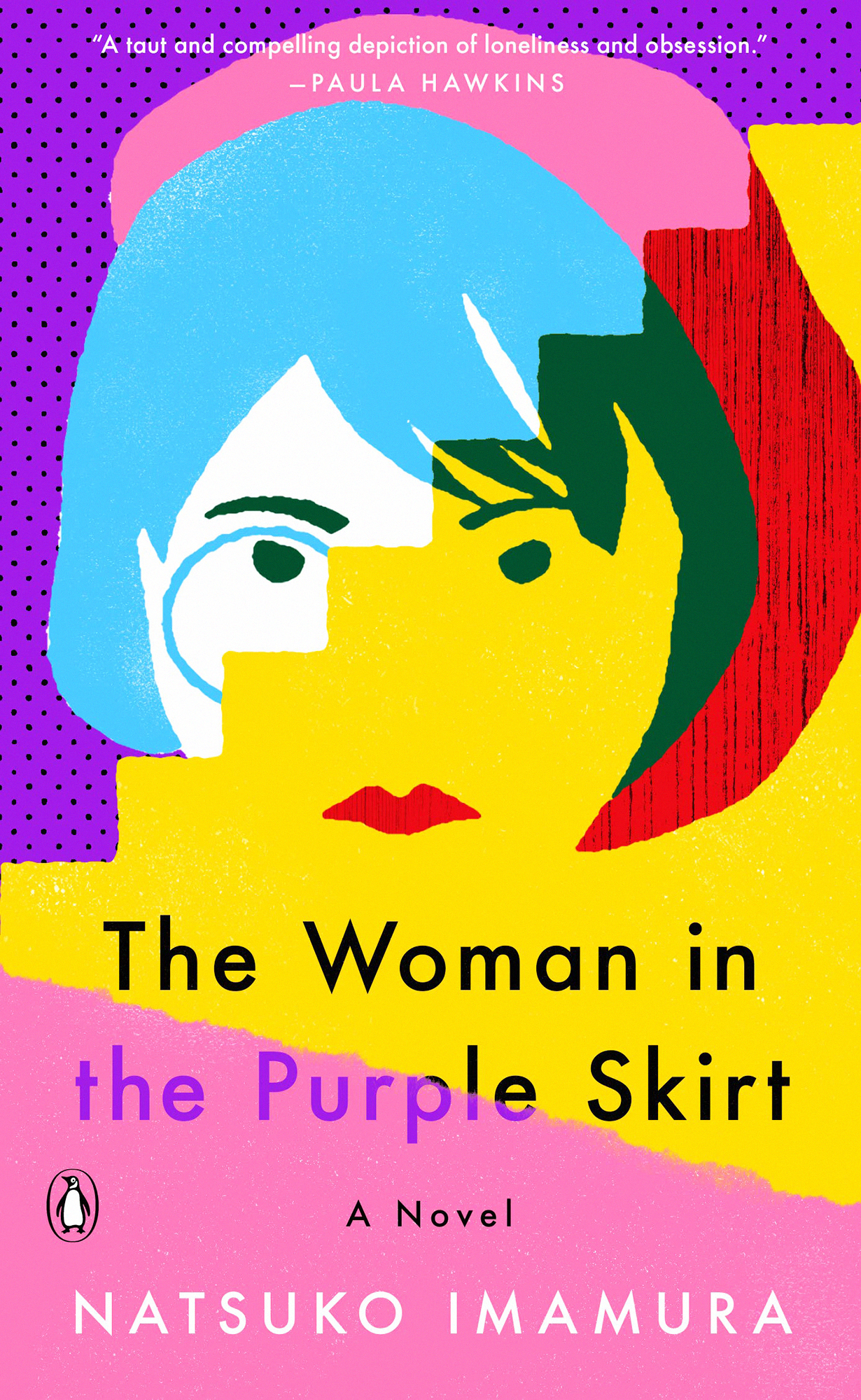
The Woman in the Purple Skirt isn’t suspense, necessarily, and it’s certainly not the “thriller” that the publisher seems to be trying to market it as, but the experience of reading this story is unsettling. The novella won the prestigious Akutagawa Prize, which is awarded to work from emerging writers that pushes boundaries and has a certain air of being “literary.” Despite the stylish chick lit cover of the American edition, the plot of The Woman in the Purple Skirt is almost depressingly mundane.
After a series of temp jobs that she quits after only a few days, the Woman in the Purple Skirt finds employment as member of the cleaning staff at an upscale hotel. She seems to be having an affair with one of her supervisors, and rumors spread that her salary is disproportionately high. At the same time, certain imbalances in inventory cause her coworkers to suspect that she is stealing. As the atmosphere at work becomes more hostile, the woman’s relationship with her supervisor also deteriorates. Meanwhile, the narrator, who is also a supervisor on the hotel’s cleaning staff, continues to glide through the life of the Woman in the Purple Skirt like a shadow.
This story is banal, but the subtle uncanniness of the narration forces the reader to view these normal events in normal lives with a sense of unease. The prose is sparse, the language is simplistic, and the affect is almost completely flat. Lucy North’s translation is reminiscent of Raymond Carver, especially in terms of dialog. Like Carver’s short fiction, the themes that emerge from beneath the placid surface of the narration are distressing: economic precarity, alienation, and the dangers of aging without a social network or financial safety net.
Despite its engagement with contemporary social issues, there’s nothing about The Woman in the Purple Skirt that requires specialist cultural knowledge, as the experience of struggling with loneliness while making minimum wage is equally shitty everywhere. I’d recommend this novella to anyone who enjoyed (or was at least moved by) Convenience Store Woman, as well as anyone concerned with urban anomie who entertains doubts about the ethics of low-wage work.
Because of the intriguing questions it raises and the unfortunate relatability of the discussion it’s likely to inspire, I would also recommend The Woman in the Purple Skirt as a text in a class on contemporary Japanese fiction. In addition, I think the novella might work well as a text for upper-level Japanese language classes, as its polished yet accessible prose evades the deliberate opacity of most Akutagawa Prize-winning work. Imamura has a field day with the narrative ambiguities made possible by the Japanese language, so it might be interesting to read the original side-by-side with North’s translation, which makes a number of tough decisions that nevertheless read as smooth and effortless.
Acclaimed author Natsuko Imamura’s first work to appear in English translation is short enough to be read in the span of an hour, but it’s worth spending time with. It’s difficult to say that a book as genuinely creepy as The Woman in the Purple Skirt is an enjoyable read, but the novella is a darkly shining jewel of literary fiction that invites and rewards analysis and introspection.


 Contemporary Japanese Literature