Strange Map

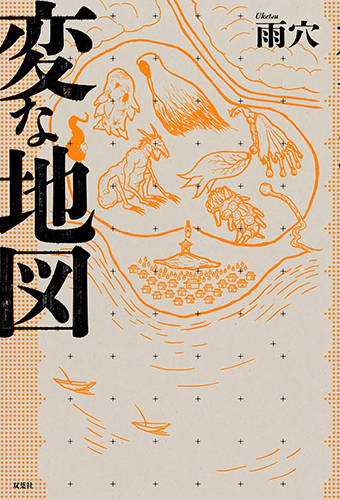
Strange Map (変な地図), published in October 2025, is the fourth book written by Uketsu, the bestselling author of Strange Pictures and Strange Houses. Unlike Uketsu’s previous books, which are collections of seemingly unrelated stories eventually connected by an overarching narrative, Strange Map is a proper novel that follows the actions of a single protagonist, Uketsu’s architect friend Kurihara from Strange Houses. Despite its more conventional narrative format, Strange Map is still filled with Uketsu’s characteristic illustrations and diagrams, which aid the reader in visualizing the uncanny spaces of its horror-themed mystery through a remarkable set of twists and turns.

Strange Map opens with the written confession of an elderly woman named Kimiko Okigami. In her youth, she writes, she took the lives of countless people. Before she dies, she wants to tell the story of the village where she was born and its neighboring mountain, which was supposedly inhabited by demons.

The next section raises the stakes even higher. In the present day of July 2015, Kōsuke Ōsato wakes up after a night of drinking to find himself lying in a train tunnel. He recognizes the tunnel immediately, as he’s the president of the railway company that constructed it. The tunnel has emergency exits, of course, but there’s just one problem – he’s right in the middle between two of them, and the first train of the morning should be coming any second now.

After thoroughly grabbing the reader’s attention, Strange Map shifts to the perspective of its main narrator, a 22yo college student in Tokyo named Fuminobu, who usually goes by his family name of Kurihara. Kurihara is an architecture major who’s currently on the job market, but he hasn’t had any luck so far. This is likely because, as he readily admits, he’s terrible at interviews. When asked why he’s interested in architecture, for instance, he can’t quite bring himself to admit that he wants to follow in the footsteps of his mother, who once played games with him involving engineering problems but died when he was still a child. 

After yet another unsuccessful round of interviews, Kurihara’s sister asks him to come home and visit his father, who needs to talk with him. This conversation ends up being about the house left behind by Kurihara’s grandmother – the woman who wrote the letter that opens the novel. Before his father sells the house, Kurihara asks to see it for himself, and he discovers a notebook containing a set of burned photos alongside the “strange map” of the title, which depicts a seaside village below a mountain filled with monsters. 

Like his late mother, Kurihara can’t sleep easy until he’s solved the problem in front of him. His father gives him permission to investigate, but only on the condition that he solves the family mystery in time to return home and do practice interviews with his sister before his next real interview, which is only a week away.

Interspersed between chapters, his grandmother’s letter continues. She writes of her hometown of Kasōko, an isolated village surrounded by the sea on one side and forest on all others. While the men caught and sold fish, the women handled the business of maintaining the village itself. Among other things, this maintenance involved carving stone statues to ward off the demons of Mojōyama, the mountain looming over the village.

Kurihara, who doesn’t know any of this history, nevertheless manages to ascertain the location of the village. He travels to the rural seaside only to find that the village was completely abandoned decades ago. To complicate matters, he finds himself smack in the middle of a scandal surrounding the succession of Kōsuke Ōsato, the president of the local railway company who was mysteriously run down by one of his own trains.

Was the death of the railway president truly an accident, or was it murder? What happened to Kasōko village? Who exactly did Kurihara’s grandmother kill – and what are the demons on the mountain?

To help the reader visualize the specifics of the story, Uketsu has provided all manner of simple diagrams illustrating how the space of the narrative is laid out. These visual inserts were necessary in Strange Pictures and Strange Houses; meanwhile, in Strange Map, they’re largely superfluous. The reader probably doesn’t need a visualization of the concept that “there are five equidistant emergency exits in the train tunnel,” for example. Uketsu has also provided slightly silly diagrams of various social relationships, such as an illustration of the railway company president wearing a suit and sitting at a desk while his second-in-command wears a construction helmet and manages a job site.

Still, I’m not complaining. Regardless of whether they’re necessary, I love all of these illustrations. I find their lo-fi clunkiness charming, and the space they create on the page helps to set the pace of the story. It would be all too easy to fly through this book, but the illustrations helped me slow down and focus on details. In addition, I found that the “unnecessary” illustrations help to reveal the inner workings of the narrator’s mind.

To me, Kurihara reads as being on the autism spectrum, an aspect of the character that contributes to the distinctive narrative style of the story. The closest comparison I can make is to Sayaka Murata’s Convenience Store Woman, but there are echoes of Mark Haddon’s The Curious Incident of the Dog in the Night-Time as well. Although he doesn’t identify as autistic, Kurihara understands that he needs to work on his people skills, and the secondary B-plot of the novel involves his carefully considered approach to teaching himself to behave “normally” instead of immediately saying something that’s true but will hurt other people’s feelings.

I’m used to Uketsu’s characters behaving like chess pieces on a game board, so this added depth of character came as a pleasant surprise. Also, while I usually read mystery novels for the pleasure of watching fictional characters die in ridiculous ways, I found myself feeling invested in Kurihara’s safety, as well as his emotional wellbeing. This attachment to the character adds yet another layer of tension to the story as Kurihara becomes personally involved with the family that runs a local inn.

Strange Map is a super fun and fantastically clever mystery novel, and its elements of gothic horror are as darkly brilliant as anything written by Edgar Allan Poe or Arthur Conan Doyle. Jim Rion has done a marvelous job with the translations of Strange Pictures and Strange Houses, and I’m looking forward to what he does with Strange Map. For the time being, the sequel to Strange Houses, which is titled Strange Buildings in English, is scheduled to be published in March 2026, so that’s something to look forward to as well.

It’s a great time to be a fan of Japanese mystery novels, and I’m interested to see how Uketsu’s work in translation might influence other authors. Do I want to see Uketsu copycats? Sure! Absolutely. But do I also want to see a generation of writers raised on YouTube creepypasta take inspiration from Uketsu and translate that sort of multimedia textual fragmentation into a new style of fiction? Hell yes. Let’s go.
Strange Pictures

Strange Pictures is a compulsively readable horror mystery novel first published in 2022 by Uketsu, a mysterious masked YouTuber. This book is addictive, so much so that I accidentally spent an entire afternoon and evening reading it. So be warned – Strange Pictures is indeed strange, and it will hold you hostage.

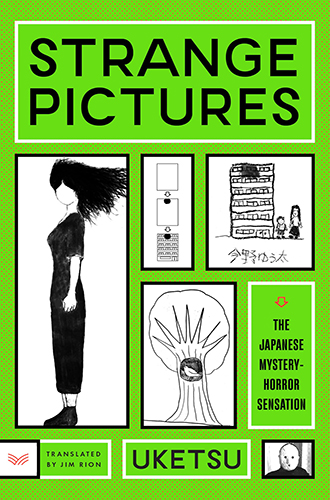
In the five-page prelude that introduces the book’s premise, a psychology professor shows her class a photo of a picture drawn by a girl who killed her mother. The drawing is a childish self-portrait that shows the girl standing between her house and a tree. Although the picture seems completely normal at first, the professor zooms in on four small details that illuminate the girl’s inner state of mind. She makes the argument that, despite the abuse the girl suffered, she’s essentially a good person who never meant to hurt anyone. In retrospect, you can’t help but wonder how you didn’t notice these details of the drawing yourself.

This trick is an incredible sleight of hand. The same can be said of the following two chapters, both of which can be read as stand-alone short stories.

In the first chapter, “The Old Woman’s Prayer,” two college students in a small Paranormal Club discuss a curious blog they’ve found online. The blog is filled with cheerful observations of its writer’s everyday life. After a three-year hiatus, however, the blog closes with a mysterious post stating, “I can never forgive you.”

How did such a happy-go-lucky blog author arrive at such a mysterious statement? The five illustrations drawn by the author’s wife might just hold the key to the mystery. By themselves, they’re nothing special, but if you put them together in the right way…

The second chapter, “The Smudged Room,” features one of my favorite tropes, a creepy drawing made by a small child.

Five-year-old Yuta’s father recently passed away, and his preschool teacher is worried about the drawing he created for Mother’s Day. The picture shows a dark cloud hovering over the apartment building where Yuta lives with his mother, who is doing her best to care for Yuta with no family support. The matter comes to a crisis when Yuta suddenly disappears, and his teacher suspects that his mother may be keeping an unpleasant secret. What was Yuta trying to draw, exactly?

These two seemingly unrelated mysteries begin to coalesce in the third chapter, “The Art Teacher’s Final Drawing,” in which two sidelined newspaper employees become obsessed with the murder of a high school art teacher. The police dismissed the case due to a lack of evidence, but there is (of course) a drawing found in the teacher’s possession that was never fully analyzed. The younger reporter starts interviewing people who knew the teacher, thereby putting himself in grave danger.

Somewhere around the middle of this chapter, the story begins to strain credibility, but at this point I was fully invested and happy to be along for the ride. Uketsu has a gift for enabling the reader to suspend disbelief, and the Sherlock moment in the fourth and final chapter is incredible.

Strange Pictures is a bestselling cult hit in Japan and across Asia. I first heard about this book through word of mouth and read it in Japanese when it was first published. I was impressed by the clarity of Uketsu’s writing, which is simple and informative without being childish or condescending. Jim Rion has done an amazing job translating Uketsu’s distinctive style, with short declarative sentences pushing the reader forward at a brisk pace.

A large part of the mystery depends on the information that the narrative withholds from the reader, some of which is highly dependent on how Japanese works as a language. I’m impressed by how Rion manages to employ English to the same effect without the slightest trace of awkwardness. Reading Rion’s translation, I felt like I was encountering Uketsu’s story for the first time.

As long as you don’t mind losing a few hours to the addictive quality of the writing, I’d recommend Strange Pictures to anyone who enjoys puzzle box mysteries, creepy urban legends, and satisfying Sherlock Holmes style walkthroughs. I can’t overstate how much fun I had with this book, and I’m very much looking forward to Jim Rion’s upcoming translation of Uketsu’s debut novel, Strange Houses.

xxxHOLiC

Title: xxxHOLiC (ホリック)
Artist: CLAMP (クランプ)
Publication Year: 2003 (Volume 1) – 2009 (Volume 16)
Publisher: 講談社 (Kōdansha)
Pages: 180 (per volume)

As embarrassing as this is to admit, I have been reading manga for a very long time. I started reading manga as a freshman in high school in 1998, back when Japanese comics were published in America as forty-page, A5-sized, left-to-right-reading comic books. A lot of things have changed in both American manga publishing and in my own personal tastes in manga since then, but two things have stayed the same. The works of CLAMP have always been popular, and I have always loved them.

CLAMP is a creative team made up of four women: Ōkawa Nanase, Igarashi Satsuki, Nekoi Tsubaki, and Mokona. They have published popular shōjo stories (meant for girls) like Magic Knight Rayearth and popular shōnen stories (meant for boys) like Chobits, but they have always managed to effectively erase the line dividing the two different demographics. A good example of this might be their popular manga Angelic Layer, which was serialized in the manga magazine Weekely Shōnen Jump (home of such boys’ fare as Dragon Ball, Naruto, One Piece, and Bleach) but which features a young female protagonist who trains and fights her battles with small dolls dressed in ornate and fantastic costumes.

CLAMP therefore has a huge fan base spanning both genders, and what’s not to love about them? They have written stories falling into every conceivable genre, from fantasy to romance to science fiction to mystery to historical fiction to reworkings of classical mythology. Their artwork is not only beautiful and varied but also constantly evolving. They are masters of the art of storytelling, always paying careful attention to plot and pacing and always managing to keep their stories moving forward and full of fresh twists and surprises. They care about their characters and rarely write good guys who are entirely good or bad guys who are entirely bad. Their manga almost never end in simple, easy ways.

I admit that I have met more than a few people who do not care for CLAMP and their particular flavor of manga. I adore the group, however, and their popularity has grown to such an extent that a beautifully illustrated retrospective of their work, All About CLAMP, was published late last year in Japan. A similar book, CLAMP in America (authored by the perennially awesome Shaenon Garitty), is scheduled to be published stateside in May of this year. CLAMP currently has several ongoing manga series, and several of their manga series have recently been adapted into anime. I feel like right now is a good time to be a CLAMP fan, so I would like to introduce my favorite manga written by these supremely talented ladies.

xxxHOLiC (pronounced “holic”) is a story about an irritable yet essentially kind-hearted high school student, Watanuki, whose eyes have the unusual condition of being able to see ghosts. These ghosts cause all manner of trouble for Watanuki, who just wants to live a normal life. When he accidentally stumbles into a magical store run by a wish-granting witch named Yūko, he asks her to cure him. She tells him that she will, eventually, but he first must pay a price equivalent in value to the granting of his wish – he must work part-time in her store every day after school. While doing various odd jobs for Yūko, Watanuki meets all sorts of strange people who want their wishes to be granted, as well as all manner of strange creatures that seem to be friends with Yūko. At school, Watanuki is enthralled by the lovely Himawari-chan and engages in a one-sided rivalry with a boy named Dōmeki, who has the magical power to drive away the ghosts that cause so much trouble for Watanuki (which annoys Watanuki to no end).

This description of the manga sounds like a chiché-filled cross between between the “wish granting with a cost” sub-genre of horror (exemplified by works like the Pet Shop of Horrors manga and the Hell Girl anime) and the “I see dead people” sub-genre of almost everything (ranging from YuYu Hakusho to Ghost Hunt) – but it’s not. I promise. Since the plot of xxxHOLiC is tied to that of its über-popular shōnen sister manga, Tsubasa: Reservoir Chronicles, it might also be dismissed as a cheap marketing gimmick – but it’s not. I promise.

The series starts off slowly, drawing the reader into its mysterious world and establishing the personalities of its quirky cast of characters. As the story progresses, however, the reader is led to question certain things that have been taken for granted. In the end, nothing is as it seems. In terms of its narrative structure, xxxHOLiC vaguely resembles something like The X-Files. There are “monster of the week” episodes, but the series as a whole is tied together both by a larger story arc and by a unity of theme running through each individual episode. Unlike The X-Files, however, the shorter story arcs of xxxHOLiC are not easily resolved and are interwoven with each other and the larger story arc, which progress slowly at its own pace. The overall tone of the manga is that of horror and mystery, but there is quite a bit of humor, romance, friendship, and playfulness thrown in as well.

I imagine that I could keep praising the various aspects of this manga (such as the brilliantly rendered character of the witch Yūko, the gradual and multi-layered world building, and the gorgeous artwork, which resembles inter-war era lithographs and goes a long way towards establishing the eerie, dream-like atmosphere of the work) for many more paragraphs. Let it suffice to say, though, that xxxHOLiC is an amazing manga series. I think it is capable of standing its ground against any film or novel. To any manga fan who has been hesitant to read this series because it seems so gimmicky and stereotypical, I encourage you to give it a chance. To any fan of horror, mystery, fantasy, or the gothic who is hesitant to read a manga, I encourage you to give it a chance. In my opinion, xxxHOLiC is one of the most interesting works being published right now in any medium.

I have been reading this manga in Japanese in the beautiful volumes published by Kōdansha. An English translation of the series (which I haven’t read yet, unfortunately) is currently being published in America by Del Rey. I would like to close with a two-page spread depicting the hyakki yagyō (“night parade of one hundred demons”) that will hopefully illustrate the distinctive art style that CLAMP has created for this manga.

xxxHOLiC: ANOTHERHOLiC

xxxHOLiC

Title: xxxHOLiC: ANOTHERHOLiC: Landolt-Ring Aerosol
Japanese Title: xxxHOLiC アナザーホリック ランドルト環エアロゾル
Author: NISIOISIN (西尾維新)
Translator: Andrew Cunningham
Publication Year: 2008 (America); 2006 (Japan)
Publisher: Del Rey Books
Pages: 203

Given my fondness for the supernatural genre, it is no surprise that I love CLAMP’s manga xxxHOLiC. It took me awhile to pick up the first volume, however, because the concept seemed so cliché and gimmicky: an excitable high school boy who can see spirits works at the shop of a witch who promises to eventually cure him in a story featuring numerous plot crossovers from the simultaneously running epic manga (I believe there are currently twenty-seven volumes of it) Tsubasa: Reservoir Chronicles. I was tempted, however, by the Japanese tankobon, which Kodansha has published in beautiful editions, and ended up becoming addicted to the series. Not only is the artwork gorgeous in the style of early twentieth century Japanese lithographs (or Edward Gorey drawings), but the manga is dark and engaging in a deliciously creepy way. Besides, I am in love with Yūko, the hedonistic yet wise ‘Dimensional Witch’ who employs Watanuki, the hapless protagonist.

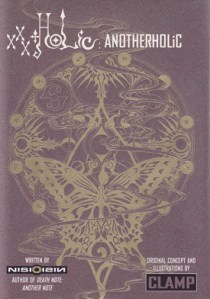
I had known about NISIOISIN’s novelization of xxxHOLiC for some time, but, unimpressed by his work in the two translated volumes of the short fiction anthology Faust, I never bothered to pick it up (ditto with his novelization of Death Note). Upon accidentally running across the book in a local bookstore, however, I was seduced by the beautiful gold-foil embossed cover and the chapter heading illustrations provided by CLAMP. Perhaps I should give it a chance, just like I did the original manga. Perhaps there is more to NISIOISIN than meets the eye.

Nope. Wrong. In short, this is a waste of a hardcover book. All of the subtle black humor and eeriness of the original manga turns to dust in the hands of the novelist. To back up a bit, it is perhaps a stretch to call ANOTHERHOLiC a novelization. The book is made up of three episodic short stories featuring the characters from xxxHOLiC. The first story, “Outerholic,” is a prose adaptation of an episode in the first volume of the manga and thus retains a modicum of the charm of the original. The second two stories are, as far as I can tell, NISIOISIN’s original creations. And they suffer for it.

Why do I hate NISIOISIN so much? Because I think he hates me, his reader. In all sincerity, what he has written is so full of bitterness that it left me feeling defensive. I’m not the sort of person who feels the need to evaluate whether NISIOISIN was true to the original characters, but I definitely got the feeling that he does not like them. Watanuki comes off as juvenile and whiny, Yūko is petty and self-important, and the writer even extends harsh editorial judgment towards his own original characters. If the writer’s unrelenting antagonistic attitude were not enough to turn me off to this book, I’m sure the sloppy writing would have pushed me over the edge. NISIOISIN’s prose is rife with sentence fragments and ellipses, which might have some sort of dramatic effect if they didn’t appear multiple times on every page. On a broader scale, NISIOISIN relies not on foreshadowing, atmosphere, or suggestion to create a sense of mystery but rather on withholding information from the reader in a taunting way that almost resembles bullying. The last story forgoes any plot at all in favor of a long and tediously sophomoric pseudo-philosophical conversation. Moreover, things like the frequent otaku references to anime like Azumanga Daioh, combined with Yūko’s debate with Watanuki over the meaning of moe, left my head spinning.

According to the author biography in the back of the book, NISIOISIN was born in 1981, which would make him 27 or 28 this year. Although his accomplishments are nothing to sneeze at, ANOTHERHOLiC made me feel like he really needs to get a life and grow up. When I first started reading this book, I was considering buying the translation of the first volume of the author’s Zaregoto: The Kubikiri Cycle, but now I’m not sure I want to read anything written by him ever again. In any case, despite Del Rey’s lovely publishing job, ANOTHERHOLiC is not worth the money, even for fans of CLAMP’s original manga.

I should mention, however, that I don’t think the failure of this book is the fault of the translator, Andrew Cunningham. Cunningham does a wonderful job of rendering NISIOISIN’s numerous idiotic puns into English, and in fact the most enjoyable part of the whole thing were the translator’s footnotes. I can only hope that Cunningham will apply his considerable talent to other authors in the future.

Grotesque

Title: Grotesque
Japanese Title: グロテスク
Author: Kirino Natsuo (桐野夏生)
Translator: Rebecca Copeland
Publication Year: 2008 (America); 2003 (Japan)
Pages:467

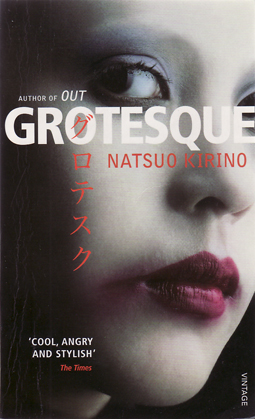
First of all, I would like to say that Grotesque is a very, very dark novel. It’s also filled with descriptions of all sorts of physical and emotional abuse, as well as numerous scenes of disgusting, extremely upsetting sex. In short, this novel is not for the faint of heart.

The novel essentially consists of the nameless narrator’s account of the murder of her younger sister, Yuriko, and her pseudo-friend from high school, Kazue, each of whom were marred by deep psychological imperfections. These emotional deficiencies were exacerbated by the harsh and competitive nature of the exclusive private high school that the two attended. In the end, both Yuriko and Kazue became prostitutes and were both ultimately murdered by the same unsavory client.

Putting the sensationalism of the novel aside, perhaps the most chilling aspect of Grotesque is the voice of the narrator. The reader quickly becomes inured to the sex and violence, but the cold and bitter tone of the narrator, as well as her pronounced disgust with her fellow human beings, continue to add a tinge of horror to the novel until the very last page. The narrator occasionally interrupts herself to present “evidence” concerning the two murder cases: the diary of her sister, the testimony of the murder suspect, and a letter from her old classmate. These stories within the story allow the reader to experience the voices of the novel’s other main characters, each of whom is just as disturbing as the main narrator.

In America, Kirino is mainly known for her first translated work, a massive chunk of a murder novel called Out (アウト, translated by Stephen Snyder). Like Out, Grotesque is long and depressing, and it would be a stretch to call any of the characters sympathetic. Unlike Out, however, Grotesque has a much smoother style, courtesy of translator Rebecca Copeland, and is therefore much easier to read. Also, compared to Out, the characters of Grotesque are much more artistically presented. Namely, in this novel, Kirino chooses to explore her characters’ depravity instead of merely wallowing in it. Moreover, I found the portion of the book that concerns the narrators’ experiences at their high school to be extremely entertaining. As I said earlier, Grotesque is not for the squeamish, but those readers who can deal with the darkness will be pleased to find an occasional glimmer of good writing and entrancing character study.

I should note that the version of Grotesque I reviewed is the British version, which I purchased in Japan. The American version of the book has been edited to remove all references to male child prostitution. Don’t let this deter you from reading the novel, though – the passages that were cut aren’t particularly riveting or important.