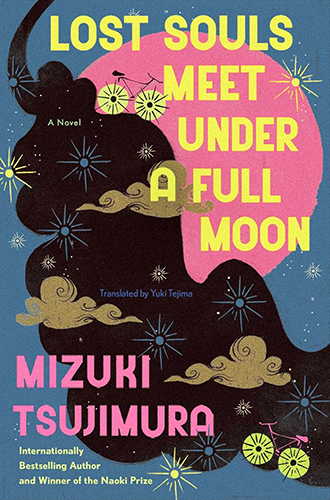
Lost Souls Meet Under a Full Moon

Lost Souls Meet Under a Full Moon brings together five interconnected short stories about people seeking to contact the dead. Though this book falls firmly into the category of “relaxing” fiction, it’s more plot-driven than most, and it distinguishes itself through its worldbuilding, especially its willingness to test the parameters of its magic system.

The central character of the novel is a handsome and stylishly dressed teenage “go-between” named Ayumi who can facilitate meetings between the living and the dead. The catch is that a person can only have one of these meetings in their lifetime, and each dead person is only allowed to return once. 

This is why the choice of the focal character of the first chapter, “The Rule of the Idol,” is so unusual. Manami asks the go-between to connect her with, of all people, a performer named Saori who made her living as a tv personality appearing on various talk shows and quiz games. When Manami was at the lowest point in her life, alone in Tokyo and bullied by her coworkers, she had a random encounter with Saori, who encouraged her to get back on her feet. Manami wants to use Saori’s death as an opportunity to thank her personally, which she never would have been able to do while Saori was still alive.

The third chapter, “The Rule of the Best Friend,” is far less wholesome. A first-year high school student named Arashi wants to be cast into leading roles in the plays performed by her school’s drama club, and she’s not shy about making her intentions known. Her biggest supporter is her best friend Misono, who joins the drama club in solidarity. Misono’s introverted grace has an alluring appeal that Arashi overlooks in her brash ambition, and she ends up losing a starring role to her best friend.

Arashi takes this poorly and stops talking to Misono. She assumes this will be a punishment, but she quickly realizes that her friendship was holding Misono back from achieving her own dreams. When Misono dies in a cycling accident, Arashi desperately wants to apologize, but she hasn’t yet developed the maturity to say what really needs to be said. I have to admit that I was surprised by the final meeting between the two friends, which is steeped in a complexity otherwise absent in these stories, and “The Rule of the Best Friend” ended up being my favorite part of the book.

In the final chapter, “The Rule of the Go-Between,” we see the characters from the previous stories from Ayumi’s perspective as he goes on his own journey during the process of inheriting the role of go-between from his elderly grandmother. Ayumi’s parents died under mysterious circumstances when he was a child, and his grandmother has carried a sense of guilt for years. Unlike his unfortunate classmate Arashi, however, Ayumi is able to break the barrier of silence and offer comfort and closure to his grandmother while they’re both still alive.

Despite a few brief moments of darkness, Lost Souls Meet Under a Full Moon presents little emotional challenge to the reader. There are very few subversive or self-reflective elements in these stories, and the characters occasionally behave like two-dimensional constructs who act solely in service to the plot. This isn’t a bad thing, of course. Lost Souls moves quickly and follows its internal logic so impeccably that the reader’s suspension of disbelief is never broken. As a result, each of the chapters is great fun to read.

Mizuki Tsujimura has taken the five-chapter cozy fiction formula and polished it to a high sheen. As far as the genre goes, Lost Souls Meet Under a Full Moon is as good as it gets, largely thanks to the author’s willingness to explore the more nuanced implications of the stories’ premise. Yuki Tejima’s translation is lovely and uses a light touch to bring the energy of Tsujimura’s prose to English-language readers. I’d recommend Lost Souls Meet Under a Full Moon to anyone looking for a good comfort read, not to mention a welcome reminder of the importance of saying what needs to be said while you’re still alive.
Lonely Castle in the Mirror

Japanese Title: かがみの孤城 (Kagami no kojō)
Author: Mizuki Tsujimura (辻村 深月)
Translator: Philip Gabriel
Publication Year: 2017 (Japan); 2021 (United Kingdom)
Press: Doubleday
Pages: 355

Thirteen-year-old Kokoro has stopped going to school after being bullied by her classmates and ignored by her homeroom teacher. Kokoro’s sympathetic mother has enrolled her in an alternative school, but Kokoro can’t bring herself to attend, as much as she might want to. Made physically ill by her anxiety, all Kokoro can do is stay at home while watching daytime television and waiting for time to pass. Just as she’s on the verge of spiraling into depression, the mirror in her bedroom begins glowing, and she is pulled through its shining surface into a mysterious castle.

Kokoro is one of seven middle-schoolers greeted by a girl wearing a fancy dress and a wolf mask who calls herself “the Wolf Queen.” The Wolf Queen tells the children that they have one year to locate a hidden key that will unlock a secret room. If one of them manages to make it inside the room, they will be rewarded by having a wish granted. The caveat is that, once the wish is granted, the castle will disappear. In the meantime, they can use the castle however they like during school hours.

It doesn’t take Kokoro and the other children long to figure out that none of them are going to school, at least not during the day. Instead of competing to see who can find the key and the room, then, they’re content to use the castle as a place to hang out while playing video games and chatting. They eventually grow close enough to make plans to get together as a group outside the castle; but, despite their firm promises to each other, no one appears at the designated meeting spot.

This intensifies the question that no one has wanted to bring up – what in the world is going on? And, perhaps more importantly, will they ever be able to see each again once their year in the castle has ended?  

Lonely Castle in the Mirror is a novel about friendship, specifically friendship between outcasts. In many ways, the group of children who gather in the castle is reminiscent of the Loser’s Club from the Stephen King novel IT (albeit with a much lighter tone). Each of the kids is living through the unpleasant fallout of a traumatic experience, but they gradually open up to each other and work through their issues together. Nothing about this character development is saccharine or sentimental, and misunderstandings and gaps in communication occasionally arise. There’s a fair amount of teenage awkwardness and egocentrism, but none of the characters is overtly unsympathetic.

Kokoro is struggling with having been targeted a group of mean girls, and the novel’s depiction of bullying felt especially real to me. The treatment Kokoro received at the hands of her classmates is genuinely disturbing, but even worse is the attitude of the teachers at her school, who apparently expect her to apologize to the people who went out of their way to antagonize her. Lonely Castle in the Mirror is YA fiction, to be sure – there is no strong language, substance abuse, or mention of sex or sexuality. Still, parts of the story are painfully honest, and the novel’s sensitive but realistic treatment of cruelty and anxiety doesn’t pull any punches.

Despite its fantastical elements, Lonely Castle in the Mirror is more of a mystery than a fantasy, although it admittedly takes its time warming up. Kokoro and her friends are in the process of recovering from trauma, and they’re understandably reluctant to discuss serious matters. Most of them avoid doing anything that would disturb the comfortable haven they’ve been miraculously granted. The novel ambles through what seem to be a few false starts, with one problem emerging only to be quietly resolved. Patient readers who accept the story on its own terms will be rewarded, however, as the plot gradually gains depth and momentum. It’s easy to fly through the pages of the lengthy final chapter, and the conclusion is extremely satisfying.  

As its cover copy proclaims, Lonely Castle in the Mirror is a bestselling novel in Japan, and there’s no reason why this story won’t resonate with readers outside of Japan. Philip Gabriel’s translation is impeccable, preserving a sense of timelessness while handling the teenage characters’ dialog with grace and good sense. It’s easy to compare Lonely Castle in the Mirror to Eto Mori’s recently translated YA novel Colorful, or perhaps even the early Harry Potter novels, but it has its own unique charm and magic. Teenagers in the same age range will find Kokoro and her friends to be sympathetic and relatable, while the story is compelling enough to wrap adult readers in its mysteries.