There’s an expression in Japanese that I really appreciate: shikata ga nai, which essentially means “what can you do.” Shikata ga nai is the verbal equivalent of a shrug of resignation. Sure, the situation may not be ideal, but shikata ga nai. What can you do.
Asako Otani’s 2023 novella Hollow Inside is about as close to a literary expression of shikata ga nai as you can get. Otani was born in 1990, which makes her a little younger than I am, but I feel like we’re part of the same Millennial generation that came of age right in time for the 2008 global economic recession and then got our feet kicked out from under us by the pandemic. This situation isn’t ideal, obviously. But what can you do.
Hirai, the narrator of Hollow Inside, has recently moved from a small and inconvenient flat into a nicer two-bedroom apartment. She’s able to afford a better place by splitting the rent with her friend Suganuma, who proposed the idea to Hirai because she was tired of her own tiny apartment. Both women are around 40, and neither has any real desire to get married.
Hirai works in the accounting office of a printing company, while Suganuma formerly worked for the consulting division of a company specializing in administration systems. The two women met through their jobs but became friends when they realized that they were both fans of the same idol group, KI Dash. Their social circles narrowed during the pandemic, but their friendship with each other survived.
After working more than twenty years in corporate jobs, neither has enough money to afford a decent apartment in the city. That’s not great, but what can you do. Suganuma confesses to being “desperately lonely” while working from home during the pandemic, and Hirai knows exactly what she means. The pandemic wasn’t great, but again – what can you do.
What they can do, it turns out, is to move in together. Perhaps this isn’t how either of them imagined that their lives would turn out, and perhaps this isn’t what society in general expected of them. Hirai confesses to feeling shy about explaining her situation to her colleagues at work, knowing that two women in their forties sharing a home together isn’t the usual situation. And indeed, when she gets a chance to explain her living arrangements at a work dinner with colleagues, everyone makes polite noises and before swiftly changing the topic of conversation.
Still, Hirai and Suganuma get along well together, and they support one another through the small tragedies of their lives, such the marriage of Suganuma’s favorite idol from KI Dash and Hirai’s disastrous date with a man who wants to induct her into a pyramid scheme. The two women eat out together, cook dinner for each other, take a spur-of-the-moment holiday to the beach, and fall asleep while watching DVDs of KI Dash concerts on an old PlayStation 2.
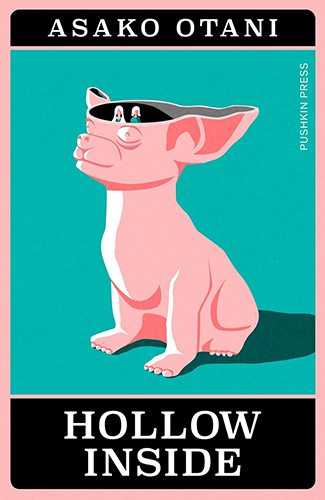
The title of Hollow Inside comes from Suganuma’s post-pandemic freelance job as a manufacturer of custom figurines memorializing the deceased pets of her clients. She’s set up a 3D printer in a corner of the living room, which also houses a wastebin of defective models. Hirai feels a kinship with these rejected memorial figurines, as she herself feels somewhat hollow during the transition between the life she assumed she’d live and the unmapped territory ahead.
This sense of hollowness isn’t necessarily a bad thing, however. As Hirai explains about a fantasy she occasionally indulges in when she’s stressed out after work…
I let all the strength drain from my body. I gave myself over to gravity and sharpened all my awareness right up to my fingertips. I lay on the bed not moving an inch. Pretending to be dead. I sometimes did this.
I was dead. Nothing in the world had anything to do with me. I thought about the dead dogs. The dead dogs that had been doted on by their owners. They had left fake bodies in the world as figurines, and their souls were running in the other worlds wagging their tails. My soul joined them frolicking there.
…there’s a certain lightness that allows her to imagine herself as free and unburdened.
There are a range of different readings of Hollow Inside, of course. Some readers might find this novella depressing; but, to me, it’s a breath of fresh air.
In Japan and elsewhere, fewer women are getting married; and, as much as I enjoy the fantasy of romance, the reality of single life as an adult is no less interesting. Hollow Inside captures a moment in the transition of one woman’s life that happens to be representative of a major demographic shift. To me, this novella also serves as an eerily accurate reflection of the economic realities of the 21st century. We might not be able to enjoy the stability and middle-class lifestyles that our parents did, but what can you do. Shikata ga nai.
And you know what? It’s not so bad, actually.

