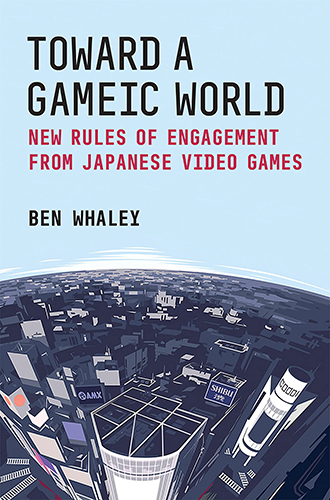
Toward a Gameic World

Ben Whaley’s 2023 monograph Toward a Gameic World: New Rules of Engagement from Japanese Video Games presents four case studies of how the virtual narratives of Japanese video games encourage engagement with social and political issues in the real world. Drawing on Katherine Isbister’s 2016 How Games Move Us: Emotion by Design, as well as a wealth of other recently published work in the burgeoning field of Game Studies, Whaley positions “engagement” as one of the primary means by which a video game conveys its message to the player.

“As I use it in this book,” Whaley explains in the Introduction, “‘engagement refers to a game’s capacity to evoke actual feelings of overcoming, guilt, complicity, or shared connection from a fictional experience of trauma.” The resulting study is not only a fascinating reading of key texts in the emerging canon of Japanese video games, but also a convincing argument for how Japanese games are able to engage transcultural audiences in political concerns ranging from youth precarity to environmental disasters.

The first chapter, “Limited Engagement,” asks interesting and culturally relevant questions about the politics of representing disaster in its discussion of the conversation surrounding the Disaster Report series of action-adventure games. Representations of apocalypse are often critiqued as being “disaster porn” meant to titillate viewers, but this chapter offers an alternate interpretation of the effects that experiencing such stories can have on individual players, as well as broader currents of historical memory.

“If mass-scale disasters conveyed in newspaper photos and YouTube videos represent collective narratives that run the risk of flattening the individual victims and individual narratives,” Whaley writes, “then video games like Disaster Report offer players the potential to rebuild some of this context by hearing lost voices, inhabiting lost bodies, and experiencing lost narratives, if only in virtual space.” In other words, the player engagement demanded by video games can serve as a means of presenting environmental disasters not as an abstract concept, but as a personally meaningful concern. The controversial Disaster Report series of games thus facilitates empathy for real-life survivors while also providing an education on disaster preparedness and survivor outreach.

The book’s fourth chapter, “Connective Engagement,” focuses on how social connections are modeled by the networked gameplay elements of The World Ends With You, a 2007 RPG set in an urban fantasy version of Shibuya. The game’s protagonist is a socially isolated teenager who suffers from depression and seems well on his way to becoming a hikikomori. While it’s easy enough to tell a story about a young person finding friendship, it’s much harder to break out of a toxic spiral of isolation in real life. The narrative of The World Ends With You acknowledges this challenge, and its gameplay cleverly models what this process actually entails.

Whaley demonstrates that, in addition to helping socially withdrawn players feel seen and recognized, the game’s networked features have the potential to encourage players to actively seek out other people in physical space, as wireless connections between Nintendo DS consoles are meaningfully rewarded within the world of the game. With its sensitive cultural study, this chapter is an antidote to sensationalistic accounts of mental health in Japan, as well as a welcome contribution to the ongoing scholarship concerning how online engagement in the communities surrounding networked games can positively affect the mental health of young people (and not-so-young people) who would otherwise feel alienated and alone.

Where the empathy of this book falls short is in the second chapter’s discussion of the 2011 visual novel / puzzle game Catherine. Catherine is a deeply misogynistic and openly transphobic video game, and critical responses to its story and characters have been mixed. While Catherine’s almost comically misogynistic treatment of its cisgender female characters is questionably open to argument and interpretation, the way the game handles a prominent transgender character is unequivocally hateful and extremely distressing. It’s therefore odd to see Catherine presented as a model of empathy.

My recommendation to readers would be to skip this chapter entirely. The author isn’t writing with malice; rather, it can often take many years to research, assemble, and publish an academic book, and scholarship that felt fresh a decade ago sometimes ages poorly. I will admit that I’ve occasionally found myself in a similar situation when I look back at my own work. This is simply the danger of writing about contemporary political issues, but it’s no reason not to create scholarship that’s relevant to the current moment.

Without sacrificing the quality of its research, Toward a Gameic World is accessible to general-audience video game fans interested in sustained critical analysis. (I didn’t mention the book’s third chapter in this review, but Metal Gear Solid fans are in for a special treat.) The book is also accessible to scholars who know little about video games but want to incorporate them into their classes. I think the first chapter on depictions of environmental disasters, “Limited Engagement,” would make an especially excellent reading for undergraduates. Whaley also offers many strong examples of how to integrate online conversations into academic literature reviews and textual analysis.

Toward a Gameic World takes the serious cultural topics addressed in a key selection of video games and, with sensitivity and grace, transforms their analysis into a surprisingly entertaining and enjoyable discussion. One might even say that it’s quite an engaging read.

Anime from Akira to Howl’s Moving Castle

Title: Anime from Akira to Howl’s Moving Castle: Experiencing Contemporary Japanese Animation
Author: Susan J. Napier
Publisher: Palgrave Macmillan
Publication Year: 2005
Pages: 355

Although I consider myself a literature person, it might be better to call what I do “media studies.” I write papers about books, but I also write more than a few papers about movies, and at least half of the Japanese movies I watch and write about these days are animated. This is something I wouldn’t have dreamed that I’d be doing when I first entered graduate school. For whatever reason, however, I read the 2005 updated edition of Susan Napier’s book on anime during my first winter break and was so inspired that I decided to start writing about popular media, too.

I had taken a lot from Napier’s two earlier books on literature (Escape from the Wasteland and The Fantastic in Modern Japanese Literature) as an undergraduate, so I’m not sure why it took me so long to sit down and starting reading Anime. If I had to guess, it probably had something to do with the bad reputation the book had (has?) among anime fans. I didn’t have a particularly strong impression from the chapters on magical girls from the original 2001 edition that I had read as a freshman in college (probably because I was eighteen years old), and several people had said that the book is poorly written, gets plot points wrong, and doesn’t respect anime as a medium.

My experience of reading the book was completely the opposite of the bad rumors I had heard. The first chapter of the book (appropriately titled “Why Anime?”) explains why Japanese animation is amazing and exciting and well worth academic attention, and I feel like it conveys a great deal of appreciation and respect for the medium. Also, I’ve seen my fair share of anime, and I’m a member of the generation that is old enough to have seen most of the works Napier discusses in Anime. Upon re-reading the book this past semester, nothing jumped out at me as overtly incorrect in terms of plot or character summary (but, then again, I have never finished and do not plan to ever finish watching Ranma 1/2, so I am willing to admit that I could be wrong). Finally, I think the writing is wonderful. Napier’s prose is clear, precise, and easily understandable by anyone who has neither a long history of watching anime nor a long history of studying Japan. Her writing is also enjoyable to read, as it is occasionally augmented by clever and poetic turns of phrase and various well-placed rhetorical devices that help her make her argument.

Anime is more or less written as a textbook for university-level students. It covers about two dozen films, television series, and OVA’s, usually focusing on two or three primary works over the course of each 20-25 page chapter. The book is broadly divided into three parts according to what Napier sees as the three essential modes of Japanese animation: the apocalyptic, the carnivalesque, and the elegiac. Woven throughout these modes are the three themes of technology, the body, and history. Chapters have titles like “Ghosts and Machines: The Technological Body,” “The Enchantment of Estrangement: The Shōjo in the World of Miyazaki Hayao,” and “Waiting for the End of the World: Apocalyptic Identity.” Although many of the works she discusses could belong in multiple chapters, I feel that Napier chooses her primary works for each chapter extraordinarily well and uses representative works to make strong arguments about various trends in contemporary Japanese animation.

Is there a danger of occasional overgeneralization? You bet. But so must there be in any entry-level textbook. A casual reader might run the risk of thinking, for example, that all Japanese animated pornography is fantastically grotesque after finishing the chapter “Controlling Bodies: The Body in Pornographic Anime” (which discusses such classics as Legend of the Overfiend and La Blue Girl), but Napier is always careful to qualify her argument and choice of texts not only within her main discussion but also in her footnotes, which document the sources from which Napier is drawing her conclusions, alternate texts for consideration, and interpretations that are at odds with her own.

Napier reads animation like a literature scholar would read a book, although her focus, understandably, seems to fall on visual imagery. Her readings of the texts follow two lines: psychoanalytic and socio-historic. Since Anime is targeted at undergraduates, neither line of interpretation is ever allowed to become too esoteric. A standard knowledge of Freudian psychology and basic sociology should suffice for the reader, who runs no danger of being confronted with Lacan’s objet petit a or the superstructures of Frederic Jameson. Nevertheless, Anime is far from mindless, and anime fans looking for extended plot summary followed by commentary, insights provided by interviews with directors, or viewing recommendations would probably best be served elsewhere.

I firmly believe that Anime works very well as an introductory textbook. It’s filled with interesting general ideas, and Napier’s clear language and precise structuring make these ideas easy to understand and debate. You don’t have to take my word for it, though, since there are plenty of other opinions floating around the internet. William Gardner (a scholar of science fiction) is happy that the book doesn’t seem like it’s written for otaku; Adam Arnold (a reviewer on Animefringe) is unhappy that the book doesn’t seem like it’s written for otaku. A reviewer for the Anime News Network claims that the book can be enjoyed as long as one is willing to accept the academic context; a reviewer for Hofstra Papers in Anthropology claims that the book can be enjoyed as long as one accepts that the academic context is not rigorous enough. Wherever you fall along this spectrum, Anime is a fun and inspiring book, and it contains a lovely ten-page bibliography that’s good to browse through for further reading on both the fun end and the serious end of writing on Japanese animation.