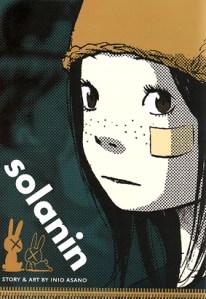
Solanin

Solanin

Title: solanin
Japanese Title: ソラニン
Author: Asano Inio (浅野いにお)
Translator: JN Productions
Publication Year: 2008 (America); 2005 (Japan)
Publisher: Viz Media
Pages: 428

Is manga literature? In some cases, like Urasawa Naoki’s Monster or 20th Century Boys, one could make a very strong positive argument. Some manga, however, like Bleach or Yuzawa Ai’s Nana series, are nothing more than once promising but now over-bloated cash cows. On the other hand, many of my favorite manga, like Azuma Kiyohiko’s Yotsuba&!, are not literature simply because they are masterpieces of a completely different art form.

But Asano Inio’s 420 page work Solanin is literature, no doubt about it. Like many Japanese narratives, it is driven not so much by plot as by character development and a fascination with the beauty of everyday life, which sounds like a Hallmark greeting card but is actually quite gritty and satisfying. Unlike a great deal of manga, Solanin deals with the problems of Japanese young people who are not sailor-suited schoolgirls and have already passed through their fun and fancy-free college years. In other words, the protagonists of Solanin have already grown up, or at least are trying to. I suppose that, in this way, Solanin is like a more focused and mature version of Umino Chika’s popular shōjo manga Honey and Clover, which chronicles the struggles and heartbreaks of a group of friends who have just graduated from art school.

As I said, there isn’t much to discuss in terms of plot (although there are some fairly gut-wrenching twists in the story), but the basic premise of the manga is that the protagonist, Mieko, who has just graduated from college and moved in with her boyfriend, has gotten sick of her boring office job and creepy boss and decided to quit working for a few months. During this time, she focuses on her friends and boyfriend, who had formed a rock band together in college. Mieko wants her guitarist boyfriend Naruo, who also feels suffocated at work, to get the band back together and be more serious about his music and his dreams, which drives the story forward but causes tension between the two. What ends up happening is way beyond what the characters – or the readers – suspect. The ending of the manga isn’t happy, necessarily, but it is fulfilling.

Although the focus of the narrative is on Mieko, occasionally chapters will be told from the point of view of another character, like Mieko and Naruo’s friends Rip (the drummer) and Kato (the bassist). These chapters rarely have anything to do with the main story but are still interesting, especially in how they highlight different aspects of the group dynamic within the circle of friends. The alternate narrative chapters also provide the majority of the manga’s comic relief, which is actually quite funny in a quiet sort of way.

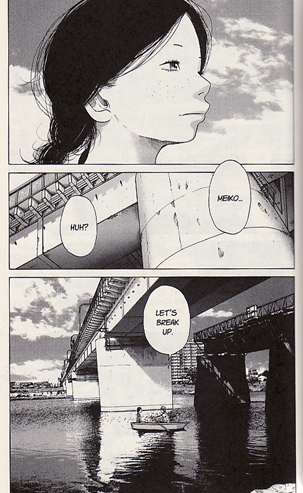
Although the characters and narrative style alone make Solanin worth reading, what really made me pick up this book and buy it was the artwork. The character designs, though simple, are very appealing. I also feel that, within the limits of Asano’s personal style, they are realistic in the way they depict different body types and facial expressions. The background art is wonderfully realistic, which is extraordinary when you realize how much of it there is. Unlike most manga, which only provide a panel of background art every page or two, Solanin is filled with beautiful drawings of the scenery and landscape of the Tokyo suburbs. Even if you think Solanin’s story is just basic Banana Yoshimoto style angsty emo crap (although, in my mind, it never gets that bad), the artwork makes the whole thing worthwhile. Really, it’s gorgeous.

So, although the cover isn’t that appealing, and although the $17.99 price tag is pretty hefty, I can’t recommend this book enough. I’m really happy I gave it a chance, despite my misgivings.

Just to give a feel for the art style, I’ll post some images from the manga. I apologize for the poor scanning quality…
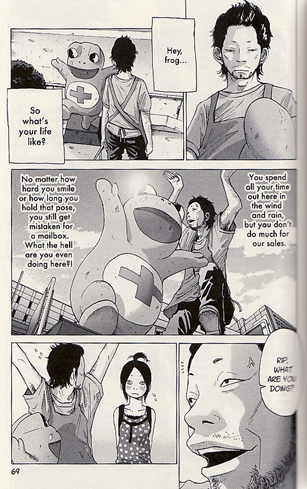
Solanin Page 1

Solanin Page 2

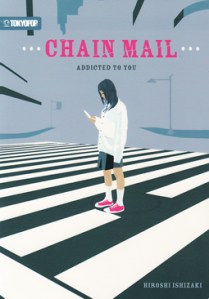
Chain Mail: Addicted to You

chain-mail

Title: Chain Mail: Addicted to You
Japanese Title: チェーン・メール―ずっとあなたとつながっていたい
Author: Ishizaki Hiroshi (石崎洋司)
Translator: Richard Kim
Publication Year: 2007 (America); 2003 (Japan)
Publisher: Tokyopop
Pages:209

Okay, I’ll admit it: when I came back home from Japan this past summer, I got really into Stephenie Meyer’s Twilight series. I know that many people like to complain about how the books are poorly written, misogynistic, heterocentric, painfully conservative, blah, blah, blah (I’m surprised no one has ever called them “phallogocentric” – that’s my personal favorite). First of all, the Twilight books are not poorly written; anyone who’s actually seen “poorly written” can attest to that fact. Second, I like to turn my feminist switch off when I read sparkly teenage vampire romance novels.

In any case, the Twilight series alerted me to the existence of the American genre of young adult fiction in a way that Harry Potter never did. (I think this is partially because I wouldn’t be caught dead reading “young adult fiction” when I was actually a “young adult,” but kids were a lot cooler seven or eight years ago.) I went to my local Borders and started doing market research, finding that, indeed, young adult fiction is a thriving genre, even though the vast majority of it is absolute crap. Perhaps the only good thing about the sudden popularity of the genre is that manga publishers like Tokyopop have started translating and publishing Japanese light novels.

A light novel is the Japanese equivalent of young adult fiction. These short, middle-school reading level books read like the plot of a manga, are often illustrated by noted manga artists, and are generally serialized like manga. Many popular anime, such as Slayers (スレイヤーズ) and The Melancholy of Haruhi Suzumiya (涼宮ハルヒの憂鬱) are adaptations of even more popular light novel series. Just as is the case with America, most light novels are absolute crap, and you will find a good selection of these less-than-stellar light novel series in Tokyopop’s catalog. Thankfully, the company has chosen to publish a few good light novels, even if they don’t have brand-name recognition.

One of my favorite offerings from Tokyopop is Ishizaki Hiroshi’s Chain Mail. Ishizaki has penned the text of several manga, most notably Miss Black Witch’s Halloween (黒魔女さんのハロウィーン), but he is also quite famous in Japan as an author of realistic fiction for young women. Although the plot of Chain Mail is somewhat far-fetched, this novel focuses on the development of its characters and their daily life as high school students in Tokyo.

What attracted me to this novel was its narrative structure. The narrative is divided between three narrators: Mai, Sawako, and Mayumi. These three girls, who may or may not know each other in real life, play a game in which they collaborate on a murder-mystery novel via posts made to an online message board on their cell phones (the internet is widely available on Japanese cell phones and has been for years). Thus, the narrative switches between the main story and the story that the girls are writing. Each girl is in charge of a certain character in the online story, and things get interesting when the events that happen to the characters in real life start to mirror the events they write into the story. There is never a hint of anything supernatural, but the blurred identities and real-life mysteries are quite uncanny.

Although only one of the three characters can be called sympathetic, I did feel a great deal of sympathy for each of them. Ishizaki doesn’t pull punches in his characterization and shows each of the three girls at her weakest moments. These three girls, who have been damaged by their families and the pressures forced on them at school, seek real friendship and connection through a cell phone game that had initially been created as a joke. Is the story pathetic? You bet. But it’s also touching and exciting, with lots of Nietzsche and Shibuya thrown in for good measure.

I would highly recommend Chain Mail to anyone interested in young adult literature, contemporary Japanese popular culture, or even Japanese literature in general. It’s a fascinating book, even if it doesn’t have pictures. Other fiction I would recommend from Tokyopop includes the Twelve Kingdoms series (by Ono Fuyumi), Kino’s Journey (by Sigsawa Keiichi) and anything written by Otsuichi, like Calling You or Goth. Tokyopop has recently taken down the “novels” section of its website, which makes me worry that the company doesn’t see a future for them, but I will go ahead and provide a link to their light novel catalog:

Tokyopop Catalog

Warriors of Art

Title: Warriors of Art
Author: Yamaguchi Yumi (山口裕美)
Translator: Arthur Tanaka
Publication Year: 2007 (America)
Pages: 175

Warriors of Art is, simply put, a beautiful, interesting, and exceptionally well-edited introduction to contemporary Japanese artists. The forty artists presented by the book represent a wide range of styles, media, and themes. A large percentage of the artists are internationally renowned and probably somewhat familiar to many Americans, who should be able to identify their styles if not necessarily their names. The book is illustrated with works instantly accessible to the casual reader, and the image quality could not be better. Every image has been reproduced in full color (where applicable) against a white background. At $35 (and deeply discounted on Amazon), Warriors of Art is also available at an affordable price.

The five page general introduction to the collection is promptly followed by a parade of artists appearing in alphabetical order. Each artist has been allotted four pages, the first of which contains a half-page, two column introduction. I have to say that, even though I generally don’t find much use for the text in art books, I genuinely enjoyed reading each of the artist introductions. These introductions put the work of the artist into perspective with biographical details and offer a few extremely apt interpretive comments, referring only to the pieces reproduced within the book. An average of five works follow each artist’s textual introduction, although the number tends of vary from artist to artist.

As for the actual content of the book, I found it extremely disturbing. Sometimes I was mesmerized by a piece, my reaction being something like “!!!!!!!!!.” Sometimes I found myself quickly turning the page because I found myself deeply upset by a particular work. As Yamaguchi says in her introduction to the book, “A glance at the work of the forty artists introduced in the book reveals recurring images of the cute, the grotesque, the erotic, the violent.” I think her description of “recurring images of” might more accurately read “a constant and overwhelming deluge of” images of cuteness and terror, eroticism and subtle (and not so subtle) aggression. In fact, one of the first plates in the book, an anime-style picture by Aida Makoto called The Giant Member Fuji versus King Gidora, depicts a female character from the anime Ultraman crying as she is both disemboweled and sexually violated by a golden hydra of Godzilla fame. Things carry on in much the same vein from there.

Even though Warriors of Art is not for the squeamish or the faint of heart (or the underage), the images are colorful, eye-popping, and deeply engaging. Questions of national identity, sexual identity, and personal identity are tackled again and again by these artists, whose experiments with style, composition, and color yield shocking results. Even a brief look at the works in this book calls the duality of high art and popular culture into question. Certainly, even though the entirety of Warriors of Art can be read less than two hours, I found myself captivated with it for days, returning to it for fresh surprises and new insights.