The Columbia Anthology of Modern Japanese Literature, Abridged Edition

Title: The Columbia Anthology of Modern Japanese Literature, Abridged Edition
Editors: J. Thomas Rimer and Van C. Gessel
Poetry Editors: Amy Vladeck Heinrich, Leith Morton, and Hiroaki Sato
Publication Year: 2011
Publisher: Columbia University Press
Pages: 960

The Columbia Anthology of Modern Japanese is the most comprehensive anthology of Japanese literature since the mid-nineteenth century; but, with two enormous (and expensive) volumes, it’s a bit daunting for all but the most stalwart of readers. I was therefore excited to learn that an abridged softcover version of the text has been released. At almost a thousand pages, the anthology still isn’t for the casually interested. As it provides a much wider selection of writers and genres than every other anthology of modern and contemporary Japanese literature on the market, however, The Columbia Anthology is an invaluable resource not only for students of Japanese literature but also for anyone interested in Japan in any capacity.

The anthology is divided into six sections spanning from the beginning of the Meiji period in 1868 to the end of the twentieth century. The two sections devoted to the Meiji era include work by naturalists and playwrights such as Mori Ōgai, Shimazaki Tōson, Kunikada Doppo, and Nagai Kafū, as well as essays by Natsume Sōseki, including “The Civilization of Modern-Day Japan.” The anthology then proceeds into the interwar period, which includes the work of authors such as Akutagawa Ryūnosuke, Edogawa Rampo, Kawabata Yasunari, and Tanizaki Junichirō. The section titled “The War Years” is mercifully short but includes stories by Dazai Osamu, Ishikawa Tatsuzō, and Ōoka Shōhei.

The “Early Postwar Years: 1945-1970” section is the longest in the anthology and reads like a hit parade of famous postwar writers such as Abe Kōbō, Enchi Fumiko, and Mishima Yukio. Many well-known postwar joryū bungaku (“women’s literature”) writers, such as Hayashi Fumiko and Kōno Taeko, are represented as well. The last section collects contemporary literature from the seventies, eighties, and nineties by both internationally famous authors such as Murakami Haruki and Ogawa Yōko and writers who are prolific and well known in Japan, such as Hoshi Shinichi and Furui Yoshikichi.

What is wonderful about this anthology is that, unlike other anthologies of modern and contemporary Japanese literature, it includes lengthy selections of Japanese poetry, both in “traditional” forms (such tanka and haiku) and in more modern forms (such as free verse). Although I am not a connoisseur of poetry in translation and thus can’t vouch for the quality of The Columbia Anthology‘s selections, I am thankful that so many works of modern and contemporary Japanese poetry have been brought together in a single volume. The majority of the original publications in which these translations appeared have long since gone out of print, so The Columbia Anthology is perhaps the best way to familiarize oneself with a rich yet underappreciated body of literature. The anthology also includes dramatic scripts by playwrights and screenwriters such as Inoue Hasashi and Kara Jūrō, texts which are also difficult to find elsewhere.

My enthusiasm for The Columbia Anthology is genuine, but some of the editors’ comments in the Preface shed light on some of the more conservative politics of literary anthologization. For example, to justify the entry of their project into a field in which many anthologies already exist, Rimer and Gessel state:

One difference between this volume and some of the earlier collections is related to the evolving view of both Japanese and foreign scholars as to what constitutes “literature.” Many of the earlier collections sought, consciously or unconsciously, to privilege the long and elegant aesthetic traditions of Japan as they were transformed and manifested anew in modern works. […] But many other kinds of writing, ranging from detective stories to personal accounts – always valued by Japanese readers but neglected by translators in the early postwar decades – can now be sampled here.

Expanding the scope of what is considered literature through diversity in anthologization is always good, of course, but two paragraphs earlier, the editors also made this strange comment:

Whatever the level of young people’s interest in manga (comics) and video games may be, literature, as opposed to simple entertainment, often remains the best way to grapple with the problems, and ironies, of the present generation of Japan.

On reading this sentence, I somehow managed to raise an eyebrow and roll my eyes at the same time. The context of this statement was a defense of the strength of contemporary literature in the face of a weighty literary tradition, but I wonder why the editors needed to make the distinction between “literature” and “entertainment” at all. Some types of print culture (such as dramatic scripts) are literature, but others (such as the text portions of visual novels) are not? Edogawa Rampo’s grotesque short stories are literature, but Otsuichi’s horror fiction is not? Haiku are literature, but tweets are not? And – most importantly – manga is not literature? Seriously?

Despite the editors’ stated desire to expand the scope of what is considered literature, their literary politics are, as I stated earlier, quite conservative. Popular fiction by writers like Murakami Haruki and Yoshimoto Banana is included in the anthology, but the work of such writers has been so resolutely canonized by scholarly articles and inclusion in course syllabi that its anthologization comes as no surprise. It’s good to have “outsider” writers like Tawada Yōko and Shima Tsuyoshi included in the anthology, but all of the volume’s stories more or less fit neatly into the category of “literary fiction.” You will not find the cerebral science fiction of Kurahashi Yumiko, or the historical revisionings of Miyabe Miyuki, or the fantastical explorations of Asian-esque mythology of Uehashi Nahoko, or the socially conscious mystery stories of Kirino Natsuo in The Columbia Anthology. You also won’t find any prewar popular fiction, such as the short stories of Yoshiya Nobuko.

This leads me to another criticism I have concerning the anthology, which is that it is remarkably dude-centric. Until the last two sections of the text (“Early Postwar Literature” and “Toward a Contemporary Literature”), there are no female writers represented (save for Yosano Akiko, who has a few poems about flowers and vaginas); not even one of Higuchi Ichiyō’s short stories is included. In the anthology’s defense, many of the women writing before and during the Pacific War, such as Enchi Fumiko and Hirabayashi Taiko, are included in the “Early Postwar” section. Unfortunately, this means that their more overtly political work has been passed over for stories that focus more on “traditional” women’s issues like female sexuality and the family. Furthermore, even though I applaud the editors for including literary essays in their anthology, it frustrates me that not a single one these essays was written by a woman, despite the fact that many female authors – including those represented in this anthology – are extraordinarily well known for their essays. What the editors has done is the equivalent of collecting the most influential essays on literature in North America and leaving out something as important and groundbreaking as Margaret Atwood’s On Being A Woman Writer.

In the end, though, I stand by my assessment of the abridged edition of The Columbia Anthology of Modern Japanese Literature as an essential resource to students of Japan. The volume contains many excellent stories, poems, essays, and dramatic scripts that are difficult to find elsewhere, and the editors keep their introductions of writers and literary epochs brief and to the point. As long as this text is supplemented to bridge over its gaps and omissions, I can imagine it becoming the backbone of a respectable introductory course on modern and contemporary Japanese literature, as well as a source of out-of-print translations of the work of less widely taught authors.

Review copy provided by Columbia University Press.
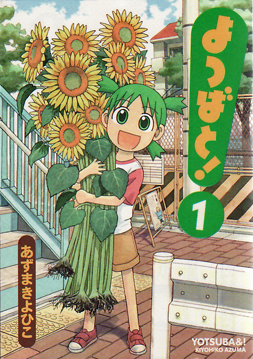
Yotsubato!

Title: よつばと!(Yotsuba to)
Artist: あずまきよひこ (Azuma Kiyohiko)
Publication Year: 2003 (Volume 1) – 2009 (Volume 9)
Publisher: 電撃コミックス (Dengeki Comics)
Pages: 225 (per volume)

Let me get this out of the way first: Yotsubato! has no story. It is not “about” anything. There is no point. It does not go anywhere. The manga could be classified as falling within the genre of comedy, but it doesn’t really try to be funny. The reader never really learns anything about the characters, and the relationships between the characters show almost no development. Nothing important or exciting happens.

Let me also get this out of the way: Yotsubato! is one of my favorite manga in the whole wide world.

I have been fond of Azuma Kiyohiko’s four-panel manga Azumanga Daioh ever since the translation was released in America in 2002. I also enjoyed the anime based on said manga. When defunct American manga publisher ADV Manga started releasing translations of Yotsubato!, Azuma’s new project following the completion of Azumanga Daioh, I picked up the first volume immediately. Unfortunately, I found myself disappointed. It wasn’t a fun manga to read. I didn’t get it. The dialog was translated in a way that was supposed to be wacky and zany, but I didn’t think the manga itself was that funny. The art was a little weird, too. A year later, in 2007, I went to Japan to find Yotsubato! featured prominently at almost every major bookstore in Tokyo and Yokohama – most memorably at the Tsutaya in Shibuya, which had an entire wall devoted to Yotsuba paraphernalia. The cover of the Japanese publication of the manga was approximately five hundred times more appealing than the cover of the translation, so I picked up a copy. While reading it on the train home, I fell in love.

Yotsubato! follows the daily life of a five-year-old girl named Yotsuba. Having been orphaned on an island somewhere outside of Japan (the circumstances are never made clear to the reader), Yotsuba has been taken in by a man named Koiwai, who seems to be in his late twenties or early thirties and makes his living as a translator. At the beginning of the first volume of the manga, Yotsuba and her adopted father move into a new house in the suburbs of a city assisted by Koiwai’s friend Jumbo, a florist with a preference for Hawaiian shirts whose name reflects his comically enormous stature. After moving in, Yotsuba and Koiwai (and Jumbo, who visits from time to time) become friends with the family living next door, which consists of a mother, a daughter in college, a daughter in high school, and a daughter a year or two older than Yotsuba (the father of the family never makes an appearance). Although other friends of Koiwai and the next-door neighbors are occasionally introduced, Yotsubato! mainly revolves around this core set of characters and their interactions. The manga moves slowly from day to day. Over the course of nine volumes, its leisurely pace has taken it from the middle of summer to the very beginning of fall.

What I love about this manga is this very slowness. I wouldn’t describe this work as “contemplative,” however; Yotsuba herself is very curious and energetic, and her adopted father is something of a character as well. There is nothing boring about the manga, but its focus on the mundane allows the reader to take a step back from his or her own presumably hectic life and enjoy an endless summer full of daytrip adventures and small discoveries. This is not to say that Yotsubato! somehow resembles something like My Neighbor Totoro. The manga is written from an adult perspective, and the reader is constantly encouraged to identify with the people who surround Yotsuba rather than with the girl herself. The occasional jokes that the manga makes are sophisticated, and the adult speech and relationships are not sanitized or downplayed.

The attention to detail expressed in every aspect of the manga finds its most visible outlet in its gorgeous artwork. As I noticed when I first read the manga in America, it takes Azuma several chapters to settle on his character designs, which are drawn in his unique style. The rest of the visual realm, however, is drawn in an almost photorealistic way, from the tiniest detail of the interior architecture of Yotsuba’s house to the products lining the shelves of a neighborhood convenience store. Aside from the shade of Yotsuba’s unique hair, there is almost no screen tone used in the manga; everything is conveyed in understated ink work, which miraculously never clutters the page or busies the panels. The slightly cartoonish characters provide a pleasing contrast to this sort of detailed background. I feel like the background art in this manga captures the essence of a Japanese suburb far away from Tokyo; so, even while I was reading this manga in Yokohama, it made me feel nostalgic for living in Japan.

I suppose you could say that I enjoy this manga because of its pace, its narrative tone, and its art. I’m not really sure, though, what makes Yotsubato! different from any other “slice of life” manga, but it is different. I have said before that I think manga can be considered literature, but Yotsubato! is not literature. It is a masterwork of an entirely different medium of artistic expression. Really, I think Yotsubato! stands alongside the works of Urasawa Naoki and Asano Inio as an exemplar of what manga is capable of.

Although I am a great believer in translation, I feel that Yotsubato! is much more enjoyable in the original Japanese. Thankfully, even beginning students of Japanese should not find the dialog in the manga to be prohibitively difficult. For those readers who have no Japanese language background, however, a new English translation of the manga is currently being published under the title of “Yotsuba&!” by Yen Press.

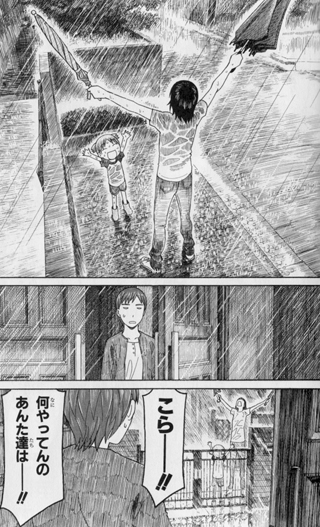
I think the following two pages demonstrate the style of the manga. In the middle of a late summer typhoon, Yotsuba runs into the storm to warn her next door neighbors to be careful. In her haste, she forgets her umbrella, so her adopted father runs after her to give it to her. Upon catching up with her, he finds her already drenched, so….

Solanin

Solanin

Title: solanin
Japanese Title: ソラニン
Author: Asano Inio (浅野いにお)
Translator: JN Productions
Publication Year: 2008 (America); 2005 (Japan)
Publisher: Viz Media
Pages: 428

Is manga literature? In some cases, like Urasawa Naoki’s Monster or 20th Century Boys, one could make a very strong positive argument. Some manga, however, like Bleach or Yuzawa Ai’s Nana series, are nothing more than once promising but now over-bloated cash cows. On the other hand, many of my favorite manga, like Azuma Kiyohiko’s Yotsuba&!, are not literature simply because they are masterpieces of a completely different art form.

But Asano Inio’s 420 page work Solanin is literature, no doubt about it. Like many Japanese narratives, it is driven not so much by plot as by character development and a fascination with the beauty of everyday life, which sounds like a Hallmark greeting card but is actually quite gritty and satisfying. Unlike a great deal of manga, Solanin deals with the problems of Japanese young people who are not sailor-suited schoolgirls and have already passed through their fun and fancy-free college years. In other words, the protagonists of Solanin have already grown up, or at least are trying to. I suppose that, in this way, Solanin is like a more focused and mature version of Umino Chika’s popular shōjo manga Honey and Clover, which chronicles the struggles and heartbreaks of a group of friends who have just graduated from art school.

As I said, there isn’t much to discuss in terms of plot (although there are some fairly gut-wrenching twists in the story), but the basic premise of the manga is that the protagonist, Mieko, who has just graduated from college and moved in with her boyfriend, has gotten sick of her boring office job and creepy boss and decided to quit working for a few months. During this time, she focuses on her friends and boyfriend, who had formed a rock band together in college. Mieko wants her guitarist boyfriend Naruo, who also feels suffocated at work, to get the band back together and be more serious about his music and his dreams, which drives the story forward but causes tension between the two. What ends up happening is way beyond what the characters – or the readers – suspect. The ending of the manga isn’t happy, necessarily, but it is fulfilling.

Although the focus of the narrative is on Mieko, occasionally chapters will be told from the point of view of another character, like Mieko and Naruo’s friends Rip (the drummer) and Kato (the bassist). These chapters rarely have anything to do with the main story but are still interesting, especially in how they highlight different aspects of the group dynamic within the circle of friends. The alternate narrative chapters also provide the majority of the manga’s comic relief, which is actually quite funny in a quiet sort of way.

Although the characters and narrative style alone make Solanin worth reading, what really made me pick up this book and buy it was the artwork. The character designs, though simple, are very appealing. I also feel that, within the limits of Asano’s personal style, they are realistic in the way they depict different body types and facial expressions. The background art is wonderfully realistic, which is extraordinary when you realize how much of it there is. Unlike most manga, which only provide a panel of background art every page or two, Solanin is filled with beautiful drawings of the scenery and landscape of the Tokyo suburbs. Even if you think Solanin’s story is just basic Banana Yoshimoto style angsty emo crap (although, in my mind, it never gets that bad), the artwork makes the whole thing worthwhile. Really, it’s gorgeous.

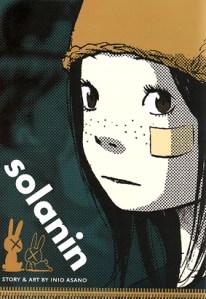
So, although the cover isn’t that appealing, and although the $17.99 price tag is pretty hefty, I can’t recommend this book enough. I’m really happy I gave it a chance, despite my misgivings.

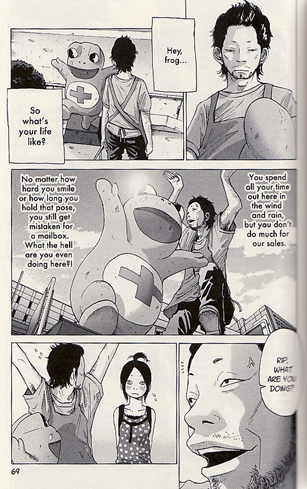
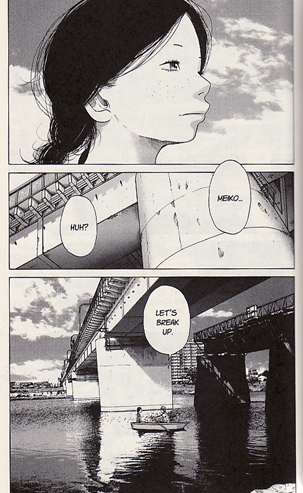
Just to give a feel for the art style, I’ll post some images from the manga. I apologize for the poor scanning quality…

Solanin Page 1

Solanin Page 2