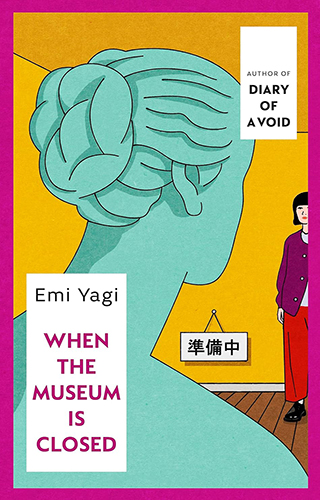
When the Museum Is Closed

Emi Yagi’s 2023 novel When the Museum Is Closed is a refreshing work of magical realism about a shy young woman who falls in love with a statue of Venus. The twist is that the statue loves her back, and – even more miraculous! – their love story has a happy ending.

Rika is a recent college graduate who works in the freezer department of a warehouse for processed food. She sees this as the perfect job for three reasons. First, she never has to talk to anyone. Second, she can take pre-prepared food home from her job, so she rarely has to cook. And third, an invisible yellow raincoat suddenly appeared over her clothing in elementary school, and she’s found it almost impossible to remove in public. The heavy vinyl fabric keeps her body temperature high, but that’s not a problem in an industrial freezer.

The only variation in Rika’s days comes from her part-time job. Once a week, Rika takes the bus to a local museum to have an hour of conversation with a statue of Venus. Venus only speaks Latin, but Rika enjoys a freedom with the dead language that she’s never found in Japanese. Though Rika is shy at first, she and Venus become friends, and they eventually fall in love.

Unfortunately, there’s a bit of a situation with a man named Hashibami, the museum curator in charge of the statue. He wants Venus all to himself, and he never wants her to change – he doesn’t want her to learn modern languages, and he certainly doesn’t want her to learn about the world outside the museum.

Venus therefore makes a deal with Hashibami. If he can get Rika to fall in love with him, she’ll allow him to fire Rika from the conversation job. Regardless, Rika isn’t interested in men, nor does she allow Venus to push her away. What Rika wants is something else entirely, and her relationship with Venus has given her the courage to chase their mutual joy.

The fantastic elements of When the Museum Is Closed are presented as entirely mundane, and it’s easy to take them at face value. At the same time, the love story between Rika and Venus resonates at an allegorical level with the experience of having a queer crush on someone who’s friendly and flirtatious yet seemingly unattainable. It’s the crush you have on an older coworker, or the crush you have on an internet friend, or the crush you have on the gayest girl you’ve ever met who is, inexplicably, married to a man. It doesn’t really matter that Venus is a statue, as anyone who’s experienced queer longing can relate to Rika’s situation. At the same time, Emi Yagi’s Venus is animated by her own distinct personality and undeniably lovely.

I’m sure that When the Museum Is Closed could also be read as an allegory for how women tend to be treated in male-dominated artistic and curatorial spaces, but the story is far more concerned with Rika’s subjective experience of her own individual life. I especially enjoyed the subplot involving Rika’s friendship with her landlord, a quirky but kind elderly woman who needs home care assistance, and I appreciated the understanding Rika develops with the neglected young boy who lives next door. Though Rika’s invisible yellow raincoat is unique to her, she’s far from the only person carrying unseen baggage, and it’s not necessarily the case that this is a problem that needs to be fixed.

When the Museum Is Closed is a short but expertly paced novel that moves quickly yet still allows the reader enough time to appreciate each scene. Its premise is intriguing and well-executed, and Yuki Tejima’s delightful translation captures the author’s tone perfectly, both in Rika’s deadpan observations and Venus’s mature flirtations. Readers who enjoyed Emi Yagi’s novel Diary of a Void will be pleasantly surprised by When the Museum Is Closed, which features the same sharpness and clarity of writing augmented by lovely moments of sweetness.

52ヘルツのクジラたち

52ヘルツのクジラたち is a bestselling novel by Sonoko Machida that won the 2021 Japan Booksellers’ Award Grand Prize. In March 2024, the story was adapted into a feature film directed by Izuru Narushima, who worked with LGBTQ consultants in order to portray a key transgender character with the same compassion and sensitivity expressed by Machida’s novel.

Kiko Mishima has left Tokyo to move to a seaside town near Oita on the eastern coast of Kyushu. She’s inherited a house from her grandmother, and she gets along well with the contractors she hired for renovations. It’s difficult to adjust to life in a small community, however, and Kiko begins to withdraw into her house.

During a trip to the grocery store, Kiko encounters a 13yo boy who can’t speak and seems to have nowhere to go. The nameless boy bears undeniable signs of abuse and neglect, so Kiko invites him home and begins caring for him.

As the novel progresses, the reader learns more about Kiko, who was emotionally abused by her mother and stepfather. Circumstances relating to her stepfather’s health prevent Kiko from escaping from her family after high school, and she’s driven to the verge of suicide by her experience of serving as her stepfather’s primary caregiver.

Kiko is rescued by her high school friend Miharu, who also grew up in an abusive family. Miharu introduces Kiko to her colleague Ango, who sympathizes with Kiko and takes responsibility for her emotional support as he helps her move into a sharehouse and begin a new life.

From the beginning of the novel, the reader is confronted by numerous questions. Given how important Ango was to Kiko, what happened to him? Why did Kiko suddenly move to Kyushu without telling anyone? Where is she getting the money to renovate her house? And, most importantly, what can she do to help the abused boy whom the entire town has decided to ignore?

52ヘルツのクジラたち takes its title from the story of 52 Blue, a whale of an unidentified species that has never been sighted but only heard via hydrophones. It sings at a frequency 52 hertz, which is much higher than the calls of other migrating whales. Because of the highly unusual sonic signature of its call, the whale migrates alone.

Kiko compares her isolation during her childhood to that of the 52-hertz whale, and she once listened to recordings of its singing to calm and ground herself after she left her family. She shares these recordings with the seemingly wordless boy she takes under her wing, promising that she’ll wait patiently until she can understand his own 52-hertz voice.   

We live in a society, however, and it’s not strictly legal to assume care of a minor without the permission of the child’s guardians. Thankfully, Miharu manages to track down Kiko and pays her a visit in Kyushu. She once again comes to the rescue, helping Kiko to reach out to the community for the support that she and the boy desperately need. 

Make no mistake, 52ヘルツのクジラたち is an intensely melodramatic novel. Its characters are either saints or devils. It’s never explained why anyone would be abusive toward a child, or why most people who witness child abuse choose to ignore it. In addition, the story’s victims of abuse come off as perfect angels who suffer with dignity and almost never display any of the problematic behavior associated with a history of sustained childhood trauma.

I find this lack of psychological depth frustrating, as it glosses over many of the issues underlying child abuse, which is often known and tacitly tolerated by the larger community. Instead of serving as a meaningful model for how such abuse can be prevented, this novel feels more like a character drama that uses serious social issues for the sole purpose of generating heightened emotions. In addition, although the treatment of the central transgender character is sympathetic, I couldn’t help but shake my head at some of the tired narrative tropes applied to their story.

Still, I can’t deny that 52ヘルツのクジラたち is a lot of fun to read. The pacing is excellent, and I was swept along by the story’s strong forward momentum. Although bittersweet, the ending is emotionally satisfying, as is the conclusion of Kiko’s character arc. I’d especially recommend this novel to fans of Banana Yoshimoto, as it feels like a progressive development of many of the themes explored in Kitchen, from a universal concern with love and loss to a more specific push for the legal rights of minors and transgender people. 

While the message of 52ヘルツのクジラたち might have benefitted from more psychological nuance, Sonoko Machida makes a strong and compelling case for mutual aid and community action in which everyone in a society benefits by actively protecting the marginalized.

The Briefcase

Title: The Briefcase
Japanese Title: センセイの鞄 (Sensei no kaban)
Author: Kawami Hiromi (川上 弘美)
Translator: Allison Markin Powell
Year Published: 2012 (America); 2001 (Japan)
Publisher: Counterpoint
Pages: 176

Kawakami Hiromi’s novel Manazuru, translated by Michael Emmerich and published in 2010 by Counterpoint, is a strange, dreamlike story told from the perspective of an otherworldly and unreliable narrator. Manazuru is about pain and bitterness, and broken hearts and broken families.

Kawakami’s newest novel in translation, The Briefcase, is a far cry from the atmospheric surrealism of Manazuru. Its narrator, Ōmachi Tsukiko, is a single woman in her late thirties who is firmly grounded in reality. The Briefcase is about her daily life and centers around her encounters with her former Classics teacher, Matsumoto Harutsuna, whom she still refers to as “Sensei.” Two decades after graduating from high school, Tsukiko meets Sensei by chance at a neighborhood bar, and the two strike up an easy friendship. Each of the ten-page chapters in The Briefcase details an episode in this friendship, such as a trip to an outdoor market or a mushroom hunting excursion with the owner of the bar Tsukiko and Sensei frequent. Seasons change, but not much else does. Nothing particularly dramatic or unexpected happens throughout the large majority of The Briefcase, and the novel’s close attention to detail provides much of its charm.

Although it doesn’t become apparent until a little more than halfway through the novel, Tsukiko gradually develops romantic feelings for Sensei. I would love to say something along the lines of “despite the significant age difference, the relationship between Tsukiko and Sensei blossoms beautifully;” but, in reality, it’s quite awkward. Not only is the situation itself awkward, but both Tsukiko and Sensei are awkward people. They’re not charmingly awkward, or amusingly awkward, or so awkward that want to hug them – they’re just awkward. Still, the gentle progression of their relationship is entertaining in its earnestness, and Kawakami describes it from Tsukiko’s perspective with commensurate delicacy:

At some point, sitting beside Sensei, I began to notice the heat that radiated from his body. Through his starched shirt, there came a sense of Sensei. A feeling of nostalgia. This sense of Sensei retained the shape of him. It was dignified, yet tender, like Sensei. Even now, I could never quite get a holf on this sense – I would try to capture it, but the sense escaped me. Just when I thought it was gone, though, it would cozy back up to me.

The quiet normalcy of The Briefcase is satisfying in and of itself, yet there are some disturbing undercurrents running through the novel. Why is Tsukiko alone? Why is Sensei alone? What happened to him? Why does he always carry around his briefcase? These uncertainties serve to make the story more intriguing, however, and don’t escalate into a full-blown crisis until the very end of the novel, when Tsukiko undergoes a startlingly surreal experience. During two of the final chapters of the novel, Tsukiko’s feelings for Sensei, as well as her fear of his rejection, are explored in a strange sequence titled “The Tidal Flat – Dream,” which may or may not have actually happen. This chapter is a unexpected break from the regular mundane atmosphere of The Briefcase, but it pulls the novel together thematically in a creative and unexpected way.

Allison Markin Powell, who also translated Dazai Osamu’s Schoolgirl, deftly conveys the lightness and humor occasional strangeness of Kawakami’s prose. Although Powell’s English is flawless (with the possible exception of a few out-of-place Britishisms), her style of translation leaves the reader with no doubt as to the Japanese setting of the novel. Passages like…

“Yes, today is a tomobiki day. But tomorrow is a red-letter day, a konoe-tora!”

…and…

Daikon, tsumire, and beef tendons, please, Sensei ordered. Not to be outdone, I followed with Chikuwabu, konnyaku noodles, and I’ll also have some daikon. The young man next to us asked for kombu and hanpen.

…are not uncommon. It’s an interesting style of translation that emphasizes the novel’s focus on peaceful daily life in a richly detailed environment, and it’s fun to read. The culturally specific words scattered throughout the text can be largely ignored if you’re not feeling up for a hyperlinked adventure on Google, though, so they shouldn’t be distracting for the reader.

The Briefcase is a gentle and quiet novel that’s enjoyable both for its story and for its atmosphere, and it’s much more accessible than Manazuru (which is not to say that Manazuru is bad, just very weird). It’s literature that doesn’t take itself too seriously, and I very much enjoyed reading it.

Kieli: The Dead Sleep in the Wilderness

Title: Kieli: The Dead Sleep in the Wilderness
Japanese Title: キーリ ― 死者たちは荒野に眠る
(Kiiri: Shishatachi wa kōya ni nemuru)
Author: Kabei Yukako (壁井 ゆかこ)
Illustrator: Taue Shunsuke (田上 俊介)
Translator: Alethea Nibley and Athena Nibley
Publication Year: 2009 (America); 2003 (Japan)
Publisher: Yen Press
Pages: 228

Kieli is one of those hauntingly pretty girls whose special blood and pure heart allow her to see things unnoticed by others. Harvey is one of those chiseled copper-haired boys who is seventeen and has been seventeen for a long time. When their paths cross seemingly at random, Harvey finds himself charmed by Kieli, and Kieli finds herself dazzled by Harvey… Stop me if you’ve heard this story before.

What’s special about this novel isn’t its love story, however, but rather its setting. In her “Afterword,” the author says, “Wasted planets, steampunk, old-fashioned radios, rusty machines, old oil. It would make me as happy as I could be if all of you who like dilapidated things and react to that kind of vocabulary like this book.” I hope the author is indeed as happy as she can be, since her book is perfect for anyone who enjoys the atmosphere conjured by such words. Kieli is set on a dying planet where society still functions to a certain degree as life crumbles to dust in stages. This decay pervades every corner of the novel:

The next morning, when Kieli opened her eyes she was lying on a sofa with broken springs in the waiting room, wrapped in her coat and a dusty old blanket.

The clinic had completely fallen to ruin. Yellow sand and dust had settled below the crisp, clear, cold morning air, and the once clean, white paint on the walls had faded to yellow and peeled off in places, showing the concrete wall underneath.

Kieli spent a while walking through the deserted house, looking for Harvey, the floor creaking with every step she made. When she went up to the second floor, the plants that decorated the balcony had withered to nothing, and only the cracked pots remained under the nebulous morning light.

Everything in Kieli’s world is slowly falling apart. Isolated cities are separated by vast stretches of desert, small villages that serve as way stations along the side of railway lines are slowly shrinking in population, and the wasteland outside habited areas is still littered with the detritus for a war over natural resources that petered out a hundred years ago. Kieli is strangely suited to life in this world, as she possess the unusual ability to see and interact with the ghosts of the dead, who are seemingly more numerous than actual living people. Through the mischief of her dead roommate, Kieli encounters Harvey, who used to be a soldier in the war. Harvey is a creation known an as Undying, a class of artificial beings powered by mechanical cores of pure energy. Aside from his bad attitude, Harvey seems mostly harmless until he unwittingly drags Kieli into a conspiracy concerning the Church that governs Kieli’s world. The two are accompanied by the ghost of an older man known as the Corporal, who resides in the shell of an old radio and provides both insight and comic relief. In an environment where everything is dead or dying, Kieli and Harvey shine brightly as they find adventure and new life in each other’s company.

Since Kieli is a light novel, it receives the full graphic treatment, with eight full-color anime-style illustrations at the front of the book and a number of black-and-white illustrations scattered throughout the book’s chapters. The tropes of the novel are not specific to Japanese popular media, and they should appeal to a wider audience for young adult fiction. Kieli is an orphan who lives in a boarding school, where she is misunderstood and unappreciated by her peers. Harvey is an angsty, brooding badass who has a soft side that he keeps hidden in order to survive in a harsh world. The spirit of the Corporal residing in Harvey’s radio is a grumpy old man who cheerfully dispenses humorous complaints. The Church is mysterious and sinister, and its agents are genuinely frightening.

A shortcoming of many light novels published in translation is that their language is more manga-like than literature-like, by which I mean that its primary purpose is to shoot the reader forward as quickly as possible through a series of increasingly improbable events. Kieli occasionally suffers from this style of narration, but it usually allows the reader time to linger over events and absorb the story’s atmosphere. The translation of Kabei’s prose is lucid and engaging, inviting the reader to enter Kieli’s world without fussing over translation notes and awkwardly translated dialog. Occasionally a character will bow to another character, but the novel otherwise has very little “cultural odor.” Because of the quality of the translation, I found myself reading not just for the story but also for the pleasure of reading such straightforward and well edited language. I also feel the same way about the translation of the Spice and Wolf light novels, and I can’t help but offer my most profound thanks to the editorial staff at Yen Press for doing such an excellent job with their releases.

Kieli ends with a bit of a cliffhanger, but its sequels have already been published by Yen Press, which seems to be keeping up a steady release schedule. I don’t know why I waited so long to start reading this series, because it’s really quite good. I can’t wait to read the next volume!