Silent Singer

Yōko Ogawa’s 2025 novel Silent Singer (Sairento Shingā) is a bittersweet story about a woman named Ririka who lives alone in a mountain forest near a community of people devoted to silence. Ririka is a professional singer, but she never makes a name for herself, only taking freelance jobs that require a performer with an anonymous voice. Though the singer and the silent community eventually fade into obscurity, Ogawa celebrates the beauty and dignity of their lives, as well as the significance of creativity that never finds an audience.

On an isolated mountain in the countryside, a group of people calling themselves “The Introverts’ Club” have bought a parcel of land and formed a community named Acacia Fields, which is devoted to quiet and simple living. The Acacia Fields community isn’t a religious organization; rather, they’re normal people committed to the philosophy that “silence soothes the soul.” Anyone can join as long as they’re content never to speak in the presence of others.

Ririka lives in an old house next to a forest adjoining Acacia Fields, where her grandmother is employed as the gatekeeper. The gatekeeper’s job is to communicate with people from the outside world while also managing a small store that sells produce, pastries, and other items produced by the community, which raises livestock and maintains extensive gardens.

While her grandmother manages in the gatehouse, Ririka has the run of Acacia Fields. She spends hours with the aging doctor of the community’s small clinic, who isn’t bound by a vow of silence and reads to her while teaching her “finger language,” a simple form of sign language used by the community. Though her mother committed suicide after being abandoned by her father, Ririka enjoys a happy childhood divided between the public school in the town below the mountain, the doting care of her loving grandmother, and the quiet but genuine affection of the people living at Acacia Fields.

Ririka discovers her path in life during a sheep shearing session at Acacia Fields, when she’s asked to sing a simple lullaby to help keep the animals calm. She performs beautifully and enjoys herself immensely. A town official who attended the event is impressed by Ririka’s singing, and he asks her to record a similar song to be played over the municipal loudspeakers every evening at 5pm. Though no one knows the singer is Ririka, the song is so well-received that the tradition continues indefinitely.

Shortly after she graduates from high school, Ririka’s grandmother passes away. Ririka remembers her grandmother by visiting her Puppet Garden, which the old woman created after a child went missing in the mountain forest one summer. To soothe the boy’s spirit, Ririka’s grandmother fashioned five dolls from discarded household objects and placed them at the center of a small grove. For Ririka, the Puppet Garden serves as a place of quiet meditation. 

Ririka takes over her grandmother’s position as the Acacia Fields gatekeeper while supplementing her income through various freelance jobs passed along by her voice instructor. In each case, Ririka is recommended because of her relative anonymity. Ririka sings jingles for television commercials, performs anime theme songs, records vocal tracks for idol groups, and even provides the voice of a talking children’s toy. Though she doesn’t seem to realize it, Ririka is quite successful as a professional singer, but she never leaves her home on the mountain.

As an adult, Ririka strikes up a romance with the security guard at the parking lot where she keeps her car. On their first date, Ririka takes him to the Puppet Garden, whose dolls are in a severe state of decay. Instead of being creeped out, the security guard is charmed. He’s a good match for Ririka, as he has an odd hobby of his own – piecing together carefully curated scrapbooks devoted to the lost works of famous authors.

The only shadow over the relationship is that Ririka finds herself unable to sing for her boyfriend. She can only sing, she explains, if her audience isn’t a living human. Meanwhile, with few young people moving to the mountain, the Acacia Fields community is in danger of being claimed by entropy and senescence.

Silent Singer resonates with echoes of the Studio Ghibli charm of Mina’s Matchbox; but, as is often the case with Yoko Ogawa’s work, a major theme of the novel is the gentle beauty of decay. Ririka’s house is slowly falling apart, as are the dolls in her grandmother’s Puppet Garden. The agricultural holdings of Acacia Fields are gradually diminishing, and the members of the community are growing old. Regardless, the village remains peaceful, as does the surrounding forest, especially in contrast to the absurdities of the freelance work Ririka takes as a singer. 

In many ways, Silent Singer reminds me of Haruki Murakami’s 2023 novel The City and Its Uncertain Walls, especially in its aggressive refusal to engage with contemporary technology. It could be the case that the nostalgic settings of the two novels are simply a product of the preoccupations of two aging writers, but that’s not how these stories feel to me.

At this point in the death spiral of our capitalist hellworld, I’m bone-tired of “progress” that dehumanizes everything it touches. Meanwhile, Murakami’s narrator leaves his corporate job to work in a small-town library in Fukushima prefecture, while Ririka remains loyal to her home in a quiet mountain forest, which provides a refuge from the profit-driven demands of the entertainment industry. And good for them! I am here for characters who do not give a single fuck about social media or self-branding.

While it might be a stretch to call Silent Singer “anticapitalist,” this is a story about the value of creativity at the margins, as well as the beauty of art without an audience. Ogawa’s obsession with the decay that creeps in at the edges of isolated communities and individual lives can sometimes feel uncomfortable, but let it be uncomfortable! There’s nothing cozy about the richness of human experience, and the care and attention Ogawa devotes to the slow endings of her stories is one of the great pleasures of her work. The work of Ogawa’s “silent” creatives may be unremarked, but it’s far from unremarkable.

Sympathy Tower Tokyo

Rie Qudan’s short novel Sympathy Tower Tokyo, which was awarded an Akutagawa Prize in 2023, is a story about language, generative AI, and the culture war discourse surrounding the construction of a fictional prison facility in a high-rent area of Tokyo’s Shinjuku district. 

Sara Machina is an artist and architect who wants to win the bid to design and build the eponymous “Sympathy Tower Tokyo,” a prison right in the middle of metropolitan Tokyo that will operate according to a utopian vision of providing state-mandated shelter to “homo miserabilis,” or people driven by economic precarity to commit crimes because they had no other options, Les Misérables style.

The main problem, in Sara’s eyes, is the name of the building, which is written in English and a mouthful to pronounce: Shinpashii Tawaa Toukyou. It’s also somewhat meaningless, Sara reflects, as are a number of other politically correct English terms that have replaced native Japanese expressions. Amusingly, she provides a list that includes examples such as negurekuto (neglect), which has replaced the formal term ikuji hōki (child abandonment) in public discourse.

Most of these loanword expressions don’t really change the meaning or public perception of the concept itself, but some do. “Homo miserabilis” is one such (fictional) example, having replaced the word hanzaisha, meaning “criminal.” Which is all well and good, Sara admits, but she still can’t envision a structure called “Sympathy Tower Tokyo.” If the building were to have a name that was more euphonic in Japanese, that would be a different story.

An appropriate name is provided by a beautiful young man who goes by “Takt,” a loanword from German used for an orchestra conductor’s baton. Takt became Sara’s casual boyfriend after she saw him through the display window of a luxury fashion store in Aoyama and point-blank asked him out; and, despite the difference in their ages, he does genuinely care for her.

While Sara frets over the intricacies of language, Takt has no qualms about using AI-built, the novel’s version of ChatGPT, to address any questions he might have. Despite his casual use of AI to understand the world and communicate with other people, Takt naturally and organically comes up with the expression Tōkyō-to Dōjō-tō (Tokyo City Sympathy Tower), which rolls off the tongue “like a spell from Harry Potter” and turns out to be exactly the inspiration Sara needs. 

Sara’s design wins, and the tower is built on prime real estate for everyone to see. It is, she says, “the answer to the question posed by Zaha Hadid’s Olympic Stadium.” 

Sara narrates the first and fifth chapters of the novel, while Takt narrates the second and fourth. The third chapter belongs to Max Klein, an American journalist covering Japan who’s gone freelance after being accused of making racist cultural generalizations. Takt is charmed by Max and begins adopting his speech patterns, while Sara (bless her heart) is mainly concerned about Max being fat and stinky and sweaty.

Max himself is a budget version of Hunter S. Thompson who seems to want to “tell it like it is” but unfortunately doesn’t possess the political acumen to make it as a mainstream reporter. In particular, Max is frustrated by what he sees as the tendency of Japanese officials (and Japanese people in general) to use smooth and politically correct language to mask their actual views and agenda.

While Max’s tirade is admittedly gauche, it seems to partially echo the author’s own views regarding excessive linguistic masking, which she expressed succinctly in an interview with The Guardian (here):  

“There are people all around you who you would never think hold discriminatory views but actually do hold those views. A lot of Japanese people, on the surface, they know how to act in a way that makes them seem welcoming of diversity. And this discrepancy between what people think on the inside and what they say is a very distinctive feature.”

In other words, language is political, but the degree to which “correct” language can shape or reshape society is debatable. This question calls to mind the online conversations in 2022 surrounding Tetsuya Yamagami, the man who assassinated Shinzō Abe and attracted immediate widespread sympathy. While the murder itself was shocking, Yamagami’s motives were faultless. How, then, would it be appropriate to talk about him? Is someone like Yamagami truly a “criminal,” or rather a “homo miserabilis”? Regardless, the language we use to refer to people who commit crimes doesn’t change the fact that we feel compelled to incarcerate them, “Sympathy Tower Tokyo” though their prison may be. 

Sara Machina was the victim of an assault that was never punished or even acknowledged, and she can’t quite reconcile herself to rhetorical towers built with politically correct language. Max goes five steps farther and expresses open disdain for the sort of wokeness that dictates that people who caused so much suffering to others aren’t properly treated like criminals but are instead allowed to live rent-free in a gorgeous luxury tower.

In the middle is Takt, the son of a high-profile “homo miserabilis” who ultimately decides to become a PR representative for the tower. Perhaps because he’s so used to consulting AI-built, his speech soon becomes just as smooth and beautiful as his face. When he begins to write about Sara Machina’s architectural genius, however, he finds that AI is insufficient, yet he can find no words in himself. This is fine with Sara, who (relatably) doesn’t wish to be perceived after becoming the target of sustained abuse on social media. 

The plot summary I’ve given here doesn’t begin to do justice to the actual conflict of Sympathy Tower Tokyo, which revolves almost entirely around language. Both English-language and Japanese-language journalists have made a big deal about how “a portion of this award-winning novel was written by ChatGPT,” but this description is painfully misleading. When characters in the novel engage with AI-built, the program’s text was in fact generated by AI, as is appropriate. Although Qudan never has her viewpoint characters make a definitive statement about LLMs, the “smoothness” of machine-generated text is positioned as a mirror to the sort of “politically correct” language used by public officials to disguise and downplay critical issues in contemporary Japanese society.  

In any case, Jesse Kirkwood’s translation is brilliant, and I very much appreciate the brief and informative “Translator’s Note” at the beginning of the book. Also, for what it’s worth, though the diegetic AI-built text may have been generated by an LLM, I didn’t get the sense that it was translated by one. If there’s any criticism to be directed at Sympathy Tower Tokyo, it’s that its emotional core is ephemeral and difficult to pin down. Perhaps ironically, the characters aren’t sympathetic; rather, their role is to serve as viewpoints along a spectrum of opinion. Still, Sympathy Tower Tokyo is a remarkably playful and intellectually stimulating book, and you can’t help but admire Qudan’s boldness in standing up and speaking to the current moment of culture war discourse.

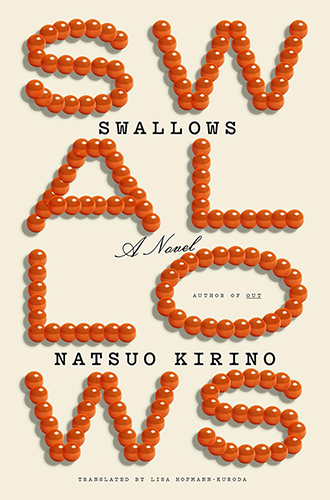
Swallows

Natsuo Kirino’s 2022 novel Swallows follows an impoverished young woman who becomes a surrogate birthmother for a high-performing couple on the cusp of middle age.

Riki works a full-time temp job as a receptionist at a general hospital, but she can only barely make rent in an aging apartment building in Tokyo. Her parents back in Hokkaido don’t have any money, and she’s completely on her own after leaving a toxic romantic relationship. Her best friend at work, Teru, isn’t doing much better, especially not with an unreliable boyfriend who pressures her to do sex work on the side so she can pay the interest on his debts. 

To raise money, Teru registers to sell her eggs under the auspices of a Japan-based fertility service, and she attempts to persuade Riki to join her. Riki is tired of eating bargain convenience store food, wearing third-hand Uniqlo clothing she buys online, and being harassed by the shitty men who live in her garbage apartment building – so she agrees.

Riki’s application attracts the interest of a company representative who thinks she’d be the perfect fit for a married couple looking for a surrogate birthmother, Motoi and Yuko Kusaoke. Riki has doubts about this situation, which is only dubiously legal to begin with, but the Kusaokes offer her a life-changing amount of money. Once Riki has signed a contract, the husband, Motoi, becomes overbearing in his need to control Riki’s private life; and, to spite him, she has casual sex before receiving his sperm. When she becomes pregnant with twins, she can’t be entirely sure that Motoi is the father. To make matters even more complicated, Yuko feels more sympathy for Riki than she does for her husband, and she’s considering ending the marriage.

Swallows is more suspenseful than you might suspect. Who is the father of the children? Will Motoi and Yuko separate? Will Riki carry the pregnancy to term? And, if she does… what then?

Despite its strong forward momentum, the narrative pacing of Swallows is uneven. The story takes a while to get going, and the opening in particular feels like a series of political talking points in an essay about economic precarity in contemporary Japan, especially in relation to young women. Moreover, perhaps because the author is using the characters to present an argument, they seem to change their position every time a new circumstance arises. While it’s fair to harbor ambiguous feelings about a major life decision, this back-and-forth drags down the middle third of the novel, which feels about fifty pages too long.

Still, Kirino isn’t wrong about the challenges facing young women in Japan, nor is she exaggerating the absurdities surrounding fertility treatments and procedures. I’ve been watching these discussions evolve in academic circles for the past decade, and it’s cathartic to see Kirino come out swinging as she demonstrates the effects that abstract political policies can have on real people. Even as someone who doesn’t live in Japan and isn’t interested in pregnancy, I was still captivated by the human drama played out on the stage of individual lives.

For me, the star character of Swallows is Ririko, Yuko’s friend who works as a professional artist specializing in erotic shunga paintings. Ririko is asexual, aromantic, and only interested in sex as a visual motif in her art. As such, her perspective on romance and pregnancy feels original and refreshing, especially in contrast to the constant waffling of the other characters. 

In addition, the scenes with Ririko are where Lisa Hoffmann-Kuroda’s translation shines especially brightly, as Ririko’s rough language (especially concerning sex) is humorous and colorful without ever stumbling into the realm of coarse or cringe.

Ririko’s family owns a small suburban hospital, and she operates a studio on the property. After Yuko introduces her to the now-pregnant Riki, Ririko invites her to live in the hospital while doing light part-time work as her administrative assistant. This portion of the novel is almost utopian, as Riki is cared for in her pregnancy by what is essentially a commune – a community of (mostly elderly) people who provide companionship and support while Riki does untaxing but important work in exchange for room, board, and a small salary. 

I really enjoyed this part of Swallows not just because of the warm and cozy vibes (by which I mean the fourth-act narrative cooldown necessary to heighten the impact of the fifth-act narrative resolution), but also because I appreciate that Kirino offers a practical and viable solution to the very real issues pertaining to economic precarity that dissuade so many women from even considering pregnancy.

Swallows might be an interesting book to pair with Sayaka Murata’s novel Vanishing World; but, without getting into why Vanishing World’s treatment of pregnancy and Japan’s demographic shift is so disappointing, I have to admit that I infinitely prefer Kirino’s speculative but still grounded application of utopian imagination.

Even if you’re not interested in the topic of pregnancy in Japan, you might be surprised by how much suspense the author manages to generate with the question of whether or not the protagonist will carry her pregnancy to term. Swallows isn’t one of Kirino’s most plot-focused or psychologically astute novels, perhaps, but I still flew through this book, which keeps the reader guessing until the literal last page. Which is fantastic, by the way. Good for her.

The Place of Shells

Mai Ishizawa’s short novel The Place of Shells, which was awarded an Akutagawa Prize in 2021, follows a Japanese woman pursuing her PhD research in European art history at a university in the German town of Göttingen. For a year and a half, she’s shared an apartment with a fellow grad student named Agatha, as well as Agatha’s dog Hector.

Around the late-summer Obon festival, when the spirits of the dead visit the world of the living, the narrator talks to her old classmate Sawata, who studied art history with her as an undergrad at a university in Sendai and currently works as a museum curator. Over Skype, Sawata tells her that their friend Nomiya will be visiting Göttingen for a brief period. This is odd, the narrator admits, as Nomiya disappeared during the March 2011 tsunami and has been presumed dead for nine years.

Nomiya’s sudden appearance isn’t the only strange thing happening in Göttingen. One of the town’s landmarks is its Planetenweg, where memorials representing the sun and planets are placed according to scale. Now that Pluto is no longer a planet, however, its memorial has been sighted in odd places, seemingly at random. In addition, Agatha’s dog Hector has been digging up mysterious bits of rubbish in the forest, and each discarded item is connected to the secret memories of the people in the narrator’s circle of friends. To make matters even more bizarre, the narrator painlessly begins to grow a set of human teeth on her back.

The Place of Shells doesn’t really have a plot, and none of these surreal occurrences are mysteries to be solved. Instead, the narrator reflects on the nature of memory as she comes to terms with the March 2011 tsunami and what she lost in the disaster, as best illustrated by this passage toward the end:

What I had been afraid of was the distortions of memory caused by emotions and the passing of time. That was where forgetting began. What my feet had felt as they went tramping around that seaside town, the scenes my eyes had taken in, the smell of the sea that rushed into my nose – these memories didn’t remain with me as raw sensations, but morphed into a distant narrative. That oblivion concealed more than just the dead who hadn’t returned to land.

As the narrator comes to terms with the constructed nature of her memories of trauma, she encounters a number of ghosts that manifest in cozy apartments and relaxed strolls through the beautiful German town. For most of us, the ghosts of the past have little to do with darkness or shadows; rather, they walk casually beside us during the day. While giving the reader a beautiful environment to explore through careful and attentive prose, Ishizawa encourages reflection on grief as refracted through the passage of time.

I’d also like to mention an aspect of this novel that was immensely appealing to me personally. For various reasons, my frame of intellectual reference is skewed away from Europe, and I’ve always wanted someone who doesn’t assume a thorough knowledge of Christianity to teach me about Western art history. The Japanese narrator (and, I suppose, the academic author speaking through her) presents an accessible discussion of her research on German artistic portrayals of Christian saints that I found fascinating. The Place of Shells is a meditation on art as much as it is on memory, and I feel as though I gained a more grounded and relatable perspective on the sort of medieval European art that I always passed by without understanding in museums.

In doing a bit of research of my own, I realized that each of the women in the narrator’s circle of friends has a connection to her saintly namesake that Ishizawa communicates through imagery both mundane and fantastic. Over the course of the story, the narrator makes something of a pilgrimage through overlapping systems of symbols in a way that mirrors her own academic study of religious art. If a reader were to draw a map of these symbols, I imagine that the constellations would be quite dense, but I found it satisfying simply to follow that narrator’s meanderings without imposing a definitive sense of meaning.

Mai Ishizawa reminds me of Yoko Ogawa in her ability to create a subtle sense of atmosphere through mundane descriptions of calm and lovely places that gradually become eerie through an accumulation of otherworldly imagery. I’m also reminded of the quiet and gentle surreality of Haruki Murakami’s 1982 novel A Wild Sheep Chase, especially in terms of the narrator’s time in the woods and proximity to historical palimpsests overlaid onto daily life.

The Place of Shells is a slow novel to be savored. A spiraling shell is an apt analogy for the style of narration, which only gradually approaches its central theme through ever-smaller circles. Ishizawa’s writing, which Polly Barton has translated with pitch-perfect clarity, is gorgeous and well worth taking a page at a time as the reader, like the narrator, softly explores a world made beautiful and strange through art and memory. 

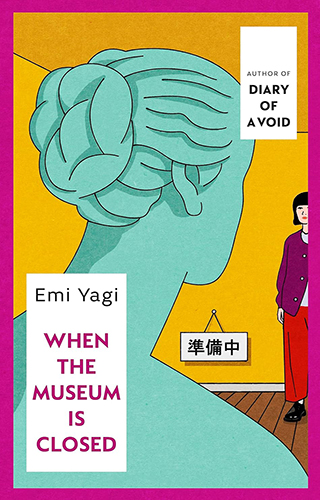
When the Museum Is Closed

Emi Yagi’s 2023 novel When the Museum Is Closed is a refreshing work of magical realism about a shy young woman who falls in love with a statue of Venus. The twist is that the statue loves her back, and – even more miraculous! – their love story has a happy ending.

Rika is a recent college graduate who works in the freezer department of a warehouse for processed food. She sees this as the perfect job for three reasons. First, she never has to talk to anyone. Second, she can take pre-prepared food home from her job, so she rarely has to cook. And third, an invisible yellow raincoat suddenly appeared over her clothing in elementary school, and she’s found it almost impossible to remove in public. The heavy vinyl fabric keeps her body temperature high, but that’s not a problem in an industrial freezer.

The only variation in Rika’s days comes from her part-time job. Once a week, Rika takes the bus to a local museum to have an hour of conversation with a statue of Venus. Venus only speaks Latin, but Rika enjoys a freedom with the dead language that she’s never found in Japanese. Though Rika is shy at first, she and Venus become friends, and they eventually fall in love.

Unfortunately, there’s a bit of a situation with a man named Hashibami, the museum curator in charge of the statue. He wants Venus all to himself, and he never wants her to change – he doesn’t want her to learn modern languages, and he certainly doesn’t want her to learn about the world outside the museum.

Venus therefore makes a deal with Hashibami. If he can get Rika to fall in love with him, she’ll allow him to fire Rika from the conversation job. Regardless, Rika isn’t interested in men, nor does she allow Venus to push her away. What Rika wants is something else entirely, and her relationship with Venus has given her the courage to chase their mutual joy.

The fantastic elements of When the Museum Is Closed are presented as entirely mundane, and it’s easy to take them at face value. At the same time, the love story between Rika and Venus resonates at an allegorical level with the experience of having a queer crush on someone who’s friendly and flirtatious yet seemingly unattainable. It’s the crush you have on an older coworker, or the crush you have on an internet friend, or the crush you have on the gayest girl you’ve ever met who is, inexplicably, married to a man. It doesn’t really matter that Venus is a statue, as anyone who’s experienced queer longing can relate to Rika’s situation. At the same time, Emi Yagi’s Venus is animated by her own distinct personality and undeniably lovely.

I’m sure that When the Museum Is Closed could also be read as an allegory for how women tend to be treated in male-dominated artistic and curatorial spaces, but the story is far more concerned with Rika’s subjective experience of her own individual life. I especially enjoyed the subplot involving Rika’s friendship with her landlord, a quirky but kind elderly woman who needs home care assistance, and I appreciated the understanding Rika develops with the neglected young boy who lives next door. Though Rika’s invisible yellow raincoat is unique to her, she’s far from the only person carrying unseen baggage, and it’s not necessarily the case that this is a problem that needs to be fixed.

When the Museum Is Closed is a short but expertly paced novel that moves quickly yet still allows the reader enough time to appreciate each scene. Its premise is intriguing and well-executed, and Yuki Tejima’s delightful translation captures the author’s tone perfectly, both in Rika’s deadpan observations and Venus’s mature flirtations. Readers who enjoyed Emi Yagi’s novel Diary of a Void will be pleasantly surprised by When the Museum Is Closed, which features the same sharpness and clarity of writing augmented by lovely moments of sweetness.

Retrograde

Retrograde collects five short stories and one novella written by a young Osamu Dazai and gorgeously translated by Leo Elizabeth Takada.

The novella, Das Gemeine, follows a 25yo student studying French literature who aspires to become a writer himself. While hovering around an amazake stand in Ueno Park and hoping to catch the attention of the young woman who works there, the narrator meets another student, a violinist who barely attends class at all. The violinist’s friend, himself a painter, warns the narrator not to believe any of the violinist’s tall tales about his supposed talent.

The three young men decide to start a literary journal together (along with their pathetically unattractive acquaintance Osamu Dazai), but petty personality conflicts crash the project before it can get off the ground. Feeling hopelessly at a loss in letters and in love, the narrator meets a sad fate that may not have been entirely an accident.

One of the many myths surrounding Osamu Dazai (the author, not the character) is that he considered himself to be a failure rejected by the mainstream literary establishment. For better or worse, I can relate. I know from personal experience that, as an outsider, you often find yourself placing your work in the hands of upstart editors organizing projects that may, in all likelihood, never see the light of day. More often than not, things fall apart precisely because the creative team had big dreams but no practical skills to realize their ambitions. 

I myself am something of a coward who immediately walks away from that sort of unpleasantness, but my familiarity with creative collaboration mishaps makes me respect the truth of the story Dazai tells in Das Gemeine, which is remarkably well-observed. The characters in this novella are deeply frustrating and more than a little cringe, but they’re 100% real – this is exactly what it’s like to work with creatives in their twenties who build castles in the air but haven’t yet developed the artistic discipline to commit their visions to paper. Bless their hearts.

The five shorter stories in the collection read like something that the narrator of Das Gemeine might actually have written. A 25yo man dies tragically and is mourned by his beautiful wife. A college student sits for the final exam of a French literature class he never attended. A high school student obnoxiously flirts with café waitresses but swiftly loses a fight with a grown man who’s not interested in his sophomoric bullshit. A teenage boy experiences a sexual awakening when the circus comes to town. Each of these stories is only a few pages long, and their unguarded sincerity contributes to their charm.

The closing story, “Blossom-Leaves and the Spirit Whistle,” is about two sisters in love with an idealized version of a man who only exists on paper until the strength of their shared storytelling summons his ghost to appear under their window… perhaps. I appreciate this story’s clever touch of Todorovian fantasy, and I’m always here for unapologetic gothic pathos. This aesthetically luxurious story is classic Dazai, in that it’s exactly the sort of work that’s contributed to his popularity among generations of students. I myself am not immune, of course, and this is by far my favorite piece in the collection.

In their “Translator’s Afterword,” Takada describes Dazai’s writing style as “a casual conversation with someone familiar,” and they explain that they want their translation to feel as if they’re “doing this just for you,” the reader. Takada gets the tone exactly right, rendering Dazai’s straightforward prose into an invitation to sympathize with the writer and his characters even despite their naked sincerity. I’ve never responded to overly “literary” renditions of Dazai’s prose, but I found myself flying through this translation. It’s fantastic.

I also want to highlight the care and attention that One Peace Books has put into the layout and typeset of this book, giving the words on the page exactly the room they need to breathe. Retrograde is a lovely object to hold in your hands, so much so that it might even spark the same youthful enthusiasm for literature that Dazai so aptly captures in his early fiction.

Much love to Leo Elizabeth Takada and One Peace Books for breathing fresh life into these classic stories from the 1930s. Retrograde is an admirable achievement, and I hope it brings the work of a fascinating author to new readers.

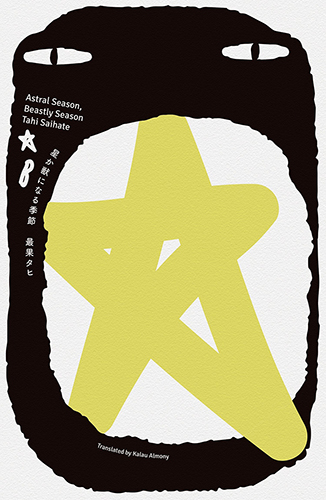
Astral Season, Beastly Season

Tahi Saihate’s Astral Season, Beastly Season (translated by Kalau Almony) is a novella about toxic high school friendships and girl group fandom gone horribly wrong.

In the first half of the book, a junior in high school named Yamashiro writes a letter to an unpopular “underground idol” named Mami Aino. Mami, who is still in high school herself, was arrested on the charge of murdering her ex-boyfriend. Another boy in Yamashiro’s class, Morishita, takes the news poorly and decides to commit a series of copycat murders so that he can confess to the crime Mami committed and take the fall in her place.

Unlike Yamashiro, Morishita is attractive, popular, and a model student. Why he’s a fan of a fledgling girl group with such a small following is unclear, and it seems like an incredible coincidence that both Yamashiro and Morishita would be attracted to the same super-indie performer. Although Yamashiro doesn’t seem to be aware of this, I strongly suspect that Morishita is much more attracted to Yamashiro than he is to Mami.

Regardless of motive, Morishita’s intention to commit murders is sincere, and he wastes no time getting started on his grim task.

The second half of the book takes place several years later, when Morishita’s childhood friend Aoyama meets up with Watase, a high school classmate of one of Morishita’s victims. Watase accuses Aoyama of portraying the murderer as “an all-around good guy” in an interview he gave to a tabloid magazine, and she wants him to apologize. Before the two of them get a chance to have a proper conversation, Aoyama is contacted by the brother of another of Morishita’s victims. This young man also wants closure, but what was going on in Morishita’s head will forever remain a mystery.

I have to admit that Astral Season, Beastly Season left me cold. More than anything, this is a book about the friendship dynamics of a small group of high school students. The novella doesn’t dwell on the psychology of the criminals, nor does it offer much description of what underground idol culture is or what it’s like to participate in this sort of fandom.

Instead, the reader is inundated with inane details about who is friends with whom, and who does and doesn’t walk home together, and who ignores other people on the train, and who went to a café together, and who is and isn’t talking to whom, and who said something mean after class, who doesn’t want to be in a group together on a school trip.

Amidst the swirl of teen friendship drama, the actual murders seem like little more than an afterthought. Were it not for the second half of the book, one might even argue that Yamashiro and Morishita are just pretending to plan and commit crimes. In fact, I tend to think that the story might actually be more interesting if this were the case. None of the characters has anything particularly insightful to say after the time skip, and the reader never learns anything about what Mami or Morishita might have been thinking or feeling. It’s all a bit disappointing.

There are two points of comparison that might bring the novella’s story into sharper contrast. The first is Yukio Mishima’s classic novel The Temple of the Golden Pavilion, a psychological drama about the (heavily fictionalized) young man who set fire to the eponymous landmark in 1950. It’s a gorgeous piece of writing, and Mishima is fascinated by the mind of a teenage loner who commits a serious crime, especially with respect to how this crime results from an intense homoerotic friendship. Another interesting companion novel is Rin Usami’s Idol, Burning (which I reviewed here), which I feel offers a much more sensitive and astute portrayal of the role that pop music fandom can play in the life of an emotionally precarious teenager.

I get the feeling that Astral Season, Beastly Season might have benefitted from a translator’s afterword explaining who the writer is and what the context for her work might have been. It might be a worthwhile project to discuss this novella in a college class or an academic paper, especially given Tahi Saihate’s status as an internet-famous visual artist who uses text to create eye-catching public art installations, but I’m not sure it stands on its own as a work of fiction. 

If nothing else, the novella is painfully honest about how high school friendship drama can feel life-shattering and world-changing to the people involved. Still, whether this sort of story is worth spending time with really depends on the interests and taste of the reader. It wasn’t for me, but perhaps a younger reader might feel a stronger sense of immediacy and connection to a beautiful high school boy who commits terrible crimes.

薬指の標本

Yōko Ogawa’s 1994 book Kusuriyubi no Hyōhon (薬指の標本) brings together two novellas that feel spiritually akin to The Memory Police, which was originally published in the same year. Like The Memory Police, the two novellas in Kusuruyubi no Hyōhon are set in a seemingly normal world haunted by a sense that something important has vanished. These stories are about ordinary people who come into contact with pockets of magic whose mundanity belies their deep strangeness.

The narrator of the first story, Kusuriyubi no Hyōhon, has moved to the suburbs after losing a portion of her ring finger in an industrial accident. While walking through the neighborhood, she encounters a handwritten “help wanted” sign taped to the front door of a “specimen museum” (標本室) operating in a building that once served as a dormitory during the postwar period. With no connections and no other job prospects, the young woman interviews for and accepts a position as a receptionist.

It’s not entirely clear what exactly the museum’s “specimens” are, and their method of manufacture is a mystery. Regardless, anyone is welcome to bring an object representing a traumatic experience to the museum, where it will be registered, cataloged, and preserved. Through each object’s transformation into a specimen, the pain of its associated memories disappears.

The narrator becomes the focus of the intense gaze and possessive interest of the artist who creates these specimens. Though she loves him, he forbids her to enter his underground workshop. Given the apparent disappearance of the people who requested that specimens be made from parts of their own bodies, the narrator can’t help but wonder what would happen if she entered the artist’s forbidden underground chamber and asked him to work his magic on what remains of her severed ring finger.

The narrator of the second story, Rokkakkei no Kobeya (六角形の小部屋), is a nurse at a large hospital where she recently ended a serious relationship with one of the doctors. She becomes fascinated by two middle-aged women she encounters in the locker room of a local sports club; and, with little else to occupy herself during the long winter evenings, she trails them to a semi-abandoned danchi housing complex.

One of these women, Midori, operates an odd service in the former apartment manager’s office. The “Katari Kobeya” (語り小部屋) is a small, self-contained room with six soundproof walls. Anyone who enters this room can speak to their heart’s content, thereby relieving themselves of the psychological burden of their secrets.

The narrator has no secrets to speak of, but she becomes friendly with Midori and her handsome son. In order for the magic of the Katari Kobeya to remain effective, however, it can’t remain in one place for long. If the narrator comes too close to this strange liminal space, she runs the risk of another heartbreak.

In her monograph The Pleasures of Metamorphosis, Lucy Fraser describes Ogawa’s stories as having a fairytale-like quality, and this is certainly true of the two novellas in this book. In Rokkakkei no Kobeya, the narrator follows two women through the trees of a snowy park at night and thereby finds herself in a warm and comforting sanctuary that can be found only by those in need. Meanwhile, Kusuriyubi no Hyōhon has echoes of Bluebeard, with an older man forbidding an inexperienced young woman from entering a special room in his gothic mansion.

In addition to the subtle inclusion of fairytale tropes, the ethereal quality of Ogawa’s writing is partially due to what Elena Giannoulis, in her article “The Encoding of Emotions in Ogawa Yōko’s Works,” calls the writer’s “mood tableaux.” Giannoulis argues that Ogawa generally doesn’t reveal much below the surface of her characters’ placid demeanors, nor do her characters go out of their way to offer psychologically perceptive commentary on the world around them. Instead, Ogawa creates a “mood” by describing what the narrator perceives with their senses. By thus crafting a vivid picture of a setting unimpeded by value judgments, Ogawa invites the reader to associate their own feelings with the cinematic tableaux they see in their mind’s eye.

Giannoulis’s argument makes perfect sense to me, especially in relation to Kusuriyubi no Hyōhon. I find the texture of Ogawa’s writing to be similar to the visual style of Hirokazu Kore’eda, who allows the camera to linger on the small details of his characters’ environment while the characters themselves remain silent. These settings tend to be mundane in the extreme, and Kore’eda luxuriates in the interiors of older structures that have become dirty and dilapidated. As in Kore’eda’s films, the combination of nostalgia and neglect lends a subtle touch of pathos to the quiet drama of Ogawa’s stories.

Kusuriyubi no Hyōhon is a meditation not on what has vanished, necessarily, but rather on what remains behind. In these two novellas, Ogawa speaks to the dignity of people, places, and objects that are in danger of being forgotten. No one would notice if anything in Ogawa’s stories disappeared – but she has noticed, and now the reader has noticed, too. Still, though there’s a certain tonal warmth and narrative coziness to Kusuriyubi no Hyōhon, Ogawa never allows the reader to relax. As in any fairytale, there’s always a sense of danger, as well as the intriguing strangeness of half-remembered liminal spaces.

がらんどう

Asako Ōtani’s novella Garandō (がらんどう), which won the 46th Subaru Literary Prize in 2023, follows two 40yo women as they settle into a cozy life as adult flatmates.

Hirai recently moved in with her friend Suganuma, who suggested that they live together so they can afford a nicer apartment. The two women met as adults through their shared fandom of the boy band KI Dash, and they managed to remain friends during the pandemic despite drifting away from their other friends and family members.   

Hirai works in an office, while Suganuma is a self-employed artist who uses a 3D printer to create custom memorial figurines of her clients’ deceased pets. The two women share chores and meals, sometimes cooking for each other and sometimes going out to eat. Although they’re not romantically involved, they often fall asleep together in the living room while watching KI Dash performances on DVDs that they play on an old PlayStation 2.

When Suganuma’s star idol suddenly marries an adult video actress, Hirai takes her flatmate to the beach for a breakup vacation. Afterward, Suganuma begins dating a married man she met at the hotel bar. Hirai is jealous but understands that this is simply the way of the world.

In resignation, Hirai signs up for a dating app, but this goes poorly. Her lack of success is partially because she’s aggressively targeted by someone involved in a multi-level marketing scam, but it’s mostly because Hirai is about as asexual and aromantic as someone can be. She has a vague aspiration of having a child one day, but is that really what she wants?

For Hirai’s birthday, Suganuma ends her relationship with the sleazy married man and uses her 3D printer to manufacture a baby as a gift for her flatmate. The story closes in much the same place it began, with the two women happy and secure in one another’s company. The title of the novella, Garandō, means “empty,” and it most directly refers to the hollow centers of Suganuma’s 3D-printed figurines. This title might at first be taken to refer to the relationship between Hirai and Suganuma as well, but their friendship is anything but hollow.

Because really, what’s to stop two adult women from spending their lives happily together as flatmates? Why do two people need to be married or related in order for it to be “normal” for them to live together? Is your life really “empty” if you don’t get married and have children?

More than anything, Garandō reminds me of Banana Yoshimoto’s bestselling 1988 novel Kitchen, which presents alternate models of modern families while comforting the reader that, even if you’re not “normal,” life is still well worth living. Granted, Hirai and Suganuma are older than the characters in Kitchen, and they’re not living in the lap of Japan’s bubble-era luxury. In addition, Ōtani’s writing style is relatively sardonic and dry, especially when compared to the bubblegum pop of Kitchen. Still, Garandō is a positive story about two weirdos who manage to find happiness. Even if their lives don’t follow the standard model, they’re doing okay.

At a slim 112 pages, Garandō is a quick read. Ōtani has a wonderful sense of pacing, juxtaposing scenes of comfort inside the home with scenes of (highly relatable) social awkwardness in the outside world. I really enjoyed this book, which pulls off something I appreciate – the normalization of “difference” without resorting to sentimentality or melodrama.

What Ōtani demonstrates in this meticulously crafted novella is that people like Hirai and Suganuma are less uncommon than you might think, and that’s cool. And honestly, given that a house and a nuclear family have become distant dreams for many of us, why not join them? 

Someone to Watch Over You

Kumi Kimura’s 2021 novella Someone to Watch Over You is a subtly unnerving story about the strangeness of the Covid pandemic.

46yo Tae lives alone in her deceased parents’ house in a small town in northern Japan. She formerly worked as a middle school teacher, but she left the job after the death of one of her students. Now she lives on her inherited savings while leaving the house as infrequently as she possibly can.

Tae’s solitary lifestyle is unaffected by the onset of the Covid pandemic, but the “stay home” orders were followed by three unpleasant incidents in quick succession. An older man who’d just retired is found dead in an apartment on Tae’s street, and someone paints graffiti on the front wall of Tae’s house. Tae also receives an odd message from the father of the deceased student on her answering machine. These three incidents blend together into a paranoid fantasy that convinces Tae that she’s being stalked.

After a handyman named Shinobu treats Tae with kindness while cleaning her bathroom drain, Tae asks him to guard her house. Shinobu, who desperately needs the cash, readily agrees. During the pandemic, he’s been forced to live in the garden shed of his parents’ house, which is currently occupied by his brother’s family. Shinobu’s sister-in-law won’t talk to him, and his niece is weird and creepy in a way particular to young teenage girls.

Tae eventually asks Shinobu to move into her house so he can keep watch full-time, but this arrangement is supremely awkward. Both Tae and Shinobu are deeply damaged people, and Tae’s insistence on maintaining social distancing rules inside her own home stunts the development of any sort of friendly relationship between them. By the end of the novel, the reader wonders if Shinobu is any better off at Tae’s house than he would have been living rough.

To speak personally, a sudden change in employment forced me to scramble to move to a different city in April 2020. Due to social distancing, I had no opportunity to form and renew social connections, and the following two years were intense and unpleasant.

Someone to Watch Over You doesn’t reflect my individual circumstances, but it perfectly conveys the sense of displacement and alienation I experienced during the pandemic. It’s validating to see this sort of surreal experience taken seriously, especially since I definitely wasn’t alone in having a bad time during the lockdowns. I don’t think it’s healthy to dwell in past trauma; but, at the same time, the cultural expectation to pretend that all of this didn’t happen four years ago can sometimes feel maddening.

The back cover of Someone to Watch Over You promises “an unlikely connection” and asks if Tae and Shinobu can “become one another’s refuge,” thus suggesting the possibility of a heart-warming conclusion to the story. This does not happen, not by a long shot. While I fear that some readers may be disappointed by the weirdness of the ending, I appreciate that the author didn’t pull her punches. The Covid pandemic was indeed strange and unpleasant, and Someone to Watch Over You is one of the truest fictional accounts of the pandemic I’ve encountered.

Someone to Watch Over You is well-written and carefully translated, and I found myself fascinated by the dysfunctional characters and pulled along by the downward momentum of their story. This disturbing little book is compelling in its use of the pandemic as a stage for exploring the darker mysteries of mundane life, and I admire how Kimura revisits this particular moment of history without the comforting lens of nostalgia.