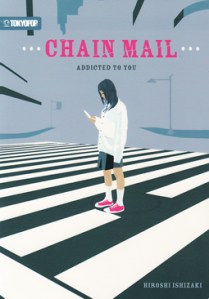
Title: Chain Mail: Addicted to You
Japanese Title: チェーン・メール―ずっとあなたとつながっていたい
Author: Ishizaki Hiroshi (石崎洋司)
Translator: Richard Kim
Publication Year: 2007 (America); 2003 (Japan)
Publisher: Tokyopop
Pages:209
Okay, I’ll admit it: when I came back home from Japan this past summer, I got really into Stephenie Meyer’s Twilight series. I know that many people like to complain about how the books are poorly written, misogynistic, heterocentric, painfully conservative, blah, blah, blah (I’m surprised no one has ever called them “phallogocentric” – that’s my personal favorite). First of all, the Twilight books are not poorly written; anyone who’s actually seen “poorly written” can attest to that fact. Second, I like to turn my feminist switch off when I read sparkly teenage vampire romance novels.
In any case, the Twilight series alerted me to the existence of the American genre of young adult fiction in a way that Harry Potter never did. (I think this is partially because I wouldn’t be caught dead reading “young adult fiction” when I was actually a “young adult,” but kids were a lot cooler seven or eight years ago.) I went to my local Borders and started doing market research, finding that, indeed, young adult fiction is a thriving genre, even though the vast majority of it is absolute crap. Perhaps the only good thing about the sudden popularity of the genre is that manga publishers like Tokyopop have started translating and publishing Japanese light novels.
A light novel is the Japanese equivalent of young adult fiction. These short, middle-school reading level books read like the plot of a manga, are often illustrated by noted manga artists, and are generally serialized like manga. Many popular anime, such as Slayers (スレイヤーズ) and The Melancholy of Haruhi Suzumiya (涼宮ハルヒの憂鬱) are adaptations of even more popular light novel series. Just as is the case with America, most light novels are absolute crap, and you will find a good selection of these less-than-stellar light novel series in Tokyopop’s catalog. Thankfully, the company has chosen to publish a few good light novels, even if they don’t have brand-name recognition.
One of my favorite offerings from Tokyopop is Ishizaki Hiroshi’s Chain Mail. Ishizaki has penned the text of several manga, most notably Miss Black Witch’s Halloween (黒魔女さんのハロウィーン), but he is also quite famous in Japan as an author of realistic fiction for young women. Although the plot of Chain Mail is somewhat far-fetched, this novel focuses on the development of its characters and their daily life as high school students in Tokyo.
What attracted me to this novel was its narrative structure. The narrative is divided between three narrators: Mai, Sawako, and Mayumi. These three girls, who may or may not know each other in real life, play a game in which they collaborate on a murder-mystery novel via posts made to an online message board on their cell phones (the internet is widely available on Japanese cell phones and has been for years). Thus, the narrative switches between the main story and the story that the girls are writing. Each girl is in charge of a certain character in the online story, and things get interesting when the events that happen to the characters in real life start to mirror the events they write into the story. There is never a hint of anything supernatural, but the blurred identities and real-life mysteries are quite uncanny.
Although only one of the three characters can be called sympathetic, I did feel a great deal of sympathy for each of them. Ishizaki doesn’t pull punches in his characterization and shows each of the three girls at her weakest moments. These three girls, who have been damaged by their families and the pressures forced on them at school, seek real friendship and connection through a cell phone game that had initially been created as a joke. Is the story pathetic? You bet. But it’s also touching and exciting, with lots of Nietzsche and Shibuya thrown in for good measure.
I would highly recommend Chain Mail to anyone interested in young adult literature, contemporary Japanese popular culture, or even Japanese literature in general. It’s a fascinating book, even if it doesn’t have pictures. Other fiction I would recommend from Tokyopop includes the Twelve Kingdoms series (by Ono Fuyumi), Kino’s Journey (by Sigsawa Keiichi) and anything written by Otsuichi, like Calling You or Goth. Tokyopop has recently taken down the “novels” section of its website, which makes me worry that the company doesn’t see a future for them, but I will go ahead and provide a link to their light novel catalog:
 Contemporary Japanese Literature