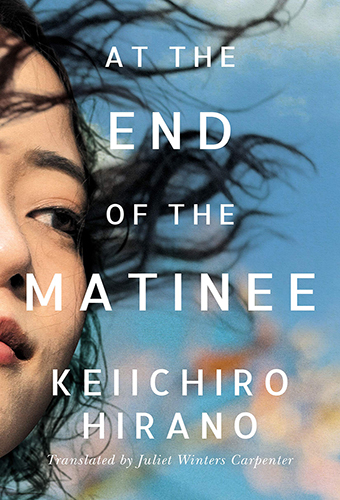
Keiichiro Hirano’s 2016 novel At the End of the Matinee is a love story about two exceptional people kept apart from one another by miscommunication and the circumstances of their careers. Their story spans a decade and crosses continents as they gradually come to accept that doing what society expects of them isn’t always the right choice.
Satoshi Makino is a young but immensely talented classical guitarist who has garnered fame for the originality of his studio recordings and the brilliance of his orchestral concerts. Yoko Komine is an acclaimed international journalist covering America’s war in Iraq during the early 2000s. The two meet in Tokyo after one of Makino’s concerts, and they immediately hit it off. During the time that Yoko is stationed in Baghdad, she and Makino exchange long emails about books, music, and art.
After a missed opportunity to consummate their relationship in Paris and a missed connection in Tokyo, Yoko cuts her ties with Makino and marries an American economics professor. Makino, who is busy caring for his aging guitar teacher, allows the distance between them to grow and ends up marrying his manager, Sanae.
Yoko’s marriage ends when her sense of ethics as a journalist leads her to realize that her husband is morally bankrupt, as is everyone in his circle of Wall Street friends. When she has an opportunity to attend one of Makino’s concerts, Yoko is approached by Sanae, who reveals the real reason why Makino never met her in Tokyo.
Despite their inability to communicate their feelings to one another at critical moments, I wanted Yoko and Makino to get together. Though the novel has a somewhat ambiguous ending, all signs point in the direction of reconnection and reconciliation. Still, because both parties are grown adults with busy professional lives, their love story is complicated. It’s the complications that make this story compelling, however, and I believe this is precisely the effect the author is trying to achieve by showing how the characters choose to prioritize different facets of their personalities based on the shifting circumstances of their lives.
At the same time, I have to admit that there’s something small and bitter in the back of my mind that wanted Yoko and Makino – who are both extremely wealthy and accomplished – to suffer. I feel like the fantasy represented by these characters is the dream of a generation that could actually achieve this sort of lifestyle and professional success, and I found myself resenting the trajectories of the characters’ lives and careers. At the End of the Matinee feels oddly like a period piece, but the 2000s are a bit too close to the present for me to be able to enjoy the fantasy of “brilliant people optimizing their talents while discovering their authentic selves” without reservations. As I wrote above, though, it’s the complications that make the story compelling, including the friction I felt between the author’s idealized version of the 2000s as an era of progressive change and its reality as the onset of our current neoliberal hellscape.
More than anything, what I love about At the End of the Matinee is Juliet Winters Carpenter’s translation, which is beautiful at a sentence-by-sentence level. Carpenter’s translation has the same air of culture and refinement as the characters, and it was a joy to immerse myself in this style of highly polished prose. Though I occasionally found myself annoyed by Makino and Yoko’s perfection while resenting their privilege, I can’t deny that they’re both magnetic, and Carpenter’s luminous translation of their conversations goes a long way toward making them feel like real, breathing people.

