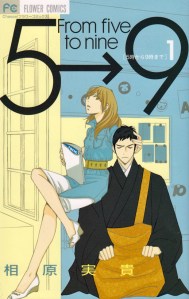
Title: From Five to Nine
Japanese Title: 5時から9時まで (Goji kara kuji made)
Author: Aihara Miki (相原 実貴)
Publication Year: 2010 (ongoing)
Publisher: Shōgakukan
Pages (per volume): 190
From Five to Nine is the current project of Aihara Miki, whose manga Hot Gimmick and Honey Hunt have been published in English translation by Viz Media. Like Aihara’s earlier titles, From Five to Nine is a drama-filled exposé of the love lives of gorgeous young people going about their business in the trendy districts on the southwest side of Tokyo. From Five to Nine is serialized in Monthly Cheese!, an unfortunately named magazine that serves as a bridge between a shōjo readership of tweens captivated by stories of pure love and a josei readership of young women interested in the more physical aspects of romantic relationships. In accordance with the magazine’s house style, all of the characters in the manga are well dressed and ridiculously attractive, emotional and sexual tensions always run high, and chapters end on cliffhangers more often than not. In other words, From Five to Nine is highly entertaining, addictive reading. It’s designed to be.
What I think is interesting about this manga is the way it explores the conflicts between different gender roles and expectations of femininity through the love affairs of its main protagonist.
Sakuraba Junko, the leading lady, teaches during the evenings at an English language conversation school (Eikaiwa gakkō). Because of her friendly professionalism and almost native fluency, she’s considered to be one of the top instructors at her workplace, and her dream is to save up enough money to study abroad in America. Since Junko has passed through her early twenties without having settled down with a man, her grandmother has started to set her up on dates with potential marriage partners through a somewhat formalized process known as miai. To appease her grandmother, Junko spends her twenty-seventh birthday out on a miai date with a Buddhist monk named Hoshikawa Takane, who graduated from Tokyo University with a major in Indian philosophy. Junko is put off by what she sees as Hoshikawa’s snobbishness; but, thinking that their date is a one-time thing and that she’ll never see him again, Junko ends up sleeping with him on a lark. For Hoshikawa, however, that one night is the beginning of TRUE LOVE FOREVER.
Because this is a manga by Aihara Miki, Junko is fated to be the unfortunate object of nonconsensual manly persuasion concerning a relationship that she doesn’t particularly care for. Immediately after Junko gets back from her one night stand with Hoshikawa, she realizes that the deadline to move out of her apartment, whose building is slated for renewal, is fast approaching. When she goes to her grandmother for help, her grandmother suggests that she take temporary residence (geshuku) in a temple with connections to the family. Unfortunately, this temple is headed by Hoshikawa, who now wants to make Junko his temple wife (tera no yome). Being a temple wife is a full-time job, and a marriage to Hoshikawa would require Junko to give up her position at the English conversation school where she currently works, as well as her dream to study abroad. Essentially, if she were to marry Hoshikawa, Junko would have to give up the pleasures of her existence as an independent urbanite and spend her days cooking, cleaning, dressing herself in traditional clothing, setting out flower arrangements, and entertaining guests. Needless to say, she wants none of this. Hoshikawa won’t give up on her so easily, however, and he takes to stalking her, abducting her, and harassing her at both at home and at her workplace. One particularly unpleasant stunt Hoshikawa pulls is to lock Junko up in a small guesthouse separated from the main temple compound by an ornamental garden. In order to escape, Junko agrees to marry Hoshikawa; and, to keep him fooled regarding her true intentions, she makes a show of waking up early to devote herself to cleaning, all the while scheming of ways to get away from the temple.
Meanwhile, her college friend Mishima Satoshi, who has been assigned to his company’s branch office in America, shows up at Junko’s school in order to brush up on his English. Mishima has feelings for Junko and harbors a secret desire to take her to America with him; but, as Junko becomes more aware of Mishima’s intentions and her own reciprocal feelings for him, she surprises herself by becoming conflicted over leaving Hoshikawa and the life he’s offering her. Junko has also attracted the interest of one of her younger pupils, a wealthy student at an elite high school who cross dresses so effectively that only a small handful of his friends know that he’s actually male. This student, Satonaka Yuki, dislikes both Hoshikawa and Mishima and wants Junko to be able to stand on her own two feet outside of relationships with creepy stalker monks and alcoholic playboy salarymen.
This is high melodrama, of course, but what is interesting about Junko’s love life is how aptly it represents the push and pull between traditional and contemporary women’s roles. Should Junko give into social and sexual pressure and relinquish her independence and her dreams, or should she take advantage of a potential romantic partner’s kindness in order to break free of the constraints of living in Japan? Is it possible for her to somehow fend for herself without a social and economic safety net? Because of the romantic drama, the reader is able to experience the emotional attraction and anxiety of all of these possibilities. For example, when Hoshikawa does something ridiculous in order to (sometimes literally) lock Junko into a traditional gender role, the denial of agency that Junko suffers is viscerally upsetting to the reader. As it gradually becomes clear that Hoshikawa genuinely cares for Junko, however, it also becomes clear that Junko’s spirited resistance might be able change the way he sees the responsibilities and aspirations of the women of his generation. In this way, Hoshikawa serves as a representative of a society that is still primarily dominated by phallocentric interests. He’s scary, and his behavior is obviously psychologically unhealthy, but he can be persuaded to change by a woman smart enough and tough enough to take him on, even if she’s coming from a position of relative disadvantage. The sort of “he can change” mentality Junko comes to embrace is presented as being just as dangerous in the fictional world of the manga as it is in real life, but the alternative – “he will never change” – would be a bleak prognosis on the sort of patriarchal mentality Hoshikawa represents. The possibility that Hoshikawa can change himself as he learns that women are people too (gasp!) is an element of social optimism that serves as an emollient to the seemingly misogynistic sexual drama of the manga.
Two other female employees at Junko’s workplace, Yamabuchi Momoe and Mōri Masako, act as counterpoints to Junko’s situation by providing different attitudes towards employment, love, and marriage.
Along with Junko, Momoe is one of the most professional and sought after instructors at the conversation school, but she has a reputation for being standoffish and emotionally chilly. Although she’s all business in the office, she secretly loves yaoi manga. When Arthur Lange, a blond-haired foreign instructor from Britain, discovers Momoe’s hidden interests, he uses the threat of revealing her identity as a fujoshi to her boss to blackmail her into a relationship. Although Momoe enjoys fantasies of attractive, foreign-looking men being sexually aggressive and emotionally manipulative, the enactment of her fantasy is much more unpleasant in real life than it is in the pages of yaoi manga. Momoe is older than Arthur, but she has never had any romantic experience, and she constantly second-guesses her reactions to his teasing and bullying. She therefore often finds herself in the position of wondering how a woman her age should behave towards men, even though she wants nothing to do with them.
Masako, a receptionist at the English conversation school where Junko and Momoe teach, is a recent college graduate who, more than anything, wants to settle down with a boyfriend and become a housewife. Her coworkers tease her by calling her “Zexy,” a nickname taken from the title of a wedding and bridal magazine. Since Masako is attractive and intelligent, her standards for a partner are high, and she can’t find anyone her own age who meets them. Unfortunately, having cultivated an attitude of flirtatious approachability, she finds herself the constant target of unwanted male attention, especially in the form of sexual harassment from middle-aged men.
Junko’s English conversation school is thus a microcosm of Japanese society staffed by different women with different expectations, goals, and challenges concerning their futures. Although the manga focuses on its three main female characters, the male characters are also allowed enough interiority for the reader to see them working, talking to each other, and thinking about their own dreams and romantic problems. All of these characters work at cross purposes because of the artificial drama created by the manga artist, but their attitudes and emotional conflicts ring true to real social expectations and gender roles.
From Five to Nine is a fascinating exploration of contemporary Japan with enough intersecting plot lines, character development, and thematic subtlety to keep even the most demanding readers engaged. The obi bands around the manga covers tout the series as “a Tokyo version of Sex and the City,” and that should be recommendation enough for anyone seeking a fast-paced, hormone-fueled examination of gender roles in the twenty-first century.



 Contemporary Japanese Literature