Hotel Iris

Title: Hotel Iris
Japanese Title: ホテルアイリス
Author: Ogawa Yōko (小川洋子)
Translator: Stephen Snyder
Publication Year: 2010 (America); 1996 (Japan)
Publisher: Picador
Pages: 164

Hotel Iris is the third work by Ogawa Yōko to appear in print in America, following The Housekeeper and the Professor and The Diving Pool. Having read several of her works now, I think I am starting to get a feel for her style of writing, which is beautifully conveyed by translator Stephen Snyder. Ogawa takes the everyday and imbues it with a sense of strangeness. Nothing overtly fantastic happens in her stories, but everything is always a little unsettling. Something is always a little bit off. There is always a sinister current running underneath the mundane. In Ogawa’s novels, the petty cruelty of human beings is on full display, but it is up to the reader to uncover the mystery of a deeper cruelty. The questions that aren’t answered are more upsetting than the questions that are.

In Hotel Iris, a seventeen-year-old young woman named Mari has been forced to drop out of high school by her mother, who needs her to work at the family’s seaside hotel. Since Mari’s father has died, Mari’s mother has taken on a kleptomaniac housekeeper, who not-so-secretly steals from Mari. When, one night, a prostitute flees from one of the rooms in the hotel, Mari finds herself attracted to the older man from whom the woman flees. This older man, who lives by himself on an offshore island, is a translator of Russian. He falls in love with Mari, who craves the sexual masochism he displays when the two are alone. The specter of the man’s dead wife, whom he is rumored to have killed, haunts their relationship, which is further strained when the translator’s tongueless, college-age nephew stays over for a few days.

These relationships develop over the course of this short novel, which is narrated by Mari, who hints at her desires, frustrations, and rich inner world through anecdotes and observations instead of through direct statements. The novel unflinching depicts all manner of sexual acts, but its eroticism and sensory imagery are focused not on the meeting of bodies but rather on the depictions of small, everyday things, like a stain on a scarf, the music of an amateur, or the dripping of pizza grease. The narrative tension created by the almost constant yet varied reiteration of certain themes, like the fear of something hidden being uncovered or the uncertainty of how far violence can go, prevents the reader from ever settling into complacency concerning Mari’s life and her relationships.

In the end, I think, this is a novel about growing up, and all the psychological baggage that goes along with the process. Ogawa warps many psychological tropes (like the Oedipus complex) through her protagonist, however, and Mari’s loss of innocence is neither celebratory nor unproblematic. In many ways, Hotel Iris is something of an antidote to feel-good chick lit novels like Yoshimoto Banana’s Goodbye Tsugumi. It’s dark and it’s disturbing. Its themes and imagery are understated; and, although it has quite a great deal of forward momentum, it is never driven by its plot, much of which is left vague. In my opinion, this is a perfectly constructed and beautifully written novel. Please buy this. Please read it. Please tell all your friends about it. Ogawa has numerous novels translated into various European languages, and we really need more of her work translated into English.
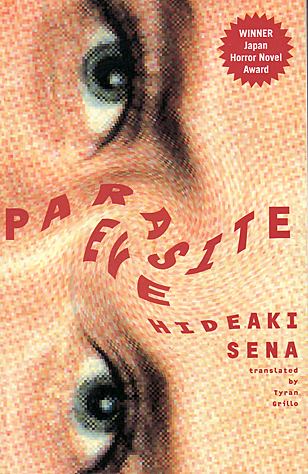
Parasite Eve

Title: Parasite Eve
Japanese Title: パラサイト・イヴ (Parasaito Ivu)
Author: Sena Hideaki (瀬名秀明)
Translator: Tyran Grillo
Publication Year: 1995 (Japan); 2005 (America)
Publisher: Vertical
Pages: 314

Sometimes I know that I should not write a particular review. Sometimes I have nothing nice to say. Sometimes, however, it’s way too much fun to resist writing about a hilariously bad book. This has happened before with Outlet and xxxHOLiC: ANOTHERHOLiC, and now it’s happening again with Sena Hideaki’s horror novel Parasite Eve, which is so bad that it’s almost good.

If nothing else, the premise of Parasite Eve is certainly original. A woman named Kiyomi has a problem with her mitochondria, which have collectively mutated into an intelligent being. These mitochondria gradually take over Kiyomi’s body, killing her and forcing her husband Toshiaki, a pharmaceutical researcher, to cultivate her liver cells. Since Kiyomi was an organ donor, one of her livers has found its way into a fourteen-year-old girl named Mariko, who begins to suffer from nightmares. As Toshiaki’s cell culture, which he has named “Eve 1,” grows, it (she) gains the ability to move around and make herself look like Toshiaki’s dead wife. Since Eve 1 cannot live for long on her own, she wants to create a half-human, half-mitochondria offspring, a project for which she needs Toshiaki’s sperm and Mariko’s womb. Although Eve 1 has a time limit for how long she can survive outside of a cell incubator, she can reshape herself at will and shoot fire. It goes without saying that Toshiaki must find a way stop her.

The narrative shifts between Toshiaki, Toshiaki’s research assistant, Mariko’s father, Mariko’s doctor, and Kiyomi. Eve 1 occasionally gets a few italicized paragraphs, too. Each of these characters is interesting in his or her own right; but, even though none of them are wooden or stereotypical, their characterization felt a bit half-hearted to me. The real focus of the first two-thirds of the book seems to be less on the characters and more on the surgery and scientific experiments they are involved in. Toshiaki’s research and Mariko’s organ transplant are described in loving detail, with all sorts of technical terms accompanied by explanations for the general reader. Even with all the non-fiction exegesis of science and medicine, the narrative progresses normally (if a bit slowly) for 175 pages. Even though there was a bit of Eve 1 shooting orgasms at people (I am not making this up) previously, this is the point at which things get ridiculous.

The next paragraph is filled with spoilers and sex. Consider yourself warned.

In the last third of the book, Eve 1 steps into the spotlight. I was especially struck by how Sena chose to portray her as intensely sexual. When Eve 1 first gains the ability to manipulate her shape while still in the cell culture incubator, she immediately gives herself a vagina and a finger and puts the two together. She then mouth-rapes Toshiaki’s student in order to gain control of her body for a few days before breaking free, at which point she turns herself into a giant vagina and rapes Toshiaki so as to procure his sperm. I kept thinking to myself, I bet Eve 1 is going to grow a penis and rape the fourteen-year-old next. So, when Eve 1 grew a penis and raped Mariko (after a short jaunt through the sewer), I actually laughed so hard that I cried a little bit. At the very end of the book, it turns out that Eve 1’s offspring cannot live (something about the male mitochondria in her body fighting the female mitochondria; don’t ask me). Instead of using her mitochondrial superpowers to generate a small-scale nuclear reaction and blow everything sky high (as I would have done in her situation), Eve 1’s daughter decides to fuse into the body of her father Toshiaki, and all of their cells have sex before they both die. Brilliant.

Body horror seems to be one of the major selling points of Parasite Eve, but body horror needs to be subtle in order to be truly effective. I believe that the body horror in this novel is unsubtle to an extreme, however, and the book has very few genuinely creepy moments. Also, by the end of the story, I really wanted Eve 1 to succeed in her mission of evolving an all-female race of mitochondria mutants, so I was a bit (okay, extremely) disappointed when both her and her daughter were defeated by the patriarchal power structures that pervade the narrative. Also, the idea that a female character needs to be either an innocent victim, a primordial mother, or a hyper-sexualized aggressor is getting a little stale. Seriously, is the dawn of a female race of X-Men with tentacles really too much to ask for?

To summarize, Parasite Eve is somewhat slow and boring for 175 pages, becomes progressively more gross and strange for the next 100 pages, and then ends in a 15 page orgy of fire and violence and slime. In other words, the pacing is a bit uneven, as is the distribution of action and explanation. Overall, reading Parasite Eve felt uncannily like reading a Michael Crichton novel, including the way that the science became increasingly more outlandish as the story progressed. If you’re a fan of Michael Crichton novels (or Dean Koontz novels), then you’ll probably be able to gloss over the flaws in the writing and enjoy Parasite Eve. Sena is working with very interesting material, after all, and his style is neither dry nor unliterary. The translation flows smoothly, and everything from dialog to the description of surgery has been rendered into natural, idiomatic English. If nothing else, it is worth reading through the first two thirds of the book in order to get to the ending. Especially if you’re into the sort of thing that happens during the ending – and, admit it, who isn’t?