Strange Houses is a four-part horror mystery novel about houses with strange and uncanny floor plans.
Each of the four chapters takes the form of a series of conversations between the narrator, their architect friend, and various people who have been involved with the houses. The first three chapters explore three different houses with extra rooms and inexplicable gaps in the walls. These explorations are liberally illustrated with diagrams in which certain sections of the floor plan are highlighted and annotated to clarify the text.
Each of these stories is like a locked room mystery. Over the course of the chapter, the narrator’s architect friend performs a close reading of a floor plan while gradually building a theory concerning what sort of upsetting behavior that type of strange space might enable.
In the final chapter, it’s revealed that these houses are connected to an old and wealthy family with a terrible secret. I have to admit that I found this situation highly improbable, so much so that it comes off as almost cartoonish. The author is great at architectural walkthroughs but skimps on the character development, which contributes to the conclusion of the book feeling somewhat hollow. Still, there’s a lot of fuel for the reader’s imagination, and fans of gothic horror will have a lot to play with here.
I flew through Strange Houses and loved every page. The speculative conversations between characters are easy to follow; and, thanks to the diagrams, the spaces are easy to visualize. I enjoyed the slow build of the overarching mystery, and the revelations about the bizarre family at the center of the strangeness were beyond anything I expected.
It’s worth noting that the first story in Strange Houses was originally written as a script for a twenty-minute video on YouTube, which you can find with English subtitles (here). There’s also a manga adaptation, which has been scanlated and is available to read (here). And finally, I’d like to share a more substantial review of the original Japanese book that was posted on one of my favorite blogs (here).
I tend to think that Uketsu’s earlier novel Strange Pictures (which I reviewed here) is somewhat more successful as a work of fiction with three-dimensional characters whose bad behavior stems from understandable motives. In comparison, Strange Houses feels more like a puzzle box than a novel. Strange Houses is less a character-driven story than it is an imaginative architectural mystery, but its eerie atmosphere and clever narrative structure make it a fascinating read for fans of speculative horror and uncanny design.
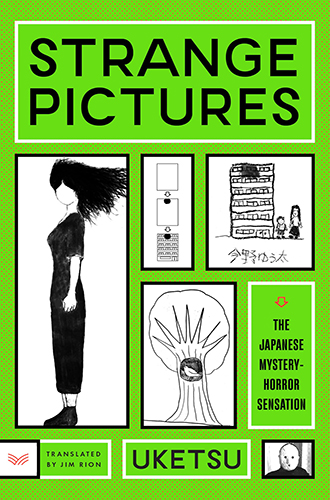
Strange Pictures is a compulsively readable horror mystery novel first published in 2022 by Uketsu, a mysterious masked YouTuber. This book is addictive, so much so that I accidentally spent an entire afternoon and evening reading it. So be warned – Strange Pictures is indeed strange, and it will hold you hostage.
In the five-page prelude that introduces the book’s premise, a psychology professor shows her class a photo of a picture drawn by a girl who killed her mother. The drawing is a childish self-portrait that shows the girl standing between her house and a tree. Although the picture seems completely normal at first, the professor zooms in on four small details that illuminate the girl’s inner state of mind. She makes the argument that, despite the abuse the girl suffered, she’s essentially a good person who never meant to hurt anyone. In retrospect, you can’t help but wonder how you didn’t notice these details of the drawing yourself.
This trick is an incredible sleight of hand. The same can be said of the following two chapters, both of which can be read as stand-alone short stories.
In the first chapter, “The Old Woman’s Prayer,” two college students in a small Paranormal Club discuss a curious blog they’ve found online. The blog is filled with cheerful observations of its writer’s everyday life. After a three-year hiatus, however, the blog closes with a mysterious post stating, “I can never forgive you.”
How did such a happy-go-lucky blog author arrive at such a mysterious statement? The five illustrations drawn by the author’s wife might just hold the key to the mystery. By themselves, they’re nothing special, but if you put them together in the right way…
The second chapter, “The Smudged Room,” features one of my favorite tropes, a creepy drawing made by a small child.
Five-year-old Yuta’s father recently passed away, and his preschool teacher is worried about the drawing he created for Mother’s Day. The picture shows a dark cloud hovering over the apartment building where Yuta lives with his mother, who is doing her best to care for Yuta with no family support. The matter comes to a crisis when Yuta suddenly disappears, and his teacher suspects that his mother may be keeping an unpleasant secret. What was Yuta trying to draw, exactly?
These two seemingly unrelated mysteries begin to coalesce in the third chapter, “The Art Teacher’s Final Drawing,” in which two sidelined newspaper employees become obsessed with the murder of a high school art teacher. The police dismissed the case due to a lack of evidence, but there is (of course) a drawing found in the teacher’s possession that was never fully analyzed. The younger reporter starts interviewing people who knew the teacher, thereby putting himself in grave danger.
Somewhere around the middle of this chapter, the story begins to strain credibility, but at this point I was fully invested and happy to be along for the ride. Uketsu has a gift for enabling the reader to suspend disbelief, and the Sherlock moment in the fourth and final chapter is incredible.
Strange Pictures is a bestselling cult hit in Japan and across Asia. I first heard about this book through word of mouth and read it in Japanese when it was first published. I was impressed by the clarity of Uketsu’s writing, which is simple and informative without being childish or condescending. Jim Rion has done an amazing job translating Uketsu’s distinctive style, with short declarative sentences pushing the reader forward at a brisk pace.
A large part of the mystery depends on the information that the narrative withholds from the reader, some of which is highly dependent on how Japanese works as a language. I’m impressed by how Rion manages to employ English to the same effect without the slightest trace of awkwardness. Reading Rion’s translation, I felt like I was encountering Uketsu’s story for the first time.
As long as you don’t mind losing a few hours to the addictive quality of the writing, I’d recommend Strange Pictures to anyone who enjoys puzzle box mysteries, creepy urban legends, and satisfying Sherlock Holmes style walkthroughs. I can’t overstate how much fun I had with this book, and I’m very much looking forward to Jim Rion’s upcoming translation of Uketsu’s debut novel, Strange Houses.
Rio Shimamoto’s 2018 novel First Love is a psychological mystery about a beautiful college student who has been arrested for the murder of her adoptive father. Although it tackles serious themes, this story is compulsively readable. All of the characters bring emotional baggage to the table, and Shimamoto teases out the reader’s sympathy as each of their histories is revealed.
Yuki Makabe is a clinical psychologist who specializes in parenting and childcare. She’s ambitious, and she’s on the verge of making a career transition to media appearances and popular audience articles. When Yuki’s brother-in-law, Kasho, is assigned to the high-profile case of Kanna Hijiriyama, a college student accused of killing her father, he asks Yuki to help him interview the young woman in order to ascertain her motive. Yuki’s prospective editor at a major publisher, a friendly young man named Tsuji, asks her to write about the case, so she agrees.
Yuki is happily married to an internationally famous photographer who supports her career by shouldering the majority of the responsibilities involved in the care of their son. Despite her loving relationship with her husband, Yuki has a troubled past with Kasho that neither of them is willing to discuss. While she and Tsuji work together on Kanna’s case, Yuki must navigate her strained relationship with Kasho, who is very charming but a bit of an asshole.
Kanna presents Yuki with another set of challenges. To begin with, Kanna can’t explain why she wanted to hurt her father, or even whether she intended to hurt him in the first place. But, if she never meant to attack him, what was she doing with a knife? To make matters more complicated, one of Kanna’s college boyfriends gives an interview to a tabloid magazine and says that Kanna went crazy after they broke up. Even Kanna’s own mother claims the young woman is crazy.
Yuki is convinced that Kanna is far from “crazy,” but the truth of the matter is elusive. Kanna is traumatized by the death of her father, and Yuki quickly realizes that the young woman’s trauma is much more extensive.
Based on the title of the novel and the relationship between Kanna and the person she may or may not have killed, a reader might suspect that there is underage incest involved. I hope I can be forgiven for spoiling the story by saying that, thankfully, this is not the case. Regardless, Kanna didn’t have a happy home life as a child.
I’m afraid that some readers may find Kanna frustrating, but her portrayal feels extremely realistic to me. I definitely knew people like this in high school and college. Generally speaking, these girls (and occasionally boys) were intelligent and competent, but they had a habit of saying whatever they needed to say to diffuse an awkward situation.
This behavior wasn’t “lying” or “being dishonest” so much as it was a manifestation of fawning, an alternative to the “fight or flight” response that’s common in young people who live in hostile home situations. Instead of fighting their parents or running away from home, “well-behaved” children and teenagers will contort their speech, emotions, and understanding of reality to ease tension. Issues often arise when this behavior carries over to romantic and professional relationships that would benefit from honesty.
Although this element of the story isn’t presented as a mystery to be solved, Yuki is confronted with the issue of whether Kanna truly consented to sex with two of the key romantic partners in her life. I can completely understand how the men involved might have understood Kanna’s words and behavior as expressing consent, but I also understand how Kanna could later admit that sex isn’t what she wanted, and that she was just going along with what was expected. As the author demonstrates, Kanna’s inability to understand her own boundaries is directly related to the emotional abuse she endured as a child.
Shimamoto doesn’t lean into an overtly feminist message, but there are multiple points in the story when Yuki comes into contact with the sort of ambient misogyny that might compel a vulnerable young person like Kanna to second-guess her own emotions and sense of self-worth. At the beginning of the novel, for example, Yuki reflects on a conversation between a male television producer and his younger female colleague that she overheard as she entered the studio.
As I was getting my makeup done, I examined my own features: not bad, but not particularly beautiful either. A face with no distinctive features. The only thing that stood out was my collarbone, protruding above my shirt.
I’d met that male producer several times previously, but he’d never once made eye contact with me. There were men like that everywhere in the television industry – men who wouldn’t engage in conversation with women they’d give less than an eight out of ten on looks. Men who thought nobody would notice this behavior. Or maybe they just thought it didn’t matter. These were men who had never suffered a single setback in their lives.
This is the sort of observation that, while eminently relatable to many people, would have Yuki called crazy if she spoke it out loud. It’s not “misogyny” or “sexism” if the male producer isn’t doing anything wrong, right? It’s not like he actually said anything offensive to Yuki, or to his younger colleague. This man’s behavior is rancid, but no one will ever call him out on it. Yuki has a supportive family and professional colleagues who aren’t human garbage, so she can cope. But what about Kanna, who hasn’t yet found a support network to replace her abusive family?
What Shimamoto criticizes in First Love are the gendered aspects of a social system that allows toxic men to flourish. First Love doesn’t offer easy solutions, but Shimamoto demonstrates that we can all be allies in pushing back.
Yuki’s husband is a prince from start to finish, and her editor Tsugi is able to see what happened to Kanna with clear eyes while re-evaluating his own perspective and never apologizing for the bad behavior of other men. Kanna’s defense lawyer Kasho has issues of his own due to childhood abuse at the hands of his mother, but he’s an adult who is capable of realizing his limitations – which is why he arranges for a series of meetings between Yuki and Kanna in the first place.
Without spoiling too much of the plot, First Love connects the stories of a number of characters who begin to question their past behavior in light of Kanna’s upcoming trial, and Shimamoto helps the reader to sympathize with these characters even when they behave badly. The point is not that men are evil or that women are innocent victims. Rather, it’s important to extend empathy instead of overlooking questionable behavior.
Putting the social relevance of the novel’s themes aside, First Love is a fun book to read. I got sucked into the story immediately. Like Yuki, I was instantly intrigued by the mystery presented by the death of Kanna’s father. Kasho’s defense argument during Kanna’s trial felt like a major revelation unfolding before my eyes, and I admire how carefully Shimamoto laid each brick in the wall. Louise Heal Kawai’s translation is featherlight and flawless and sets the tone perfectly.
I’d recommend First Love not just to fans of mystery and suspense, but to any reader interested in a compelling character drama that offers a number of different perspectives on family, mental health, and the darker aspects of everyday interactions that often go overlooked.
Seichō Matsumoto’s Tokyo Express is a slim mystery novel from 1958 whose crime is largely dependent on train schedules. Although two apparent victims of suicide appear to have traveled together to a lonely seaside town, were they in fact being pursued…?
The officer assigned to the case, a young detective named Mihara, suspects the involvement of the president of an industrial manufacturer with close ties to the government. Mihara assumes that his prime suspect, an affable middle-aged gentleman named Yasuda, was attempting to cover up an illegal collusion.
As Mihara pursues various train schedules across the Japanese archipelago, he learns that Yasuda’s elaborate system of alibis checks out. But, if Yasuda didn’t murder the two victims, who could have been helping him?
For me, there were far too many timetables in Tokyo Express, and I found myself skimming to avoid getting bogged down in the numbers. No one in the story has much of a personality, and Mihara is mostly a cipher for the reader. Despite the plot’s emphasis on travel, the locations that Mihara visits don’t really have a sense of place or setting.
I’m given to understand that there are many mystery fans who appreciate this style of writing, namely, just the facts with little by way of atmospheric description. If you’re looking for a puzzle box in book form, Tokyo Express has a lot of fun moving parts to play with. If you read mysteries more for the story, however, it might be better to take a pass on this particular ride.
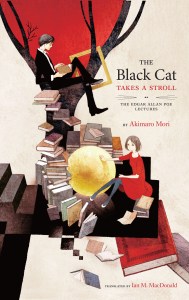
Title: The Black Cat Takes a Stroll: The Edgar Allan Poe Lectures
Japanese Title: 黒猫の遊歩あるいは美学講義 (Kuroneko no yūho arui wa bigaku kōgi)
Author: 森 晶麿 (Mori Akimaro)
Translator: Ian M. MacDonald
Publication Year: 2016 (America); 2011 (Japan)
Publisher: Bento Books
Pages: 146
Let me preface my review of The Black Cat Takes a Stroll by saying that this book is misogynistic pseudo-intellectual garbage.
I’ve tried to keep my tone sane and reasonable, but I don’t want to mislead anyone into wasting their time reading about something that celebrates notions of male dominance and superiority. If you know this sort of thing won’t appeal to you, it’s probably best to skip this review.
The Black Cat Takes a Stroll is a collection of short horror-themed mystery stories centered around “the Black Cat,” a genius 24-year-old professor. The narrator is a first-year PhD student specializing in Western literature. She became friends with the Black Cat when the two were undergraduates together, but now the narrator is the Black Cat’s personal assistant, or “sidekick,” as she calls herself. She has decided to write her dissertation on the work of Edgar Allan Poe, and the book opens with the Black Cat mansplaining the narrator’s research to her.
This is how each of the six stories in the book plays out: something strange happens within the narrator’s circle of friends and acquaintances, she doesn’t understand what’s going on, and so she goes to the Black Cat, who delivers a condescending lecture about literature and philosophy. The mysteries are bizarre and absurd, and they tend to be more reminiscent of the “erotic grotesque nonsense” of the Shōwa-era dark fantasist Edogawa Ranpō than they are of the dark yet largely linear logic of Edgar Allan Poe, yet the Black Cat still draws on his knowledge of European intellectual traditions to explicate the psychology of the people involved.
In the first story, “To the Moon and Back,” the narrator has come into possession of a hand-drawn map that doesn’t seem to correspond to the neighborhood it purports to represent. Although the provenance of this map clearly suggests the circumstances of its creation (the narrator found it carefully preserved and tucked away in her mother’s dresser drawer, which would lead most people to the immediate conclusion that it was given to her by a former lover), the Black Cat is more interested in discussing abstractions relating to mapmaking. His mental process is explained by the narrator as follows: “Applying Bergsonian aesthetics to literary criticism is the Black Cat’s specialty. Upon returning from Paris, he published a paper titled, Dynamic Schema and the Poetry of Stéphane Mallarmé that caused a sensation” (12). Through a series of complicated mental gymnastics, the Black Cat is able to apply a diluted mishmash of schema theory to arrive at the obvious conclusion, ie, the secret letter in the narrator’s mom’s underwear drawer is from the narrator’s mom’s secret lover. Good job, son! Handshakes all around.
The more intriguing story underneath the plot of “To the Moon and Back” concerns why the narrator’s mother had a secret lover to begin with. According to the narrator, her mother is a successful academic specializing in Japanese literature, a job that has not been easy for her. As the narrator says, “Japanese universities are feudal institutions. To succeed in the ivory tower of academe, a woman has to work at least twice as hard as her male colleagues – which only makes my mom seem that much more amazing” (15). Because the narrator has entered graduate school because of her respect and admiration for her mother, I wanted to know more about this woman and her relationship to her daughter, but the author never allows the narrative focus on the Black Cat to waiver for more than a few paragraphs.
This is a major shortcoming in all of the stories in the collection, in which female characters function solely as plot devices and abstract concepts for the Black Cat to play with. To add insult to injury, the Black Cat loves to cite real-life Western scholars and theorists, but never in the entire book does he mention an actual female writer.
I mean listen, we’ve all read Sherlock Holmes and watched the Iron Man movies, and we all love narcissistic yet brilliant male characters, but the misogyny underlying The Black Cat Takes a Stroll frequently results in awkward and uncomfortable situations that serve to underscore the author’s disdain for women. To give a representative example, in the fourth story, “The Hidden Flower,” the Black Cat manipulates the narrator into a situation in which she will be raped by his uncle so that he can prove a point to her. His uncle doesn’t take the bait, and so the Black Cat brings the narrator home with him and hypnotizes her so that she won’t remember what happened. He can’t stop himself from bragging about the incident after the fact, however, because he still wants the narrator to understand the point he’s trying to make. Instead of being like, “Wow, it’s super not cool that you set me up to be sexually assaulted for the sake of winning an argument and then tried to gaslight me,” the narrator is comforted by the level of control the Black Cat is capable of exerting over her. At the end of the story, she says, “My head slumps onto the Black Cat’s shoulder. Safe and secure, I feel I could sleep forever” (96-7).
It’s entirely possible that I could be misreading or overreacting to “The Hidden Flower,” but honestly, I’m not too terribly interested in going through it again. In any case, this is merely one of the many examples of the Black Cat’s patronizing attitude regarding the narrator and her subsequent worship of him. Here’s another example from the first page of the story…
This stuff crumbles the moment I touch it with my chopsticks. Sesame tofu isn’t meant to crumble. It’s supposed to be gooey. I’m baffled.
“A bit like the paper you just presented,” observes the Black Cat seated beside me. He’s alluding to the fiasco that I’ve just succeeded in putting out of my mind. The guy is a fiend – a genius, true, but nonetheless a fiend. Then again, maybe that’s the nature of geniuses. (73)
No, no it’s not. This guy is nothing more than a garden-variety asshole, and it’s painful to see the narrator fawn over him.
The Black Cat Takes A Stroll is an unironic romanticization of male misogyny within an academic context, and I hated every page. If you’re a woman who has seen male colleagues promoted ahead of you, and if you’re sick of being told your business by insufferable male douchebags, and if you’re frustrated by the societal assumption that men know more about your mind and body than you do, then the stories in this collection might hit a little too close to home. The gut punches this book delivers are frequent and unyielding, and I couldn’t read more than five pages at a time. Even if you’re not as sensitive to overt sexism as I am, I still don’t think the mysteries presented by the author (such as the mystery of the letter in the mother’s underwear drawer) are all that original or compelling.
I’m happy to see that a book like The Black Cat Takes a Stroll has been published in English translation – it’s good to see work coming out that isn’t associated with the current big names familiar to English-language readers. It’s also wonderful that novella-length genre fiction from Japan is finding its way into English, and I think that Bento Books is doing something interesting and important. Still, between misogynistic light novels and misogynistic suspense fiction, I feel that there’s a definite bias in the material that has come out in the past few years, and The Black Cat Takes a Stroll doesn’t add anything new to the landscape of contemporary Japanese fiction in translation.
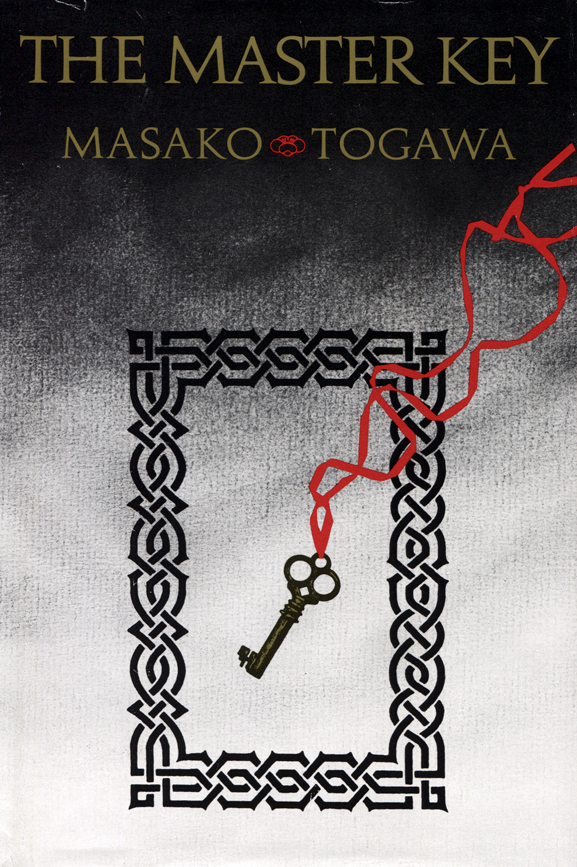
Title: The Master Key
Japanese Title: 大いなる幻影 (Ōinaru gen’ei)
Author: Togawa Masako (戸川 昌子)
Translator: Simon Grove
Publication Year: 1985 (United States); 1962 (Japan)
Publisher: Dodd, Mead & Company
Pages: 198
The Master Key, first published in 1962 and set in the late 1950s, is an interesting window into a period of postwar Japan that we don’t often see represented in Japanese fiction in translation. The story takes place entirely within the closed world of the K Apartments for Ladies, a large, multi-story building located in southeast Ikebukuro and registered as a charitable trust with “rents pegged at wartime levels.”
On its surface, the story is about a 1951 kidnapping of a young boy who is the son of a Japanese woman and an American military officer. Seven years later, when the K Apartments building is lifted and moved to a different location in a grand public works experiment, the body of a child is discovered buried underneath a shared bathing area in the basement. Right around the time the child disappeared, a man dressed as a woman was struck by a van in an intersection near the apartment building, and it’s revealed to the reader early in the novel that this man disguised himself as a woman to help one of the tenants dispose of the body that would later be found in the building’s basement. Who in the apartment buried the body, and what relation does this have to the kidnapping incident?
About twenty pages into The Master Key, however, it becomes clear that the mystery portion of the story is going to take a backseat to an extended exploration of the inner worlds contained within the K Apartments for Ladies and the psychological dysfunctions of its aging tenants.
Ishiyama Noriko, who has been diagnosed with “nervous pains,” has removed herself from the rest of the world and lives in a dark apartment stuffed with other people’s trash, which she occasionally boils and eats to sustain herself. Yatabe Suwa, a former concert violinist who now gives music lessons to children, is haunted by the loss of potential represented by the theft of a violin from her own teacher, even though it’s possible that she herself may have more to do with this incident than she likes to admit. Kimura Yoneko retired from her position as a schoolteacher years ago and spends her days writing letters to her former students, and she is not above checking into the affairs of the other tenants as well. Santo Haru is obsessed with a religious cult, and she is in the palm of its leader, who frequents her apartment to hold prayer meetings centered around the trances of its vestal priestess.
The plot is complicated and circuitous but is centered around the use and whereabouts of the master key of the title, which various tenants use to sneak into one another’s rooms in order to discover the secrets of others while concealing their own. At the end of the novel, it’s revealed that there is a mastermind orchestrating all of their movements, someone who has been spying on everyone for years and has manipulated the women around her for her own amusement. As someone who had essentially done the same thing to these characters through the process of reading this novel, I felt somewhat guilty, but not enough to lessen my enjoyment of how neatly all of the different plot threads are eventually tied together.
I will openly admit that I love stories about women being unpleasant and irrational and absolutely human. All of the female characters in this story are a little pathetic and a little demonic in that they have no power outside the K Apartments but all manner of strange little powers within their closed world. I’m sure this can be read as a metaphor for something, but it need not be, as the haunted and uncanny environment the characters shape through their bizarre actions is absolutely fascinating in and of itself.
For people with more background on Japanese history and urban space, the story’s setting in Ikebukuro is of special interest. In the immediate postwar period, Ikebukuro famously functioned as a heterotopia in which diverse groups of people came together and the norms of mainstream society didn’t necessarily apply. There is all manner of hidden “national polity” history in Ikebukuro, where the family-state of Japan has buried countless failed narratives under highways and skyscrapers. The Master Key thus serves as an excellent example of postwar Tokyo gothic (as similarly exemplified by Kyōgoku Natsuhiko’s The Summer of the Ubume). A reader doesn’t need historical knowledge to appreciate the story, but a bit of research into the setting has the potential to deepen the experience of reading this novel, which has sub-basements under sub-basements under sub-basements.
The Master Key is long out of print but still cheaply available through a number of online used book services. If you have access to your local or university library’s Interlibrary Loan program, it’s well worth requesting this book. It’s a quick read, and it packs a huge impact. To my fellow horror and mystery lovers especially, I highly recommend tracking down a copy of this short, satisfying, and creepy little novel.
Title: Another, Volume 1
Japanese Title: Another (Anazā) 上
Author: Ayatsuji Yukito (綾辻 行人)
Translator: Karen McGillicuddy
Year Published: 2013 (America); 2009 (Japan)
Publisher: Yen Press
Pages: 254
If you’ve watched the Another anime and are looking for a quick answer regarding whether or not you should read the novel the anime is based on: Yes, you should read it. It’s a fun book and a quick read. It’s just as creepy as the anime, but it’s creepy in different ways. The basic plot is the same, but enough of the details are different to maintain a feeling of suspense.
Before I begin, I should say that this review only covers the first volume of a two-volume novel. According to Amazon, the second volume won’t be released until July 23, 2013. Since Another is a highly compelling mystery novel, and since the first volume doesn’t offer closure but instead only deepens the mystery, I might caution anyone who hasn’t already seen the Another anime series (which is available on Hulu) against reading the first half before the second half is available.
Another begins in April of 1998 in a small mountain town called Yomiyama. The narrator is Sakakibara Kōichi, who suffers from a lung disease called “primary spontaneous pneumothorax.” Since his father is spending a year abroad in India, Kōichi has moved from Tokyo to Yomiyama to live with the parents of his deceased mother. Before he can start ninth grade with his new class (the Japanese school year begins in April) at the North Yomi Middle School, however, Kōichi suffers a relapse of his disease and is hospitalized. While in the hospital, he is visited by two students from his class who badger him with a series of unpleasantly persistent questions about his background in relation to Yomiyama. Even more curious is his encounter with a strangely taciturn girl wearing a North Yomi uniform in the hospital’s elevator. This girl, Misaki Mei, is wearing a conspicuous eye patch and headed down to a part of the hospital basement that should be empty.
As soon as Kōichi is released from the hospital, his mother’s younger sister Reiko, who lives with Kōichi’s grandparents, sits him down and tells him the “North Yomi fundamentals,” the third of which is “you must at all costs obey whatever the class decides.” Kōichi, who had been bullied at his old school because of his family name, is uncomfortable with this rule; and, when he finally begins school, he is unpleasantly surprised when he realizes that everyone in his class is bullying Mei. No one acknowledges her presence in the classroom, and no one will discuss her with Kōichi. Kōichi gets hints that what is going on is more than mere bullying, however; the class’s treatment of Mei is somehow tied to a curse laid on the third class of the third year students at North Yomi.
Another is half horror and half mystery. The horror comes from the existence of ineffable supernatural phenomena, the grisly deaths of Kōichi’s classmates, and the looming inevitability of the class’s fate. The “you must at all costs obey whatever the class decides” dictum is majorly creepy as well. These horror elements lend a major sense of urgency to the mysteries Kōichi must puzzle out: Why is everyone ignoring Misaki Mei? What is the curse afflicting Class 3-3? How did the curse come about, and how does it work?
The answers to these questions are eventually revealed at the end of the volume. To be honest, the specifics of the curse don’t actually make a great deal of practical sense, but that’s okay – the setup and nature of the curse are clever and interesting. Since this is only the first half of the story, it goes without saying that not everything is revealed. In fact, the end of the first volume sets up an even more interesting mystery. The curse is apparently linked to one specific person in each class in which the curse is active, the so-called “casualty” (死者), but who could this be? The first volume doesn’t give the reader the necessary clues to figure this out, but it does hint at a particularly nasty moral dilemma that the reader can look forward to exploring in the second half of the story.
Another isn’t the most beautifully written book in the world. When compared to the anime, with its moody musical score, atmospheric lighting, and lush background images, the novel doesn’t seem to take full advantage of the potential creepiness of its setting in an isolated mountain town before the advent of widespread cell phone and internet use. What the novel does do is to deliver an additively readable young adult horror story that can also be read as a power fantasy of working through some of the more unpleasant aspects of ninth grade. A new kid transfers into a new class at a new school, and things are weird and awkward not because fifteen-year-olds are weird and awkward but because there’s a curse. The class seems to be bullying a shy girl who doesn’t fit in not because fifteen-year-olds can be terrible people but because there’s a curse. The homeroom teacher is sketchy and the librarian is spooky not because some adults have trouble dealing with fifteen-year-olds but because there’s a curse.
Class 3-3 is in its own little universe created by both unknowable supernatural forces and unstated institutional regulations, and everything the students in the class do is truly a matter of life and death. Under the veneer of normalcy created by daily routine, nothing is normal at all, and the sickly transfer student and uncanny quiet girl might just end up being the heroes who save everyone. It’s a fairly heady fantasy for anyone who’s ever that things at their middle/high school weren’t quite right. Even without the analogy to the implicit strangeness of ninth grade, the momentum of the race to get to the bottom of what’s going on at North Yomi Middle School is enough to keep anyone reading until the end.
Even though I know what happens, I’m still eagerly awaiting the second volume.




 Contemporary Japanese Literature