Bone Ash

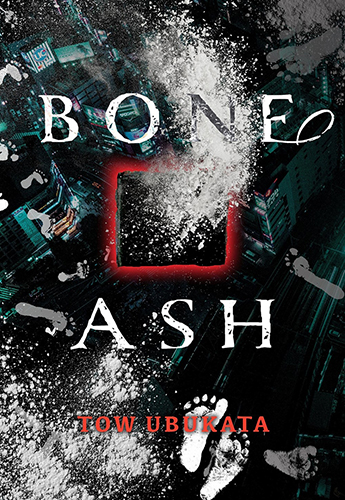
Tow Ubukata’s 2022 horror novel Bone Ash is a story about cursed architecture. The twist is that the architecture in question is the skyscraper outside Shibuya Station that was under construction during the mid-2010s. Deep under the construction site is a hole, and inside that hole is… Just some random guy? What’s he doing there? And what happens if he leaves?

Bone Ash’s everyman protagonist is a white-collar office worker named Mitsuhiro Matsunaga. Mitsuhiro is employed by the PR department of the development firm overseeing the aforementioned construction project contiguous to Shibuya Station, and his job is to ensure that all news is good news so that none of the project shareholders get cold feet. When a pseudonymous Twitter account starts posting creepy photos of the site with sinister captions about contractor injuries, the task of managing the situation falls to Mitsuhiro.

The first order of business is to track down the location of each photo to ensure that there aren’t any code violations. So far, so good. During his investigation, however, Mitsuhiro finds an odd door that isn’t in the floorplans, and behind the door is an impossibly deep staircase that eventually empties into a cavernous concrete space with a bare minimum of lighting. There’s a small Shintō shrine off to one corner, as well as a discarded piece of heavy machinery painted entirely white. And also a pit with a man chained to the bottom.

The man seems somewhat confused, but he insists that he’s happy to stay where he is. Somewhat against the man’s wishes, Mitsuhiro hauls down a ladder, hoists him out of the pit, and hauls him up the infinite staircase. Before he has a chance to recover from this exertion, a fire breaks out on site, and the man disappears.

When he files a report the next day, Mitsuhiro is informed that he entered a “ritual hall,” a space constructed to preserve a shrine (or other place of religious significance) on the land occupied by a large building. The man in the pit was a “mi-keshi,” something like a sin eater who would symbolically absorb the spiritual pollution caused by the displacement of deities. As long as a purification ritual is conducted properly by the appropriate religious authorities overseeing the ritual hall, everything should be fine. Unfortunately, Mitsuhiro has disrupted the ritual, and now there’s going to be hell to pay. 

The scenario introduced by Bone Ash is incredible. The overview I’ve provided in four paragraphs is expanded in amazing detail over the span of about 170 pages, and these details are fascinating. Ubukata walks the reader through the deliciously liminal space of the ongoing construction site like a pro, all the while explaining the bureaucracy surrounding large-scale building construction in Tokyo in a way that genuinely caught and held my attention.

By the time the focus of the exposition shifts to the religious history surrounding the ritual hall in the earth under the building, I was hooked. The existence of creepy underground shrines sealing ancient calamities is a fun urban legend, and Ubukata’s skill as a writer is to ground this sort of fantasy in enough historical precedence to make it seem entirely plausible. I know this concept is silly, but as I read Bone Ash I was like Agent Mulder in The X-Files – I want to believe.

Bone Ash unfortunately falls apart once its focus shifts to Mitsuhiro’s attempts to deal with the curse he’s incurred, which influences his behavior in disturbing ways. Though he’s a convenient viewpoint character during the opening exposition, Mitsuhiro doesn’t have much of a personality, thus making his situation somewhat difficult to sympathize with.

I suppose the reader is supposed to identify with Mitsuhiro’s “everyman” qualities, but many of the author’s assumptions in this regard were lost on me. I don’t think it’s normal to feel compelled to work 15 hours a day, for example, nor have I ever been tempted to kill people for the chance to drive the company car.

Because I never really got a sense of who Mitsuhiro is supposed to be as a person, his cycle of making bad decisions for inexplicable reasons felt somewhat boring and repetitive. I get the sense that one solid conversation about what was going on could have gotten Mitsuhiro sorted out, but none of the other characters in the novel behave much more rationally than he does. In addition, though Mitsuhiro’s pregnant wife and young daughter become unwitting victims of his curse, they’re never allowed interiority and only exist to create complications.

I think what Bone Ash really wants to be about is the plight of unhoused people in Tokyo. Large-scale construction on top of open-air parks and other public gathering places often displaces communities of the unhoused, who are additionally exploited as day laborers with no recourse to legal reparations should something happen to them. Whether or not literal curses exist, Ubukata asks the reader to seriously consider the cumulative effect of this human misery, which is not only ignored but actively encouraged by Japanese politicians. Though this theme of housing precarity and labor exploitation is never fully developed, its introduction in the first half of the novel is handled with a remarkable degree of sensitivity.

In the end, it might seem odd to recommend Bone Ash only for the first 170 pages, but they’re really good pages! Despite my criticism of its narrative structure, I’d recommend this novel to anyone interested in the strange complications of urban architecture and the darker corners of Japanese religion and folklore – as well as to anyone interested in exploring uncanny spaces.  

I’d like to extend my appreciation to Bone Ash’s translator, Kevin Gifford, whose smooth and confident style grabbed my attention from the first few pages of the novel. In addition, Wendy Chan at Yen Press has done a fantastic job with the book design, which is very cool and clever. I hope the care and attention given to this release helps Bone Ash find an enthusiastic audience of readers interested in the sort of well-researched urban legends and creepypasta stories that are perennially popular on YouTube and Reddit.

Strange Houses

Strange Houses is a four-part horror mystery novel about houses with strange and uncanny floor plans.

Each of the four chapters takes the form of a series of conversations between the narrator, their architect friend, and various people who have been involved with the houses. The first three chapters explore three different houses with extra rooms and inexplicable gaps in the walls. These explorations are liberally illustrated with diagrams in which certain sections of the floor plan are highlighted and annotated to clarify the text.

Each of these stories is like a locked room mystery. Over the course of the chapter, the narrator’s architect friend performs a close reading of a floor plan while gradually building a theory concerning what sort of upsetting behavior that type of strange space might enable.

In the final chapter, it’s revealed that these houses are connected to an old and wealthy family with a terrible secret. I have to admit that I found this situation highly improbable, so much so that it comes off as almost cartoonish. The author is great at architectural walkthroughs but skimps on the character development, which contributes to the conclusion of the book feeling somewhat hollow. Still, there’s a lot of fuel for the reader’s imagination, and fans of gothic horror will have a lot to play with here.

I flew through Strange Houses and loved every page. The speculative conversations between characters are easy to follow; and, thanks to the diagrams, the spaces are easy to visualize. I enjoyed the slow build of the overarching mystery, and the revelations about the bizarre family at the center of the strangeness were beyond anything I expected.

It’s worth noting that the first story in Strange Houses was originally written as a script for a twenty-minute video on YouTube, which you can find with English subtitles (here). There’s also a manga adaptation, which has been scanlated and is available to read (here). And finally, I’d like to share a more substantial review of the original Japanese book that was posted on one of my favorite blogs (here).

I tend to think that Uketsu’s earlier novel Strange Pictures (which I reviewed here) is somewhat more successful as a work of fiction with three-dimensional characters whose bad behavior stems from understandable motives. In comparison, Strange Houses feels more like a puzzle box than a novel. Strange Houses is less a character-driven story than it is an imaginative architectural mystery, but its eerie atmosphere and clever narrative structure make it a fascinating read for fans of speculative horror and uncanny design.

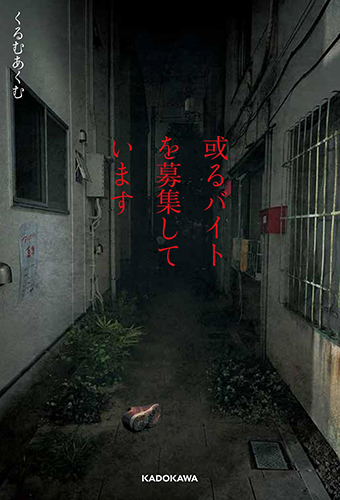
或るバイトを募集しています

Aru baito o boshū shite imasu (或るバイトを募集しています) is a collection of eight short horror stories conveyed in the form of documentary-style found footage. Each story is prefaced by a listing for a part-time job that seems a little strange, or perhaps too good to be true.

The most representative of these jobs is a request to make an offering of flowers at a certain empty lot between midnight and 1:00am every night. An aspiring comedian who needs the money and keeps late hours takes the job and carries it out faithfully. He never sees anything strange, but something about the job still feels off.

When he does research about the location, he can’t find anything out of the ordinary. Another entertainment industry professional explains that the job is probably a strategy to lower the land value. The comedian’s employer wants to buy the land and assumes they’ll be able to get it at a steep discount if it becomes known in the neighborhood as a “stigmatized property” (as explained by Business Insider here). 

The comedian does his best not to think about it too hard. When he finally gets a gig and fails to make his nightly offering, he leaves the studio only to find that an unknown number has called several times. When he checks his voicemail, a mysterious woman speaks to him through static, saying, “The flowers from yesterday have withered. Why didn’t you come tonight? Can I still stay here? Can I still stay here? Can I still stay here?”

Slightly outdated media and technology are a recurring theme in the collection, and this isn’t the only story about creepy messages left on an answering machine. Other stories revolve around physical media like VHS tapes, DVDs, and handwritten letters. When it comes to creepy found objects, I get the sense that there’s a certain air of uncleanliness that clings to the physical media of a prior century.  

Along with the spookiness of the stories, I enjoyed the rationalizations for why each strange job might exist. If I had to guess, I’d say that this collection is partially inspired by the recent discourse surrounding yami baito, or “shady part-time jobs” (which the BBC did a podcast about here). In real life, yami baito involves organized crime organizations using aboveground job postings on social media to recruit young people for illegal activities such as cash withdrawal fraud and stripping copper wiring from abandoned houses. Still, it’s not too difficult to imagine an entirely different shadow world seeking to prey on the living with the offer of easy money.

More than social commentary, however, Aru baito dwells in the realm of internet creepypasta. The collection’s author, Kurumu Akumu, has spent the past several years sharing short and spooky stories on various platforms, including YouTube (here), Note (here), and Twitter (here). Aru baito reflects the found footage nature of creepypasta by presenting its stories in a variety of formats, such as interviews, screenshots of text conversations, blog comments, and so on. The unusual formatting is a lot of fun, making the book feel like a file folder of cursed printouts.

Kurumu Akumu’s work reminds me of the mockumentary-style horror of Uketsu’s Strange Pictures, but Aru baito has no connecting narrative, nor does it make any attempt at portraying psychological realism. Instead, the reader feels as if they’re encountering real urban legends in the wild, and the lack of context heightens the eerie feeling of looking at something that shouldn’t be seen. Aru baito is an unsettling collection that blends the horror of cursed analog media with the eerie plausibility of urban legends, leaving readers with the lingering sense that some part-time jobs are better left unfilled.

Strange Pictures

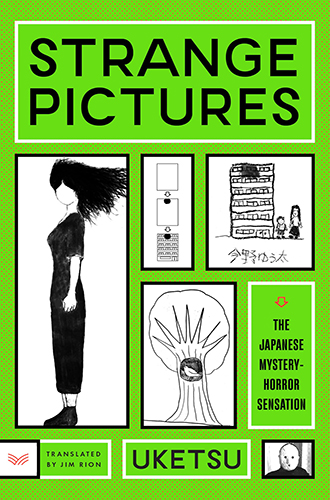
Strange Pictures is a compulsively readable horror mystery novel first published in 2022 by Uketsu, a mysterious masked YouTuber. This book is addictive, so much so that I accidentally spent an entire afternoon and evening reading it. So be warned – Strange Pictures is indeed strange, and it will hold you hostage.

In the five-page prelude that introduces the book’s premise, a psychology professor shows her class a photo of a picture drawn by a girl who killed her mother. The drawing is a childish self-portrait that shows the girl standing between her house and a tree. Although the picture seems completely normal at first, the professor zooms in on four small details that illuminate the girl’s inner state of mind. She makes the argument that, despite the abuse the girl suffered, she’s essentially a good person who never meant to hurt anyone. In retrospect, you can’t help but wonder how you didn’t notice these details of the drawing yourself.

This trick is an incredible sleight of hand. The same can be said of the following two chapters, both of which can be read as stand-alone short stories.

In the first chapter, “The Old Woman’s Prayer,” two college students in a small Paranormal Club discuss a curious blog they’ve found online. The blog is filled with cheerful observations of its writer’s everyday life. After a three-year hiatus, however, the blog closes with a mysterious post stating, “I can never forgive you.”

How did such a happy-go-lucky blog author arrive at such a mysterious statement? The five illustrations drawn by the author’s wife might just hold the key to the mystery. By themselves, they’re nothing special, but if you put them together in the right way…

The second chapter, “The Smudged Room,” features one of my favorite tropes, a creepy drawing made by a small child.

Five-year-old Yuta’s father recently passed away, and his preschool teacher is worried about the drawing he created for Mother’s Day. The picture shows a dark cloud hovering over the apartment building where Yuta lives with his mother, who is doing her best to care for Yuta with no family support. The matter comes to a crisis when Yuta suddenly disappears, and his teacher suspects that his mother may be keeping an unpleasant secret. What was Yuta trying to draw, exactly?

These two seemingly unrelated mysteries begin to coalesce in the third chapter, “The Art Teacher’s Final Drawing,” in which two sidelined newspaper employees become obsessed with the murder of a high school art teacher. The police dismissed the case due to a lack of evidence, but there is (of course) a drawing found in the teacher’s possession that was never fully analyzed. The younger reporter starts interviewing people who knew the teacher, thereby putting himself in grave danger.

Somewhere around the middle of this chapter, the story begins to strain credibility, but at this point I was fully invested and happy to be along for the ride. Uketsu has a gift for enabling the reader to suspend disbelief, and the Sherlock moment in the fourth and final chapter is incredible.

Strange Pictures is a bestselling cult hit in Japan and across Asia. I first heard about this book through word of mouth and read it in Japanese when it was first published. I was impressed by the clarity of Uketsu’s writing, which is simple and informative without being childish or condescending. Jim Rion has done an amazing job translating Uketsu’s distinctive style, with short declarative sentences pushing the reader forward at a brisk pace.

A large part of the mystery depends on the information that the narrative withholds from the reader, some of which is highly dependent on how Japanese works as a language. I’m impressed by how Rion manages to employ English to the same effect without the slightest trace of awkwardness. Reading Rion’s translation, I felt like I was encountering Uketsu’s story for the first time.

As long as you don’t mind losing a few hours to the addictive quality of the writing, I’d recommend Strange Pictures to anyone who enjoys puzzle box mysteries, creepy urban legends, and satisfying Sherlock Holmes style walkthroughs. I can’t overstate how much fun I had with this book, and I’m very much looking forward to Jim Rion’s upcoming translation of Uketsu’s debut novel, Strange Houses.

Japanese Suspense Novels by Female Authors

The Memory Police by Yoko Ogawa
Normal people quietly go about their lives on a sleepy island where memories collectively vanish a bit at a time. But what happens to the people who can’t forget?

Masks by Fumiko Enchi
Two cultured and handsome men compete for the affections of a beautiful young widow while her devious mother-in-law manipulates their relationships from the shadows.

The Woman in the Purple Skirt by Natsuko Imamura
The Woman in the Yellow Cardigan is intrigued by the Woman in the Purple Skirt – so intrigued that she follows her every move and investigates every detail of her private life.

All She Was Worth by Miyuki Miyabe
Pursued by debt collectors, loan sharks, and yakuza henchmen, a woman vanishes, leaving behind a trail of false identities and broken lives.

The Eighth Day by Mitsuyo Kakuta
A desperate woman, spurned by her married lover, kidnaps his child and goes on the run. Now an adult, the kidnapped child has no memory of this and must piece together what happened from interviews and newspaper clippings.

Penance by Kanae Minato
A young girl is assaulted and killed in a small rural town, and the murderer is never caught. Years later, a series of letters from the girl’s mother forces her former friends to reflect on what they knew and what they could never tell anyone.

The Graveyard Apartment by Mariko Koike
A family moves into an inexpensive apartment next to a graveyard, but their hopes for a new life are shattered as strange and inexplicable things begin to happen in their building.

There’s No Such Thing As An Easy Job by Kikuko Tsumura
A woman suffering from burnout leaves her white-collar position and goes to a temp agency, requesting that she be placed in an “easy” job. There’s no such thing as an easy job, however, and it stands to reason that companies who are desperate for temp workers have shady ulterior motives.

Convenience Store Woman by Sayaka Murata
An unmarried woman finds joy and meaning in the comfortable routine of working at a convenience store. When pressured by her family and friends to quit her job and find a partner, how far will she go to prove that she’s “normal”?

Real World by Natsuo Kirino
A teenage boy from an affluent Tokyo suburb kills his mother in a fit of explosive rage. The friends of the girl next door decide to help him escape and gradually succumb to the darkness at the core of their seemingly perfect lives at a prestigious private high school.

. . . . . . . . . . . . . . .

The illustration above is by James of ShelfWornDrawn, whose work can be found on Instagram (here) and on Tumblr (here). You can commission a portrait of your own library via his Etsy page (here).


Earthlings

Japanese Title: 地球星人 (Chikyūseijin)
Author: Sayaka Murata (村田 沙耶香)
Translator: Ginny Tapley Takemori
Publication Year: 2018 (Japan); 2020 (United States)
Press: Grove Press
Pages: 247

Content Warning: This review contains a frank discussion of child abuse and incest.

If you’ve made it past the content warning, you should also be aware that Earthlings contains extended and explicit descriptions of parental child abuse, incestuous child sexuality, adolescent sexual abuse, severe dissociation, suicidal ideation, mental illness, murder, starvation, and cannibalism. This material is central to the story, which has a truly disturbing ending.

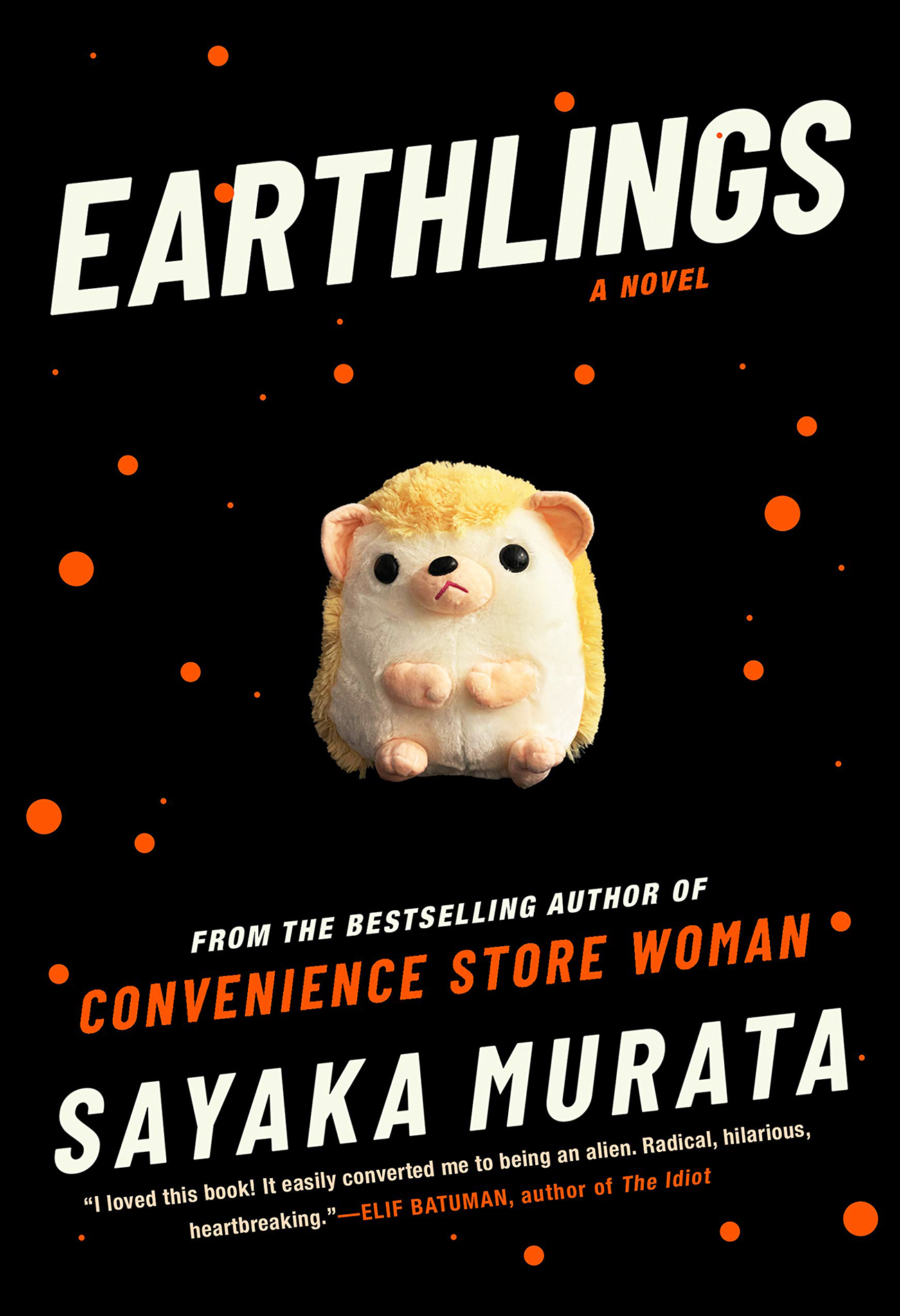
While I would happily recommend Sayaka Murata’s novel Convenience Store Woman to anyone, Earthlings is definitely not for everyone. Elif Batuman calls this novel “hilarious” in the blurb on the front cover of the American edition, and I’m not sure where that’s coming from. Earthlings is deeply sad and upsetting. It’s not the least bit funny, joyous, offbeat, or quirky. The author’s tone may be deceptively light, but the themes of her story are as dark as they come.

Earthlings is a novel about the deteriorating mental state and unfortunate life decisions of a relatively normal girl named Natsuki who is made to feel that she isn’t human because of the sustained abuse she receives at the hands of her parents and teachers. The point of the story isn’t to argue that we need to free ourselves from the normative expectations of an oppressive society. Rather, Earthlings demonstrates just how deeply painful and unhealthy social alienation can be to the people who are arbitrarily designated as outcasts and scapegoats.  

The novel begins with the eleven-year-old Natsuki’s confession that she is a special child who was chosen by an alien named Piyyut, who came from Planet Popinpobopia to help her fight evil witches as a magical girl. Although Piyyut looks like a stuffed animal to ordinary people, he’s actually an emissary sent by the Magic Police. This is a secret to everyone except Natsuki’s cousin Yuu, who tells Natsuki that he understands Piyyut’s situation because he’s an alien too.

From the very first page, it’s clear that Natsuki has created a fantasy version of herself in order to escape the neglect of her parents. Neither of Natsuki’s parents attempt to hide their preference for her older sister Kise, who has a codependent Münchhausen-by-proxy relationship with their mother. While Kise can do no wrong and requires special care and attention, Natsuki becomes the scapegoat of her mother, who constantly criticizes her appearance and personality. Instead of defending Natsuki, everyone in her family defers to her mother – everyone except her kind and friendly cousin Yuu, whom Natsuki decides is her boyfriend and future marriage partner.

Because of the strength of her magical girl fantasy, Natsuki is able to survive the abuse she suffers at home. Unfortunately, precisely because this abuse makes her vulnerable, she becomes the sexual target of a young and popular teacher at her after-school tutoring program. The author gets the abusive teacher’s mentality exactly right. He starts with small acts that have plausible deniability, such as using “posture correction” as an excuse to grope Natsuki. When he escalates his behavior in an attempt to test the boundaries of what he can get away with, he does so in a way that Natsuki will be ashamed to talk about, such as fishing her used sanitary napkin out of the trash after she uses the bathroom.

Natsuki knows there’s something wrong with the teacher’s behavior and tells her mother, but her mother takes the teacher’s side and scolds Natsuki for overreacting. She then punishes Natsuki for “making up stories” by forcing her to spend more time with the teacher. Natsuki ends up going to the teacher’s house for a private lesson, which leads to exactly the scenario you’re afraid it will. The sexual assault scene is long, explicit, and extremely difficult to read. Once again, the author depicts the mentality of child abuse with perfect accuracy, in that the teacher forces Natsuki into a situation in which she feels compelled to “consent” to her assault, thus making it seem like her own fault.

Severely traumatized and knowing from experience that no one will believe she’s been raped, the now twelve-year-old Natsuki resolves to commit suicide in the mountain forest surrounding her grandparents’ house during the annual family get-together for the summer Obon festival. Before she dies, Natsuki wants to experience genuine physical affection, so she convinces her cousin Yuu to go out in the woods with her to have penetrative sex, after which she swallows an entire bottle of her aunt’s sleeping pills.

As Elif Batuman says in the blurb on the front cover of Earthlings, the abuse, rape, and attempted suicide of a twelve-year-old girl is “hilarious.”

Except it’s not. Natsuki’s fantasy of being a magical girl is a psychological coping mechanism, and her lack of affect is the result of severe trauma. Not only are the events Murata describes terrible to read, it’s also terrible to hear them recounted in the voice of a twelve-year-old narrator who doesn’t yet possess the emotional maturity to process what’s happening to her. This narrative style isn’t “quirky.” It’s horrifying.  

After Earthlings firmly establishes itself as a horror story told by an unreliable narrator, it jumps forward in time to 34-year-old Natsuki, who is currently in her third year of marriage to a man named Tomoya. After her suicide attempt, Natsuki was essentially treated as a prisoner by her family for two decades, and marriage seemed to be the only way for her to escape. Natsuki met Tomoya on a website for people in situations similar to her own, namely, people who need to get married in order to appease their families. The site caters mostly to the LGBTQ+ community; and, while Tomoya’s sexuality is never specified, he seems to be aro-ace, meaning that he does not experience romantic attraction and is disgusted by physical sexual contact.

Tomoya and Natsuki are essentially roommates who sleep in separate bedrooms while sharing an apartment. This arrangement works well for both of them, at least until their families begin to exert pressure about having children. The stress of this pressure weakens the deep fault lines of their respective childhood traumas, and they decide to escape society by fleeing to Natsuki’s grandparents’ house in the mountains. The house is currently occupied by Yuu, who has been acting as a caretaker for the property after having been laid off from a prestigious office job in Tokyo. As you can imagine, what happens to these three characters in an isolated cabin in the woods isn’t great, and the novel’s ending is shocking.

Earthlings is about three broken people whose connection to reality gradually deteriorates as they feed one another’s delusions while in total social isolation. The plot summary I’ve provided is the background necessary for the reader to understand the core of this story, as well as its tone.

In Convenience Store Woman, Sayaka Murata argues for the quiet dignity of menial service jobs and the validity of neurodivergent perspectives. The narrator of Convenience Store Woman enjoys her job as a clerk at a convenience store because she finds the routine comforting and appreciates being able to interact with other people according to a preset script. Toward the end of the novel, she finds herself in a difficult situation because she succumbs to her family’s pressure to find a partner and chooses the first person to make himself available despite his unsuitability. Many readers of this internationally bestselling novel identified with the narrator’s perspective and sympathized with the author’s description of the small pleasures of part-time service industry jobs that are often looked down on by older generations.

Earthlings explores similar material and themes but takes a radically different approach. In this novel, Murata emphasizes her narrator’s social alienation to an extreme degree. The narrator’s unwilling separation from “Earthlings” is not a good thing, nor is it depicted as being relatable. Instead, Murata uses these characters to ask serious questions about what it means for neurodiversity and queerness to be forcibly removed from mainstream society. For instance, why are child molesters protected by their communities while the children they abuse are treated as unbalanced and unclean? Why is traveling overseas to undergo expensive and invasive surgery in order to have children seen as normal, while choosing to remain childless is viewed as antisocial and neurotic?

If you can handle the dark tone and gruesome subject matter of Earthlings, it’s an extremely compelling story. At the risk of calling child abuse “hilarious,” I have to admit that I was entertained, especially once Natsuki starts living in her grandparents’ abandoned house in the woods. For what it’s worth, the ultimate fate of the pedo teacher and the garbage parents who enabled him is unpleasant yet satisfying.   

As a fan of social horror, I love Earthlings, but I would caution potential readers to take the content warnings seriously. Sayaka Murata is a brilliant writer who tells strange and complicated stories, and I look forward to seeing more of her sizeable body of work in translation. I just hope that, in the future, she’s treated like the complex and nuanced literary figure she is instead of marketed as an easily digestible product of pop culture.

The Woman with the Flying Head

Author: Yumiko Kurahashi (倉橋由美子)
Translator: Atsuko Sakaki
Publisher: M. E. Sharpe
Publication Year: 1997
Pages: 159

Yumiko Kurahashi was a member of the generation of female writers whose work began appearing in the early 1960s. She continued writing into the 1990s, by which time she had produced a number of collections of short stories. Kurahashi is notable for her absurdist imagination, as well as the cleverness with which she blends multiple literary traditions from Noh drama to Greek tragedy.

The Woman with the Flying Head was published in 1997 by the academic press M. E. Sharpe (which has since been incorporated into Routledge) and collects eleven stories that were originally published between 1963 and 1989. Some of these stories are playful, and some are creepy, but all are fiercely intellectual reflections on both carnal and creative desires.

There’s a fair amount of taboo sexuality in these stories, including incest and bestiality, not to mention sexual entrapment and murder. It’s important for the reader to understand that these stories are explorations of concepts and ideas, not mimetic representations of three-dimensional characters. In the opening story, “The Extraterrestrial,” why do a brother and sister have sex with the alien that hatched out of the egg that mysteriously appeared in their bedroom one morning? It doesn’t matter; what matters is the experimental space generated by the scenario.

You can have a lot of fun with Kurahashi’s stories once you accept the author’s writing on its own terms. If you’re the sort of person who enjoys close reading and analysis, there’s a lot to read and analyze. It’s also entirely possible to enjoy the stories as sex comedies and interpersonal dramas constructed on a scaffolding of absurdist thought experiments. Kurahashi has won numerous literary awards for her work, and this collection is prefaced with a serious and thoughtful introduction by the translator, but “supernatural sci-fi erotic dark comedy” is probably the most accurate label to apply to the author’s distinctive genre of fiction.

The intellectualism attributed to Kurahashi partially stems from her references to a wide range of world mythologies. Although her narrators tend to be terrible and problematic men, the real stars of the show are the demonic women who torment them. Far from being symbols of female resistance or empowerment, the majority of Kurahashi’s female characters are demons in the traditional sense. They are to be feared and abhorred instead of admired, and they tend to reflect the anxieties of a patriarchal society even as they playfully mock fears regarding female sexuality.

The demon in the 1985 story “The Witch Mask” takes the form of a Noh mask that has been passed down as an heirloom in the narrator’s family. This style of mask, the horned hannya, is used to represent women who have turned into demons after succumbing to powerful emotions. The narrator’s mask is particularly frightening because its hunger literally consumes its victims with desire.

The male narrator of the story is fully aware of the danger of the mask, but the cursed object still captivates him. He places the mask on the face of each of his lovers and watches their bodies writhe as it consumes them. He refers to his obsession with the beautiful mask as “an irresistible desire” before finally applying it to the face of his fiancée, whom he loves dearly. He attempts to justify this murderous act by confessing that he “was haunted by an idea – the call of the demon… the desire to put the witch mask on a beautiful face.” 

“House of the Black Cat” is also about a hungry demon. This demon alternates in shape between a regular-sized housecat and a human-sized catwoman. The cat in its humanoid form is strangely alluring to the story’s human protagonist, Keiko, as she watches it go about its day in a video made by her husband’s friend Kamiya. The video becomes pornographic as the cat “devours” her human partner, who bears a strong resemblance to Kamiya himself. It seems that Kamiya disappeared shortly after lending Keiko’s husband the video. Although Keiko is never able to conclusively determine his fate, she suspects that the cat killed him so that she could feed him to her children, four black kittens. “House of the Black Cat” is about forbidden sexuality; but, as is the case with many of Kurahashi’s stories, it’s also about the creative drives that inspire artists to test the boundaries of consensus reality.     

The stories collected in The Woman with the Flying Head are strange, fantastic, and thought-provoking. Kurahashi’s writing is filled with vivid imagery and suggestive symbolism that blend together to create fantasies that are both horrible and darkly fascinating. A decent comparison might be Patricia Highsmith’s Little Tales of Misogyny, or perhaps even Jorge Luis Borges’s Labyrinths, but Kurahashi’s voice is absolutely unique. I always find myself returning to The Woman with the Flying Head every October for Halloween, but these creepy little stories are perfect for whenever you want to take a step back from the grind of mundane reality to channel some playfully demonic energy.  

Strange Tale of Panorama Island

Strange Tale of Panorama Island
Japanese Title: パノラマ島奇談 (Panorama-tō kitan)
Author: Edogawa Ranpo (江戸川 乱歩)
Translator: Elaine Kazu Gerbert
Publication Year: 1927 (Japan); 2013 (United States)
Publisher: University of Hawai’i Press
Pages: 113

Strange Tale of Panorama Island is a short novel about murder, misdirected passion, and artistic delusion that climaxes with an explosive conclusion.

The story’s antihero, Hirosuke Hitomi, is a writer who is neither living his dream nor making a living. His life is horribly bleak until he receives news that a college friend named Genzaburō Komoda has passed away from a rare illness. Although Hirosuke was never close to Genzaburō, he knows that he was the sole heir of a wealthy family. He also knows that he resembled the recently deceased young man to such a strong degree that he could have been his doppelganger.

Hirosuke sees his chance, and he takes it. He fakes his death by leaping from a ship, an act interpreted as a suicide by the newspapers that report the event. He then disinters Genzaburō’s body, destroys it, and crawls to the Komoda family estate, claiming to have experienced a miraculous recovery. As Genzaburō, he blames his disorientation and seeming loss of memory on the trauma, knowing that the family’s doctors will be too embarrassed by their “mistake” to interrogate him.

Hirosuke is not content to live an easy life of luxury in the company of Genzaburō’s beautiful widow Chiyoko, however. Instead, he uses the vast wealth of the Komoda family to buy an island and fill it with aesthetic marvels, creating a sensualist utopia outfitted with near-future technology. The wonderland he names Panorama Island is both a museum of the fantastic and an amusement park for adults.

The short translator’s introduction explains the cultural context of the novel, specifically the public interest in panoramas during the 1920s in Japan, but none of this information is necessary to appreciate the marvelous imagery Edogawa dreams up to dazzle the reader as Hirosuke leads Genzaburō’s widow across the island. If Chiyoko knows Hirosuke’s secret, which she almost certainly does, what will become of her? Like Chiyoko, the reader can only be amazed by the island while disturbed by the troubled genius that created it.

Edogawa is interested, like his namesake Edgar Allan Poe, in the precise mechanics of how Hirosuke’s series of crimes might be possible. The novel contains a touch of the pulpy adventure story, as well as an earnest foray into the realm of medical science. Thankfully, the narrative never becomes mired in superfluous details, with most of the science remaining staunchly fiction. Hirosuke’s degeneration as a human being receives much more attention, as does his erotic and grotesque fascination with the confused and powerless widow of his former friend.

Although it’s published by a university press, Strange Tale of Panorama Island is a pleasure to read. The introduction and endnote sections are short, discrete, and quite interesting. If you’ve read and enjoyed any of the books in the Penguin Horror Classics series, including the handsome reprints of the work of Edgar Allan Poe and H.P. Lovecraft, you’ll more than likely have a lot of fun with Strange Tale of Panorama Island. The novel was originally written for a broad but intelligent audience, and it’s aged extremely well, partially thanks to the excellent translation.

I also want to recommend the manga adaptation drawn by Suehiro Maruo and published in English translation by Last Gasp Press. Maruo, a gekiga artist who has adapted numerous other works of dark mystery fiction, delights in the lurid imagery of the story, which he depicts with his signature detailed linework and bold panel compositions. Readers should be cautioned that, although this is a “classic” that’s taught in university classes, it is most definitely not safe for work.

The Graveyard Apartment

the-graveyard-apartment

Title: The Graveyard Apartment
Japanese Title: 墓地を見おろす家 (Bochi o miorosu ie)
Author: Koike Mariko (小池 真理子)
Translator: Deborah Boliver Boehm
Publication Year: 2016 (America); 1988 (Japan)
Publisher: Thomas Dunne Books
Pages: 325

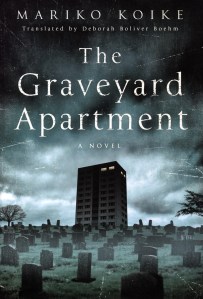
Kano Misao and her husband Teppei have found the perfect apartment. It’s quiet and spacious with southern exposure, and it’s in a new, modern building. Sure, this building happens to be right next door to a graveyard, but it’s the 1980s, and the pleasant proximity to an open green space outweighs any sort of silly superstitious stigma. The only problem is that strange things always seem to be happening in the basement. It might be that the building is haunted, but why? And what would the ghosts want from Misao and Teppei?

Like many other haunted house stories, The Graveyard Apartment is, at its heart, a family drama. Misao and Teppei are happy together with their five-year-old daughter Tamao and their dog Cookie, but the bright little family is trailed by the dark shadow of Teppei’s first wife Reiko, who was driven to suicide by her husband’s affair with Misao. When the stress of the paranormal activity in their new apartment places stress on Misao and Teppei’s relationship, the fault lines of their marriage begin to crack. The novel opens inauspiciously with the death of Tamao’s pet bird Pyoko, who the girl claims now visits her in dreams. Misao and Teppei’s disagreement over how to handle their daughter’s insistence on the reality of the supernatural is the first of many arguments, which gradually escalate over the course of the story.

The Graveyard Apartment is not The Shining, however, and the ghosts troubling the family are not manifestations of buried psychosexual traumas – they are, most assuredly, actual vengeful spirits. The horror of the novel derives from the fact that, despite the lingering guilt over Reiko’s suicide, the malice of the building’s ghosts could not be directed at a more normal and easygoing family. If a sweet young mother and fledgling illustrator like Misao can find herself trapped in a claustrophobic basement while unknown things approach unseen in the darkness, it could happen to anyone.

It turns out that the apartment building is a remnant of a failed development project from the 1960s that would have resulted in an underground shopping plaza connecting the basements of several office and residence buildings to the local train station. The neighborhood temple resisted this development and refused to sell or subdivide its land, however, and so the tunnel under the graveyard was left unfinished, with the Kanos’ building the only part of the project that came to fruition. The link between the temple graveyard and the ghosts in the basement is extremely tenuous (especially since the point of Buddhist funerary rites is to pacify angry spirits), but the haunting can be more easily understood as the consequences of the era high economic growth, which has finally started to claim victims as the bubble economy begins to collapse in on itself.
The Kanos were led to believe that they could have it all – Teppei could divorce his old-fashioned wife and marry for love, Misao could have both a child and a freelance career in a creative field, and they could find a reasonably priced apartment in a convenient location to house their happy family. It had to be too good to be true, right?

Originally published in 1988, The Graveyard Apartment is a reflection of the anxieties concerning the optimistic consumerism of the 1980s, in which an ideal middle-class lifestyle was widely considered to be glossy and attainable as the magazines Misao illustrates. Although the real threat to families ended up being overinflated property values, Koike’s ghosts are creepy enough on their own even without any sort of economic allegory, and the end of the novel is genuinely disturbing. The Graveyard Apartment is a satisfying slow burn of a haunted house story perfectly suited to its setting in Tokyo, and I highly recommend it to my fellow fans of horror fiction.

( Review copy provided by Thomas Dunne Books. )