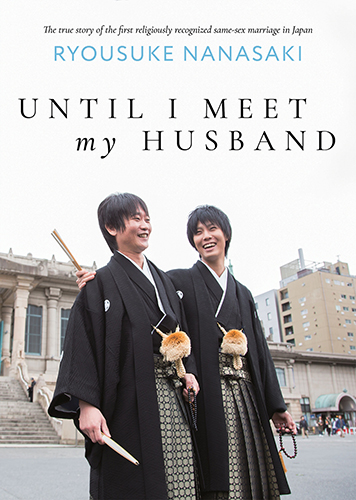
Until I Meet My Husband is a collection of short autobiographical essays by Ryousuke Nanasaki, an activist who established LGBT Community Edogawa in 2015 and a wedding planning company called Juerias LGBT Wedding in 2016, both of which contributed to Tokyo’s Edogawa ward officially recognizing same-sex partnership by issuing marriage certificates.
Nanasaki lays out his motivations for becoming an activist toward the end of the book, but the majority of his essays are humorous stories about life and love. As Nanasaki explains in the final chapter, “In Place of an Afterword,” he wants readers to understand the “raw, uncut truth” of queer identity, which is that gay people experience happiness and make mistakes like everyone else.
As a result of Nanasaki’s honesty, the essays in Until I Meet My Husband are immensely entertaining and compulsively readable. Many of the stories will be familiar to queer Millennials, from receiving a stern lecture from a well-meaning teacher in elementary school to dating other closeted queer kids in high school to falling a little too hard for your first serious partner as an adult. Nanasaki leans hard into friendship drama, relationship drama, and family drama, but he’s so funny and good-natured that you can’t help but support him through his misadventures.
Molly Lee’s translation is pitch perfect, conveying the confidence and enthusiasm of Nanasaki’s voice in natural English that’s a pleasure to read. Along with the original essay collection, Seven Seas has also released the manga adaptation, which features dreamy artwork by BL manga author Yoshi Tsukizuki.
Emuko Asai began posting essays online in 2021. She never considered herself to be a writer, she says, but the enthusiastic support she received from thousands of readers inspired her to keep sharing her stories. Asai’s 2024 collection 置かれた場所であばれたい (Okareta basho de abaretai) is a clear demonstration of the appeal of her essays, which inject a healthy dose of good humor into the trials and tribulations of everyday life.
Okareta basho de abaretai follows a loose timeline from Asai’s girlhood to her current career as a professional in the field of early childhood education. Although I get the sense that the staunchly pseudonymous Asai grew up in an upper middle-class family, the path she followed to adulthood was anything but standard. To me, Asai reads as having mild learning impairments, and she frequently makes jokes about her terrible grades and how much she hated studying. Since she was never going to meet expectations, Asai always figured that she might as well enjoy herself and have a good time.
One of my favorite essays is Miko no arubaito (Part-time job as a shrine maiden) which is about the weekend Asai worked at a large Shinto shrine during the rush over the New Year holiday. Just like her normal part-time job at a bakery, her duties involved standing behind a counter and helping people pay for their purchases. Amusingly, Asai had a bit of trouble with code-switching between secular and religious settings, which resulted in several comedic exchanges with confused patrons.
( As an aside, Miko no arubaito would be an excellent reading assignment for a Japanese language class, especially since its humor is dependent on a knowledge of the taigū hyōgen set expressions used by service workers. )
Asai’s most popular essay on social media is Yasashii uragiri (A gentle betrayal), which is about a written test given by her high school Home Economics teacher. This story will probably be familiar to American Millennials, many of whom were exposed to a variation of this test at some point in secondary education. Over the course of the essay, we follow Asai’s progress through the exam, which presents a lengthy series of detailed instructions. The last item on the list is, of course, “Don’t write anything. This is a test of whether you read the directions before starting work.”
Although Asai presents this story as little more than an amusing anecdote, I get the feeling that this experience was probably crucial in her decision to become a teacher. Many of Asai’s experiences with education seem confrontational at best (and downright depressing at worst), so it would make sense that she had a positive response to a teaching strategy that fostered independent thought and prioritized practical application.
In later essays, Asai describes her own goals as a teacher while challenging herself to accommodate different learning styles. Perhaps the best example is Sensei-tte, dare no koto (Who are you calling Teacher?), in which Asai attempts to help a 4yo child overcome his refusal to sit down and draw with crayons. It turns out that what the boy really disliked was having his pictures compared to the drawings of his best friend, who displays a small measure of artistic talent. Asai readily admits that she herself can’t draw, but what she can do (using an age-appropriate version of the Two Cakes! meme) is to help this little kid realize that his work is just as valuable as his friend’s.
Lest you think Asai has grown soft, however, she follows this essay with one titled Unchi somurie (Poo Sommelier), which is about how she possesses the rare but useful ability to tell which of her young charges has shit themselves at school.
Emuko Asai’s essays read a bit like David Sedaris, albeit without the cutting edge of Sedaris’s characteristic meanness. Her work isn’t wholesome, necessarily, nor is there an absence of irony. Rather, Asai expresses a type of radical good humor that occasionally borders on passive-aggressive sweetness but always mellows out into a chill attitude of c’est la vie – or YOLO, as the case may be. If nothing else, it’s always amusing to follow the unexpected progression of the author’s thoughts as she relates episodes of her life that probably would have been traumatic for someone without her incredible store of gentle good humor.
You can follow Emuko Asai on Twitter (here), and you can read her essays online on Note (here). The most recent posts are only accessible to subscribers, but her older essays are free to read. My recommendation would be her story about her Home Economics test, Yasashii uragiri, which you can find under its original title (here).
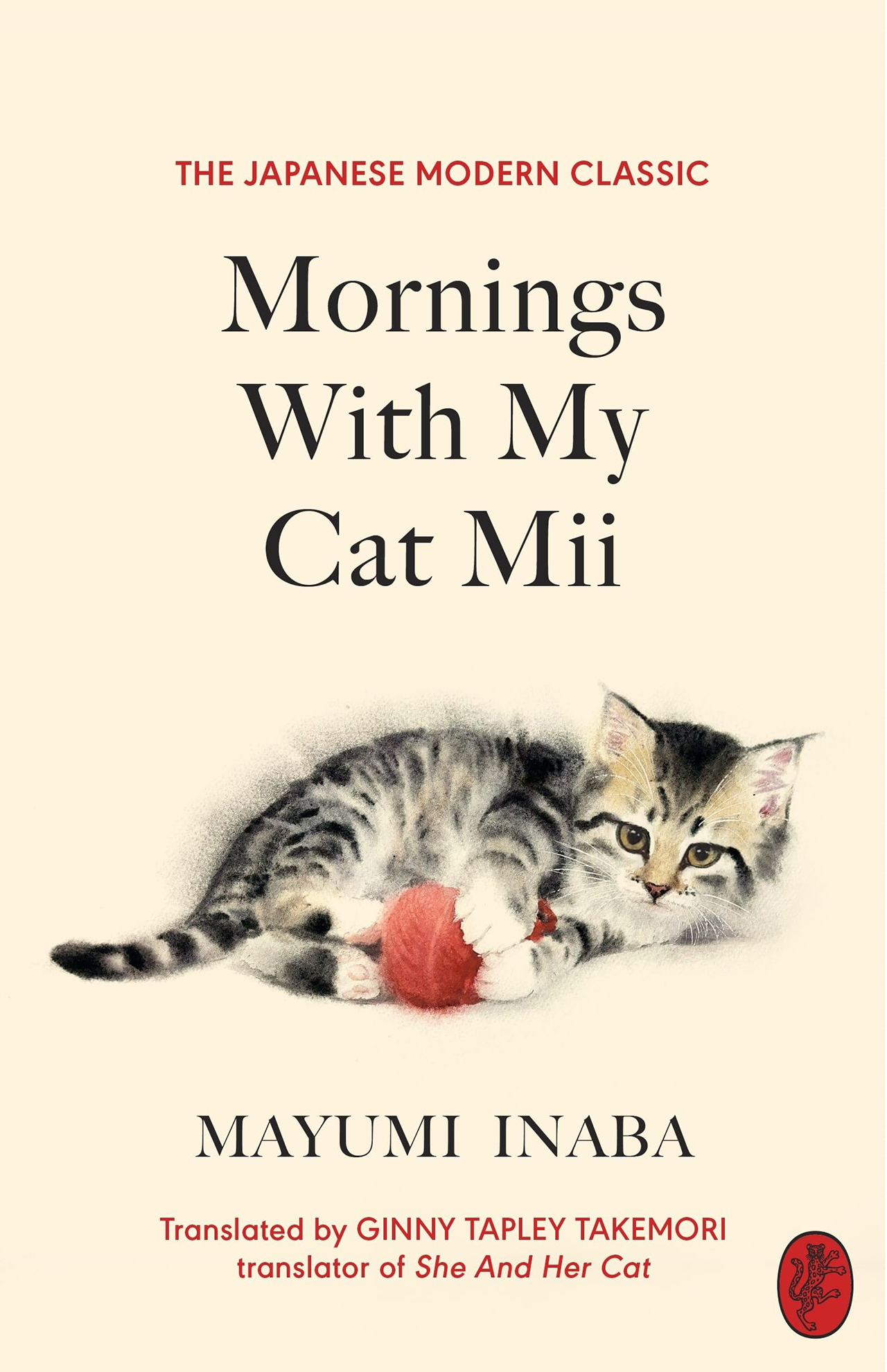
Cats are adorable creatures, it’s true. It’s also true that they’re a little magical. Unfortunately, the experience of caring for a cat isn’t all sunshine and rainbows, and there’s a lot of cleaning involved. Mayumi Inaba’s autobiographical essay collection Mornings With My Cat Mii is a beautifully written attempt to capture the not-always-rosy reality of sharing your space with a cat while doing your best to manage your life as a human.
In the summer of 1977, Inaba follows the cries that drift in through her window and discovers a ball of fluff stuck at the top of a fence along the bank of the Tamagawa River in western Tokyo. Since it’s freezing outside, she takes the kitten home. Inaba names her “Mimi,” or “Mii” for short, after her constant crying. Despite her precarious childhood, Mii goes on to live for almost twenty years, accompanying the author through major developments in her personal life and career.
Mayumi Inaba (1950-2014) worked in a number of creative industries while publishing stories, essays, and poetry. The opening essays in Mornings With My Cat Mii are about the milestones in Inaba’s life as she divorces her husband in Osaka to focus on her career in Tokyo. As time passes, Inaba begins to devote more attention to her friendships and psychological wellbeing, a shift in priorities represented by her growing love for Mii.
Mornings With My Cat Mii is far from wholesome, however. Inaba is nothing if not honest about the vicissitudes of life. Sometimes you and your partner grow distant. Sometimes you get kicked out of your house by your landlord. Sometimes people abandon animals. And sometimes you have to bear witness to your pet’s slow decline toward death.
A major element of Inaba’s commitment to honesty are her raw descriptions of the mess of keeping an animal in your house. Sometimes, for example, your entire apartment is going to smell like cat urine. Sometimes you have to scrub puke out of the carpet. Sometimes you have to extract your cat’s feces with your own hands.
Regardless, Inaba always finds a silver lining and an interesting story to tell. I especially enjoyed her essay “The Pet Sitter,” which provides an intriguing glimpse into the thriving industry of petcare services in Japan while digging its heels into the silliness of celebrity pet therapists. I also love “The Winter Break,” which describes a trip Inaba took to the countryside with her sister so Mii could touch grass and frolic in nature. The essay “Moving House” stands out as a playful description of a typical day in young Mii’s life in Inaba’s old house in the west Tokyo suburbs, which were still filled with pockets of nature in the 1970s.
Each essay is less than ten pages long, and most of them feature several verses of a poem as a postscript. Ginny Tapley Takemori has done a marvelous job translating Inaba’s poetry. Just be aware that some of these poems might make you a bit misty-eyed, especially if you’re feeling sentimental about the death of a pet of your own.
I’m generally not a fan of Japanese cat books, but Mornings With My Cat Mii isn’t bubblegum pop about how all of life’s problems can be magically solved by a cat. Rather, this is messy and honest nonfiction about the hardships of pursuing a creative career as a single woman. Still, Inaba manages to find moments of sweetness in life, which she generously shares with the reader in her soft and shining prose.
Shōji Morimoto’s Rental Person Who Does Nothing is probably the most chill autobio essay collection I’ve read, and it’s also one of the more interesting. Morimoto, who makes himself available to strangers through Twitter, offers encouragement and support simply by being present.
Don Knotting’s translation does an excellent job of conveying Morimoto’s distinctly casual voice as he explains the situations in which someone might need an impersonal companion – when filing divorce papers, for instance, or when arriving to the airport after a visit with aging relatives. Morimoto doesn’t pass judgment, nor does he offer any sort of advice or therapy. Rather, he serves as a companion for tasks that are difficult to accomplish alone.
Generally speaking, Morimoto is asked to accompany people on relatively mundane tasks. A common request (that I found extremely relatable) comes from people who need someone to sit next to them while they write a difficult email. Although some requests are awkward, most are surprisingly wholesome. My favorite anecdote is about the person who asked Morimoto to express happiness and excitement when he greeted their dog in a public park.
To me, the most interesting thing about Rental Person Who Does Nothing is not the type of requests people send, but rather Morimoto himself. Like Marie Kondo (whom I wrote about here), Morimoto has a very distinct personality that comes with a story.
Morimoto was bullied at work by his supervisor, who told him that it didn’t matter whether or not he was there at all. Morimoto’s aggressively chill affect comes off as a weapon of resistance against the assumption that someone’s worth is dependent on how productive they can be for an impersonal institution. It fits the theme that there are no life lessons in these essays, just people being people.
To me, this memoir serves as a record of how social media has enabled a new type of ephemeral interpersonal relationship that can be psychologically healthy in its own way. Rental Person Who Does Nothing also inspires introspection regarding how a companion might help you on your own journey, as well as speculation about what sort of request you might make to Morimoto yourself.
Yōko Ogawa’s 2023 collection からだの美 brings together sixteen short essays on the theme of bodies and physicality. The three primary topics are sports, performing arts, and animals.
The essays about sports were mostly lost on me, but I loved Ogawa’s discussions of animals, especially naked mole rats. As Ogawa reflects on their odd appearance and rigorously structured society, she writes that the world is an infinitely strange place, and that she couldn’t invent creatures like this from imagination even if she wanted to.
My favorite essay is レース編みをする人の指先, which is a meditation on how our lives and bodies are shaped by creative practice. Even though crafts such as embroidery and sewing lace seem to have no practical purpose in modern society, we continue to make things by hand just for the joy of it.
The Japanese literary tradition of essay writing is a bit different than what many of us have come to expect from English-language essays. To make a generalization, Japanese literary essays tend not to include anything overly personal about the author or lay bare any sort of trauma. It’s not a given that an essay will address political topics or attempt to persuade or educate the reader. Rather, reading a Japanese essay is often like engaging in a gentle conversation. I find this lo-fi style of writing to be quite relaxing to read, but your mileage may vary on whether the essays in からだの美 come off as pleasantly chill or somewhat flat and underwhelming.
To me, からだの美 is an interesting companion to Ogawa’s 2022 short story collection 掌に眠る舞台, which also explores the relationship between art and the body. Ogawa’s fiction follows strange people who inhabit a twilight world that feels slightly removed from our own, so I found it amusing to read her perfectly normal nonfiction essays about the brighter side of topics she’s explored in her recent stories.
Title: What I Talk About When I Talk About Running
Japanese Title: 走ることについて語るときに僕の語ること
Author: Murakami Haruki (村上春樹)
Translator: Philip Gabriel
Publication Year: 2008 (America); 2007 (Japan)
Publisher: Vintage International
Pages: 180
Yay! Another Murakami book has come out in paperback! Yay! It’s translated by Philip Gabriel (the author of Spirit Matters: The Translucent in Modern Japanese Literature and veteran Murakami translator)!
Some critics say that people would read Stephen King’s grocery list if he published it. Although I’m not sure I would go that far, I certainly enjoyed King’s essay On Writing. Although I was disappointed that the newest Murakami translation isn’t one of his earlier novels (Hear the Wind Sing, for example, or Pinball, 1973) or his latest novel (1Q84) but a memoir-length essay on running, I decided to go ahead and read it. Because some writers, yes, I will read anything they publish. Even a log of miles run per month.
Over the course of my career as a student of Japanese, I have come to realize that the essay is still a thriving form of literature in Japan. It sometimes seems like every popular writer from Yoshimoto Banana to Murakami Ryū has at some point published at least one collection of essays. Instead of taking the form of concentrated inquiries into a single subject in the style of John McPhee, however, most of these essays are personal in nature and written in a light-hearted tone. What I Talk About When I Talk About Running is much the same. The memoir is conversational rather than educational and a pleasure to read.
In short, Murakami is preparing to run in the 2005 New York City Marathon. He has found that, as he gets older, it becomes harder to train and to run marathons in the amount of time that he would like to. Therefore, partly as refection, and partly as inspiration, he writtes a series of essays as he prepares to run in New York. These essays take him from Hawaii to Japan to Cambridge, Massachusetts, from summer into fall, and years into the past. He writes about running in Tokyo, running in Greece, running in triathlons, running in ultra-marathons, running next to Olympic runners, running next to John Updike, running next to Harvard freshmen, and running next to rivers. He talks about his decision to start running and his decision to become a writer. Everything is equally interesting.
The tone of the book is honest and self-effacing. Although it’s quiet, Murakami has a definite sense of humor that balances out his more contemplative passages. Aside from the fact that I don’t think he mentions drinking whiskey or cooking spaghetti even once, Murakami could very well be one of his infinitely personable narrators. Even though I have almost zero interest in running (or writing novels) myself, I was fascinated by these essays. I’m glad they were translated and published in America.



 Contemporary Japanese Literature