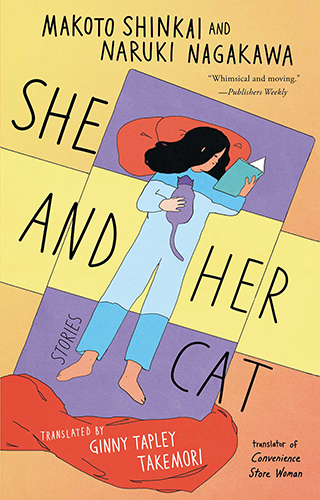
She and Her Cat collects four interlinked short stories about women and their cats. Though these stories are bittersweet, their gentleness is a source of comfort and encouragement.
The stories in She and Her Cat were written by Naruki Nakagawa, who’s mainly known as a screenwriter for science fiction anime from the mid 2000s, and the concept is based on the 1999 short indie film (which you can watch on YouTube here) created by the international superstar anime director Makoto Shinkai. I think it’s fair to say that the original short film is a representative example of the iyashikei “comfort” genre of anime, which Patrick Lum describes as “designed to be as comfy and mellow as can be.” This book, which Nakagawa wrote in his late forties, similarly uses young female characters to create a sense of living in a world where a brighter future is always possible.
The first story is a direct adaptation of Shinkai’s original short animation. A young office worker named Miyu brings home a kitten who’s been left outside in the rain in a disintegrating cardboard box. Miyu is growing apart from both her boyfriend and her best friend, and she feels as though she’s no longer able to understand the nuances of other people’s feelings. Thankfully, her new cat Shiro loves her unconditionally, and he’ll always be there for her.
The second story is about an art student who can’t find the motivation to apply to a university-level Fine Arts program, and the third is about an aspiring manga artist who was unable to make her debut and became a hikikomori after the death of her writer, who also happened to be her childhood friend. Both women find the courage to pull themselves out of their depression and take the first few steps forward – with the help of their cats, of course.
In the last story, a childless middle-aged woman finds herself alone after caring for her husband’s parents only to be left by her husband himself. As she gets older, so too does the boss of the neighborhood stray cats, and she ends up adopting him. Around the same time, her nephew has a quiet breakdown at his first job out of college, and the woman ends up sheltering him too. In return, he eagerly learns the non-corporate life skills she shares, and he naturally begins to help her manage the household. While it’s always rewarding to nurture a mutually loving and beneficial relationship with a cat, this story reminds the reader that kindness can exist between humans as well.
The narrative viewpoint of these stories alternates between the cats and their human companions. When the cats aren’t expressing their undying love for the human ladies in their lives, they’re off on their own adventures in the neighborhood, doing as cats do. Even more than the human characters, the cats have strong personalities and know what they’re about.
Comforting Japanese books about cats are currently enjoying a small cultural moment, and She and Her Cat is among the best of them. As you might expect from a book written by a professional screenwriter, each “scene” is fairly short, which makes for a quick and engaging read. Nagakawa maintains the distinctive narrative voice associated with Makoto Shinkai’s films, and Ginny Tapley Takemori conveys this straightforward gentleness perfectly in translation. In the English edition, each story is prefaced by a gorgeous full-page illustration by Rohan Eason, which only adds to the book’s charm. Exactly like the creatures it celebrates, She and Her Cat is light, nimble, and filled with character.
 Contemporary Japanese Literature