Memento Bento

Memento Bento is a 65-page chapbook created by the Italian artist Alessandra Criseo. The chapbook, which is structured like an annotated sketchbook, chronicles Criseo’s trip to Japan with her partner Andreas in April and May of 2014. Over the course of two and a half weeks, the pair visited Tokyo, Kyoto, Nara, and Yokohama.

At the time, Criseo was working in London as a freelance character designer and concept illustrator for video game development studios. Criseo’s primary interest in Japan lay in its culture of cuteness, and the pages of Memento Bento are filled with sketches of clothing, characters, and street fashion. This fascination with cuteness is supplemented by photos of cute food, such as strawberry-themed pastries and the popular Tokyo Banana souvenir cakes.

Despite her stay in the popular tourist destinations of Kyoto and Nara, Criseo cares less about traditional Japanese architecture and handicrafts than she does about common urban cityscapes and mundane everyday objects. “I love taking the train. [It’s] one of the pleasures of life, especially in a country with such pretty houses as this one,” she writes next to an ink drawing of herself sketching on a commuter train.

Along with the urban tangle of telephone poles and power lines, Criseo is also fascinated by vending machines, instant ramen packaging, toilets, umbrellas, disposable cameras, and the uniquely non-aerodynamic shapes of domestic Japanese automobiles. Having submerged herself in the visual clutter of Japan, Criseo writes that she’s not looking forward to returning to the “boring and gray” monotony of London.

The heterodox and chaotic aesthetic often decried by older observers of Japan is a source of fascination and delight for Criseo. As an artist and professional designer, Criseo has translated her study of Japanese commercial design to her own clothing and stationery, which she distributes through her independent label, Mezzolume.

When I wrote about Ryōko Nagara’s recent manga about the local material culture of Sapporo (here), I was reminded of how many visual representations of Japan created by Europeans (such as Onibi: Diary of a Yokai Ghost Hunter) often emphasize “Shōwa retro” objects and spaces. In a time when the speed and productivity demanded by neoliberal capitalism leave many people anxious and exhausted, there’s a certain appeal to old and “useless” things, which artists like Criseo present as visually charming and emotionally compelling.

If you’re interested, you can order an English-language edition of Memento Bento (here), and you can follow Alessandra Criseo on Instagram (here).

Kamimachi

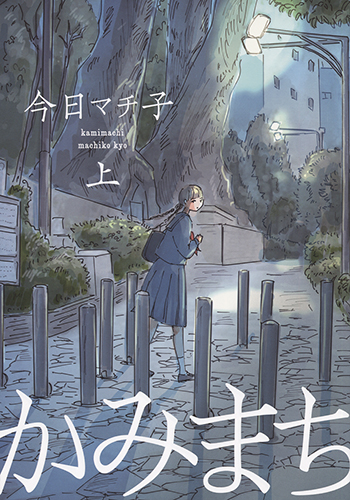
Machiko Kyō’s Kamimachi (かみまち) was serialized from June 2019 to December 2022 and published as a two-volume graphic novel in August 2023. The story follows four homeless teenage girls who find themselves at a privately run youth shelter called Kami No Ie (“Family of God”) in the Tokyo suburbs.

Although he initially seems kind and welcoming, the middle-aged man who runs this shelter is a sexual predator, and he has assaulted and murdered one of his young charges prior to the beginning of the story. The ghost of this young woman, in the form of a Christian angel, helps the girls find the courage to escape the Kami No Ie shelter.

Each of the four main characters in Kamimachi has become homeless after escaping a toxic home environment.

Uka is the only child of a single mother who projects her loneliness and frustrated ambitions onto her daughter. The story begins as Uka leaves home and seeks shelter by means of a roomshare app. After a number of awkward situations, Uka comes to the attention of a group of men who use the app to recruit sex workers. These men force Uka into a situation in which she’s expected to trade a night at a short-term rental space for sex. She breaks out of the apartment and wanders the streets of Tokyo before finding herself at the Kami No Ie shelter.

Uka’s closest friend at the shelter, Nagisa, has been sexually abused by her stepfather for years. She finally flees from home after her mother witnesses one of these assaults and turns away in disgust.

Arisa was raised as a television idol by a single mother. After her mother’s sudden death in an accident, Arisa is given to the care of a talent manager who steals her inheritance and financial assets, leaving her destitute.

Yō is one of five siblings. She’s so neglected by her family and bullied by her brothers that she finds it preferable to sleep in subway stations. Eventually she stops returning home altogether.  

For each of these young women, Tokyo becomes a wilderness whose anonymous open spaces serve as a refuge from the enclosed interiors where they’re coerced into enduring abuse. Kyō draws indoor scenes using small panels with blank backgrounds, and these scenes often feature close-ups of the characters’ faces in moments of distress. Meanwhile, Kyō depicts outdoor scenes with large panels that frame the characters with trees and buildings. The expansive outdoor settings often serve as the stage for small moments of kindness and emotional clarity.

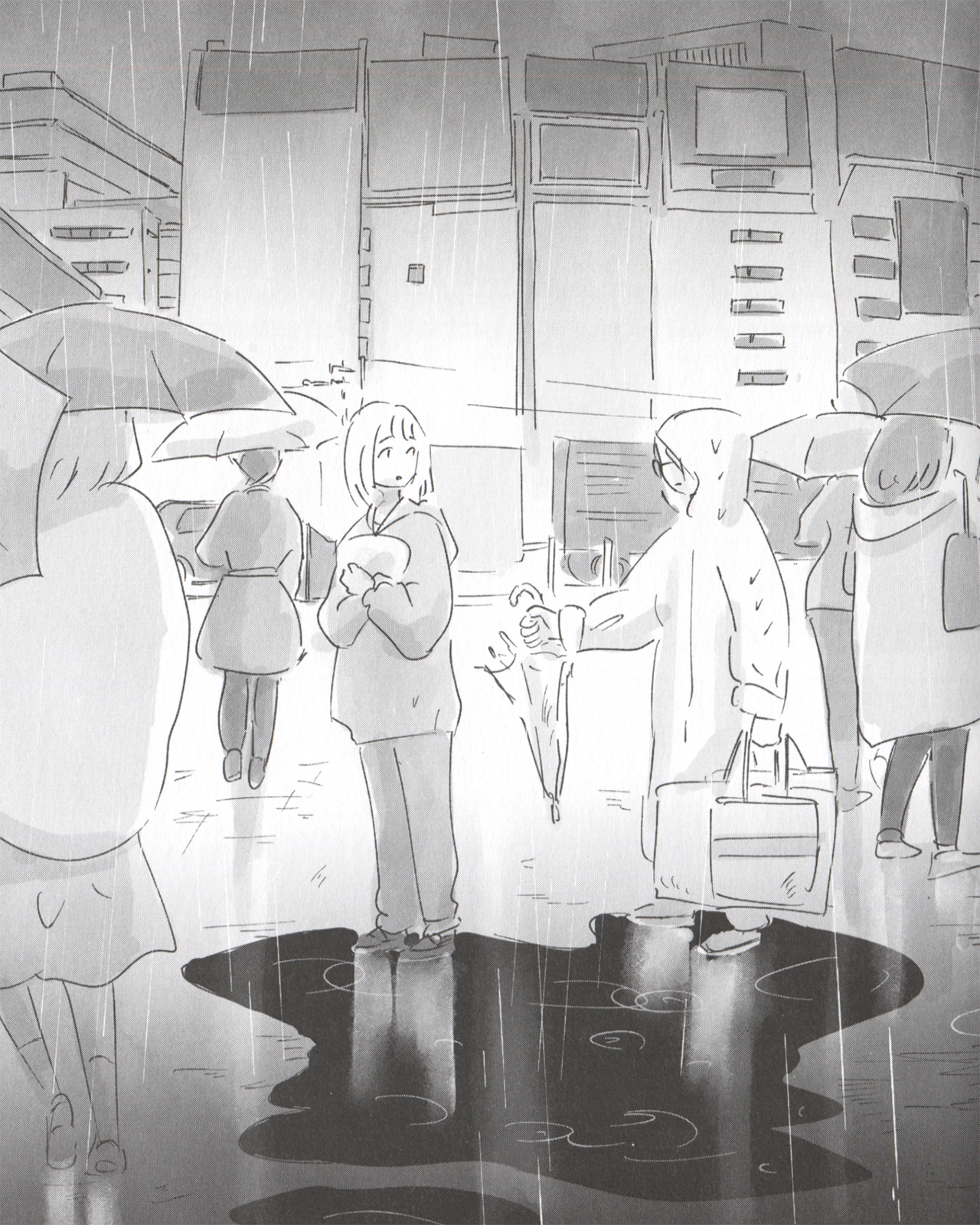
In Chapter Three, for example, Uka flees into the night after an attempted sexual assault at a roomshare apartment. After her escape, she wanders through the rain with nothing but the clothes on her back. Out of context, the rainy cityscape may seem bleak, but the large panels filled are a visual relief after the oppressively small and claustrophobic panels that depict the apartment.

One of the anonymous figures passing in the rain, whom the reader later learns is Yō, stops beside Uka to give her an umbrella. Page 71 opens with a close-up of Yō’s extended hand before spreading into an open panel in which Uka and Yō stand at the center of a composition framed by misty buildings and puddles on the concrete. The two small figures reaching out to one another are enclosed in a soft curtain of rain, and the sense of relief at being a part of a larger world is palpable.  

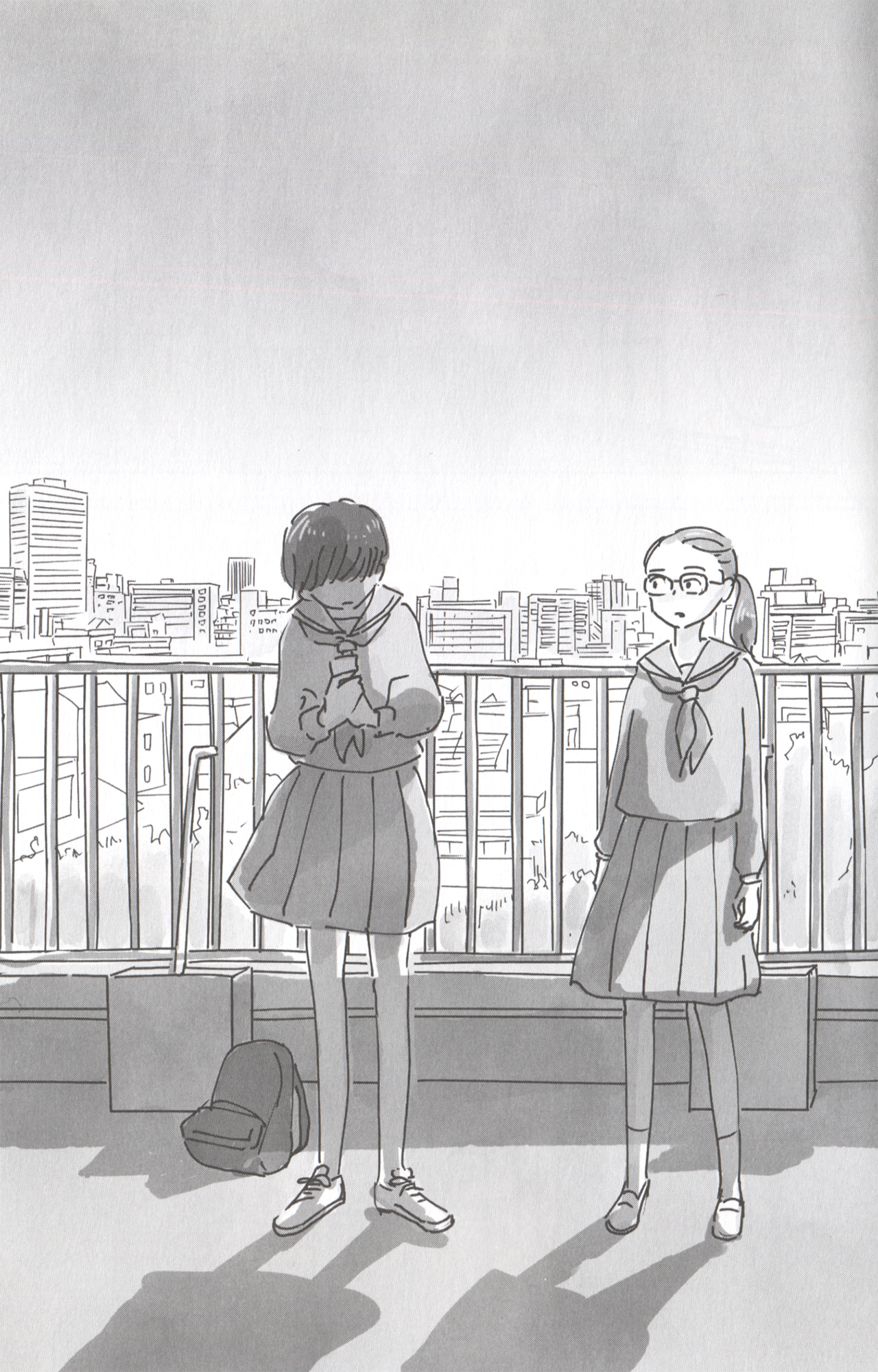
Chapter Seven contains a similar scene in which the open sky and background cityscape suggest freedom from the violence that occurs behind closed doors. Nagisa, who’d encountered Uka in a roomshare arrangement, takes Uka’s discarded uniform and attends school in her place. One of Uka’s former classmates approaches Nagisa, offers to share her lunch, and asks that Nagisa talk with her on the roof. Nagisa initially tries to be normal, showing the girl photos of her mother and stepfather’s new infant daughter.

During this scene, the panels become progressively smaller until Nagisa finally admits the truth about having left her family. The shift to a full-page panel depicting the city’s jumble of buildings spreading under the open sky signals Nagisa’s admission that something has to change. This moment also serves as the catalyst for Uka’s classmate to begin searching for her missing friend, a decision that ultimately results in Uka’s rescue from the Kami No Ie shelter.

The openness of Tokyo cityscapes in these scenes suggests that the sort of hidden abuse endured by these young women needs to be brought into the open and exposed to the light of public scrutiny. Along those lines, I can’t help but feel that Kyō’s depictions of outdoor spaces in Kamimachi also reflect the artist’s emotional response to the Covid pandemic. For people in precarious situations, being physically stuck inside often exacerbated the experience of feeling trapped within oppressive social systems.

As an artist who documented the pandemic years through evocative illustrations posted to Instagram, Kyō’s project is not simply to depict the beauty of architecture and greenery within the city, but also to comment on the importance of open outdoor “third places” for young people suffering from social pressure and economic strain. Kamimachi doesn’t provide easy solutions, but it’s cathartic to see the issue of youth precarity brought out into the open air. 

Machiko Kyō is a prolific and award-winning artist whose illustration collections have been celebrated by The Comics Journal (here). If you’re interested in reading more about the artist’s work, I published a short essay on her 2013 graphic novel Cocoon – whose animated adaptation is scheduled to premiere on NHK in Summer 2025 – on Women Write About Comics (here). Here’s hoping that English-language readers will be able to experience Kyō’s compelling and thought-provoking work in the near future.

Belles Ruelles

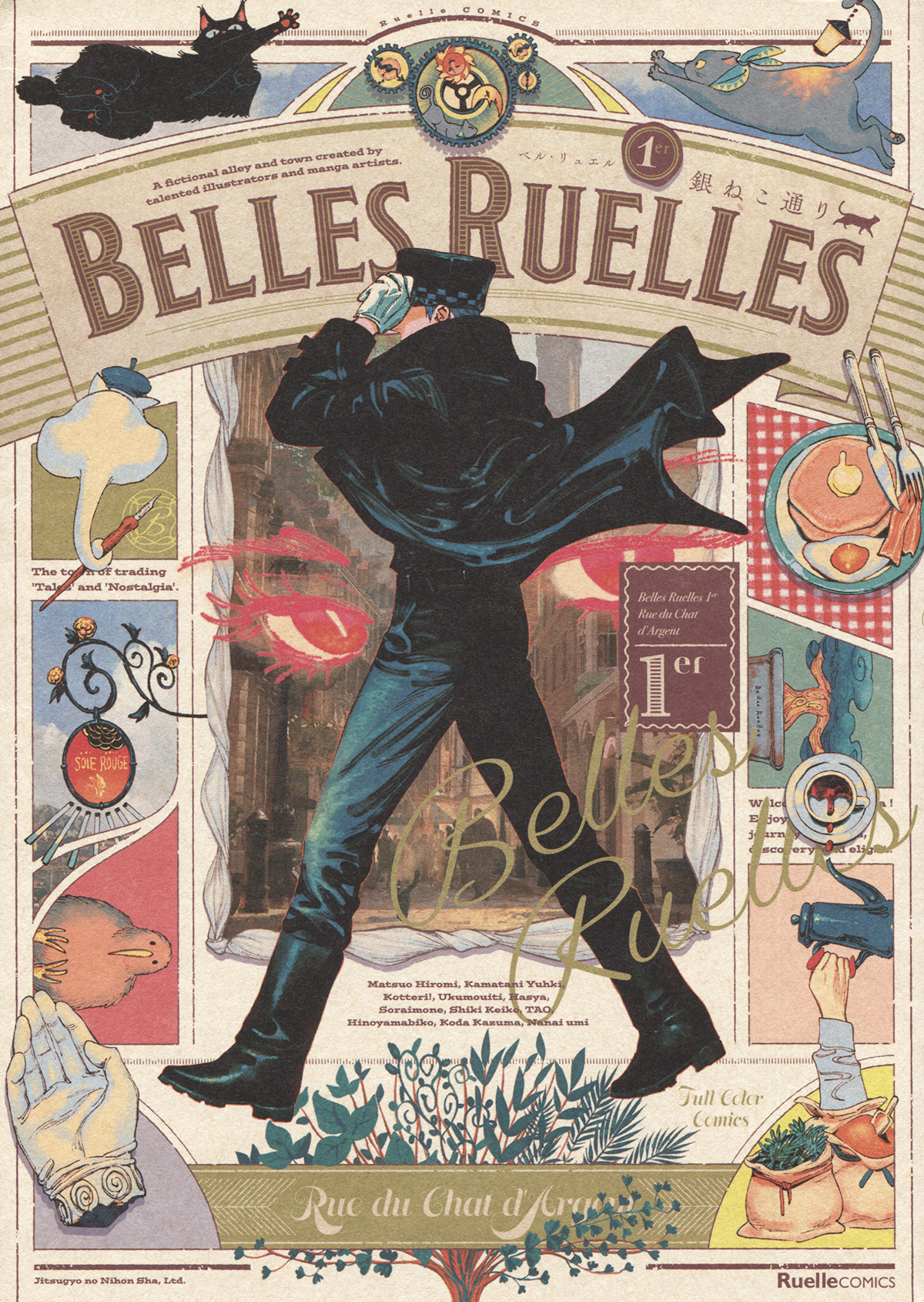
Belles Ruelles is a gorgeous full-color anthology that collects the work of eleven manga artists and illustrators, each of whom has been tasked with telling a story set in the fictional European town of Eufemia.

Eufemia has preserved its medieval cityscape while maintaining a lively community of established shops, young entrepreneurs, and cultures from all over the world. It’s filled with narrow alleys, charming old buildings, ivy-adorned walls, and even a bit of magic.

One of my favorite stories is Keiko Shiki’s “Spice,” in which the young assistant at a store specializing in herbal teas and cooking spices learns just how much love and care the store owner puts into perfecting her craft.

I also love Hiromi Matsuo’s “Soie Rouge,” in which a college student tastes the luxury of trying on a kimono for the first time. Every panel of this manga is an artistic masterpiece, and the writing gently guides the reader through the sartorial experience.

I’m happy to see that this anthology is the first in a series, because I’m very much looking forward to visiting Eufemia again soon. If you’re a fan of the fantasy European setting of Studio Ghibli movies like Kiki’s Delivery Service, I’d encourage you to take a trip yourself.

Tree in the Middle of the World

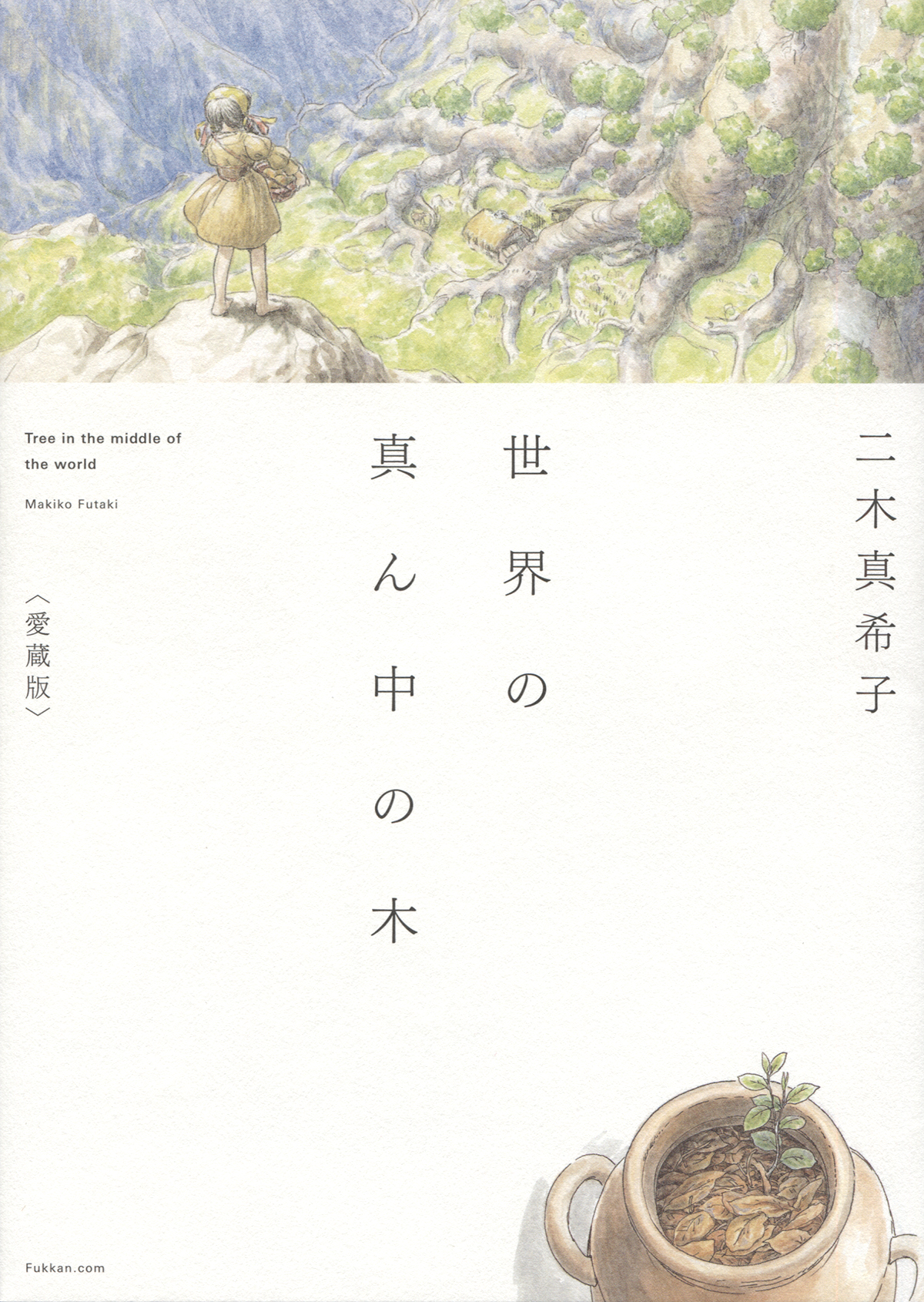
世界の真ん中の木 (Tree in the Middle of the World) is a lushly illustrated picture book written and drawn by Makiko Futaki, a former animator at Studio Ghibli. Originally published in 1989, this book is now available in a beautiful hardcover edition that allows the full glory of the artwork to shine.

In the Afterword to the original softcover edition published by Animage, Futaki wrote that she was inspired to create this story after visiting the Yakushima natural heritage forest, where she conducted visual research for My Neighbor Totoro. Despite its young protagonists and verdant greenery, however, Tree in the Middle of the World is a complex ecofable that has more in common with Princess Mononoke

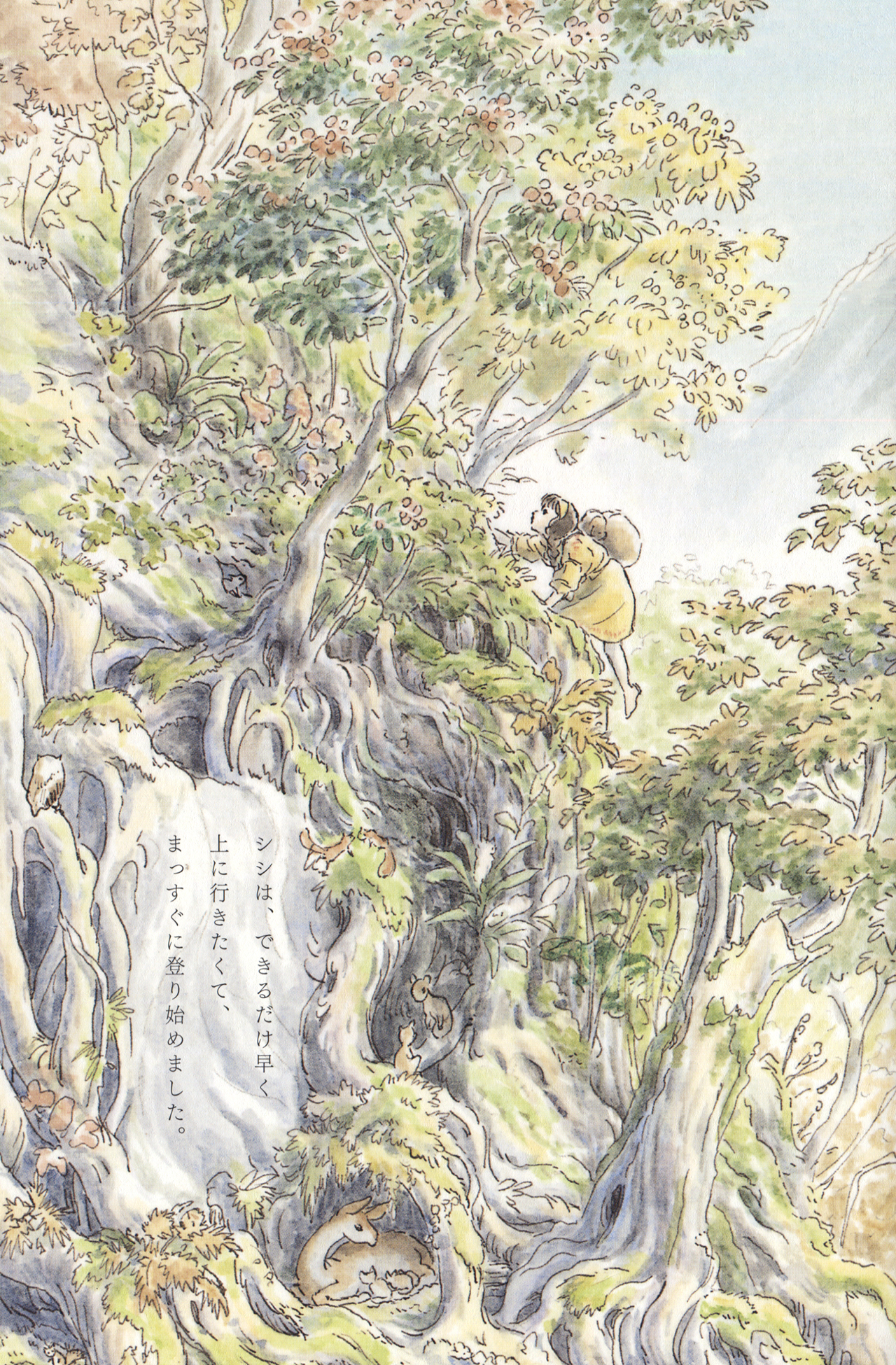
A preteen girl named Cici lives in the mountains with her grandmother. Their small cottage lies at the base of the gargantuan “tree in the middle of the world,” and their modest livelihood is supported by its ecosystem. One year, the tree’s cycle of seasons goes strangely awry, and the sapling Cici attempts to grow from one of the tree’s seeds withers. Hoping to learn more about the malady affecting the tree, Cici resolves to speak with the legendary golden bird that lives in its uppermost branches.

During her epic three-day climb, Cici realizes that the state of the tree’s health is far more dire than she suspected. To make matters worse, she seems to be followed by a young archer from the steppes named Dimo. Dimo is an inexperienced speaker of Cici’s language, but he manages to communicate that he intends to kill the very bird she seeks. Thankfully, Cici does not have to bear her worries alone. Early in her climb, she gains a travel companion in the form of a talking frog whose avuncular good nature serves as a welcome relief from the hardships of her journey.

When Cici finally finds the golden bird, she learns that it has gone insane in its old age, and the putrescence it sheds from its rotting feathers is the cause of the tree’s sickness. Just as he intended, Dimo appears in the nick of time to slay the bird, which answers Cici’s question with its dying breath – in order to save the tree, Cici must venture underground to scatter the tree’s seeds below its roots.

This is a fearsome undertaking, to be sure, but Dimo promises to lend his aid. The two children thus embark on a second journey that proves to be just as dangerous as the first. Just when all hope seems lost in the darkness, Cici and Dimo arrive on the shore of a golden sea that might just be the very stream of life itself. Having succeeded in the quest, the two children return to the surface, where the first winds of spring greet them with verdant laurels of fresh greenery.

Although I’ve outlined the contours of the story, Tree in the Middle of the World is a substantial book whose plot contains a number of twists, turns, and quiet spaces for rest and contemplation in between. The writing is simple but evocative, especially during the portion of the story that takes place underground. Miraculously, every page boasts gorgeous illustrations, each of which is more magical than the last.

Tree in the Middle of the World reminds me a great deal of Hayao Miyazaki’s Shuna’s Journey, albeit with two key differences. First, the visual layout of Tree in the Middle of the World makes its text much clearer and easier to read than the text in Shuna’s Journey; and second, Futaki is far more focused on guiding the reader along a journey through the space of a fixed setting. Like Shuna’s Journey, however, Tree in the Middle of the World contains moments of genuine fear and menace that might not be appropriate for younger children.

Tree in the Middle of the World doesn’t skirt around the shadows of its themes. Like everything in nature, the life of the giant tree exists in cycles, as does that of the giant bird that nests in its branches. Sometimes, like Cici, we find ourselves at the end of a cycle, and there’s not much we can do to prevent the death and destruction we see everywhere around us. Still, it’s our responsibility to preserve the seeds of what we hold dear and plant them carefully in the hope that they will grow strong and healthy in the future when the cycle turns once again.

Tree in the Middle of the World is an uplifting and optimistic story guided by a fantastic sense of adventure. Through her luminous artwork, Futaki conveys the joy of being surrounded by green and growing things, and the action is easy to follow even if your Japanese reading ability isn’t perfect – or if you don’t read Japanese at all. If nothing else, it’s impossible to read Tree in the Middle of the World and not feel inspired to go outside and interact with the world with a renewed sense of hope and purpose.

Are You An Echo? The Lost Poetry of Misuzu Kaneko

are-you-an-echo-book-cover

Title: Are You An Echo? The Lost Poetry of Misuzu Kaneko
Poems: Kaneko Misuzu (金子 みすゞ)
Illustrations: Hajiri Toshikado (羽尻 利門)
Text and Translation: David Jacobson, Sally Ito, and Michiko Tsuboi
Publication Year: 2016
Publisher: Chin Music Press
Pages: 64

This guest review is written by Holly Thompson (@hatbooks on Twitter).

Are You An Echo? The Lost Poetry of Misuzu Kaneko, published by Seattle-based Chin Music Press, is an unusual picture book — bold and broad in concept and scope. This is a multifaceted book, containing a history of the rediscovery of the writings of Japanese poet Misuzu Kaneko (1903-1930), a biography of Kaneko’s short life, current context for her work, and a selection of 25 of her poems.

With a foreword by Setsuo Yazaki, the Japanese children’s author and poet whose curiosity led to the rediscovery of her writings in 1982 and subsequent publication of all 512 of her poems in six volumes plus his own complete biography of Misuzu Kaneko, the reader is offered context: “Misuzu Kaneko’s poems are part of every child’s curriculum at Japanese elementary schools.” Of the intense fondness readers feel for Kaneko’s poems, Yazaki points out that her words “possess a deep kindness toward all things whether they are alive or inanimate.”

The story opens with a question — “Who was Misuzu Kaneko?” — then chronicles Yazaki’s quest to learn more about this insightful poet. From Yazaki’s encounter of Kaneko’s poem “Big Catch” about a huge sardine catch, which led to his desire to learn more about the poet and his ultimate discovery of her pocket diaries full of her poems, the narrative shifts to Kaneko’s life story and her childhood in the town of Senzaki (now part of Nagato City) in Yamaguchi Prefecture near the western tip of Honshu where her family ran a bookstore. Raised among books, Kaneko began writing poems, and at the age of twenty, after several of her poems were published in Japanese magazines, she became a well-known children’s poet. Kaneko’s poems appear interspersed with the book’s narrative — poems that focus on ordinary local topics, imbued with a sense of awe and curiosity. The poems “Benten Island,” “Wonder,” “Beautiful Town,” “Fish,” “Snow Pile,” and “Flower Shop Man” provide a solid introduction to the deceptively simple poetics of Misuzu Kaneko.

Kaneko’s life unfortunately took a tragically dark turn after her marriage to a man who was, as explained in the story, “a bad, unfaithful husband.” She gave birth to their child who she adored, but she “caught a disease from her husband that caused her great pain.” What’s more, he forbade her to write. Kaneko divorced him, but he demanded custody of their daughter. The book does not shy away from the truth that Kaneko, in her illness and despair, made the decision to end her life after writing a letter to her husband imploring that he leave their child in the care of her mother.

This is admittedly dark material, but picture books are not only intended for the youngest readers. Are You An Echo? is a picture book for all ages and is especially well suited to the middle grades. Kaneko’s poems resonate in part because she wrote while suffering and longing. Her poems, so simple at first glance, reach straight to the heart, lift the spirit and stay with you. To write a story about Misuzu Kaneko without broaching her death by suicide would have constituted a huge omission.

Thus, after a spread illustrated in gray tones that includes Kaneko’s poem “Cocoon and Grave” containing a metaphor of a butterfly as an angel, a subsequent warm double-page spread offers hope, depicting Kaneko’s mother and her daughter by the sea remembering Kaneko’s “kind and gentle soul.” The narrative then shifts once again, this time to more recent history — the devastating earthquake and tsunami of March 11, 2011, in northern Japan. Kaneko’s poem “Are You An Echo?” was featured in a public service announcement televised after the disaster, and survivors in Tohoku, and people all around Japan struggling to cope after such profound and enormous loss, found comfort and hope in her words.

Following the story is “A Selection of Misuzu’s Poems,” with fifteen illustrated double-spread pages of Kaneko’s poems, impressively presented side by side in both the original Japanese and in English translation. Counting the poems that appear in English within the narrative, as well as the fifteen selected poems presented bilingually, Are You An Echo? offers 25 of Kaneko’s tender poems that reveal her extraordinary heart and boundless empathy. The titles of poems like “Stars and Dandilions,” “Telephone Pole,” “White Hat,” “Waves,” and “Dirt” reveal Kaneko’s unique ability to imbue ordinary items with sensibility and love.

What a feat to contain all of this material — history, biography, poetry collection — in a single picture book, including an informative author’s note by David Jacobson and a Translators’ Note by co-translators Sally Ito and Michiko Tsuboi. Expansive watercolor illustrations by Tokushima-based Toshikado Hajiri capture early 1900s provincial Japan and provide sweetly detailed and poignant accompaniment to the story and various poems.

Are You An Echo? The Lost Poetry of Misuzu Kaneko is a beautifully packaged, substantial picture book to treasure — a book to give poetry lovers of all ages, in all corners of the world.

Visit the Chin Music Press website for the book, Misuzu Kaneko, for information, backstory and further resources.

Review copy provided by Chin Music Press.

* * * * *

Holly Thompson (www.hatbooks.com) is a longtime resident of Japan and author of the novel Ash and three verse novels for young people: Falling into the Dragon’s Mouth, The Language Inside, and Orchards, winner of the Asian/Pacific American Award for Literature. She compiled and edited Tomo: Friendship Through Fiction — An Anthology of Japan Teen Stories, and she teaches writing in Japan, the U.S. and places in between.

are-you-an-echo-page-14

The Night Parade of One Hundred Demons

The Night Parade

Title: The Night Parade of One Hundred Demons
Author: Matthew Meyer
Publication Year: 2012
Publisher: Amazon CreateSpace
Pages: 224

The Night Parade of One Hundred Demons, which began its life as a Kickstarter project, collects roughly four dozen entries on various yōkai, which are accompanied by lavish full-color illustrations. Both the pictures and the text are by Matthew Meyer, an artist heavily influenced by Japanese prints. Meyer has lived in a rural town in Fukui prefecture since 2007, and, as he explains on his Kickstarter page, he has been collecting and translating local folklore for years. There are a number of other books on yōkai available for digital download (such as Matt Alt and Hiroko Yoda’s fantastic Yokai Attack!), but what The Night Parade does especially well is to add regional color and variety to Japanese legends of supernatural creatures that may already be familiar to many Japanophiles.

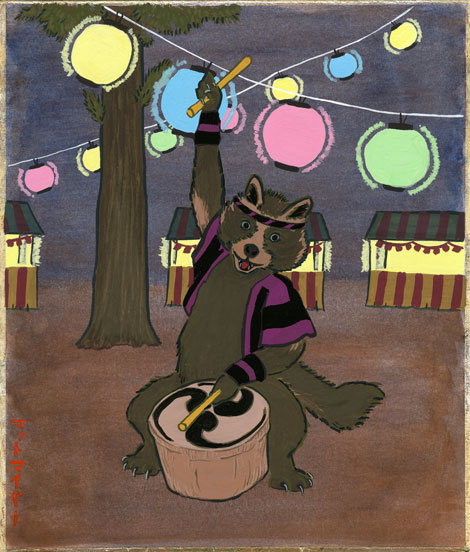
Compiled in such a way as to resemble an illustrated bestiary, The Night Parade is divided into several sections, which include “In the Wilds,” “Out on the Town,” and “In the House.” The book includes entries on yōkai that appear frequently in popular media, such as the kappa, the kirin, the kitsune, the tanuki, and the yuki onna, as well as many lesser-known creatures, such as the bake kujira (an enormous ghostly whale), the jorōgumo (a man-eating spider), and the nuppepō (a flabby, stinky lump of flesh that lives in temple graveyards), and the nopperabō (who looks and acts like an ordinary person but has no face). Each entry contains information on the diet and appearance of these yōkai, their behavior, their interactions with human beings, and the various forms they may take, as well variations on and translations of their names.

Many of the entries are also peppered with interesting information about the historical and cultural contexts of these creatures. For example, the entry on the takanyūnō, or “tall priest,” contains a special section on why suffixes relating to Buddhism and Buddhist priests are so common in the names of yōkai. (Apparently, it’s not so much a connection to religion as it is a certain wariness regarding traveling priests, or at least strangers dressed as traveling priests.) The entry on the kerakera onna, a gigantic “cackling woman” who haunts the alleyways of red light districts and hounds men into their graves with her incessant laughter, alludes to the tendency in Japanese folklore to grant great power to long-lived things, whether they be cats (which become neko mata) or eating utensils (which become tsukumogami), and surmises that prostitutes who managed to live into middle age may well have become yōkai, an interesting conjecture that leaves the mind to wonder about what such a bit of folklore might correspond to in a less numinous context.

Meyer has published his work through Amazon’s CreateSpace program, which offers both print and digital versions of the collection. I can’t offer an opinion of the physical copy of The Night Parade, but the digital edition is beautifully formatted, and its images are of extremely high quality. Although the book is relatively kid-friendly, it includes frank (although far from explicit) references to prostitution and human sexuality. Most of the images are stylized as colorful and cute or understated and eerie, but a few (such as the illustration of the ubume, a spirit of a woman who has died during childbirth) may be too intense for younger readers. My honorary nieces and nephews have been delighted by pictures like the illustration of the onryō, a vengeful ghost who is depicted as a pale shrieking woman bleeding from her eyes, but discretion might be advised for more sensitive children.

Meyer has recently launched a successful Kickstarter project for a second collection, titled The Hour of Meeting Evil Spirits, so expect another excellent illustrated bestiary from him soon!

Matthew Meyer - Tanuki

Tokyo on Foot

Title: Tokyo on Foot
Author/Artist: Florent Chavouet
Publication Year: 2011
Publisher: Tuttle
Pages: 206

While I was in New York City for the New York Comic Con last weekend, I met a friend of mine for lunch. Accompanying her was her new fiancé, a really cool guy who’s lived and traveled all over Asia. All over Asia except for Japan, that is. He said that, based on the Japanese movies he’s seen, he’s a bit afraid of Tokyo. It seems too big, and too modern, and too noisy – hyperkinetic and almost like science fiction. I asked him what Japanese movies he’s seen. Akira and Lost in Translation, he told me.

I think that, for a lot of people who are familiar with Japan but haven’t actually been there, Japan exists not as a real place where real people live but rather as some sort of strange and exotic fantasy land called “Japan.” For some people, “Japan” consists of towering skyscrapers and flashing lights and all-night karaoke rooms, while for some people “Japan” is all about green mountains and cherry blossoms and Zen temples and tea houses. There is a touch of good old fashioned Orientalism at play here; but, then again, Japan actively markets itself in such a way as to encourage these assumptions, even domestically. Furthermore, the fantasy of “Japan” is perhaps not so fantastical – places like the 109 Building in Shibuya and the Philosopher’s Path in Kyoto really do exist.

In the end, though, Japan is a real place where real people live, and it’s not any more beautiful or ugly or modern or rural than, say, New Jersey. What I love about Florent Chavouet’s Tokyo on Foot is that it visually depicts Tokyo as a real city with many, many faces. Yes, there are huge buildings and busy intersections in West Shinjuku, but there are also tiny restaurants and old houses on the verge of falling apart in West Ikebukuro. And then there’s everything in between, from architectural oddities in Ueno to cute little bars in Daikanyama to Shintō shrines nestled between skyscrapers in Takadanobaba. Chavouet draws them all beautifully.

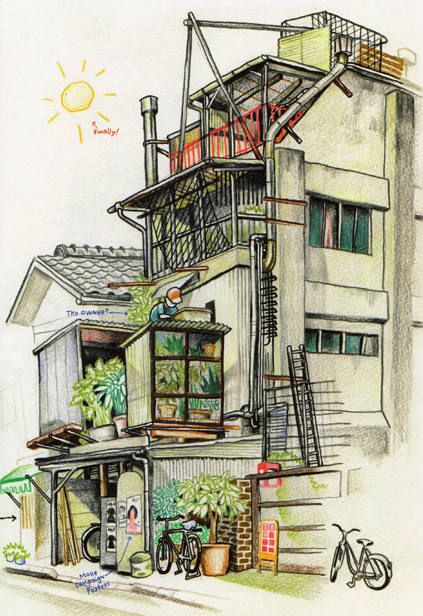
Tokyo on Foot is divided into neighborhoods, with each section opening with a drawing of the local kōban (police station) and a highly detailed annotated map. What follows this map are several pages of drawings of buildings, street corners, storefronts, landmarks, and occasionally people that the artist observed in the neighborhood. Most of these drawings occupy a full page, and all of them are in high-contrast full color. Chavouet’s drawings of people are caricatured, and his drawings of buildings and objects are almost photorealistic, but all of his subjects receive the same careful attention to detail. Chavouet’s medium of choice is colored pencils, and his pencil work really brings out the colors and textures of everything he draws. Really, it’s gorgeous.

Chavouet often accompanies his sketches with annotations. He’ll make small notes concerning the weather, how he got to a certain location, and what interactions he had with the people who watched him drawing. He’ll also include small cultural details, like the fact the Mr. Donuts offers free coffee refills. In each section, there is usually at least a page or two of smaller sketches illustrating concepts like the vast insect population of Tokyo or how to make a disco lamp using cheap materials from Tokyu Hands (“like Target, only better”). There is occasionally political commentary as well, such as when the artist draws the heads of conservative male politicians attached to the bodies of young women in bikinis or mocks the nonsense spewed by the right wing campaign trucks that tour the streets of Tokyo (“Down with kisses and TLC, long live war and mean people”). In a scattered and roundabout manner, Chavouet also turns a satirical eye on the police officers who repeatedly harassed him for parking his bike in the wrong place and/or loitering (in other words, staying in one place long enough to draw it).

What Chavouet draws is a Tokyo that isn’t some futuristic (or idyllic) alien city but rather a city where people live, work, drink, smoke, have trouble finding parking, chill out in coffee shops to get out of the rain, hang out with their friends, sometimes act like assholes or creeps in public, take lunch breaks in the park, and all the other things people do in a huge urban area filled with millions of people. Through his pencil work, Chavouet depicts the beauty of the monumental, the grimy, the quaint, and the pedestrian. Rows of potted plants outside of someone’s house in a small back alley just behind a major train station can be just as calming and peaceful as a painstakingly manicured Zen garden, and telephone poles covered in posters can be just as awe-inspiring as Corinthian columns.

I can’t wrap my head around how much I love this book. Get this book for yourself. Get this book for your hipster art school friends. Get this book for your mom who doesn’t understand why you care about Japan in the first place. And get this book for your friend’s fiancé who thinks Japan is exactly like Akira. At least, that’s what I plan on doing.

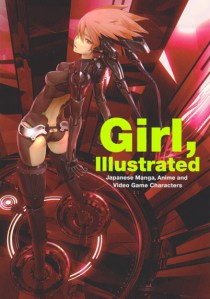
Girl, Illustrated

Title: Girl, Illustrated: Japanese Manga, Anime and Video Game Characters
Japanese Title: ガールズグラフ:コミック・ゲーム・ライトノベルのイラストレーターファイル (Girls graph: Comic, game, light novel no illustrator file)
Art Director: Sometani Yōhei (染谷 洋平)
Translators: Shima Miya (嶋 美弥) and Marian Kinoshita (木下 マリアン)
Publisher: Pie Books
Publication Year: 2009
Pages: 205

A few days ago I was killing time in the Borders next to Penn Station in New York City. I love this Borders. Not only do they allow people to sit on the heating vents next to the windows when it’s freezing outside, but they also have the largest and best-stocked manga section of any brick-and-mortar bookstore I’ve ever been inside. Every time I visit this Borders I find something that I had no idea had even been published. This time I found several copies of Girl, Illustrated. While I was flipping through one of them, I kept thinking about the recent New York Times article titled “In Tokyo, a Crackdown on Sexual Images of Minors.”

I am not a big fan of the article. For one, it doesn’t bother to introduce Ishihara Shintarō, his racism, his sexism, or his vocal ultra-nationalist political stance. So, when Ishihara is quoted as saying of the media in question that “These are for abnormal people, for perverts,” his statement seems only natural from a moral perspective. (Although one does chuckle a bit when he says, “There’s no other country in the world that lets such crude works exist.”) Indeed, the media that Ishihara hopes to censor is sensationalized as child pornography, and an impartial reader has no choice but to view it with disgust. It is only in the very last line of the article that someone is quoted as saying, “It’s a completely imaginary world, separate from real life.”

I wish the journalist who wrote the article, Hiroko Tabuchi, had played up this side of the debate more. I wish she had mentioned that, while Ishihara and his cohort are drafting legislation against the depiction of imaginary girls, they are also fighting an ongoing battle against feminists who want to change the law that doesn’t allow a married couple to maintain separate surnames (which hinders the career development of many female professionals). I wish these things because, in the past two weeks, enough people have quoted from or referenced the article that I am starting to fear how it may have influenced a non-specialist’s view of Japanese popular culture.

As all of this ran through my mind while I paged through Girl, Illustrated, I decided that the best way to look at Japanese illustrated images of girls is to actually look at Japanese illustrated images of girls. I would therefore like to review Girl, Illustrated, a bilingual art book published in Japan and available in America through online retailers like Amazon, Borders, Barnes and Noble, and Tower Books. Before I begin, I would like to state that this book does not contain child pornography. I myself do not support child pornography, and it is not my aim to defend or justify it in any way. Instead, I hope to challenge common notions regarding “anime-style” Japanese illustrations of young women.

The style of illustration in question is known as bishōjo-kei, or “bishōjo style,” with “bishōjo” meaning “beautiful young woman.” A bishōjo (as opposed to a regular shōjo, or “young woman”) is usually a female protagonist or central supporting character in a manga, anime, or light novel that belongs to a genre generally regarded as being targeted towards a male audience, like science fiction or adventure fantasy. Good examples might be Nausicaä (from Nausicaä of the Valley of the Wind), Nadia (from Nadia: The Secret of Blue Water), or Ayanami Rei (from Neon Genesis Evangelion). Bishōjo are rooted firmly in fantasy, whether that fantasy is a post-apocalyptic technological wasteland or a halcyon senior year of high school. They need not be connected to an actual narrative, however, and are often depicted in original artistic compositions.

Girl, Illustrated is a collection of such compositions. Each artist is allotted two pages and four to six full-color illustrations. Accompanying these images is a section for information about the artist, which includes fields for the artist’s birth date, gender, hometown, webpage, inspiration, and comments. More often than not, most of these fields have been left blank, but the information is written in both English and Japanese when it is available. Unfortunately, the translation isn’t always perfect. For example, something like 銃器・武器と女の子を描く (drawing girls with guns or other weapons) might become something like “drawing girls in their underwear with guns,” but these short artists’ comments are still fun to read.

This being said, the main draw of Girl, Illustrated is what the artists say with their illustrations. Through affective character design and rich, detailed backgrounds, each of these illustrations wordlessly suggests a story. The vast majority of these images have been created with digital ink in programs like Photoshop, Illustrator, and PaintTool SAI. Although most of the artists choose not to reveal their gender, judging from those that do, it seems that 2/5 are female. Among these female artists are young professional illustrators like Sakizou, Foo Midori, and fukahire. All of the artists, male or female, take beautiful young girls as their subject matter, and there doesn’t seem to be any discernable difference between the themes and style of the male illustrators and those of the female illustrators. For example, this is a piece by the female artist onineko:

And here is a piece by the male artist Ichikawa Takashi:

Both of these illustrated girls seem to be young, pure, and innocent. They are magical beings firmly enmeshed in their respective fantasy worlds, and there is a kind of “Alice in Wonderland” quality about them that probably seems familiar to a Western (and non-otaku Japanese) audience. Illustrations like these won’t raise any eyebrows.

Problems in the interpretation and judgment of these images arise when the girls are not quite so pure and innocent but instead betray hints of sexuality. For example, one picture by the male artist gorobots parodies the NHK (Japan Broadcasting Corporation) with the logo NPK (Japan Panty Corporation) and contains the text “When you sit down, I stand up,” double entendre absolutely intended:

Such sexualized images of young women are not just drawn by men, however. Exposed breasts, bums, and panties are also explored in the work of female artists like Higuchi Norie:

The portfolios of other female artists whose work appears in Girl, Illustrated are full of scantily-clad young women enjoying themselves and each other’s company. Regardless of the extent or intensity of the sexualization, however, the fantasy element of these pieces remains strong, and the girls are always more playful than pornographic.

As I mentioned earlier, I am not defending child pornography. Illustrated pornography in Japan is extraordinarily explicit, and it is quite clearly packaged as pornography and sold in separate venues, regardless of the imagined ages of its imaginary protagonists. As for sexualized but non-(overtly-)pornographic images of young girls, though, I might argue that they belong to a different discursive space altogether. Bishōjo simply are not real. They are not real because they are illustrated, obviously, but they are also not real because they are the embodied representatives of pure fantasy. Their world is not our world, and they are our gateways into that world. People who draw and appreciate them do so because of the beautiful otherworld they channel, not because they are fodder for onanistic inclinations. One might draw a parallel between the bishōjo style of illustration and the hyper-sexualized men and women on the covers of American fantasy novels; the tight leather pants and clinging silk dresses of these painted figures are not so much signifiers of pornography as they are emblems of a certain Tolkienian fantasy aesthetic.

The fundamental idea behind the proposed manga (and game and illustration) censorship law in Tokyo is that men are looking at women in a way that is psychologically unhealthy. There is obviously a pornographic gaze that is encouraged and exploited in many aspects of popular and commercial art, but I wonder if perhaps it wouldn’t be unreasonable to posit the existence of something like a “fantasy gaze,” or at least a type of gaze that is less concerned with the image itself than the story behind the image.

Moreover, the sizable percentage of women painting and consuming these bishōjo characters and illustrations complicates the idea of an all-powerful male gaze. One might argue, as have many feminist scholars, that these women have adopted an hermaphroditic gaze. In other words, female viewers have internalized the male gaze and therefore identify with male characters and viewers when they look at sexualized images of women. I myself would like to raise the possibility of a female gaze. This female gaze is responsible for the fanworks featuring male-on-male pairings from popular series like Naruto and Hetalia, of course, but I think it’s also a way for women to portray and look at themselves and other women. By creating and appreciating mildly sexualized images of girls, for example, women can embrace and celebrate a sexuality that lies beyond virgin/mother/whore stereotypes. For women, then, the appeal of bishōjo is not merely the asexual appeal of the fantasy world they represent but also the self-reflexive appeal of being young, beautiful, magical, and, yes, sexual. Furthermore, who is to say that male viewers don’t similarly employ this female gaze when looking at such images?

Girl, Illustrated isn’t just a collection of gorgeous artwork. It’s also a way of looking at and thinking about Japanese bishōjo illustrations. Included at the beginning of the volume is a (mostly) translated essay about how bishōjo characters are marketed and used to promote domestic regional tourism in Japan. Are the editors of the volume trying to suggest that perhaps bishōjo are Japan? It’s a stretch, but it’s also an interesting cultural perspective. In any case, this collection is both fascinating and beautifully produced. Even if you’re more interested in fine art than you are in anime, Girl, Illustrated is still an excellent resource for examining both portrayals of the body and the possibilities of new digital media.